Osfin vs Trintech: Which Financial Reconciliation Platform Is Best for You?
For banks and financial institutions dealing with millions of transactions every day, manual reconciliation processes can lead to costly errors and operational bottlenecks. That’s why automation in financial reconciliation software is no longer just a convenience but a critical requirement. Two major players in this space are Osfin and Trintech, both of which offer advanced solutions to simplify and secure reconciliation workflows.
This article delves into a detailed comparison of Osfin vs Trintech on various parameters to help you choose the best fit for your financial institution’s operational needs.
What is Osfin? And Its Reconciliation process
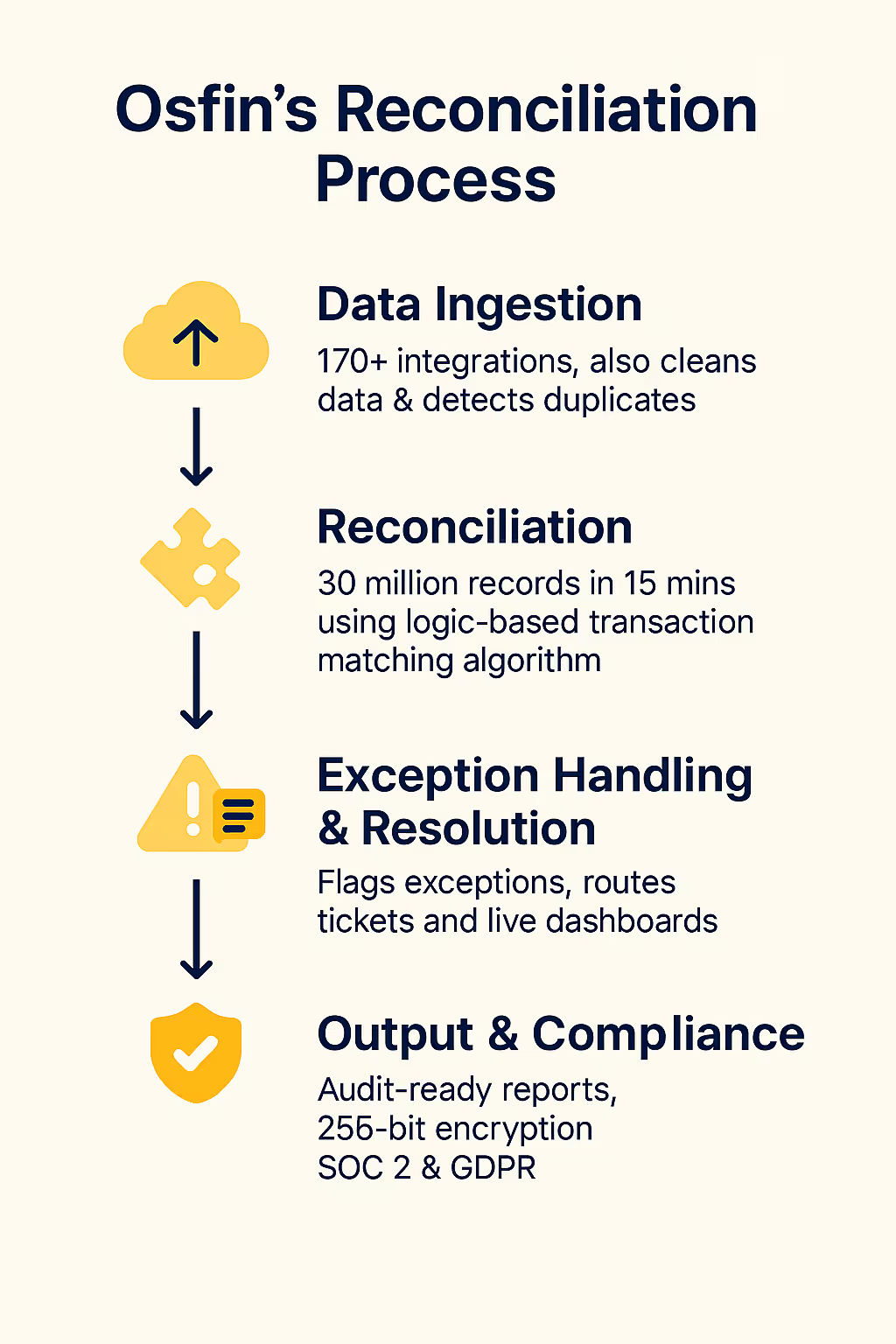
Osfin is a comprehensive financial reconciliation tool that is designed and built to meet the needs of banks, financial institutions, card providers, and treasury services. It is a file format agnostic platform, capable of importing data from over 170+ integrations across multiple sources, regardless of the original format.
Its powerful, logic-based matching engine reconciles up to 30 million records in just 15 minutes, even in complex scenarios. Automated exception handling flags unmatched transactions, assigns reasons, and routes issues to the appropriate stakeholders through a ticketing system, while real-time dashboards provide clear visibility. Osfin guarantees compliance and security through audit-ready reports, 256-bit encryption, role-based access, two-factor authentication, and certifications including ISO 27001 and GDPR.
{{banner1}}
What is Trintech Financial Reconciliation Software?
Trintech is a global, cloud-based financial close and account reconciliation software. It is used by organizations like financial institutions, retail, healthcare, and power sectors. Trintech aims to automate and standardize reconciliation and financial close processes to reduce manual effort, operational risk, and errors, while also increasing speed and accuracy.
Beyond matching, Trintech’s software also offers comprehensive controls and reporting with customizable dashboards and real-time analytics. This helps finance teams to get visibility into reconciliation status, risk exposure, and financial performance. Its System of Controls™ combines record-to-report activities in a seamless platform that enhances audit readiness and compliance, including SOX and Basel II standards.
Trintech integrates with various ERP and accounting systems, and it is also scalable for mid-sized to enterprise-level organizations and designed to support regulatory compliance, risk management, and fraud prevention.
Trintech also offers features like automated journal entries, intercompany accounting, and real-time reporting. This platform helps finance and accounting teams to avoid repetitive manual transaction matching that is highly prone to errors and excessively time-consuming. Trintech had a reputation for reliability, and its extensive industry experience has made it one of the market leaders in reconciliation software.
Detailed Comparison: Osfin vs Trintech
Osfin is designed as a format-agnostic reconciliation solution that delivers 100% accuracy and deep integration capabilities with banks, financial institutions, and treasury teams. On the other hand, Trintech offers a mature, comprehensive financial close management suite trusted by many large enterprises.
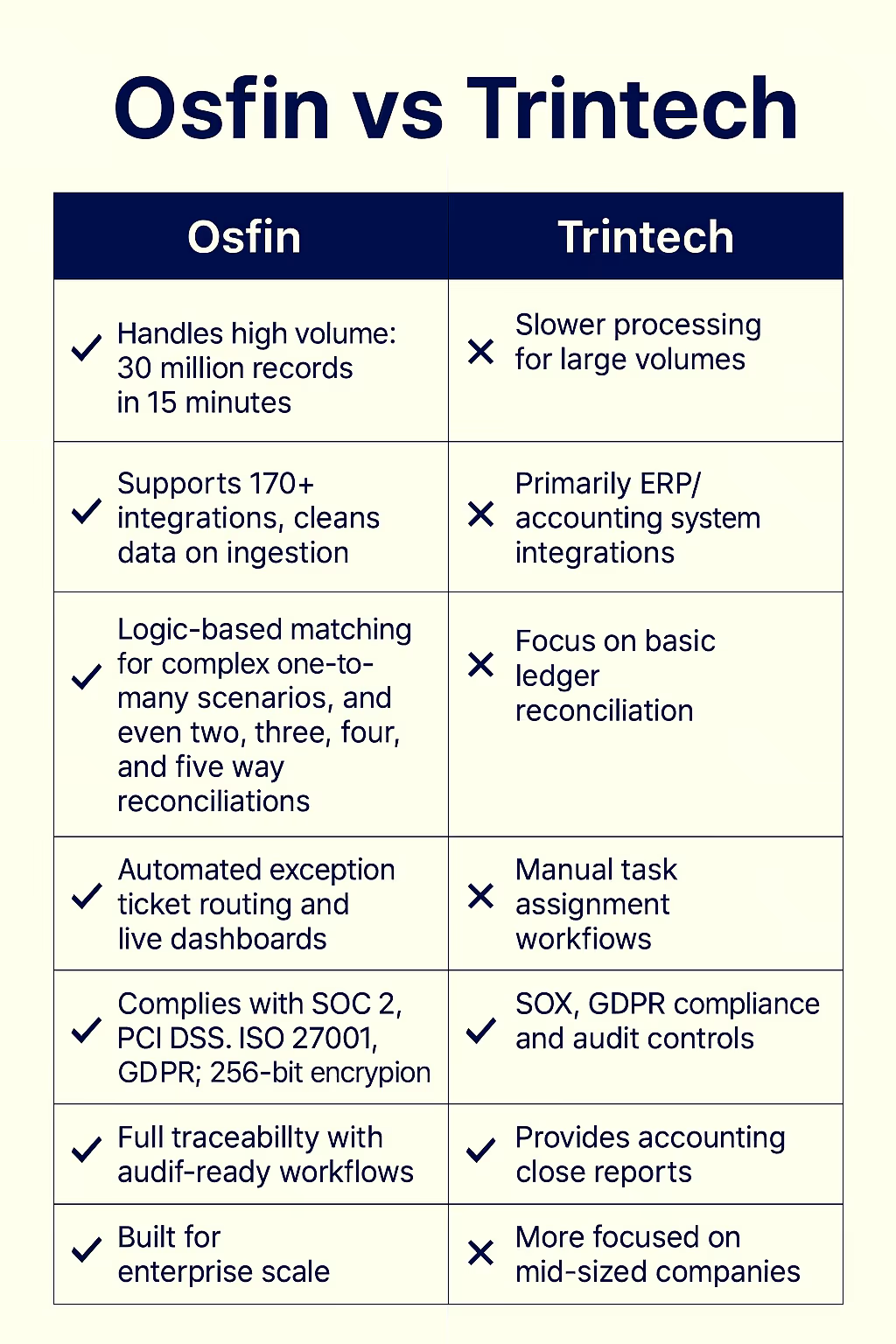
Here’s a feature comparison table to help you pick the best reconciliation tool suited for your organization:
While both reconciliation software offer automation, let’s look at their features, pros, and cons to choose the best-suited platform for your financial institution.
Osfin’s Features
- During the ingestion process, Osfin standardizes and normalizes data while applying custom deviation tolerances, filtering out poor-quality data and also detects outliers and duplicates before it enters the reconciliation process.
- Osfin’s reconciliation process uses logic-based matching algorithms that can handle complex scenarios such as many-to-one, one-to-many transactions and even two, three, four, and five way reconciliations. This platform reconciles up to 30 million records in just 15 minutes, including the automation of payment gateway reports with detailed commission, tax, and fee breakdowns.
- Exception handling with Osfin is an automated process. The unmatched transactions are immediately flagged with accurate reasons assigned to them. And then these transactions are escalated to the respective internal or external stakeholders via an integrated ticketing system.
- Osfin’s live and easy-to-read dashboard provides real-time insight into match status, exposure, and active exception queues, and helps the team to resolve issues swiftly. For outputs, this platform delivers comprehensive compliance reports and maintains audit-ready workflows with full traceability or what we call a complete transaction history.
- Osfin delivers a strong security framework with stringent role-based access controls that assign system permissions as per the job responsibilities of individuals. This platform also follows a maker-checker workflow that separates duties by seeking approvals for key reconciliation actions. In addition, every user activity, like automated or manual processes, is carefully recorded in the audit trail, creating a reliable record for compliance reviews.
- Security is ensured with 256-bit encryption, role-based access controls, and two-factor authentication, and Osfin also complies with important global standards, including SOC 2, PCI DSS, ISO 27001, and GDPR.
- Osfin’s intuitive dashboard acts as a control center and offers a real-time visualization of reconciliation progress and key financial metrics.

Pros:
- Firstly, Osfin’s ingestion capabilities are extensive and flexible. With over 170 integrations and as a file format agnostic platform, Osfin easily imports data from multiple sources and formats.
The platform also focuses on data cleaning with custom deviation tolerances and detecting duplicates and outliers early, these are the features that Trintech lacks in its ingestion process. This approach keeps Osfin one step ahead of all reconciliation platforms and delivers 100% accuracy.
- To deliver the best reconciliation speed and accuracy, Osfin’s logic-based matching engine handles extremely large volumes efficiently, reconciling 30 million records in just 15 minutes with 100% guaranteed accuracy. Trintech, while scalable, does not provide this level of speed and accuracy.
- Exception handling with Osfin is an automated process that flags unmatched transactions with accurate reasons. And then the ticketing engine routes these exceptions to the respective teams. Live dashboards give real-time visibility into match status, exceptions, and financial exposure, enabling proactive management and quicker resolutions.
- Osfin's reconciliation platform complies with stringent global standards, including ISO 27001 and GDPR. Security features like 256-bit encryption, role-based access controls, and two-factor authentication protects sensitive financial data of your financial institution.
Trintech Features
- Trintech automates the process of matching transactions across multiple accounts, and reduces the manual effort needed, speeding up reconciliation cycles for faster financial close.
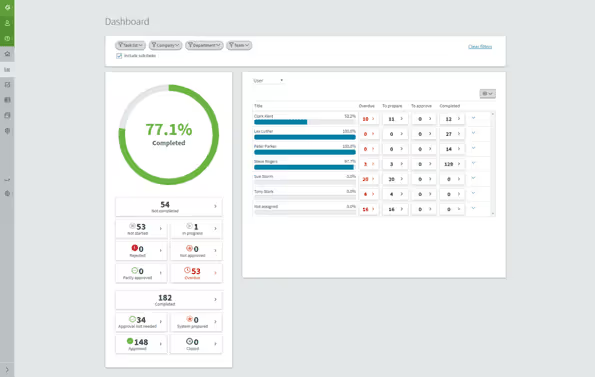
- Its centralized dashboard provides a single platform where all reconciliation data is consolidated, allowing finance teams to have real-time visibility and greater control over the reconciliation process.
- Trintech integrates smoothly with a wide array of ERP and accounting systems, ensuring that data flows accurately and consistently between financial systems and the reconciliation platform.
- Businesses or financial institutions can customize the reconciliation workflows to suit their specific needs, setting up tailored exception management, approval hierarchies, and operational procedures for greater efficiency.
- Trintech platform delivers detailed, real-time reports with analytics and visualizations that help with compliance, strategic decision-making, and detailed audit readiness.
- Every transaction, adjustment, and approval is tracked and logged to maintain a comprehensive, transparent audit trail, simplifying internal and external audits.
- For risk management and fraud reduction, Trintech has a built-in anomaly detection and fraud alert mechanisms to identify suspicious transactions and control risks effectively.
- Trintech handles large transaction volumes and complex reconciliation needs across multiple business entities and international geographies.
Pros
- Comprehensive automation reduces manual errors and accelerates the process of month-end close cycles.
- Robust integration with diverse financial systems and ERPs ensures consistent data alignment.
- Flexible workflow customization adapts to complex business processes and regulatory requirements.
- Real-time reporting and audit readiness enhance financial transparency and governance.
- Powerful anomaly detection and fraud prevention capabilities.
- Provides Cadency platform that is suitable for large enterprises with complex, multi-entity financial environments
Cons
- Implementation and onboarding with Trintech can be resource-intensive due to the platform's breadth and customization options.
- Some users report a steeper learning curve for new users unfamiliar with advanced financial software.
- May be more than what small or mid-sized businesses require if their reconciliation needs are simpler.
{{banner1.1}}
Final Thoughts
Selecting the best reconciliation tool between Osfin or Trintech can change how your financial institution addresses reconciliation challenges. Osfin pushes the boundary with its impressive data processing capabilities, like maintaining 100% accuracy. While Trintech remains a trusted, mature platform with comprehensive reconciliation and financial close features, it may not match Osfin’s speed or file-agnostic flexibility.
For financial institutions seeking a modern, scalable reconciliation solution that combines speed, accuracy, transparency, and robust compliance, Osfin offers a compelling alternative to traditional players.
{{banner2}}
Frequently Asked Questions (FAQs)
1. How does automated reconciliation software like Osfin deliver accuracy?
Automated reconciliation software uses programmed matching rules to reduce manual errors, flags mismatches for investigation, and maintains thorough audit trails to deliver top-notch accuracy.
2. How is Exception Handling Performed by Osfin?
Platforms like Osfin automatically flag unmatched transactions and then add precise reasons to these exceptions and then route them to the right teams through integrated ticketing systems.
3. Can I customize reconciliation rules in Osfin or Trintech?
Yes, both platforms allow rule customization to cater to your specific business logic, industry requirements, and transaction types.
4. What are the benefits of live dashboards in reconciliation software?
Live dashboards offer real-time insights into the reconciliation process and exception queues, just like an overview. This transparency enables finance teams to act quickly and prioritize high-risk issues as soon as they are detected.
5. Can you integrate reconciliation software with legacy ERP and banking systems?
Yes, Osfin and Trintech support integration with popular ERP, accounting, and banking systems to automate reconciliation without manual intervention.