HighRadius vs BlackLine: Which Is Better for Finance Teams?
TL; DR
If you’re comparing HighRadius and BlackLine, you’re likely looking to automate finance operations and reduce manual work. HighRadius shines in AI-driven AR automation. BlackLine is strong in financial close management and broader accounting controls.
But if your biggest challenge is complex, high-volume reconciliation, a focused platform like Osfin may be the better fit.
Finance teams today feel pressure from all sides. Leaders want books closed faster. Auditors want clean trails and strong controls. Teams want fewer errors and less manual entry. In those conversations, two names often come up: HighRadius and BlackLine.
Both are cloud-based. Both target accounting and finance operations. Both strive to automate repetitive manual tasks.
Where they differ is in what finance challenges they focus on most.
HighRadius tends to focus strongly on cash and receivables processes. It supports teams handling credit decisions, collections and predicting when payments will arrive. These are areas that directly affect working capital and cash visibility.
BlackLine tends to focus on accounting controls and the month-end close. It helps teams handle reconciliations, journal entries, and structured close tasks. Teams that want strong audit trails and an organized close calendar often turn to tools like this.
This often confuses teams and leaves them wondering which platform is better-suited for their needs.
To clear such confusions, we compare BlackLine vs HighRadius, outlining what they offer, what they don’t, and if there is a better solution out there that can address their weak points.
What is HighRadius
HighRadius targets what it calls the "Office of the CFO," meaning the people and processes that sit between revenue coming in and financial reporting going out.
The platform uses AI, robotic process automation, and natural language processing to automate and optimize Order-to-Cash, Treasury, Record-to-Report, B2B Payments, Close and Reconciliation, and Accounts Payable processes.
One product worth noting is LiveCube, a no-code platform. It lets finance teams upload their existing Excel sheets and run AI agents on top of them, rather than asking teams to abandon their current workflows entirely.
What is BlackLine
BlackLine’s core focus is financial close management and accounting process automation. It addresses traditional accounting challenges by collating financial data and processes, automating routine tasks, and ensuring accountability through visibility.
Its primary products cover financial close management, account reconciliations, intercompany financial management, and accounts receivable automation.
HighRadius vs BlackLine vs Osfin
This table briefly clarifies what is the difference between HighRadius vs BlackLine and how they both differ from Osfin, an automated reconciliation platform.
{{banner1}}
HighRadius vs BlackLine Comparison
Now, let’s take a detailed view of the difference between HighRadius vs BlackLine.
HighRadius
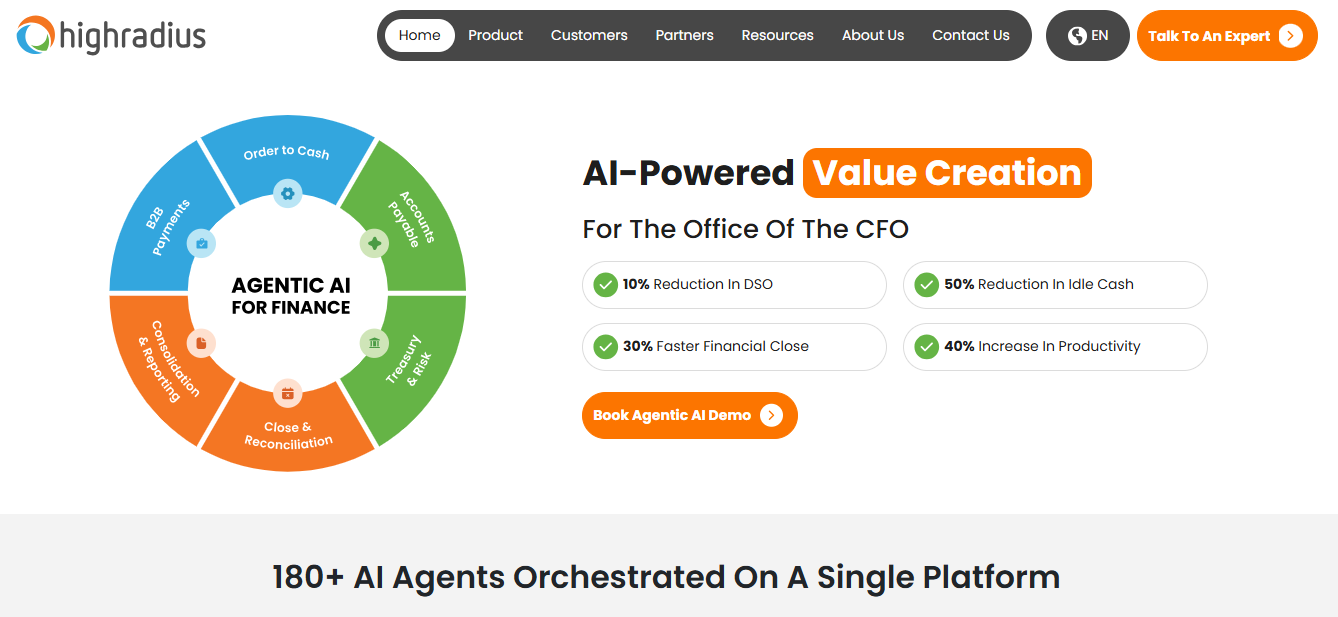
HighRadius helps teams handle cash application, collections, credit, deductions, and reconciliations with less manual effort. What makes it different is its strong focus on AI-driven automation across receivables and cash workflows.
Key features
- AI-driven transaction matching and reconciliation.
- Predictive insights for credit risk and payment behavior.
- Automated journal entry generation and posting.
- Real-time dashboards for cash flow, exceptions, and close status.
- Financial close and reconciliation with 90% auto-reconciliation rate.
- Integrated receivables automation with AI-based prioritization.
- B2B Payments with surcharging and interchange fee optimization.
- Anomaly management and real-time visibility across the close process.
Pros
- Reduces manual finance effort with high automation and AI support.
- Strong ERP integrations with SAP, Oracle, NetSuite, and more.
- Improves collections, reporting accuracy, and cash visibility.
- Scales well for large, complex finance environments.
Cons
- Enterprise pricing and implementation can be expensive for small teams.
- Setup and integration often require months and specialist support.
- Some users report complexity in configuration and navigation.
- Certain invoice and payment UI elements could be smoother.
Integration
HighRadius connects with many major enterprise systems to bring finance data into one place for automation. It offers ready-made links to 50+ ERP systems such as SAP, Oracle, NetSuite, and Microsoft Dynamics, as well as bank feeds and sub-ledger systems.
The platform uses APIs for bi-directional syncing, which helps eliminate manual imports and export steps.
Finance teams can also connect customer relationship systems and other financial data sources, so reconciliation, cash application, and close processes have a complete view of the data they need.
Customer reviews
As per the reviews from third-party platforms like Gartner and G2, this is what users of HighRadius say:
The platform offers good automation capabilities and is easy to use. But many users find that the platform can have an initial learning curve that takes up additional time for training. It’s batch-processing integration is also flagged quite a few times with users demanding real-time integrations.
In addition to this, support responsiveness can vary and sometimes there is slow resolution for deeper issues.
User interface
Although HighRadius provides functional dashboards with real-time info across modules, some finance users consider the UI heavy and with steep learning curves. Platform users highlight that interface strength improves with training and adoption over time.
{{banner1.1}}
BlackLine
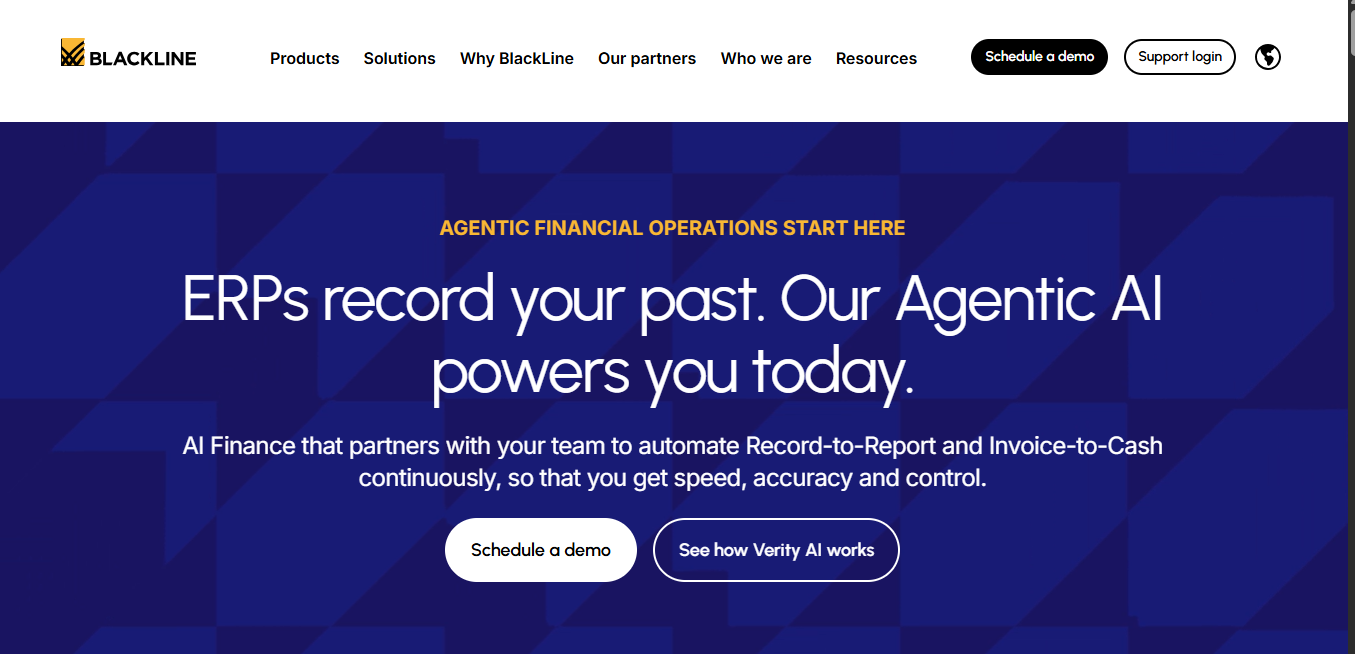
BlackLine focuses on reconciliations, task management, journal entry automation, and continuous accounting workflows. What sets BlackLine apart is its emphasis on internal controls and audit trails during the close process.
Key features
- Automated balance sheet reconciliations.
- Close task management and checklists.
- Journal entry templates and posting workflows.
- Transaction matching with rule-based logic.
- Audit trail and control dashboards.
- Alerts for exceptions and overdue tasks.
- Role-based access and segregation of duties.
Pros
- Clear workflows for month-end close teams.
- Reduces reliance on spreadsheets and manual checklists.
- Good fit for compliance-focused organizations.
- Enterprise-grade reporting and dashboards.
Cons
- Can feel heavyweight for small or mid-size teams.
- Users report a steep learning curve for new teams.
- Some features require additional licensing.
- Multi-module setup may take time to configure.
Integration
BlackLine integrates with major enterprise resource planning systems such as SAP, Oracle ERP Cloud, Microsoft Dynamics, and NetSuite to bring financial and transactional data into its platform.
Customer reviews
On platforms like G2 and Capterra, customers often praise BlackLine for bringing structure and control to the financial close and reconciliation process. It’s also appreciated for its automation capabilities and integration and task management workflows.
At the same time, some users cite a learning curve for new staff and the need for training to use advanced features fully. There are also mentions of the software being clunky and slow at times.
User interface
BlackLine’s interface presents dashboards, task lists, and reconciliation workspaces clearly for accounting teams. Users see status indicators, overdue items, and controls in a centralized view. Some reviewers find the UI dense at first because of the number of modules and options, but they also note that the design supports detailed finance work once users are familiar with it.
Why consider Osfin over HighRadius and BlackLine
HighRadius and BlackLine are both established finance platforms. HighRadius brings strong automation to receivables and cash workflows. BlackLine brings structure and control to the financial close.
But here is the reality many teams face.
Reconciliation is where time drains, errors surface, and audit pressure builds.
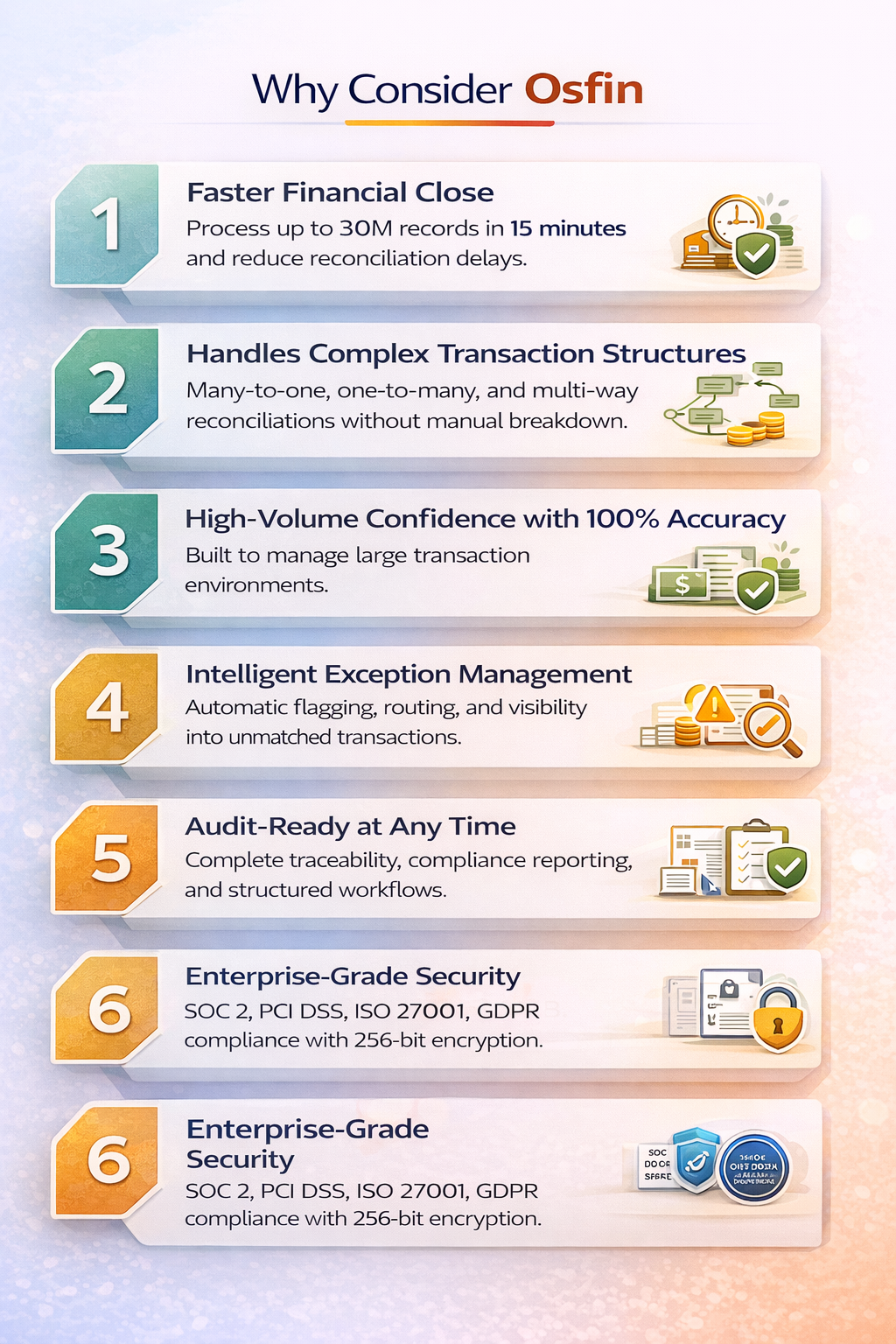
This is exactly where Osfin focuses its entire platform. Instead of spreading across multiple finance domains, Osfin concentrates on the full reconciliation lifecycle. That focus shows up at every stage.
It Starts at Ingestion
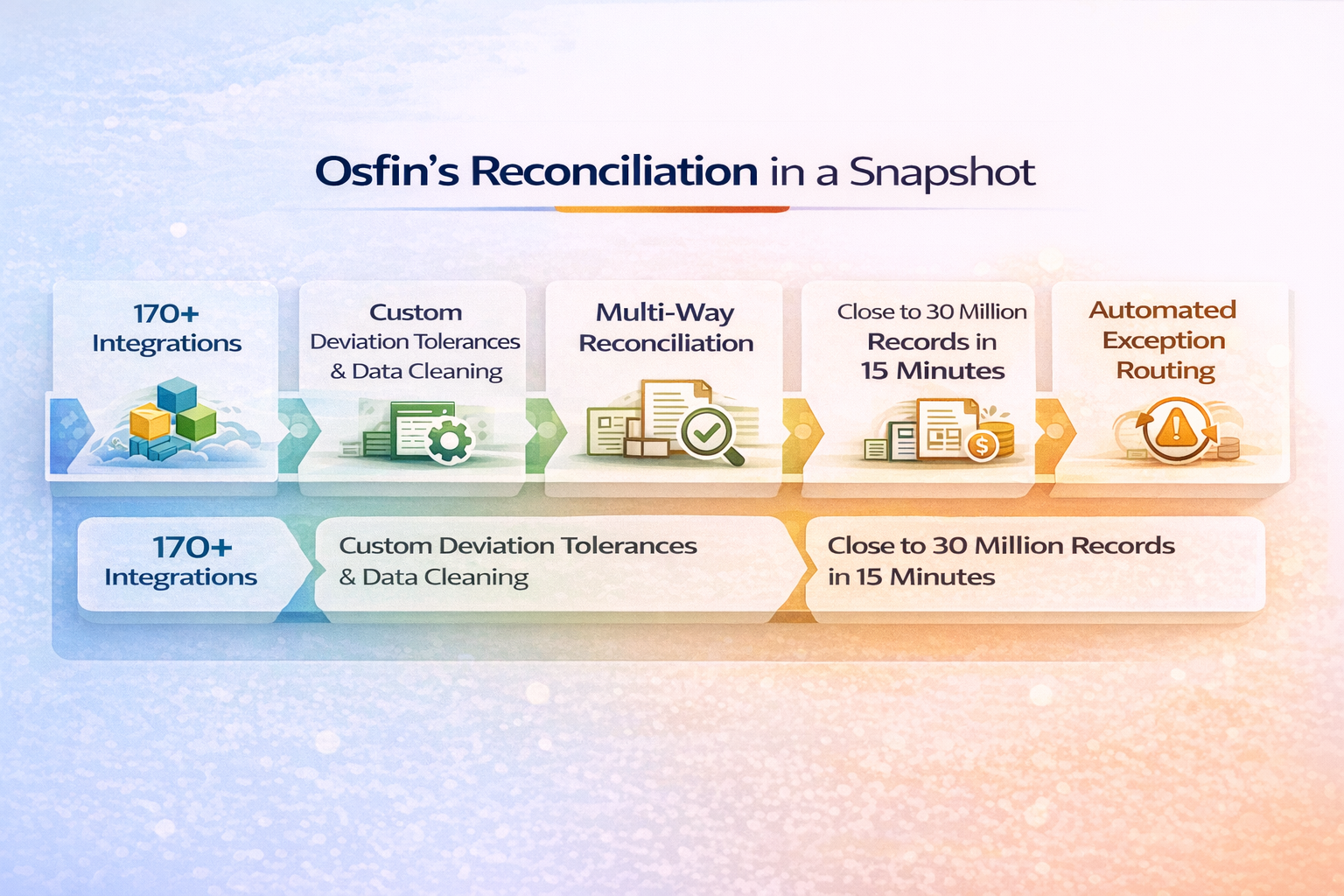
Osfin is file format agnostic and supports 170+ integrations. Teams can pull data from ERPs, banks, payment gateways, and custom systems regardless of format. During ingestion, Osfin applies custom deviation tolerances to filter weak data before reconciliation starts. It detects duplicates and outliers at the ingestion stage itself.
Matching That Handles Real-World Complexity
Finance data is rarely one-to-one.
Osfin uses logic-based matching that supports many-to-one and one-to-many transactions. It handles two-way, three-way, four-way, and five-way reconciliations without layering complex manual rules.
Performance is measurable. Osfin reconciles 30 million records in 15 minutes. For high-volume environments, that speed changes close timelines.
It also auto-reconciles payment gateway reports with commission, tax, and fee breakdowns. That removes the need to manually verify layered deductions.
Exception Handling That Moves Work Forward
Most reconciliation delays sit in unmatched transactions.
Osfin automatically flags unmatched items and assigns accurate reasons. It routes those transactions to the correct team member through its ticketing and exception engine. Escalations happen inside the system, not over email chains.
Live dashboards show match status, exposure levels, and open exception queues. Teams see risk clearly and act faster.
Audit-Ready Output Without Extra Work
The audit trail is part of the workflow. After reconciliation, Osfin delivers compliance-ready reports with full transaction history and traceability.
Security controls are built in. Data is protected with 256-bit encryption. The platform supports maker-checker workflows, role-based access, and two-factor authentication. It complies with SOC 2, PCI DSS, ISO 27001, and GDPR requirements.
Osfin should be the top choice when organizations:
- Want deep reconciliation focus.
- Need faster implementation without long enterprise rollout cycles.
- Handle high transaction volumes.
- Manage complex many-to-one and multi-way reconciliations daily.
- Want compliance-ready reports with full traceability at any time.
- Operate in regulated environments that demand SOC 2, PCI DSS, ISO 27001, and GDPR compliance.
- Prefer a focused system that simplifies user experience rather than adding layers of modules.
If reconciliation drives your close timeline, audit pressure, and operational risk, then depth matters more than breadth. A specialized system like Osfin can remove friction where it hurts most and deliver measurable impact faster.
{{banner3}}
FAQs
1. What is the main difference between HighRadius, BlackLine, and Osfin?
HighRadius is typically chosen for AR automation and AI-driven finance workflows. BlackLine is known for strengthening financial close and accounting controls. Osfin takes a more focused approach, specializing in high-volume, complex reconciliation with built-in compliance and audit-ready traceability.
2. Which platform is better for complex, high-volume reconciliations?
For organizations handling many-to-one, one-to-many, and multi-way reconciliations at scale, a specialized reconciliation engine like Osfin can offer more depth and speed compared to broader finance automation platforms.
3. Is implementation time different across these platforms?
Enterprise-wide platforms like HighRadius and BlackLine may involve longer rollout cycles due to their broader modules and integrations. Focused systems like Osfin are often quicker to implement, especially when the primary need is reconciliation automation.
4. How important is compliance when choosing a reconciliation platform?
Compliance is critical, particularly in regulated industries. Finance teams should look for features such as audit trails, role-based access, data encryption, and adherence to standards like SOC 2, PCI DSS, ISO 27001, and GDPR to ensure long-term operational security.