Osfin vs FloQast: Which Financial Reconciliation Platform Is Best for You?
Financial institutions and banks strive to ensure precision, speed, and accountability when managing their books. Treasury teams have to reconcile millions of transactions daily, each flowing in from payment gateways, card networks, ERP systems, and internal ledgers. And implementing manual reconciliation or working with semi-automated spreadsheets leaves room for data delays, human error, and compliance risks.
Osfin and FloQast are two powerful platforms built to streamline financial reconciliation. But when banks, treasury teams, and card providers evaluate both, the contrast in scalability, automation, and compliance becomes clear.
This article discusses both platforms in detail. How they manage ingestion, transaction matching, exceptions, and compliance, to help you identify which platform fits their unique reconciliation goals.
What is Osfin?
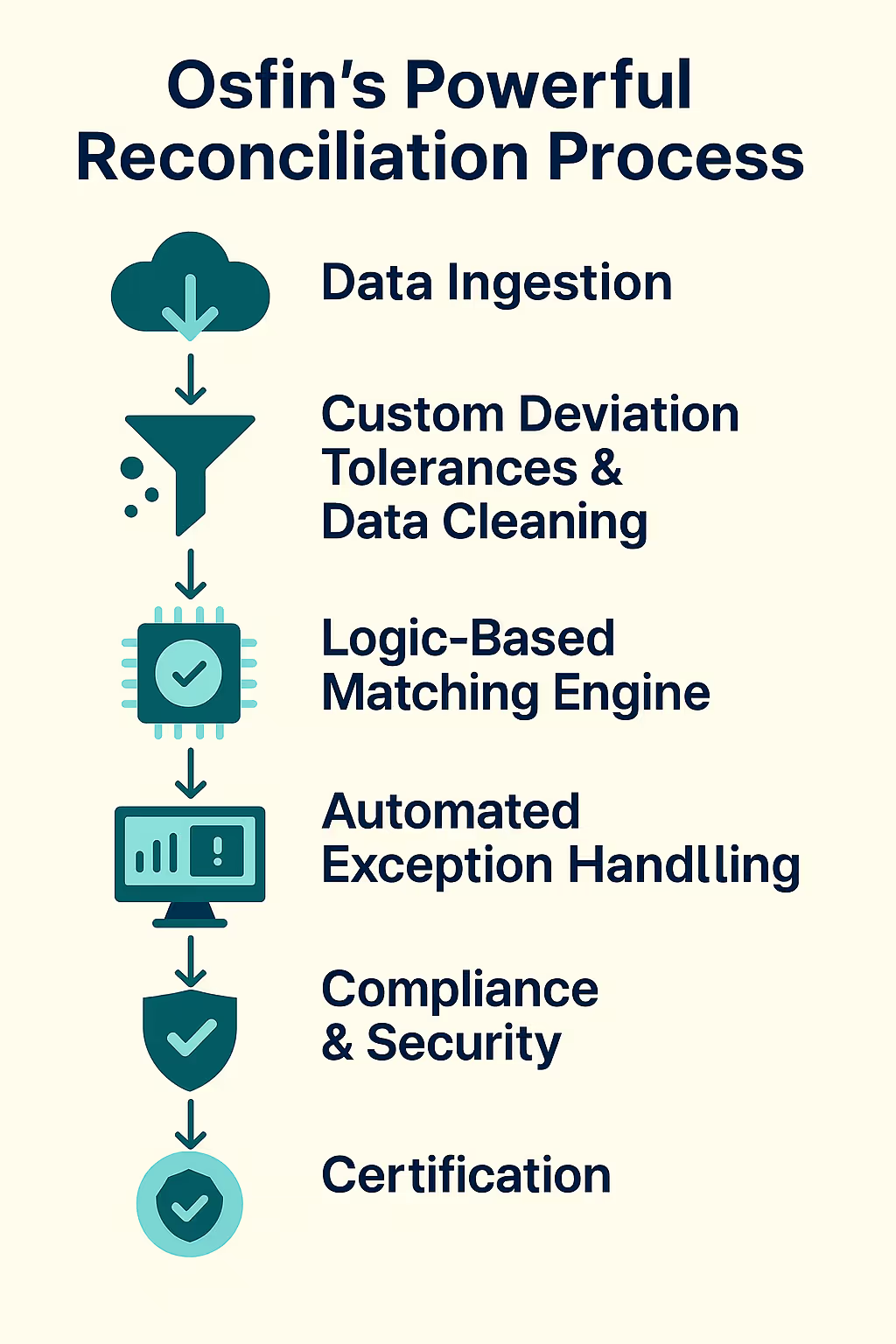
Osfin is a format-agnostic, automated reconciliation and exception management platform engineered exclusively for banks, financial institutions, fintechs, and corporate financial operations teams. It automates the transaction reconciliation process, by consolidating data from over 170 sources, cleansing and standardizing formats, and generating fully auditable, compliance-ready reports. Osfin delivers industry-leading precision for high-volume environments, by automatically eliminating duplicates and outliers. It also provides real-time dashboards and secure, role-based user access to every reconciliation step.
{{banner1}}
What is FloQast?
FloQast is a cloud-based financial close management platform, primarily for accounting and finance teams who are seeking to simplify their month-end close and reporting processes. The platform offers checklists, task automation, and progress tracking, making it easier for businesses to coordinate the close of their books.
FloQast also integrates with leading ERP and accounting software to help teams collaborate and reduce time spent on manual data entry.
While FloQast is effective for companies that are looking to upgrade from manual spreadsheets and improve their reconciliation efficiency, its primary audience is just the internal accounting departments rather than an enterprise-scale financial institution. The platform's design focuses on simplifying month-end routines, managing reconciliations within the general ledger, and providing workflow visibility for close processes.
For banks, card providers, and large fintechs, reconciliation needs extend far beyond what FloQast is built to handle. Complex transactional relationships, high-volume multi-system data, automated exception management, and regulatory traceability often demand functionality and scalability that go beyond task checklists or periodic reconciliations.
Detailed Comparison: Osfin vs FloQast
When you understand specific features, capabilities, and target users, choosing the right reconciliation or financial close platform becomes an informed process. Osfin and FloQast both enhance financial data management but address different organizational needs. To decide on which platform your financial institution needs, let's compare Osfin vs FloQast feature by feature.
To make an informed choice between Osfin and FloQast, let’s closely examine their core features, pros and cons.
Key Features of Osfin
Importing Data (Ingestion)
Every reconciliation process begins with extracting and standardizing data from multiple systems. And Osfin makes this easy through its file–format–agnostic ingestion layer.
Being format-agnostic means it can handle data in any form, including CSV files, XML, APIs, PDFs, or direct database exports, and convert them into a unified, standardized structure.
Osfin connects with more than 170 different data sources, including ERPs, core banking platforms, card processors, payment gateways, and treasury systems. The platform applies custom deviation tolerances at the point of ingestion, automatically filtering poor-quality or incomplete data before it moves forward and reduces downstream errors significantly.
Osfin also identifies duplicates and outliers during ingestion, which eliminates redundancies and potential mismatches before the reconciliation engine runs.
Reconciliation Process
Once data enters the system, Osfin's logic-based reconciliation engine starts processing it with suitable both simple and complex match cases: one-to-one, one-to-many, and many-to-one or multi-way reconciliations, including two-way, three-way, four-way, or five-way transactions to make sure that no record is left unmatched.
Osfin processes up to 30 million records in just 15 minutes, an industry-leading speed that helps banks and payment providers to achieve near real-time reconciliation. It also auto-reconciles payment gateway reports that contain detailed commission, tax, and fee breakdowns, saving hours of manual work for finance teams.
Exception Handling
Osfin automates the entire process of identifying and addressing unmatched transactions through its built-in exception handling engine. The platform auto-flags every unmatched transaction, assigns a clear reason code, and routes it to the correct stakeholder for resolution.
It implements a ticketing system, and each ticket is assigned dynamically to internal or external teams while real-time dashboards give complete visibility into exception queues, match rates, and exposure levels.
This allows operations, finance, and compliance officers to stay aligned without switching tools or maintaining manual trackers.
Compliance Reporting and Security
At the final stage, Osfin generates detailed reconciliation summaries and compliance-ready reports. Each reconciliation cycle can be revisited through its complete, traceable audit trail, which includes every transaction, the logic applied, any exceptions handled, and their resolution status. Osfin ensures a robust security framework with strict role-based access controls that restrict system permissions on the basis of job functions, and hence enforcing the principle of least privilege.
Also the platform incorporates a maker-checker flow, that segregates duties by asking approvals for critical reconciliation actions. And all user activities, whether automated processes or manual interventions are meticulously captured and logged in the audit trail, providing an irrefutable record for compliance audits.
Osfin secures all data with enterprise-grade protections, including 256-bit encryption, role-based access, and two-factor authentication. It also meets globally recognized standards, such as SOC 2, PCI DSS, ISO 27001, and GDPR standards for compliance.
- Unified, Format-Agnostic Ingestion: Osfin effortlessly imports data from more than 170 sources, irrespective of file format, to make sure your reconciliation teams always work with complete and clean data. Its custom deviation tolerances filter out poor-quality and duplicate information well in advance of the reconciliation process to avoid costly manual data corrections.
- Logic-Based Reconciliation: Trusted with a record of reconciling 30 million transactions in just 15 minutes, Osfin offers industry-leading speed with its advanced logic-based matching, which supports complex transaction relationships such as many-to-one and one-to-many, perfectly suited for banks, card providers, and fintechs with high-volume, multi-party data.
- Automated Exception Management: Osfin's exception handling automatically flags unmatched transactions, supports each exception with precise reasons, and routes these issues through a built-in ticketing system. Real-time dashboards keep teams aligned on match status, exception queues, and exposure, speeding up the process of issue resolution.
- Intuitive and Modern User Interface: Osfin is designed with finance teams in mind, and offers a clean, user-friendly experience that reduces reliance on IT support. Its dashboard provides real-time visibility into reconciliation status, key metrics, and exception queues, making complex financial data easy to understand and act on.
- Excellent Customer Support: Feedback from users reports strong and responsive customer support that helps resolve issues quickly and guides finance teams in maximizing automation benefits.
- Compliance-Ready and Secure: Osfin maintains compliance with SOC 2, PCI DSS, ISO 27001, and GDPR. The platform safeguards your data with 256-bit encryption, two-factor authentication, and strict role-based access controls. Audit-ready reports and traceable workflows make regulatory reporting and audits easy.
- Scalability and Flexibility: Whether processing thousands or millions of transactions daily, Osfin scales effortlessly to meet your growth. Its architecture supports complex, multi-system environments that are common in financial institutions and delivers sustained accuracy and control.
Key Features of FloQast
Month-End Close Management
FloQast is built to automate and streamline the month-end close process. It replaces manual spreadsheets and siloed emails with task scheduling, progress tracking, and checklist automation so accounting teams can close more efficiently and accurately during close cycles.
ERP and Accounting Software Integrations
FloQast integrates seamlessly with popular ERP platforms like NetSuite, QuickBooks, and Microsoft Dynamics. These integrations make it easy to pull in financial data directly, centralizing close activities without the need for manual data uploads.
Collaboration Tools
FloQast fosters transparency by providing real-time status updates, shared checklists, and centralized communication features. Controllers and CFOs can track progress, identify bottlenecks early, and ensure accountability through assigned task owners and due dates.
Basic Reconciliation Workflows
FloQast supports ledger reconciliations and balance validations mainly within the accounting general ledger. It automates tie-outs and version control for reconciliation documents to reduce errors and audit risks, but it does not specialize in high-volume or multi-source transaction matching.
User Interface
The UI is simple, checklist-driven, and focused on guiding finance teams through a structured close process. This user-friendly approach helps teams quickly adapt to the platform without extensive technical knowledge.
Pros
- Easy to use and implement, and is ideal for accounting teams upgrading from spreadsheets.
- Excellent for managing month-end close activities.
- Good integration with popular ERP and accounting systems.
- Enhances team collaboration and visibility during the close process.
Cons
- Limited capability for large-scale, multi-source transaction reconciliation.
- Manual or semi-automated exception tracking may slow resolution.
- Not designed for complex matching logic needed by banks and payment providers.
- Compliance and audit features are less extensive than specialized reconciliation software.
{{banner1.1}}
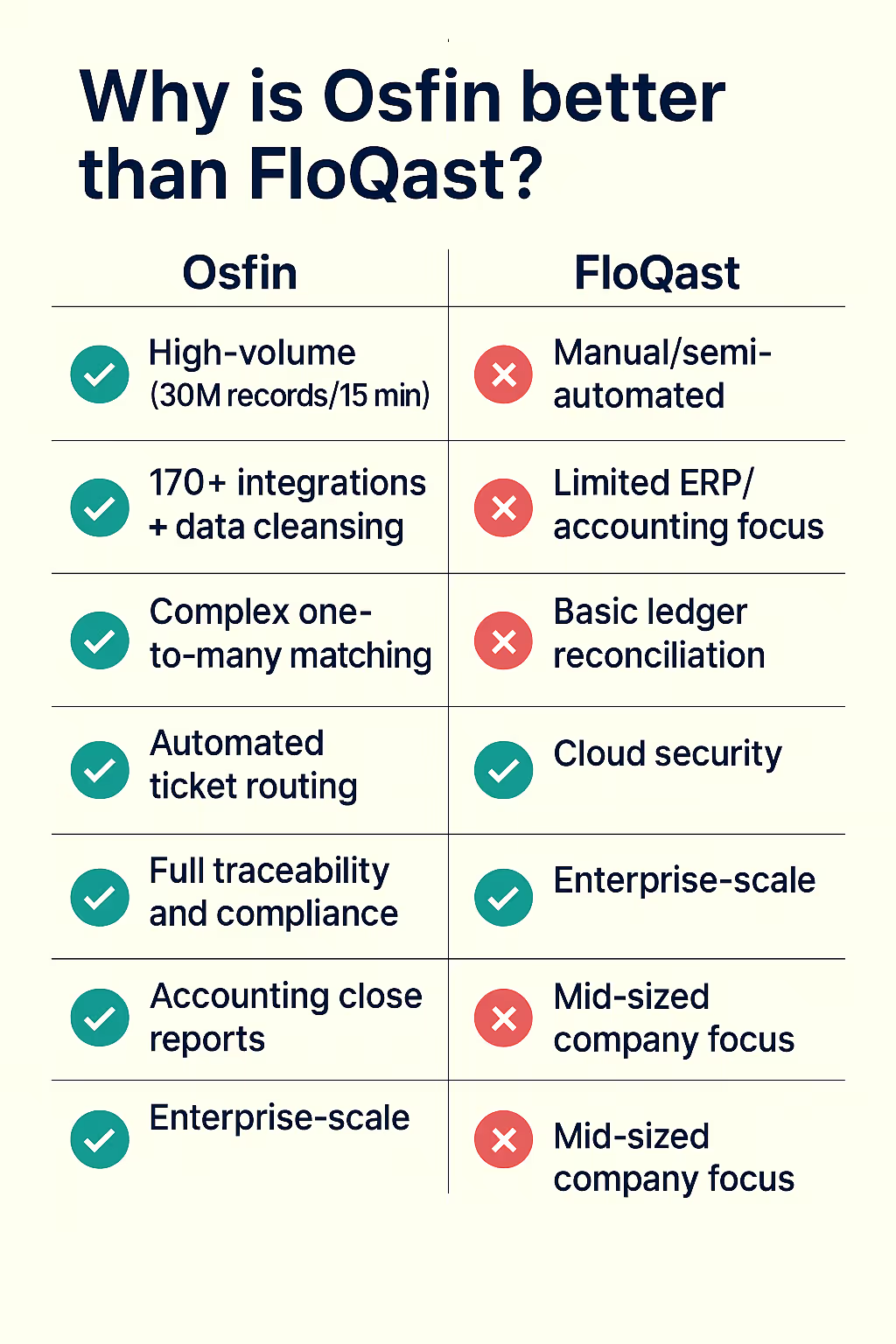
The Bottom Line
A compatible financial reconciliation software is crucial for banks, financial institutions, and treasury teams. Even if FloQast offers a user-friendly, checklist-driven approach that is well-suited for internal accounting teams and for month-end close management, it may not scale effectively to the high-volume, multi-system reconciliation needs of larger financial enterprises.
On the other hand, Osfin is explicitly built for large-scale, complex financial environments. Its format-agnostic ingestion from 170+ sources, lightning-fast logic-based matching, automated exception handling, and compliance-ready reporting are perfect for banks, card providers, and fintechs handling millions of transactions daily.
In the end, your choice depends on your organization's scale, data complexity, and compliance requirements. For enterprises seeking fast, intelligent, and fully automated reconciliation workflows, Osfin is the ideal partner.
{{banner2}}
Frequently Asked Questions (FAQs)
1. What makes Osfin different from FloQast?
Osfin is exclusively designed and built for large-scale financial reconciliation with multi-source data ingestion, automated exception management, and compliance reporting. FloQast focuses more on month-end close management, checklist automation, and internal accounting workflows.
2. Can these platforms integrate with existing systems?
Both platforms integrate with ERPs and financial systems, but Osfin supports over 170 source integrations, including payment gateways and card processors, whereas FloQast’s integrations are mostly centered on popular ERP and accounting software.
3. Are both platforms compliant with security standards?
Yes. Osfin meets SOC 2, PCI DSS, ISO 27001, and GDPR standards, and FloQast adheres to enterprise cloud security standards appropriate for financial close management teams.
4. How do they handle unmatched transactions?
Osfin automatically flags unmatched transactions, assigns reasons, and routes them via a ticketing system for resolution. FloQast relies more on manual task assignment and progress tracking for exceptions during the close process.
5. How accurate is the reconciliation with each platform?
Osfin offers 100% reconciliation accuracy through advanced logic-based matching and accurate data cleansing during ingestion, while FloQast provides reliable ledger reconciliations mainly for accounting teams but may require manual input for complex datasets.