Solvexia Review: Features, Pros, Cons & Use Cases
TL;DR
- Solvexia automates payment reconciliations, rebate calculations, and XBRL reporting for banks via no-code drag-and-drop from ERPs and gateways.
- It connects ERPs, APIs, and spreadsheets to cut processing time 100x and errors by 98% on secure cloud platforms like Azure.
- GTreasury's January 2026 acquisition adds treasury matching for 7-Eleven-style high-volume POS/bank commissions.
- Strong for flexible automation, but we’ll also look at how Osfin is better for 100% accurate high-volume matching with a free trial.
What is Solvexia?
Solvexia is a leading no-code automation platform that is built specifically for finance teams of operating banks, financial institutions, card providers and treasury services. You can use this platform to streamline complex financial processes like expense analytics, rebate management, reconciliation and regulatory reporting by replacing manual spreadsheets with drag-and-drop workflows.
Moreover, Solvexia also connects to ERPs, databases, spreadsheets and APIs through built-in integrations that help you enable end-to-end automation without requiring extensive coding capabilities. Finance professionals can use Solvexia to combine, transform, validate and analyze high-volume data to deliver insights in minutes, which cuts the processing time by up to 100x and reduces errors by 98%.
Solvexia runs on a secure cloud server like Microsoft Azure and seamlessly embeds audit trails, governance controls, and compliance features. This helps you to handle critical workflows such as financial close reconciliations and XBRL reporting with maximum speed and accuracy.
In January 2026, Solvexia was acquired by GTreasury, and now, it also enhances treasury automation for global enterprises, making it a go-to Solvexia review highlight for operational excellence in fintech and banking.
It is trusted by major banks and insurers across the globe, and it steers clear of repetitive tasks like payment matching and commission calculations. Solvexia’s visual builder and scalability are two features that stand out for handling reconciliation challenges that are common for treasury services. Moving on, let’s look at the platform’s key features to do a thorough Solvexia review.
What Are the Key Solvexia Features?
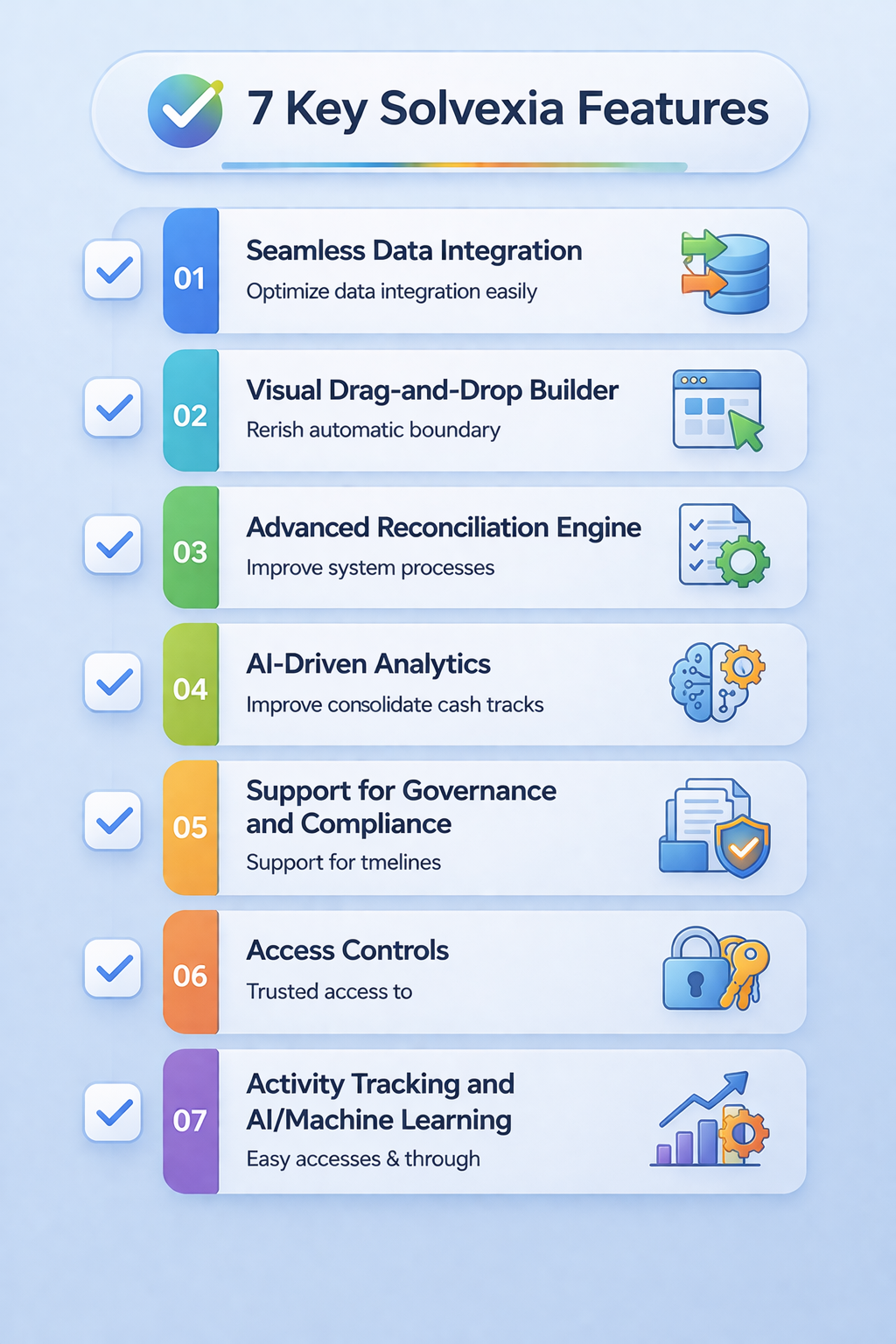
Solvexia is better known as a no-code automation tool that is tailored for banks and other financial institutions that deal with financial reconciliation, reporting, and data workflows. In this Solvexia review, we’ll estimate its effectiveness and strength by covering its key features:
- Seamless Data Integration
Solvexia effortlessly connects with your ERPs, spreadsheets, databases, third-party accounting systems and APIs and handles formats like Excel, CSV, JSON, XML, and PDFs for flexible financial automation across sources.
- Visual Drag-and-Drop Builder
Your finance team can use this tool to custom build reconciliation logic, data transformations, validation rules, and exception handling without any coding requirements. It is a good option if you’re focusing on payment matching and variance analysis.
- Advanced Reconciliation Engine
Solvexia is a platform that supports rule-based matching for high-volume transactions, rebate calculations, and bank statement reconciliations. It also supports reconciliation with real-time activity dashboards for quick insights.
- AI-Driven Analytics
It helps you automate repetitive tasks like expense analytics and operational reporting. Solvexia also offers features such as smart alerts via email or SMS to flag issues early and boost efficiency.
- Support for Governance and Compliance
Solvexia features complete audit trails, version control, role-based access, and SOX/XBRL-ready controls on secure Microsoft Azure cloud. This is vital for regulated treasury operations, considering the latest acquisition news.
- Access Controls
It allows you to define the levels of authorization and accordingly, set access for specific files in your system.
- Activity Tracking and AI/Machine Learning
Solvexia makes use of a software program that continuously tracks and documents all activities across devices and networks to accordingly adjust its behaviour based on the observed data. It also offers a variety of alerts and notification types.
These features make Solvexia a solid financial automation platform, though specialized reconciliation needs may call for alternatives like Osfin for 100% accuracy in high-stakes matching. Schedule a demo with Osfin today to explore yourself!
Solvexia Pros
Next in the Solvexia review, we’ll look at why this platform scores the highest marks from finance leaders in banks, financial institutions, card providers, and treasury services. Here are some pros that Solvexia brings for financial teams:
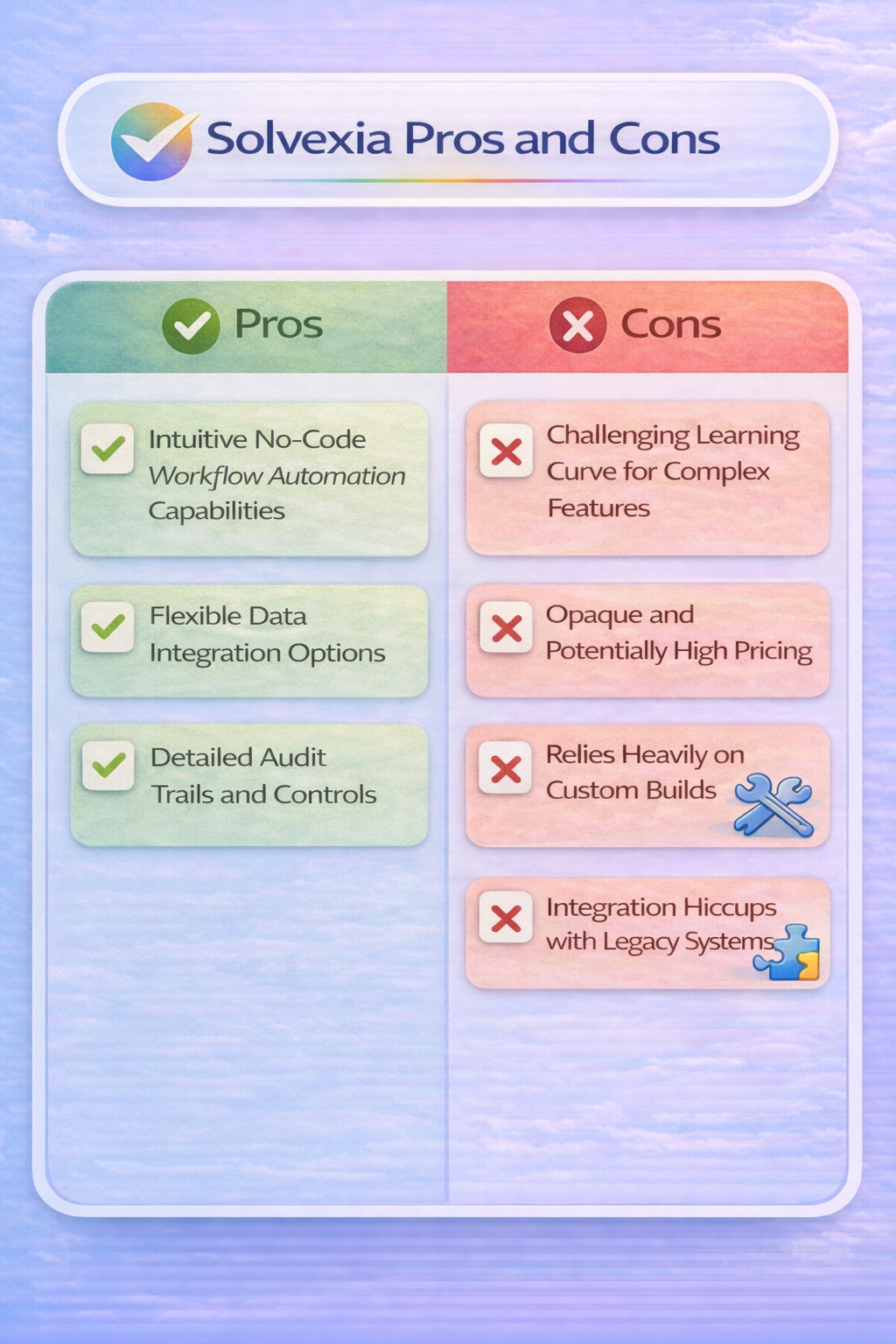
- Intuitive No-Code Workflow Automation Capabilities
It's got a simple drag-and-drop interface that allows you to build complex workflows for financial reconciliations and data transformations without any extreme coding dependency. This lets your operations team work independently of IT, speeds up setup, and makes it easy to tweak processes as needs change.
- Flexible Data Integration Options
The platform pulls data from ERPs, spreadsheets, databases, and APIs with ease. It handles various file formats and mixed data types common in finance. This cuts down preprocessing time and helps unify info from different sources for smoother month-end closes.
- Detailed Audit Trails and Controls
Solvexia logs every action, change, and workflow run in detail. It includes version tracking, user permissions, and approval steps to enforce proper separations. These tools keep regulated teams compliant with SOX and provide the clear records auditors need.
Solvexia Cons
We know that no platform is perfect, and that’s why in this Solvexia review, we'll also look at some drawbacks that banks, financial institutions, card providers, and treasury services should weigh before proceeding with Solvexia.
- Challenging Learning Curve for Complex Features
The no-code interface works well for basics, but advanced reconciliation logic and custom workflows require significant training and time to master effectively.
- Opaque and Potentially High Pricing
Solvexia pricing requires custom quotes based on users, data volume, and modules, with no public tiers available. This can lead to higher-than-expected costs for mid-sized organizations.
- Relies Heavily on Custom Builds
Users often build workflows from scratch due to fewer industry-specific templates, increasing initial setup time for specialized financial processes like payment matching.
- Integration Hiccups with Legacy Systems
Connecting to older ERPs or non-standard data sources may demand additional configuration or support. This can delay full implementation of your project.
These drawbacks lead some financial teams to explore alternatives like Osfin, which provides faster deployment and 100% accuracy for high-volume financial reconciliations. Opt for a free trial today to ensure accuracy and speed in your reconciliation process!
Solvexia Pricing Overview
Solvexia follows a custom pricing model tailored for banks, financial institutions, card providers, and treasury services, with no public tiers or fixed rates listed. You need to contact sales for quotes based on factors like the number of users, data volume, workflows, and required support.
Costs can scale with usage, and you can expect per-user-per-month structures for larger teams, often starting in the mid-range for financial automation but varying widely by customization needs. Solvexia offers 24/7 support, and there are implementation and consulting services also available.
What are Some Solvexia Use Cases?
Finance teams at banks, financial institutions, card providers, and treasury services turn to Solvexia for practical solutions to everyday challenges like payment mismatches and spreadsheet overloads. This Solvexia review highlights specific use cases backed by customer examples and industry applications.
- Payment Gateway Reconciliations
Retail giants like 7-Eleven use Solvexia to match POS, bank, and gateway data across high-volume transactions, automating commission and fee breakdowns for faster month-end closes.
- Custody and Bank Statement Matching
Wealth managers using Solvexia can automate custody reconciliations by pulling statements from multiple custodians, applying rules for variances, and generating audit-ready reports that are crucial for treasury compliance.
- Rebate and Commission Calculations
Fintechs and insurers like Heartflow or life providers use Solvexia to calculate complex rebates, reinsurance, and sales commissions from disparate sources. This helps them ensure accuracy and timeliness without manual spreadsheets.
- Regulatory Reporting Automation
Firms that offer financial services handle APRA, HMRC Making Tax Digital, or XBRL submissions by transforming data and building approval workflows, which helps you meet deadlines with full traceability.
- Expense and Spend Analytics
Pharma companies and travel firms consolidate committed spend or corporate expenses from ERPs and cards, running analytics to spot trends and flag any anomalies, if present, efficiently.
Who Should Consider Using Solvexia?
If you're a finance team in banks, financial institutions, card providers, or treasury services grappling with manual spreadsheets and disjointed data, Solvexia could be your go-to no-code automation solution. You can consider using Solvexia if:
- You handle complex, multi-source data daily: You'll appreciate how it integrates ERPs, spreadsheets, and APIs to unify payment gateways, bank statements, and commissions for seamless month-end processes.
- Your team lacks coding expertise: The drag-and-drop builder lets you design custom reconciliations, rebate calculations, and validation rules independently, speeding up deployment and iterations.
- Compliance and audits are your priority: You'll benefit from detailed audit trails, version control, and SOX/XBRL-ready controls that keep your operations transparent and regulator-approved.
Who Might Need an Alternative?
If Solvexia doesn't fully align with your needs as a bank or a financial institution that’s seeking advanced capabilities and a clear focus on automation of financial reconciliation, you may want to explore alternatives in this Solvexia review. So you might need an alternative if:
- You're dealing with high-volume reconciliations: Solvexia's custom builds work for moderate scale, but for processing like 30 million records in 15 minutes with 100% accuracy, you need advanced engines like Osfin's logic-based matching.
- You require complex, advanced reconciliation automation: Basic rule-matching falls short for many-to-one or one-to-many transactions across gateways with commissions, taxes, and fees.
- Budget constraints limit enterprise quotes: Mid-sized teams often find custom pricing steep, and they generally opt for a trial period to explore the platform themselves. But Solvexia doesn’t offer any free trial feature to deliver enterprise-grade features without the opacity.
Solvexia vs Modern Reconciliation Platforms
In this Solvexia review, we’ll be comparing the Solvexia platform to modern reconciliation platforms that reveal key differences for banks and financial institutions that are focused on high-stakes financial matching. While Solvexia excels in broad no-code automation, specialized reconciliation automation platforms like Osfin deliver superior speed, accuracy, and finance-specific workflows.
Here's how Solvexia stacks up against modern reconciliation platforms:
Why Fintechs Are Choosing Osfin Over Traditional Enterprise Suites
Fintechs, banks, financial institutions, card providers, and treasury services increasingly choose Osfin over traditional suites like Solvexia for its purpose-built reconciliation engine that delivers unmatched speed, 100% accuracy, and seamless compliance. In this Solvexia review, we saw how Solvexia focuses on automation of manual tasks rather than high-accuracy bank reconciliation capabilities. Here, Osfin stands out by automating end-to-end workflows without the custom builds and learning curves of general platforms.
You're likely switching to Osfin because it follows a streamlined, chronological process tailored for high-volume finance operations:
- Osfin starts with data ingestion as a file format-agnostic platform. It features over 170 integrations that import data from multiple sources regardless of format. It standardizes and normalizes incoming data while applying custom deviation tolerances to filter out poor-quality inputs before the reconciliation process even begins. This step also detects duplicates and outliers right at ingestion, and helps you prevent costly downstream issues that plague traditional suites.
- Next comes the reconciliation process, which is powered by logic-based matching that effortlessly handles many-to-one and one-to-many transactions. Osfin auto-reconciles payment gateway reports, complete with commission, tax, and fee breakdowns and offers speed and precision far beyond custom-coded alternatives. It supports 2-way, 3-way, 4-way, and even 5-way reconciliations for complex scenarios like intercompany, bank, or custodian matching.
- The next step is exception handling, which takes automation further by automatically flagging unmatched transactions and assigning them accurate reasons based on intelligent rules. Unresolved items escalate and route to the appropriate internal or external team member through Osfin's dedicated ticketing and exception handling engine. You also get live dashboards tracking match status, exposure levels, and exception queues in real-time, to help you plan and execute on quick resolutions.
- Finally, outputs provide compliance-ready reports with complete traceability and full transaction history for effortless audits. Osfin also secures your data with 256-bit encryption, role-based access controls, and two-factor authentication, while fully complying with SOC 2, PCI DSS, ISO 27001, and GDPR standards. That’s how it gives fintechs the enterprise-grade security they need without any compromises.
Final Thoughts
Solvexia delivers solid no-code automation for financial teams handling reconciliations and reporting. It offers reliable capabilities in flexible data integration and workflow building that help banks, financial institutions, card providers, and treasury services eliminate errors and speed up processes.
That said, it often requires custom setups and training for complex needs. So if you are dealing with high-volume operations that demand faster reconciliations, you might need more precise tools like Osfin that save you this hassle.
Osfin’s format-agnostic ingestion with more than 170 integrations pulls data from anywhere, cleans it with deviation tolerances, and spots duplicates early. And its logic-based reconciliation gives you ultimate speed with 30 million reconciled records in 15 minutes at 100% accuracy.
Fintechs choose Osfin for 100% accuracy, scalability, and complete transparency. Are you ready to upgrade? Request an Osfin demo today!
FAQs
1. Is Solvexia suitable for fintech companies?
Yes, Solvexia suits fintechs managing reconciliations, rebates, and reporting with its no-code automation for payment gateways and workflows. Many use it after the GTreasury acquisition for broad finance and treasury tasks. That said, Osfin takes it further with logic-based matching across more than 170 integrations, and can handle reconciliation of 30 million records in 15 minutes at 100% accuracy.
2. Does Solvexia offer real-time reconciliation?
Solvexia speeds up batch processing with monitoring dashboards, and though real-time matching isn't its focus, it offers general capabilities so that you can design workflows for near-term results. Osfin is a better option here as it heavily focuses on real-time reconciliation through capabilities like live dashboards during its rapid reconciliations, smart exception ticketing, and full traceability.
3. How much does Solvexia cost?
Solvexia offers custom sales quotes tied to users, volume, and features, landing in enterprise territory without public pricing. It offers no free trial. You need to book a demo to get a custom quote for your financial institution.
4. What are the best alternatives to Solvexia?
Osfin tops the list for the best alternatives to Solvexia. It is designed for specialized reconciliation, performs format-agnostic ingestion, multi-way matching, automated exception routing, and is SOC 2/GDPR compliant. These features outpace Solvexia's general tools. Also, Osfin’s free trial lets you test 100% accurate reconciliation of 30 million records in 15 minutes firsthand, something Solvexia withholds, making Osfin the practical upgrade for precision-focused teams.
5. Is Solvexia good for mid-sized businesses?
For mid-sized businesses with growing automation demands, Solvexia offers flexibility despite setup time and costs. However, for efficient scaling, Osfin delivers better with 2/3/4/5 way reconciliations, live tracking, and secure data and outputs at 100% accuracy.