Best Cash Flow Forecasting Platform in 2026
TL; DR
- Cash flow forecasting platform is used to predict how money will move in and out for a business. Its aim is to make it easier to plan investments, manage expenses, and avoid cash shortfalls.
- This guide covers 10+ of the best tools in 2026, including Fathom, HighRadius, Abacum, and Agicap, along with what each one is best suited for.
- But forecasting is nothing if the underlying data used for it is not accurate. And for that, you need a proper reconciliation tool, without which, even the best cash flow forecasting tools are bound to produce misleading insights.
Cash flow forecasting might sound quite simple at first. You just look at what’s coming in, what’s going out, and simply project where you think you’ll land in the future.
In reality, it’s hardly that simple.
Often, businesses have to deal with scattered data, delayed updates, and uncooperative systems. By the time the numbers come together, they’re often already stale. And that makes it harder to rely on forecasts when decisions actually need to be made.
That’s what makes cash flow forecasting platform a core part of modern finance operations. They can bring together data from different sources, automate projections, and give teams a clearer view of their future cash position.
Here, we provide a list of some of the best cashflow forecasting platform solutions in 2026, what each one does well, and how to choose the right fit for your business.
What is a Cash Flow Forecasting Platform?
Cash flow forecasting tool is used to predict cash inflows and outflows that a business can expect in a specific period in the future. The purpose of this prediction is to manage their cashflow efficiently. Basically, it helps:
- Avoid unexpected cash shortfalls before they happen
- Plan when to make large purchases or investments
- Decide when to draw on a credit line
- Give lenders or investors confidence in financial planning
Why is Cash Flow Forecasting Critical in 2026?
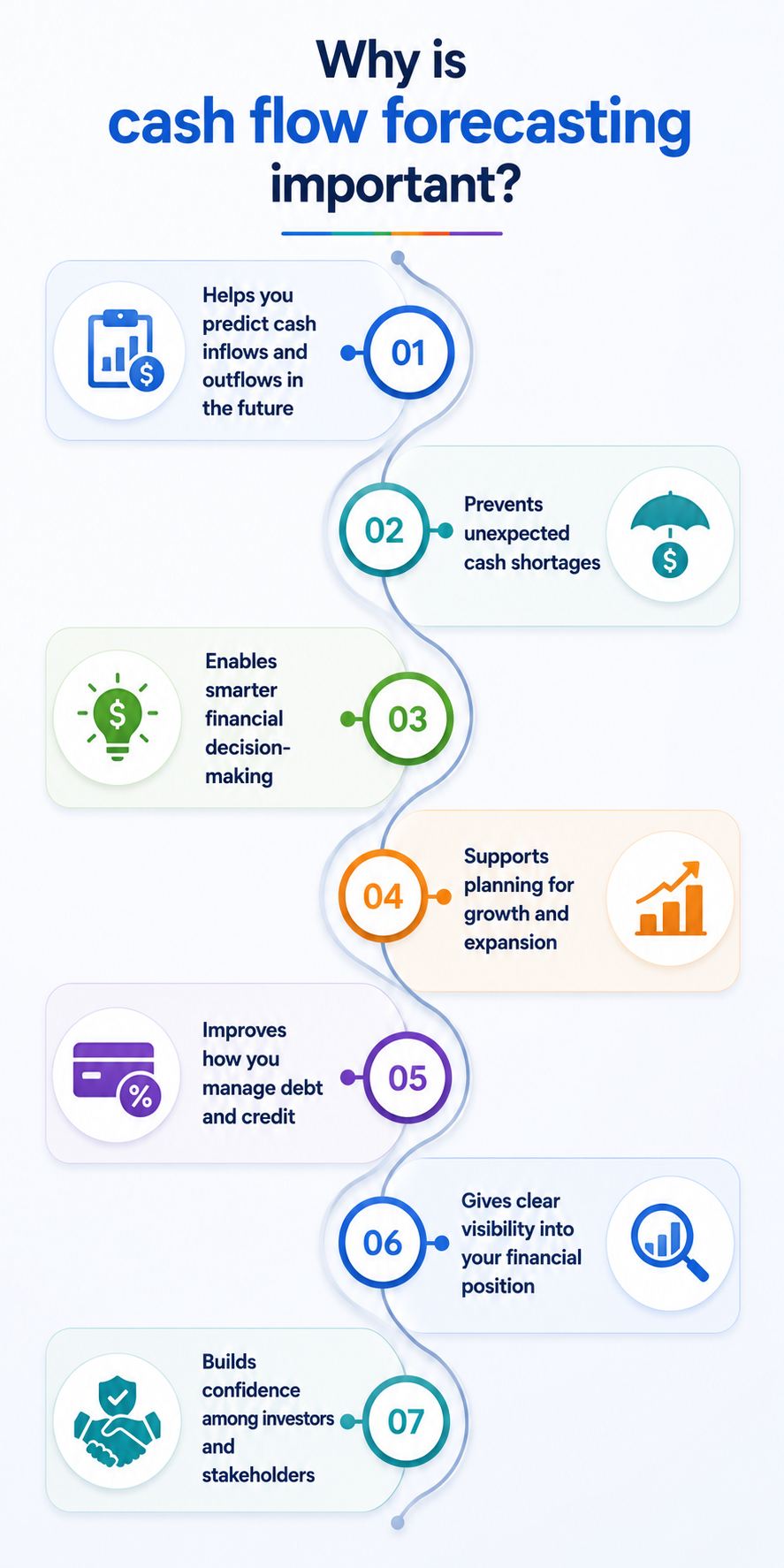
Cash flow forecasting tools give you a clear picture of what your expenses should be, how much you can invest in growth, and what amount you can set aside to meet unforeseen challenges.
In other words, cash flow forecasting is the base on which you can confidently take any significant business decision, be it investing in new machinery, expanding into new domains, or bringing on new talent.
In 2026, the reasons why cash flow forecasting has become something which you can’t afford to ignore include:
- Unpredictable interest rates: Borrowing costs have stayed stubbornly volatile. For CFOs who manage debt obligations or are considering new credit facilities, even a small rate shift can meaningfully alter your cash position. Forecasting gives you the lead time to act, and not just react.
- Effect of AI on competitive edge: Competitors can launch, scale, and undercut faster than ever. That puts a lot of pressure on your margins. And it may not even show up immediately in your P&L. But your cash flow is bound to be affected. Knowing your runway at any given moment is what separates a strategic response from a panicked one.
- Shift in investor and board expectations: Finance teams are now expected by board members to be ready with rolling forecasts, not just historical reports. Cash flow visibility has become a core part of how financial leadership is evaluated.
- Hard prediction of operational costs. From supply chain fluctuations to energy costs to talent market swings, the inputs that drive your outflows are less stable than they were even three years ago. Static budgets are not designed to keep up.
How to Evaluate Cash Flow Forecasting Platform?
We curated this list of cash forecasting platform based on how the platforms are performing on various fronts, such as:
- How intuitive is their UI?
- How in-depth is the forecasting logic? Can the platform handle complex flows and multi-entity consolidations?
- How much is their integration coverage? Does the integration work seamlessly across multiple sources?
- Does the platform offer low-code/no-code customization?
- Does the platform provide real-time visibility into forecasts?
- How high is the forecasting accuracy of the cash flow projection platform, and does it employ automation?
- Does it provide a clear audit trail, and trend and reporting analysis?
- How well can the cash flow forecasting solution scale with your business?
{{banner1}}
Comparison Table
10+ Best Cash Flow Forecasting Platform in 2026
Here is a curated list of the best cash flow forecasting platform you can use in 2026:
1. Fathom
Fathom is the first cash flow forecasting platform on our list. It’s built for small to mid-sized businesses and their advisors. It turns your financial data into clear visuals and forward-looking forecasts.
Key features:
- Three-way forecasting across P&L, Balance Sheet, and Cash Flow
- Scenario planning to model best-case and worst-case outcomes
- Integrates directly with Xero, QuickBooks, Sage, and MYOB
- Automated, scheduled reporting with customizable templates
2. HighRadius
HighRadius is built for scale. If you’re dealing with large transaction volumes, multiple entities, and operations across regions, this is the kind of tool that actually keeps up. It’s less about basic forecasting and more about having tight control over cash across the business.
Key features:
- Forecasting that pulls live data from ERPs and bank systems for up to 95% accuracy
- Automated variance analysis that flags discrepancies between forecast and actuals
- Scenario modeling to stress-test outcomes across different market conditions
3. Abacum
Abacum feels more like a modern FP&A workspace than a traditional cash flow forecast tool. If your team is tired of juggling spreadsheets, this is a cleaner way to bring everything into one place and actually collaborate on it.
Key features:
- Rolling forecasts and scenario planning with instant impact visibility
- Multi-dimensional modeling for headcount, revenue, OPEX, and more
- 50+ integrations with ERPs, CRMs, and HRIS systems, including NetSuite, Salesforce, and BambooHR
- Automated reporting with real-time dashboards for stakeholders
4. Agicap
Agicap is all about visibility. It gives you a clear, day-to-day view of where your cash stands, which is something a lot of tools overcomplicate. If you want to stay close to your numbers without digging through reports, this does the job well.
Key features:
- Real-time cash tracking synced directly from bank accounts and accounting tools
- Short, medium, and long-term forecasting, including 13-week rolling forecasts
- Multi-entity consolidation with the ability to drill down into individual entities
- Automated bank reconciliation and payment execution from a single platform
5. Cash Flow Frog
Cash Flow Frog is an easy-to-use and one of the best cash flow forecasting platforms for small businesses and accountants who want accurate cash flow visibility without the complexity. Connect your accounting platform, and it does the heavy lifting for you without any setup or spreadsheets.
Key features:
- Instant rolling 36-month forecast generated automatically from your accounting data
- What-if scenario modeling to simulate the impact of hiring, expenses, or new revenue
- Integrates with QuickBooks, Xero, Sage Intacct, FreshBooks, and Zoho Books
- Customer-level insights that rank clients by payment behavior and collections
- Consolidated reporting across multiple entities with branded PDF export
6. Brixx
Brixx is a good pick if you’re building financial plans without a deep finance background. It keeps things simple and visual, so you’re not stuck trying to figure out complex models. It’s especially useful for startups or small teams that need to map out growth, test ideas, and create something presentable without overcomplicating the process.
Key features:
- Three-way forecasting across cash flow, P&L, and balance sheet
- Scenario planning to test different business models, pricing strategies, or growth paths
- Models payment terms, loan repayments, and asset purchases for a complete cash picture
- Visual dashboards and presentation-ready reports exportable to Excel or PDF
- Long-range planning up to five years, built for pitching investors or planning growth
7. Float
Float keeps things focused. It’s built purely for cash flow forecasting, and it does that really well without adding unnecessary complexity. If you’re already using tools like Xero or QuickBooks, it fits right in and gives you a clear, visual view of your cash position without much setup.
Key features:
- Real-time visual forecasts synced automatically from Xero, QuickBooks, or FreeAgent
- Daily, weekly, and monthly views with up to 36-month rolling forecasts
- Cash runway tracking with a threshold alert so you know exactly when you're at risk
- Multi-entity support with consolidated views across companies
8. Nomentia
Nomentia is a treasury and cash management platform built for enterprise finance teams that need total control over complex, multi-bank, multi-entity cash operations. It goes well beyond forecasting. It's a full treasury suite designed for organizations where cash management is a serious operational function.
Key features:
- Real-time cash visibility across 10,000+ bank connections globally
- Rolling liquidity forecasting consolidated from ERPs, banks, and subsidiary data
- FX risk management, interest rate tracking, and debt management integrated into forecasts
- Automated payment workflows with approval controls and full audit trails
9. Sage
Sage isn’t a standalone cashflow forecasting solution, but it works well if you’re already using its accounting or ERP systems. Instead of adding another platform, it brings forecasting into the same environment, which makes it easier to manage financial data and planning in one place.
Key features:
- Real-time cash flow visibility pulled directly from accounts payable, receivable, and bank balances
- Rolling and scenario-based forecasting built into the Sage Intacct planning module
- Customizable dashboards showing liquidity trends, KPIs, and variance analysis
- Integrates natively with Sage's broader ERP and accounting ecosystem
10. Jirav
Jirav is an FP&A platform that suits accounting firms and their clients. Particularly, growth-stage and mid-market businesses that need more than basic reporting. It replaces the complex Excel models with structured, driver-based financial models that are faster to build and easier to maintain.
Key features:
- Rolling forecasts and scenario planning with instant cross-statement impact visibility
- Workforce planning integrated into the financial model for headcount and compensation forecasting
- Industry-specific templates to get clients up and running quickly without building from scratch
11. Numeric
Numeric is an accounting close automation platform that has expanded into cash management and financial analytics. It's built for enterprise accounting teams that want to cut down the manual work of month-end close, and connect that close data directly into cash visibility and forecasting.
Key features:
- Automated month-end close with task management, reconciliation, and variance analysis in one place
- Real-time transaction monitoring with alerts for anomalies and discrepancies
- Cash management module that matches bank transactions against GL entries automatically
12. Fluidly
Fluidly is a cash flow management tool built for small businesses and their accountants, with a particular focus on making forecasting as automatic as possible. Rather than requiring manual setup and input, it uses your existing accounting data to build and update forecasts for you — keeping things simple and real-time.
Key features:
- Automatic cash flow forecast generated from Xero or QuickBooks data with no manual setup
- Rolling forecast updated continuously as new transactions come in
- Scenario modeling to test the impact of key decisions on future cash position
- Automated credit control with invoice reminders, call scheduling, and debtor tracking
- Funding matching that connects businesses to pre-qualified lenders based on their cash position
Limitations of Cash Flow Forecasting Tools
There’s no denying that a tool for real-time cash forecasting is quite critical when it comes to managing and predicting a business’s future cash projections. But there are certain drawbacks in how exactly they work. These include:
1. Excessive reliance on estimates: Forecasting tools are basically built on assumptions like projected revenue, expected payment timelines, and anticipated expenses. When those assumptions drift from what’s real, even slightly, the forecast is no longer reliable. Your team ends up making high-stakes decisions based on numbers that are more educated guess than ground truth.
2. Grounded in probability: Forecasting is inherently probabilistic. There's always a confidence interval, a best-case and worst-case range. For CFOs who need a definitive number to make a board-level decision or manage a credit facility, "probably around this figure" isn't good enough.
3. A misplaced perception of financial stability: Perhaps the most dangerous drawback. A well-presented forecast dashboard can create a false sense of control. If the underlying data feeding that forecast is unreconciled, outdated, or mismatched, the business may believe it's in a stronger cash position than it actually is. Right up until it isn't.
The Real Problem Beneath the Forecast
All of these limitations point to the same root cause: forecasting tools show you where you expect to be, but they can't guarantee the accuracy of what's actually in your books.
And when your underlying transaction data is unreconciled, i.e. mismatched, delayed, or duplicated, even the most sophisticated forecast inherits those errors. In other words, that's not a forecasting problem. That's actually a reconciliation problem.
Why Reconciliation is Critical for Cash Forecasting
Financial reconciliation is the process of verifying that two sets of records match. Most commonly, your internal books and your actual bank statements. Every transaction that goes in or out of your business needs to be accounted for, matched, and confirmed. If something doesn't line up, reconciliation is what catches it.
In most businesses, this happens periodically: monthly, sometimes weekly. And therein lies the problem.
A forecast built on unreconciled data is a forecast built on an assumption.
When your books haven't been reconciled, your cash position isn't a fact. It's an estimate. Transactions may be missing, duplicated, or misclassified. Your forecasting tool has no way of knowing this. It takes your recorded data at face value and builds projections from it.
The result is a compounding problem. Inaccurate actuals produce inaccurate baselines. Inaccurate baselines produce unreliable forecasts. And unreliable forecasts lead to decisions that look informed but aren't.
Reconciliation closes that loop.
It ensures that before any projection is made, the starting point, which is your actual, verified cash position, is correct. It works like a ground truth that gives your forecast something solid to stand on.
This changes how reconciliation should be thought of. You can’t relegate it to a back-office compliance task that happens at month-end. It's a real-time financial control that directly determines how much you can trust the numbers you're making decisions with.
{{banner1.1}}
Where Osfin Fits in Cash Flow Forecasting?
For cash flow forecasting to be genuinely reliable, reconciliation needs to work at both ends of the process.
1. Before the forecast: ensuring clean data goes in
A forecast is only as accurate as the data feeding it. Before any projection is made, your transaction data needs to be verified, matched, and free of errors. Osfin sits at the front of this process. It ingests data from multiple sources, filters out duplicates and poor-quality entries at the point of ingestion, and ensures that what enters your forecasting tool reflects your actual financial position.
2. After the forecast: closing the loop on actuals
Forecasting doesn't end when the projection is made. As the period unfolds, actual transactions need to be reconciled against what was projected. Discrepancies need to be caught, investigated, and resolved.
Osfin's exception handling and live dashboards ensure that unmatched transactions are flagged in real time, routed to the right team member, and resolved before they distort your running cash position. That means your forecast stays calibrated against reality.
To make sure your entire cash flow process works on accurate data, this is how Osfin works:
1. Data Ingestion
Osfin is file format agnostic, meaning it can pull in data from virtually any source, in any format, through 170+ integrations. Then, it filters data using custom deviation tolerances during ingestion to catch poor-quality data before it enters the reconciliation process, and automatically detects duplicates and outliers at the point of entry. Problems are stopped upstream, before they can compound downstream.
2. Reconciliation
Osfin uses logic-based matching that can handle many-to-one, one-to-many, and complex multi-way reconciliations like two-way, three-way, four-way, and five-way. It reconciles 30 million records in 15 minutes with 100% accuracy, and auto-reconciles payment gateway reports complete with commission, tax, and fee breakdowns.
3. Exception Handling
When transactions don't match, Osfin assigns an accurate reason for the discrepancy and automatically routes the exception to the right team member through its ticketing and exception handling engine. Added to the mix are its live dashboards that show match status, exposure, and exception queues in real time, so finance teams always know exactly where things stand.
4. Output
Post reconciliation, Osfin delivers compliance reports and maintains audit-ready workflows with complete traceability and full transaction history. Your data is secured through and through with 256-bit encryption, maker-checker flows, role-based access, and 2FA. Its compliance with SOC 2, PCI DSS, ISO 27001, and GDPR requirements is another significant advantage, so finance teams are reconciling in a way that holds up to regulatory scrutiny.
How Can You Choose the Right Cash Flow Forecasting Platform?
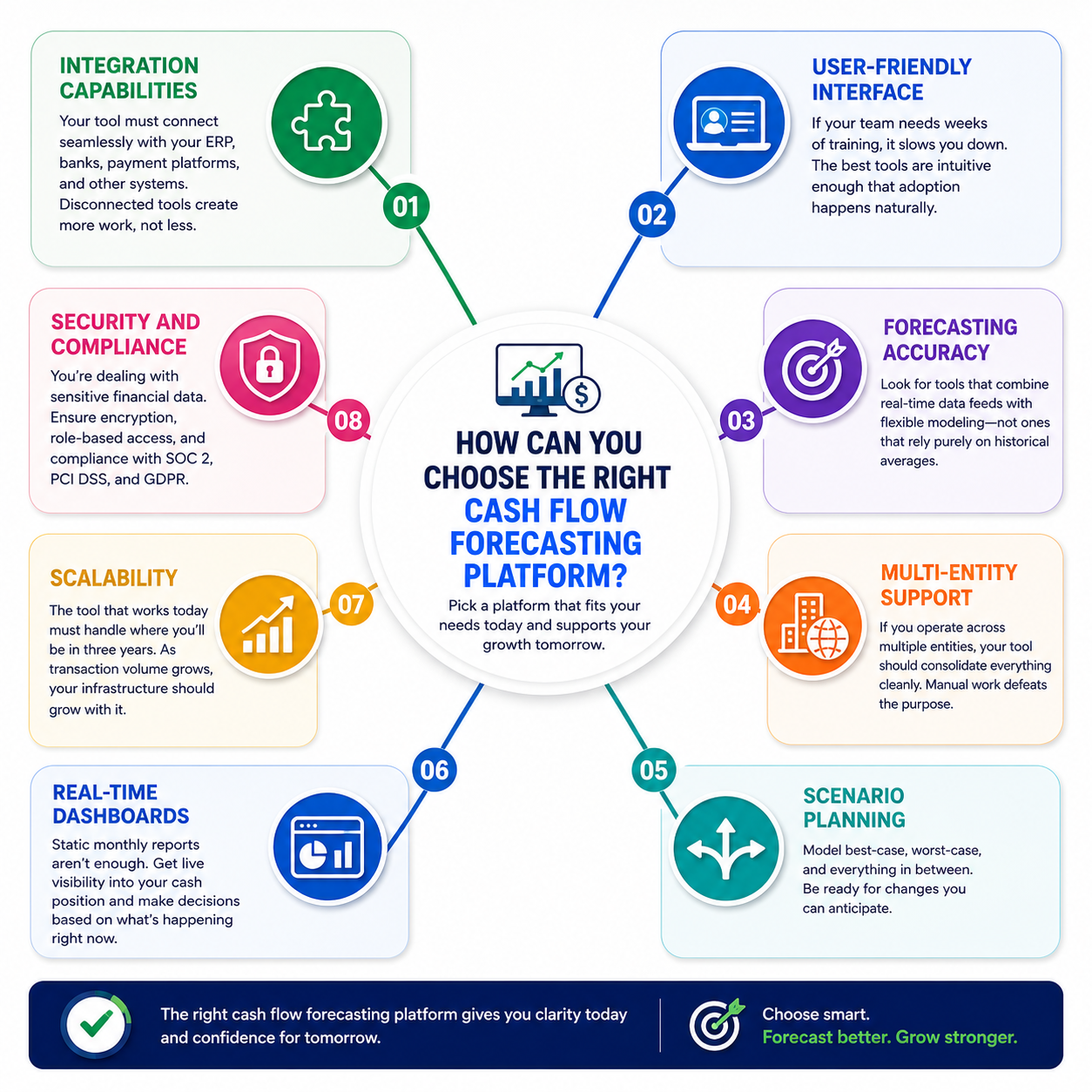
You now have a comprehensive list of the best cash flow forecasting platform. Each platform brings strong capabilities to the table. But the right one for you depends on your specific needs. Here are the features you absolutely cannot compromise on:
- Integration capabilities: Your forecasting tool is only useful if it connects to the systems you already use, like your ERP, banks, and payment platforms. Disconnected tools create more work, not less.
- User-friendly interface: If your team needs weeks of training to use it, it's already slowing you down. The best tools are intuitive enough that adoption happens naturally.
- Forecasting accuracy: The whole point is to get the numbers right. Look for tools that combine real-time data feeds with flexible modeling. Not ones that rely purely on historical averages.
- Multi-entity support: In case you operate across multiple entities, subsidiaries, or geographies, your tool needs to consolidate everything cleanly. Managing separate forecasts manually defeats the purpose entirely.
- Scenario planning: Business conditions change. Your platform should let you model best-case, worst-case, and everything in between. That’s because you should never be caught off guard by a shift you could have anticipated.
- Real-time dashboards: Static monthly reports aren't enough anymore. You need live visibility into your cash position so decisions are based on what's happening now.
- Scalability: The tool that works for you today needs to handle where you'll be in three years. Transaction volume grows. Your reconciliation and forecasting infrastructure needs to grow with it.
- Security and compliance: You're dealing with sensitive financial data. Non-negotiables include encryption, role-based access, and compliance with standards like SOC 2, PCI DSS, and GDPR.
The Future of Cash Flow Forecasting
Cash flow based financial planning platform has come a long way from spreadsheets and monthly reviews. And if the direction of travel is any indication, it's only going to get more sophisticated.
1. Smarter forecasting models
Traditional forecasting relied on historical averages and human analysis. That's changing. Advanced machine learning models are now able to analyze vast financial datasets and identify patterns that human analysts might miss to produce sharper, more reliable predictions.
2. Real-time data
The days of working off stale data are numbered. Modern forecasting tools can now continuously pull information from ERP systems, CRM platforms, and market data feeds. This gives finance teams a live, constantly updated picture of their cash position rather than a periodic snapshot.
3. Stress testing at scale
Scenario planning used to mean running three versions of a forecast: best case, worst case, or base case. That's a thing of the past now. Tomorrow's tools will generate thousands of scenarios based on historical data and live market conditions, helping treasury teams model how events like currency shifts, customer defaults, or supply chain disruptions would affect their cash position, before they can even happen.
4. A more connected financial ecosystem
The future isn't just smarter tools working in isolation. It's tools working together. Treasury ecosystems are emerging that connect banks, suppliers, customers, and regulators in a unified network, capable of delivering real-time forecasting across multiple entities simultaneously.
Final Takeaway
Cashflow forecasting systems play a central role in how businesses plan, spend, and understand where they stand. Be it planning an investment, managing a tight quarter, or tracking overall performance, forecasts guide everyday decisions.
The quality of a forecast depends on the data behind it. Choosing the right platform for forecasting cash flow helps, especially one that offers strong integrations, real-time visibility, support for multiple entities, and flexible scenario planning. These are standard expectations today.
At the same time, accurate data matters just as much. Unreconciled transactions, mismatched records, or delays can affect the numbers in ways that aren’t always obvious. This makes reconciliation an important part of the process, helping ensure that financial data stays consistent and reliable.
Osfin supports finance teams working with large volumes of transactions by keeping data clean, matched, and verified. It can ingest data from 170+ integrations in different formats, reconcile millions of records quickly, and flag exceptions in real time. This helps maintain accuracy across financial operations and supports more dependable forecasting.
{{banner2}}
FAQs
1. How accurate are cash flow forecasts?
The accuracy of cash flow forecasting solutions depends on the quality of the underlying data and assumptions. Even the best tools can produce unreliable forecasts if the input data is incomplete or unreconciled.
2. What features should I look for in a cash flow forecasting platform?
You must make sure the platform comes with real-time data integration, scenario planning, multi-entity support, automation, accurate forecasting models, and clear reporting dashboards.
3. What are the drawbacks of cash flow forecasting tools?
Cash flow forecasting tools rely on assumptions and historical data, which may not always reflect real-world changes. Without accurate and reconciled data, forecasts can be misleading.
4. How does reconciliation impact cash flow forecasting?
Reconciliation makes financial data accurate and complete. Without a good reconciliation platform, your forecasts can be built on incorrect data, leading to unreliable projections and poor decision-making.