Numeric Review: Features, Pros, Cons & Use Cases
TL;DR
- Numeric is an AI-powered financial close automation platform. It streamlines month-end accounting for banks, financial institutions, fintechs, card providers, and treasury services.
- Numeric automates financial close processes, reconciliations, and flux analysis for banks via AI-powered ERP integrations.
- It pulls ERP/GL data to cut month-end close times while enabling real-time collaboration and cash matching automation.
- Numeric is trusted by fintechs like Brex and public companies like Riskified (NYSE: RSKD) for audit-ready workflows and anomaly detection.
- While it is a strong option for mid-sized teams and ERP-heavy operations, alternatives like Osfin deliver superior 100% accurate high-volume reconciliation with a format-agnostic data ingestion process.
What is Numeric?
Numeric is an AI-powered financial close automation platform designed to streamline month-end accounting for finance teams in banks, financial institutions, and fintech companies.
It automates repetitive tasks like reconciliations, flux analysis, and reporting by pulling transaction data directly from ERPs such as NetSuite, QuickBooks, and Xero.
Unlike traditional tools, Numeric connects subledgers, automates journal entries, and offers collaborative dashboards for smooth team coordination. It is ideal for mid-sized financial organizations handling growing transaction volumes. Banks and financial institutions benefit from its smart matching and cash management features, which eliminate manual cash reconciliation and provide detailed analytics for compliance checks. Numeric stands out for scaling with ERP-heavy environments.
What are the Key Features of Numeric?
Numeric comes with several features that help streamline reconciliations, flux analysis, and reporting. These capabilities help reduce manual errors and speed up closings, which is crucial for fintechs and financial operations under tight compliance deadlines.
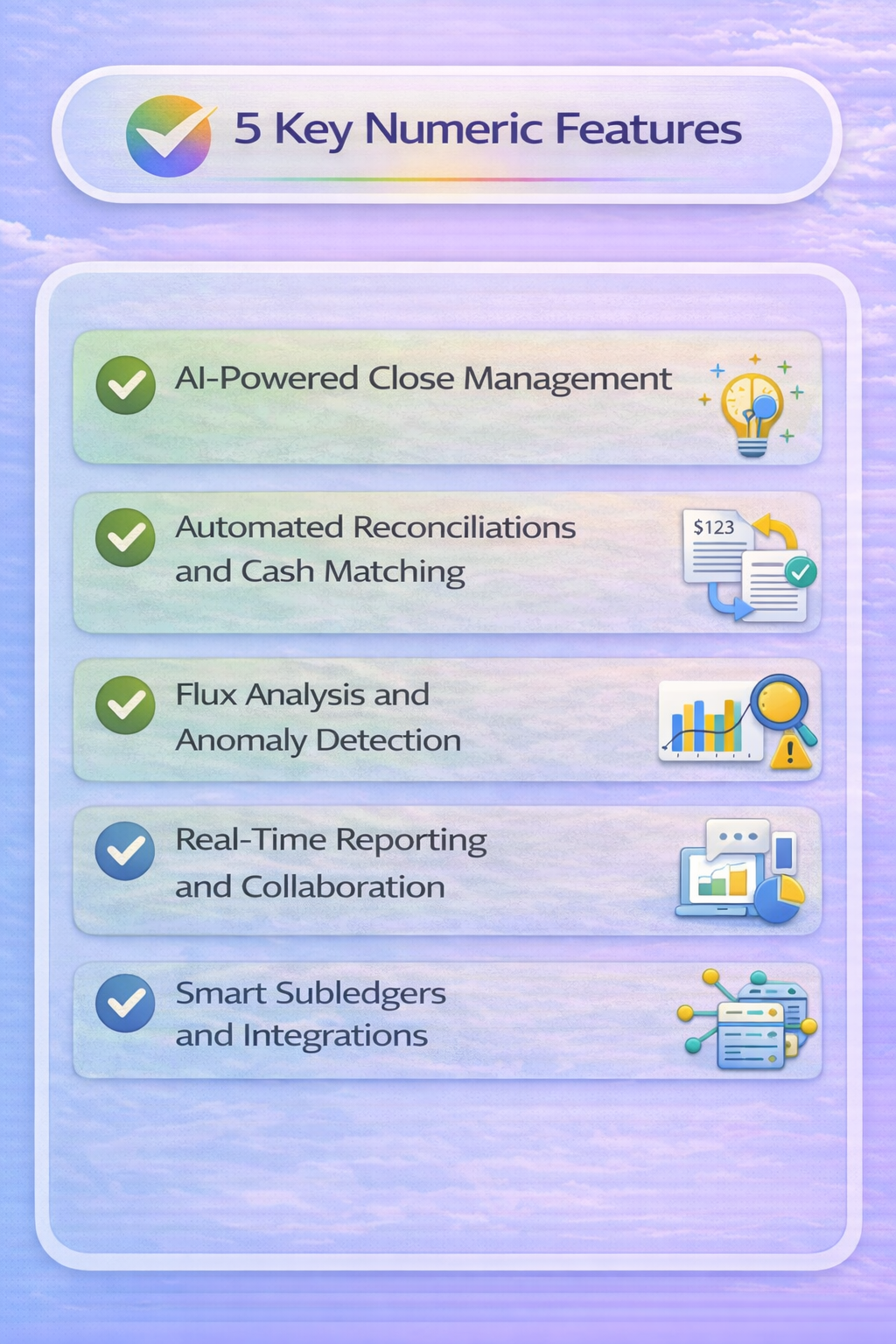
Here are the standout Numeric features that deliver value:
- AI-Powered Close Management
Numeric creates dynamic checklists, assigns tasks, and tracks progress in real-time. This ensures nothing slips through during month-end rushes. It automates recurring workflows and surfaces bottlenecks instantly, so treasury teams stay ahead.
- Automated Reconciliations and Cash Matching
The platform handles transaction matching with AI rules, automating a major part of cash reconciliations and generating journal entries for unmatched items.
- Flux Analysis and Anomaly Detection
AI drafts offer detailed explanations for variances and flag anomalies in general ledger data as they happen. This feature is helpful for card providers analyzing commission fluctuations or unexpected exposures.
- Real-Time Reporting and Collaboration
You can build custom dashboards, share insights securely, and collaborate via integrated tools without the need for email chains. Using Numeric, financial institutions get audit-ready reports with full traceability that are necessary for regulatory reviews.
- Smart Subledgers and Integrations
Numeric uses automated schedules to help you manage fixed assets, accruals, and more, while also connecting to bank feeds and ERPs for a single source of truth.
These features position Numeric as a solid choice for financial close software, but for banks and financial enterprises tackling millions of transactions, platforms like Osfin offer deeper scalability, along with format-agnostic data ingestion from more than 170 different integrations.
{{banner1}}
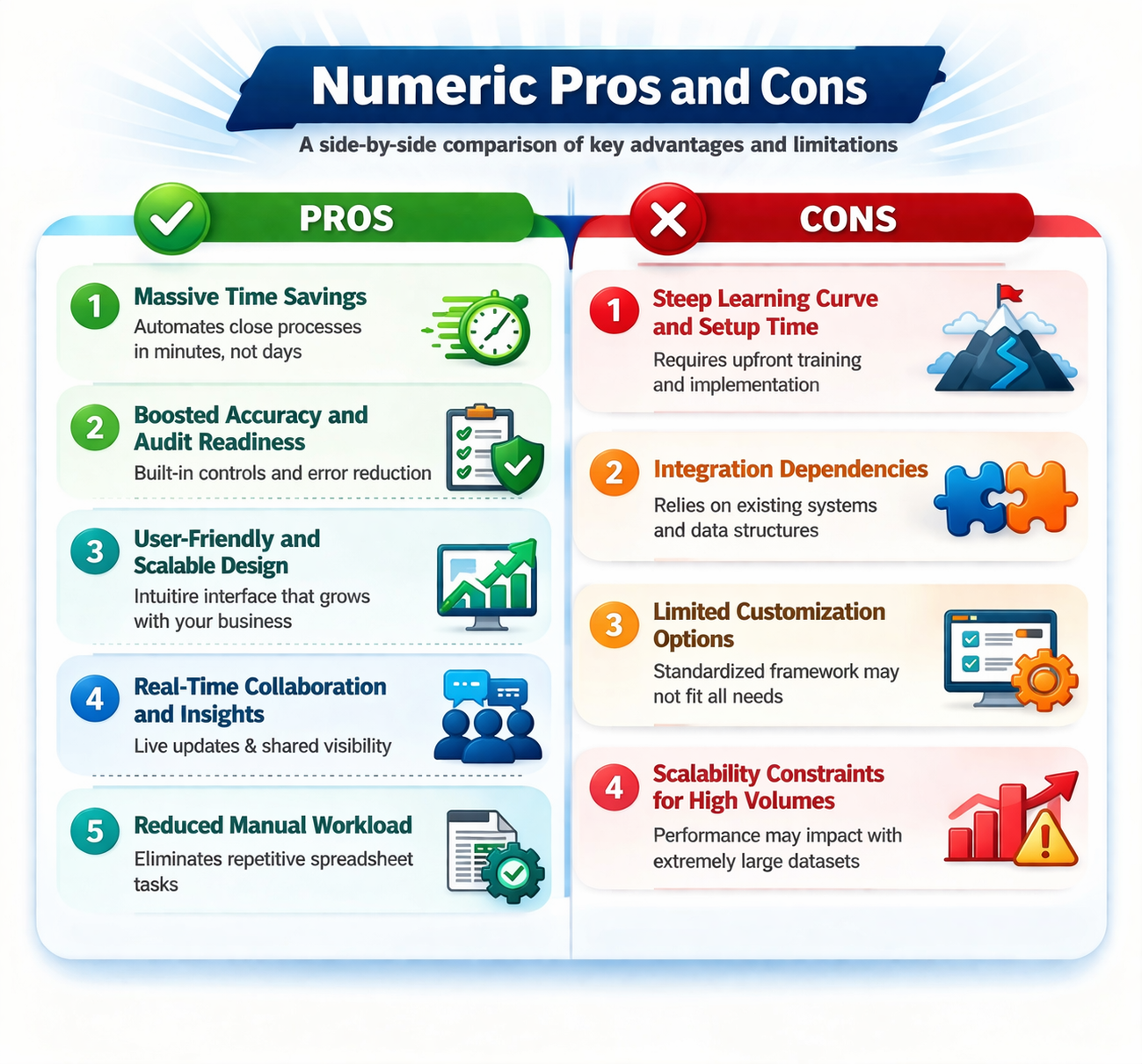
What are the Pros of Numeric?
Numeric’s AI-driven tools deliver real efficiency gains, slashing month-end close times and freeing up finance teams for strategic work. This helps them maintain compliance while scaling with growing transaction volumes. This makes it a smart pick for mid-sized fintechs and accounting teams.
Here are the top benefits that make Numeric a strong contender for financial close software:
- Massive Time Savings
Numeric automates a significant percentage of cash matching and drafts 80% of flux explanations with AI, cutting close cycles from days to hours. This makes it a good option for busy treasury services working under tight deadlines.
- Boosted Accuracy and Audit Readiness
Numeric’s real-time anomaly detection and full traceability ensure error-free reports, giving banks and financial institutions confidence during regulatory audits without scrambling for documents.
- User-Friendly and Scalable Design
The intuitive interface integrates seamlessly with ERPs like NetSuite and QuickBooks, scaling effortlessly as card providers handle more payment data without performance dips.
- Real-Time Collaboration and Insights
It also offers dynamic checklists, shared dashboards, and team assignments that keep everyone aligned, while custom analytics support leaders in financial institutions to spot bottlenecks and optimize workflows.
- Reduced Manual Workload
Numeric eliminates the use of spreadsheets by offering automated journal entries to smart subledgers. This lets finance teams focus on high-value analysis rather than repetitive tasks.
What are the Cons of Numeric?
While Numeric brings solid financial close automation, there are certain drawbacks to using it. These limitations can slow the adoption process and frustrate users expecting seamless out-of-the-box performance across diverse financial close software needs.
Here are the key Numeric cons based on user feedback:
- Steep Learning Curve and Setup Time
New users often face a challenging onboarding process to master AI features and workflows. This demands first-hand training for finance teams looking to implement Numeric in their financial workflow.
- Integration Dependencies
Numeric relies heavily on smooth ERP connections like NetSuite or QuickBooks. If this requirement isn’t fulfilled, it might cause friction for banks with legacy or mixed systems.
- Limited Customization Options
Early adopters report rigid setups that don't offer flexibility for complex, multi-entity structures or unique treasury requirements.
- Scalability Constraints for High Volumes
It handles moderate workloads well but struggles with an increasing number of transactions. It lacks deep real-time ERP integration for enterprise fintech demands.
{{banner3}}
What are Numeric’s Pricing Plans?
Pricing emerges as a key consideration when evaluating financial close automation options. Numeric operates on a tiered model without a free tier, starting from accessible entry points but scaling to custom quotes for advanced needs.
Here's a breakdown of Numeric's pricing plans based on available details:
- Essentials Plan ($30/user/month): Covers basic close management with dynamic checklists, task assignments, Slack integration, and AI assistance. It is ideal for smaller treasury services starting their automation journey.
- Growth Plan (Custom Pricing): Builds on Essentials with live ERP integrations (QuickBooks and Xero), auto-reconciliations, bank statement parsing, flux analysis, and CPA-led onboarding, perfect for growing financial institutions handling moderate volumes.
- Enterprise Plan (Custom Pricing): Includes everything covered in Growth with additional ongoing transaction monitoring, custom reporting, unlimited flux analysis, SAML security, live bank feeds, and cash management designed for banks and card providers on mature ERPs like NetSuite.
Exact costs beyond Essentials demand a sales quote, as pricing adjusts for team size, usage, and features, making it flexible yet less predictable upfront.
What are Some Use Cases for Numeric?
Finance teams at banks, financial institutions, card providers, and treasury services rely on Numeric for practical financial close automation solutions to common challenges like manual reconciliations and month-end delays. This Numeric review highlights specific use cases with real customer examples and industry applications that demonstrate its value.
Here are the top use cases where Numeric proves its value as financial close software:
- Month-End Close Orchestration for Fintechs
Companies like Brex use Numeric to automate checklists, task assignments, and progress tracking across distributed teams. This compresses close timelines by 33% while eliminating bottlenecks in high-transaction payment environments.
- Automated Cash Reconciliation in Treasury Services
Banks and treasury teams leverage auto-matching features for cash transactions against ERPs, generating journal entries for outliers. This is perfect for card providers reconciling bank feeds with GL data in real-time.
- Flux Analysis and Variance Explanations
Finance teams at Dailypay draft 80% of flux reports via AI, spotting anomalies instantly during closes. This saves hours on variance reviews for financial institutions prepping board-ready insights.
- Public Company Audit Preparation
Riskified (NYSE: RSKD) turned weeks of manual audit work into hours using Numeric's traceability, automated reconciliations, and documentation. Such aid proves to be beneficial for the listed fintechs under SEC scrutiny.
- ERP-Integrated Workflows for Mid-Sized Banks
You can integrate with NetSuite, QuickBooks, or Sage Intacct to centralize subledgers, accruals, and reporting. Plaid uses it to streamline multi-entity closes without spreadsheets.
Who Should Consider Numeric?
If you're a bank, financial institution, card provider, or treasury service struggling with slow month-end closes and scattered ERP data, Numeric could transform your financial close automation. You should consider Numeric if you’re:
- A Mid-Sized Fintech or a SaaS Firm: Growing teams that handle moderate transaction volumes will benefit from Numeric's task checklists and auto-flux analysis for scaling closes efficiently.
- A Public or Pre-IPO Company: Teams that are preparing for SEC audits, like Riskified, can use Numeric's traceability to convert manual processes into automated, board-ready reports.
- An ERP-Heavy Accounting Department: Financial institutions on NetSuite or QuickBooks can leverage seamless integrations for cash matching and variance insights.
- A Distributed Finance Team: Treasury services with remote collaborators can gain alignment through shared dashboards and communication platform integrations during quarter-ends.
- A Controller Seeking Visibility: Accounting managers who are tired of bottlenecks can choose Numeric for real-time progress tracking and AI alerts for predictable closes every month.
Who Might Need an Alternative?
If Numeric doesn't fully meet your needs as a bank, financial institution, card provider, or treasury service seeking advanced high-volume reconciliation, you may want to explore alternatives. Here's who benefits most from switching:
- High-Volume Transaction Banks: Institutions that process millions of payments daily exceed Numeric's matching depth and speed. This is when you need to look for platforms like Osfin that reconcile 30 million records in 15 minutes with logic-based, many-to-one handling at a 100% accuracy.
- Complex Reconciliation Fintechs: These include card providers dealing with commission splits, taxes, and fees that require auto-reconciliation of payment gateway reports. This is one of those areas where Numeric falls short because it lacks logic-based matching for many-to-one/one-to-many transactions and can't automatically break down complex payment structures.
- Format-Diverse Data Teams: Financial operations pulling from multiple non-standard sources (CSVs, PDFs, APIs) demand format-agnostic ingestion with data cleaning functionalities like custom deviation tolerances, duplicate detection, and normalization. These features go beyond Numeric's ERP focus.
- Enterprise Compliance Leaders: These are treasury services that require live dashboards for exception queues and automatic flagging of unmatched items with reasons. They also need SOC 2, PCI DSS-compliant workflows that promise audit-ready platforms with full traceability and 256-bit encryption.
- Scalable Multi-Entity Groups: Banks with global, multi-currency operations seek ticketing systems that route exceptions to stakeholders, unlike Numeric's collaboration tools, which prioritize task checklists over operational precision.
Numeric vs Modern Reconciliation Platforms
In this Numeric review, we compare Numeric's financial close automation to modern reconciliation platforms, highlighting key differences for banks, financial institutions, card providers, and treasury services focused on high-volume matching. While Numeric excels in month-end coordination with AI checklists and ERP integrations, specialized platforms like Osfin provide superior speed, 100% accuracy, and finance-tailored workflows for complex payments.
Here's how Numeric stacks up against modern reconciliation platforms:
Why are Fintechs Choosing Osfin Over Traditional Enterprise Suites?
Fintechs, banks, financial institutions, card providers, and treasury services are rapidly shifting from bulky traditional enterprise suites to agile platforms like Osfin for their financial close automation and reconciliation needs. These modern organizations require speed, scalability, and seamless integrations. This matches Osfin's purpose-built design, which gives your finance team a natural, reliable upgrade over rigid enterprise tools.
Here are some reasons why fintech platforms opt for Osfin:
- Superior Data Ingestion
Osfin is a file format-agnostic platform and supports more than 170 integrations from banks, ERPs, credit card networks and payment gateways, importing data regardless of format (CSV, PDF, API). It also standardizes data files, applies custom deviation tolerances to filter poor-quality data , and detects duplicates and outliers before reconciliation begins.
- Lightning-Fast Reconciliation
Osfin uses logic-based matching to handle many-to-one, one-to-many, and multi-way reconciliations (two-way, three-way, four-way, and five-way). It also auto-reconciles payment gateway reports with commission, tax, and fee breakdowns. Osfin processes 30 million records in 15 minutes with 100% accuracy.
- Smart Exception Handling
All unmatched transactions are automatically flagged with precise reasons and escalated and routed to the right team member for review and resolution. This happens due to Osfin's dedicated ticketing and exception-handling engine. Osfin also offers live dashboards that provide real-time views of match status, exposure risks, and exception queues, so all operations decisions can have hard data to back them up.
- Secure, Audit-Ready Outputs
Osfin delivers comprehensive compliance reports while maintaining fully traceable, audit-ready workflows with complete transaction history. All your transaction data stays protected via 256-bit encryption, role-based access controls, and two-factor authentication, fully complying with multiple regulatory standards like SOX ,PCI DSS, ISO 27001, and GDPR.
Final Thoughts
Numeric delivers quality financial close automation for banks and other financial institutions that manage a moderate amount of month-end workflows and ERP integrations. It offers reliable AI-driven capabilities in task checklists, cash matching, and flux analysis that help your finance team significantly reduce close times and boost collaboration without heavy overhauls.
That said, Numeric often requires custom ERP setups and struggles with high-volume transaction matching for complex fintech needs. So if you're dealing with millions of payments daily that demand faster and 100% accurate reconciliations, you might need more precise tools like Osfin that save you this hassle.
Osfin’s format-agnostic ingestion with more than 170 integrations pulls data from multiple sources, cleans it with deviation tolerances, and spots duplicates early. That’s why fintechs often choose Osfin for precision and scalability.
Ready to transform your reconciliation process? Book a demo with Osfin for better accuracy and speed.
FAQs
1. Is Numeric suitable for fintech companies?
Yes, Numeric works well for fintechs with moderate transaction volumes and ERP systems like NetSuite. It helps you automate close checklists and flux analysis efficiently. However, if you handle millions of complex payments daily, you'll likely need Osfin's scalable reconciliation for 100% accuracy.
2. Does Numeric offer real-time reconciliation?
Yes. Numeric provides real-time transaction monitoring and AI alerts, letting you spot anomalies quickly during closes.
3. How much does Numeric cost?
Numeric starts at $30/user/month for Essentials, with Growth and Enterprise plans requiring custom quotes based on your team size and features. You'll need to contact sales for exact subscription pricing, which is tailored to your company’s needs.
4. What are the best alternatives to Numeric?
The top alternatives for Numeric include Osfin for high-volume accuracy, FloQast for workflow orchestration, and BlackLine for automating enterprise operations. If you need format-agnostic reconciliation from across multiple sources, Osfin is the perfect option for you, considering its speed,100% accuracy, and compliance features.
5. Is Numeric good for mid-sized businesses?
Yes. Numeric is a good option for mid-sized businesses that use QuickBooks or NetSuite for streamlining month-end closes with AI automation and collaboration tools. You can scale moderately, but if you are looking for high transaction growth, then Osfin might be a better choice.