HighRadius Pricing: Cost & Plans Explained
If you're evaluating finance tools, chances are you've come across HighRadius. It's a well-established platform that covers a lot of financial operations. But the real question isn't whether HighRadius is a good product. It's whether it's the right product for what your business actually needs.
Here, we’ll dissect HighRadius, find out its pricing, where it works, and where you’re better off using an alternative.
What is HighRadius?
HighRadius is a financial platform that automates and manages a bunch of financial operations using its various AI-powered offerings. The platform has a focus on simplifying tasks like order-to-cash, treasury management, accounts payable, and record-to-report.
What Can You Do with HighRadius?
HighRadius is not confined to any specific function. Instead, it caters to various financial needs of organizations, such as:
- Order to Cash: With HighRadius, you can handle things like collections, credit checks, cash application, invoicing, and deductions.
- Accounts Payable: On the payable front, it captures and processes incoming invoices, matches them against purchase orders, manages supplier onboarding, and handles vendor payments.
- B2B Payments: HighRadius also has a B2B payments module that handles how businesses accept and process payments from other businesses.
- Treasury and Risk: For treasury teams, it covers cash management, cash flow forecasting, and treasury payments. Basically, it helps organizations keep track of where their money is across bank accounts, predict future cash positions, and execute payments.
- Close and Reconciliation: The platform also manages close checklists along with handling accruals, reconciling balance sheets, matching daily revenue, and sorting out intercompany transactions between entities.
- Reporting: For organizations with multiple entities, it handles pulling together financial data across all of them. And dealing with things like currency conversions, intercompany eliminations, and charts of accounts mapping across different subsidiaries. Then, it generates statutory and management reports, as well as custom reports, from that consolidated data.
HighRadius Pricing Details: What We Know
Unfortunately, there’s not much that we know about HighRadius’ pricing. The platform has not publicly disclosed its exact prices and tiers. But we know that it uses a subscription-based SaaS pricing model that lets you pay-as-you-go. There’re no upfront licensing costs, and the subscription covers servers, storage, and infrastructure.
Beyond that, no actual numbers are published anywhere. Their pricing is listed as "contact for pricing." Meaning it's custom-quoted, likely based on the modules you pick, number of users, transaction volume, and company size.
{{banner1}}
Pros and Cons of HighRadius
To glean what the strengths and weaknesses of HighRadius are, we combed through various review platforms and pulled out what users mention most often:
HighRadius's strengths
- Automates repetitive AR tasks like cash application, collections, and customer communications.
- Easy to navigate for non-technical finance users.
- Keeps invoices, open AR, and credit hold status all in one place.
- Users like that workflows and reports can be customized to match how their teams work.
HighRadius's weaknesses
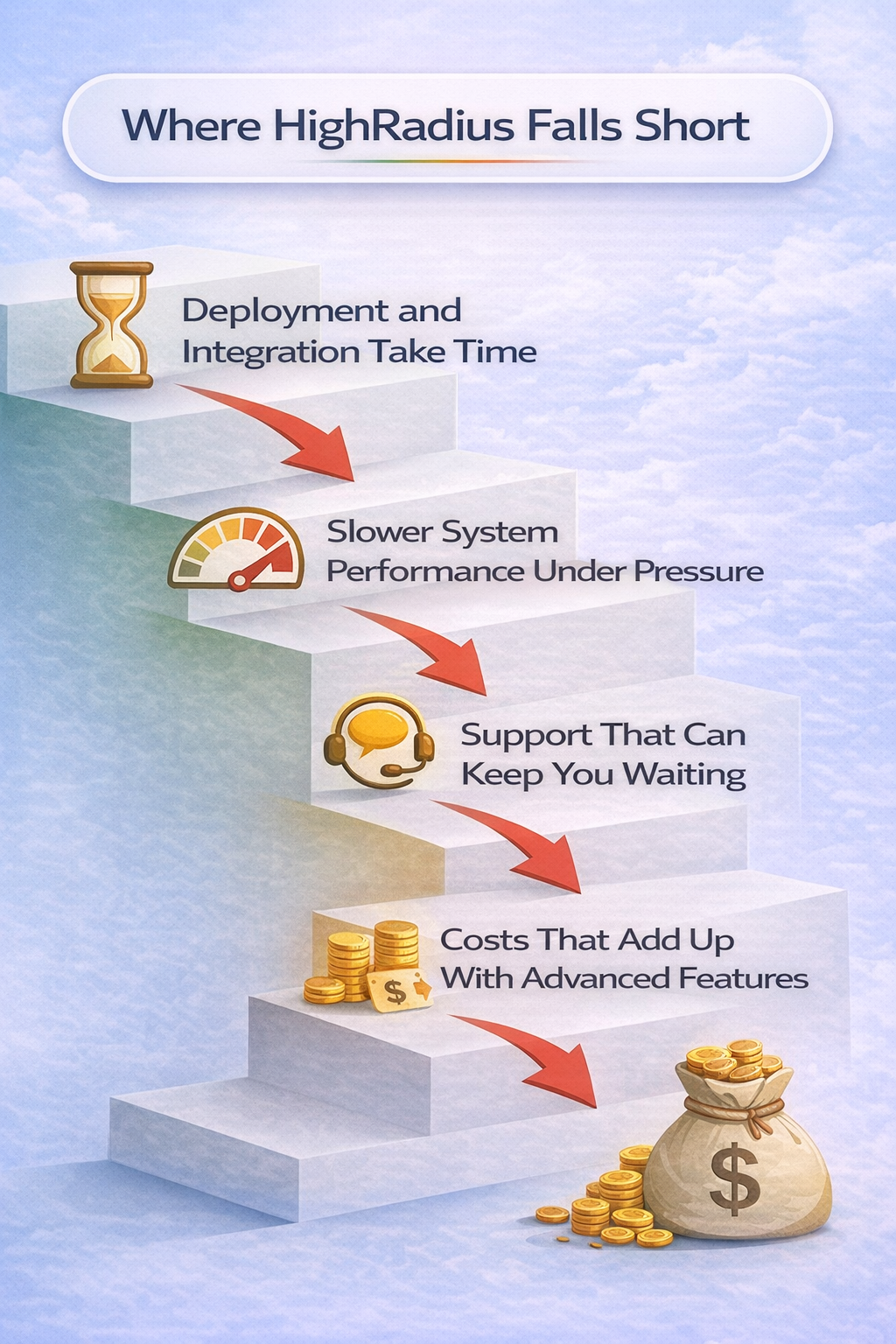
- Several reviewers note that deployment and integration with existing systems can take time and require significant effort.
- Users occasionally report slower system performance when searching or processing large volumes of transactions.
- Some users mention delays or challenges in resolving issues through support channels.
- Pricing can be high for some organizations, with extra charges for things like adding new currencies.
When Should You Reconsider HighRadius?
HighRadius has its strengths, but it’s not built for every organization. Depending on your priorities, there are certain situations where the platform may feel limiting or unnecessarily complex, such as when:
- Your team needs to move fast: Users often mention long implementation timelines and a steep learning curve. Many also say they need HighRadius’s team to make changes that ideally should be self-serve. If you don’t have months to spend on setup, this can slow things down.
- Reconciliation is your core: The platform covers a lot of ground: AP, treasury, close, reporting. But, if what you actually need is deep, high-volume reconciliation, you're paying for a lot of features you won't use.
- You need more integration coverage: The software works well with large ERPs, but if your setup includes other sources like payment gateways, banks, internal databases, or industry-specific tools, the integration options may feel limited.
{{banner3}}
A Better Alternative: Osfin for Product-Led Growth
Osfin is a financial reconciliation platform built for teams that handle high volumes of transactions and can't afford errors, delays, or manual work slowing them down. It focuses on the part that causes the most day-to-day pain – reconciliation - and automates it end-to-end.
How Osfin Delivers Greater Value
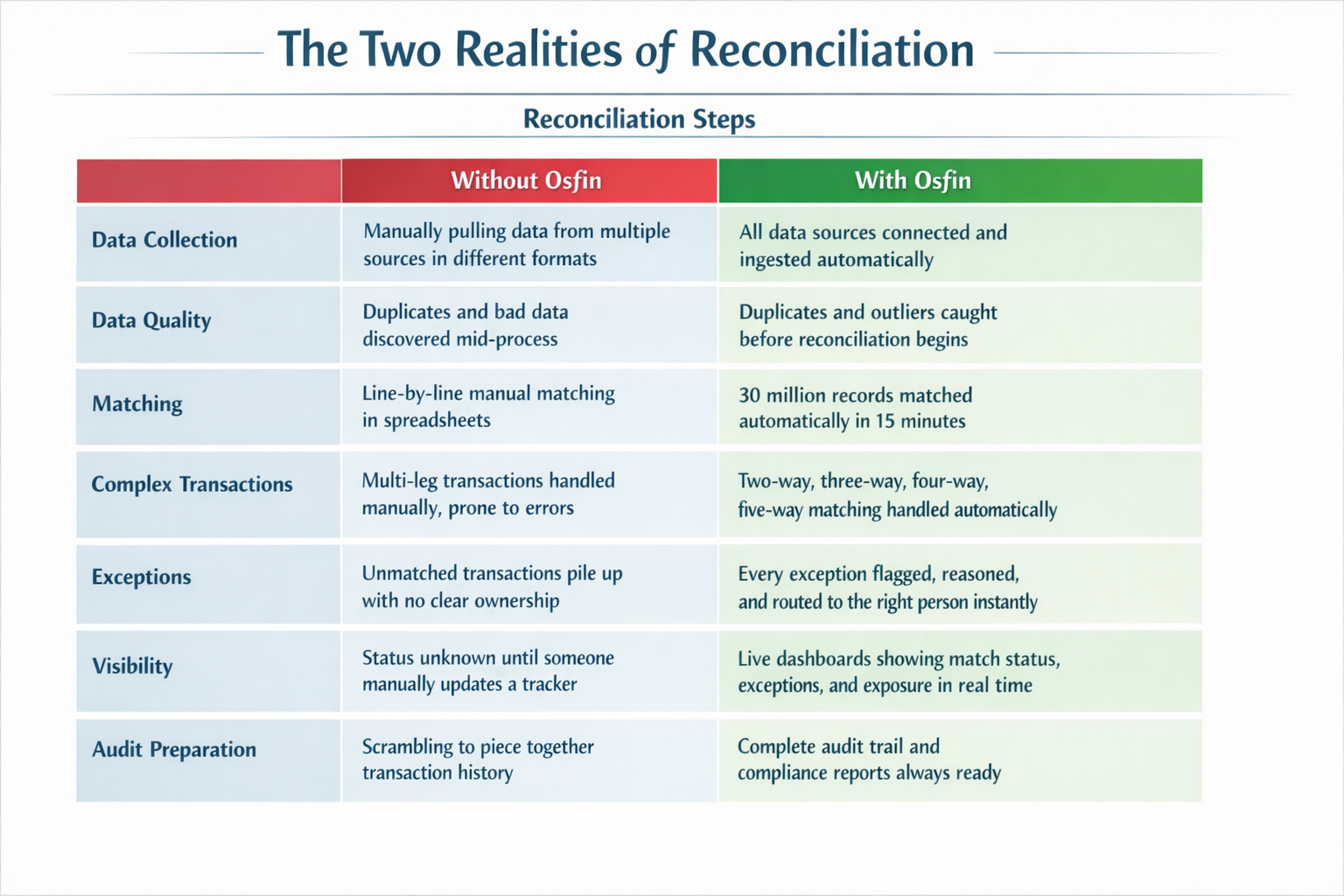
Osfin takes a different approach towards reconciliation. Instead of bundling it into a larger suite, Osfin puts it front and center. It handles the volume your business runs at. And being a low-code platform, it helps your team configure workflows and adapt to changes without raising a ticket or waiting on a vendor.
Not just your ERP, Osfin plugs into any number of data sources you work with, so wherever your transaction data lives, Osfin can pull it in and reconcile it.
Here's what that actually means in practice:
Bring in data from anywhere, in any format
Osfin is file format agnostic, meaning it can pull in data from virtually any source, through 170+ pre-built integrations spanning CBS, payment gateways, ERPs, payment switches, POS systems, internal databases, and more. Not just source, it can pull data in any format, such as MT940, ISO 20022, BAI2, XML, CSV, TXT, or JSON.
Before reconciliation even begins, Osfin applies custom deviation tolerances to filter out poor-quality data, and automatically detects duplicates and outliers at the point of ingestion. So by the time your data hits the matching engine, it's already clean.
Match transactions the way they actually happen
Osfin's matching engine handles many-to-one, one-to-many, and multi-way reconciliations across two-way, three-way, four-way, and five-way, using logic-based matching rules you define. It auto-reconciles payment gateway reports, complete with commission, tax, and fee breakdowns.
Keep track of everything
When something doesn't match, Osfin automatically assigns an accurate reason to each unmatched transaction. And routes it to the right team member through a built-in ticketing and exception handling engine. Moreover, live dashboards show match status, exposure, and exception queues in real time, so your team always knows exactly where things stand.
Walk into every audit fully prepared
After the reconciliation, the platform delivers compliance reports and maintains audit-ready workflows with complete transaction traceability and history. Data is secured with 256-bit encryption, maker-checker flows, role-based access, and two-factor authentication. The platform also complies with SOC 2, PCI DSS, ISO 27001, and GDPR, so whether you're preparing for an audit or satisfying a regulator, you're covered.
Choose what truly serves your growth!
There’s no denying that every organization works in a different way and has unique needs. It’s not necessary that what works for one is bound to work for another.
The platform you choose to go for should be based on your specific requirements and workflows. For large enterprises with the budget, the timeline, and the IT bandwidth to support it, HighRadius does the job.
But that’s not every business.
If your team is spending too much time chasing unmatched transactions, stitching together data from five different sources, or waiting on a vendor to make a configuration change, that's not a tool working for you.
Osfin keeps it simple and fast. Bring your data in from anywhere, match it at scale, catch what doesn't fit, and walk out with a clean audit trail. No bloated suite and no months-long setup.
{{banner1.1}}
FAQs
1. What is HighRadius used for?
HighRadius is made for mid to large enterprises. It helps corporate finance teams handle processes such as order-to-cash, accounts payable, treasury management, B2B payments, financial close, and reporting.
2. What are the main complaints users have about HighRadius?
Mostly, HighRadius users flag a steep learning curve, long implementation timelines, limited self-service configuration, a clunky support ticketing system, and pricing that can get expensive as you add features or currencies.
3. How is Osfin different from HighRadius?
Osfin is built exclusively around reconciliation, which means every feature, every integration, and every industry use case is designed with that one problem in mind. It also serves a wider range of industries and connects to more data sources out of the box.
4. Can Osfin handle large transaction volumes?
Yes. Osfin can process up to 30 million records in just 15 minutes. That makes it well-suited for teams dealing with high-frequency, high-volume transaction environments like payments, gaming, or capital markets.