B2B Payments: Methods, Process & Trends (2026 Guide)
TL;DR:
B2B payments are payments made from one business to another. They are usually larger and more complex than normal consumer payments. Businesses use different methods like bank transfers, credit cards, digital wallets, etc.
However, managing B2B payments at scale can be difficult. Errors, duplicate payments, delays, and fraud can create serious problems. Manual processes further slow things down.
Automation solves these problems. It reduces manual work, lowers costs, prevents mistakes, and improves cash flow visibility. AI tools can also detect fraud and unusual transactions early.
Real-time payments, API integrations, and virtual cards are some emerging trends in B2B payments.
What are B2B Payments?
B2B payments are simply payments made by one business to another for products or services. They can either be a one-time transaction or recurring, depending on the agreement between the buyer and the supplier.
What sets B2B payments apart from standard consumer payments is complexity. When you buy something as an individual, the transaction usually settles on the spot. However, B2B payments don't work that way.
Approvals take time.
Settlement can stretch across days or even weeks.
Multiple people on the accounts payable team may need to sign off before a payment goes out.
And on the receiving end, the supplier has to match that payment to an invoice and reconcile it in their accounting system.
The stakes are also higher. B2B transactions typically involve much larger sums than consumer purchases, and the smallest error can disrupt the entire supply chain. To make things easier, businesses use a range of tools and systems for managing these transactions.
Why B2B Payments Matter in Enterprise Environments
Large enterprises process payments at high volumes. This means small problems can snowball quickly. An error that would take just a few minutes to fix in a small business can take hours to sort out when it shows up across hundreds of transactions.
In enterprise environments,
1. Payment Errors Compound Quickly
When you’re dealing with a large number of payments, even a small difference between the payment amount and the invoice can slow everything down. Each mistake has to be checked, matched, and fixed. At scale, this is not only tedious but also expensive.
2. Multi-Rail Systems Create Reconciliation Gaps
Many enterprises don't rely on one payment method. They use wire transfers, ACH, credit cards, and international payment networks - sometimes all at the same time. However, each method shares information differently, which can make it difficult to track what has been paid and what is still due.
Read more: ACH vs Wire Transfer: Differences in Cost, Speed, and Use Cases
3. Manual Controls Increase Audit Risk
Traditional payment methods like cheques and wire transfers involve more manual handling. This increases the risk of something going wrong. If you still use manual processes, you may face more risks when it comes to following regulations and keeping your financial records accurate.
4. Delayed Reconciliation Hits Working Capital
If your team cannot match payments quickly, you won’t know how much money you actually have. This makes budgeting confusing and financial decisions less confident. To manage your cash properly, you need a clear view of what's coming in and going out.
{{banner1}}
B2B Payment Methods
You can manage B2B payments using multiple methods. In fact, most businesses offer several payment methods to customers for more flexibility and convenience. Some popular methods include:
1. Bank Transfers (ACH, RTGS, Wire Transfers)
Bank transfers are one of the most common ways businesses pay each other. However, not all bank transfers work the same way.
- ACH Payments
They move money between U.S. bank accounts through the automated clearing house (ACH) network. They are ideal for recurring payments. However, ACH transfers don't process on weekends, holidays, or outside business hours, so they're not ideal when you need funds to move fast.
- Wire Transfers
These work differently. They move money electronically through global networks like SWIFT or Fedwire, and can be used for cross-border transfers. Settlement usually happens within two business days. However, banks generally levy a flat fee of $15 to $50 per wire, which can add up quickly.
- RTGS (Real-Time Gross Settlement)
This method is designed for high-value transactions that need to move immediately. In India, RTGS is specifically used for transactions of Rs. 2 lakh or more.
2. B2B Credit Card Payments
Credit cards are simple to use and widely accepted. They offer security, convenience, and often rewards or purchase protection.
That said, they come with costs. For example, merchant fees can be quite high, which is why not every business accepts cards. However, if payment amounts change month to month, or if a vendor requires immediate payment, credit cards are often the most practical option. They also give you more control over spending compared to methods like ACH or EFT.
3. Digital Wallets and Mobile Payments
Digital payment platforms, like PayPal, Wise, Google Pay, and Apple Pay, are linked to a bank account, debit card, or credit card and can be used to send and receive payments quickly. Some even support international transactions, which makes them useful for cross-border B2B payments.
They are faster than wire transfers. However, fees can vary for each platform, so compare costs based on how often and how much you pay.
4. Electronic Payment Systems
Electronic Funds Transfers (EFTs) cover different categories, including ACH payments, credit and debit cards, corporate cards, and wire transfers. The right method depends on:
- The size of the transaction
- How quickly does it need to arrive
- How much security is needed
- Embedded Lending in B2B Systems
Third-party financing is a growing option in B2B payments. Instead of paying a supplier, you can use a bank or financial institution to finance the purchase.
This kind of embedded lending is ideal when you're dealing with large transaction sizes and longer payment cycles.
B2B Payment Processing Infrastructure
No matter which payment method you offer, you need a solid infrastructure to process all online payments securely. Depending on the method, you can opt for:
1. Payment Gateways
A B2B payment gateway is the technology that connects the paying business to a secure payment processing system. Simply put, it sits between your website and the payment processor to transmit transaction data securely.
You can connect a payment gateway using an API. When a buyer is ready to pay, they see the available payment options and the gateway routes that data to the right parties: the acquirer, card scheme, processor, and others involved in completing the transaction.
2. Payment Processors
While the gateway links the business and the processing system, the payment processor is what actually moves the money. It transmits payment data between the customer's bank and your bank.
Some popular B2B payment processors include CyberSource, Moneris, PayPal, and ChasePaymentTech.
3. ERP-Integrated Payment Platforms
An ERP (Enterprise Resource Planning) system manages a wide range of business data - accounting, inventory, procurement, etc. When you integrate your ERP with a payment platform, payment data flows automatically between the two systems. This means you don't need to enter information or sync data manually.
Every time a payment is processed, the ERP updates instantly.
4. Multi-Rail and Cross-Border Complexity
A multi-rail payment strategy gives you access to more than one payment network to complete a transaction. For example, say a Spanish business is paying suppliers both in Germany and the UK. For the German supplier, it might use SEPA or SWIFT. For the UK supplier, Faster Payments Service (FPS) would be more practical.
Remember, if you are operating across multiple countries, managing different rails can be complicated. This is because every country has its own rules, processing times, and fees.
B2B Payments in eCommerce you're running a B2B eCommerce platform, you need to ensure your payment setup aligns with an online environment. The good news is that most traditional payment structures can be digitized without losing flexibility. For example,
1. Purchase Orders
A customer sends you a formal authorization to purchase specific goods at a specific price. Once you accept it, it becomes a binding contract. You can even digitize this process so orders only enter the system once the purchase order has been confirmed.
2. Bank Transfers
You can automate payments through bank transfers as well. This way, the system can hold the order until the transfer is received. This removes the need for manual follow-up and keeps the process moving.
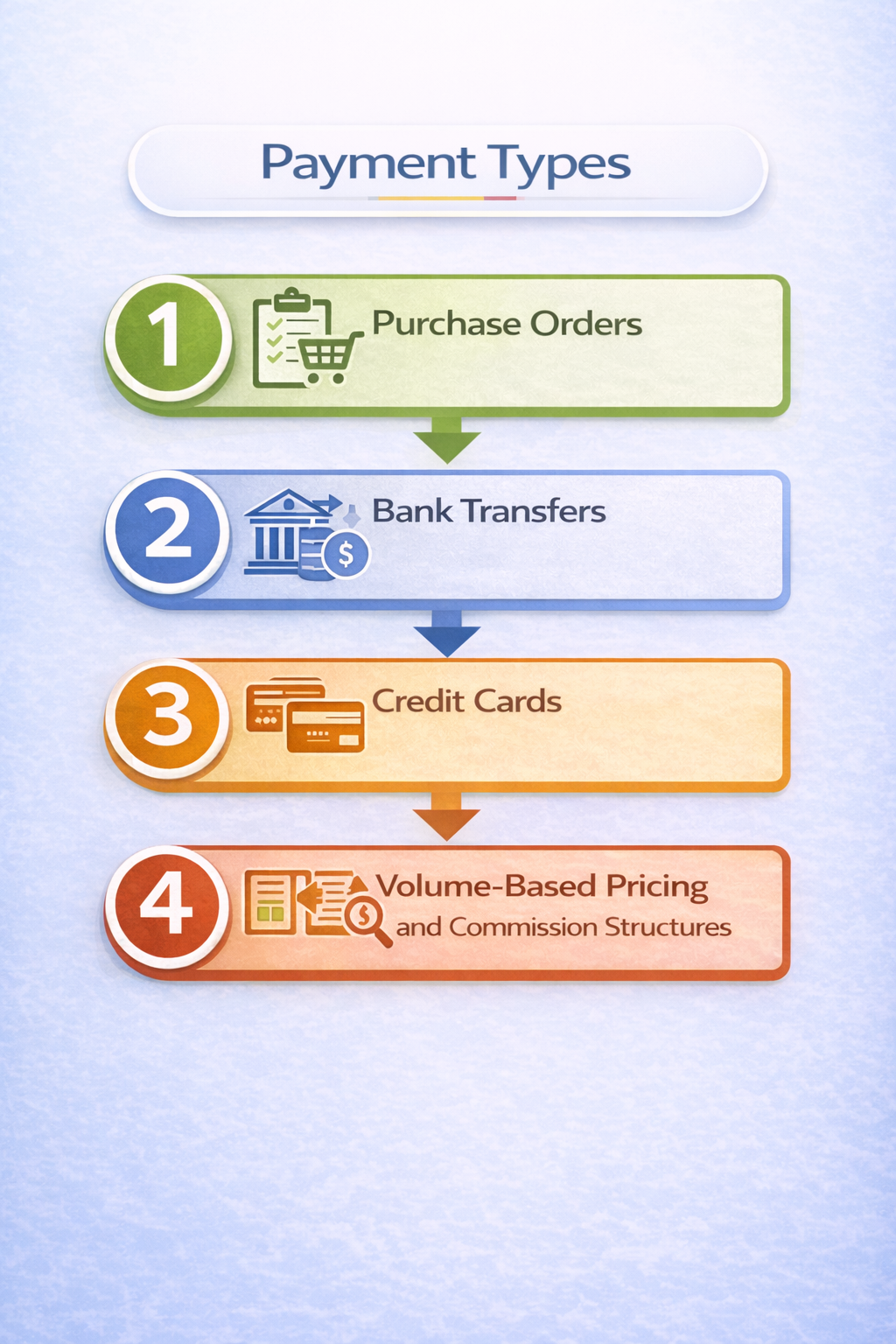
3. Credit Cards
While credit cards may look like the simplest options, they come with risks for B2B eCommerce. For example, chargebacks. A buyer can dispute a charge, and you may be left stranded while the dispute is resolved. So, make sure to have appropriate safeguards in place to protect against fraud.
4. Volume-Based Pricing and Commission Structures
B2B pricing isn't always linear. Buyers may get different rates based on order size, their relationship with the supplier, or the terms of a marketplace agreement. So, evaluate eCommerce platforms carefully depending on how well they handle flexible pricing.
Trends in B2B Payments (2026 Outlook)
The way businesses pay each other is changing fast. As we enter 2026, several new trends are reshaping the B2B payment infrastructure.
1. Real-Time Payments
Real-time payments are becoming the norm. In the US, 125 million transactions were processed in the last quarter of 2025 alone. Unlike traditional ACH, which can take days to settle, real-time payments move money instantly, giving you more control over cash flow.
2. API-Driven Ecosystems
API-based payment systems give you more control over how payments and financial services fit into your daily work. Instead of using separate tools that don’t connect well, you can link payments, cash management, and other financial tasks directly into your existing systems.
3. Embedded Finance
Open banking regulations and API standardization are pushing embedded finance further into the mainstream. This can make it easier for you to offer built-in financial services without building them from scratch.
4. AI-Based Fraud Detection
These systems monitor patterns continuously. For example, say a business that typically pays suppliers in one region suddenly initiates a large transfer to an unfamiliar location. The system will flag it before the money moves. For international payments, AI also factors in things like transaction history, payment corridors, and sanctions.
5. Virtual Cards
Currency volatility and supplier diversity are increasing by the day. Virtual cards let you set dynamic spending limits for individual vendors, reducing unauthorized spend. They also give you tighter control over outgoing payments.
6. Automated Payment Workflows
Automated payment workflows reduce the manual tasks that slow teams down. They cut errors, speed up payment cycles, reduce labor costs, and give you real-time visibility into what's been paid and what's outstanding.
7. Continuous Reconciliation
Instead of reconciling payments at the end of a period, automated systems now do it in real time. They flag discrepancies as they happen rather than days later when they're harder to resolve.
Automation in B2B Payments
Manual payment processes are slow, error-prone, and hard to scale. Automation addresses all three.
1. Automated Payment Initiation
If you have ongoing supplier or vendor relationships, payment initiation doesn't need to be a manual task every time. You can simply set up automated systems to initiate recurring payments on a fixed schedule.
Once the rules are in place, the system takes care of it. This is especially useful for predictable, high-volume payment cycles where the amounts and recipients don't change much.
2. Approval Workflow Automation
If you have a manual setup, invoices might pass through several people's hands before they get approved and paid. That takes time. Plus, each new handoff increases the chances of delays or errors.
Automated approval workflows make this easier. Instead of passing invoices around, the system sends them to the right people automatically.
3. Real-Time Exception Monitoring
Not every payment goes through smoothly. Amounts don't match, invoices are missing details, or a payment gets flagged for an unusual pattern. In a manual process, these issues can sit undetected for days.
Automated systems flag exceptions as they happen. This means you can act quickly rather than discovering problems after the fact.
4. Payment-to-Invoice Reconciliation
Reconciliation is one of the most time-consuming parts of B2B payments. Matching payments to invoices across different methods, formats, and systems can be challenging.
Automated reconciliation software automatically matches incoming payments to outstanding invoices regardless of the payment method used. Intelligent matching handles complex scenarios, too. For example, one payment covering several invoices, or several smaller payments clearing one big invoice.
Common B2B Payment Risks
B2B payments usually involve large amounts of money, many people, and several steps. If they are not managed carefully, they can lead to risks such as:
1. Fraud and Cyber Threats
Phishing scams, account hijacking, invoice fraud, and payment fraud all target B2B transactions because they usually involve large amounts. Even a single fraudulent payment can leave you with serious financial and reputational damage.
2. Duplicate Payments
Duplicate payments are very common. Fraudsters sometimes submit fake invoices for goods that were never delivered.
However, duplicates can also be accidental. For example, a vendor may submit the same invoice twice, or a payment gets processed more than once due to a system error. Without automated duplicate detection, these can slip through and go unnoticed for weeks.
3. Incorrect Routing
Outdated or incorrect account details can cause payments to fail. Or worse, land in the wrong place. Chasing suppliers for corrected details across time zones can add to the hassle.
Not to mention that every failed payment comes with real costs:
- FX losses
- Reprocessing fees
- Extra reconciliation work
- Strained vendor relationships
4. Settlement Delays
Traditional rails like ACH don't guarantee that a payment will clear at the time it's initiated. On top of that, failure notifications can take days to arrive.
With real-time payment systems, banks can confirm success or failure within seconds. This ensures a much faster resolution when something goes wrong.
5. Manual Reconciliation Errors
Matching transactions can be difficult when you’re handling a large number of payments. It puts extra pressure on your team and takes up time they could spend on more important work.
Not to mention it leaves the door open for mistakes and oversights, which can land you in deep financial trouble later.
6. Regulatory Exposure
If your business operates in different countries, you must follow local rules. For example, AML laws, KYC requirements, and data protection regulations.
Not complying with them can lead to financial penalties and cause reputational damage.
Measuring B2B Payment Performance
To see whether your B2B payment process is running smoothly, you should track a few important numbers. These include:
1. Days Payable Outstanding (DPO)
DPO measures the average number of days a business takes to pay its suppliers after receiving an invoice. A high DPO can indicate that a business is holding onto cash longer. It can also signal that payments are getting stuck somewhere in the process.
2. Reconciliation Timeliness
This measures how quickly your team can match payments to invoices and close out records. Delays in reconciliation mean delays in knowing your actual financial position. Therefore, your payment tools should be able to recognize payments received, match them to the corresponding revenue, and automatically generate journal entries.
3. Processing Cost Per Transaction
B2B payment processing isn't free. You're typically paying a mix of interchange fees, assessment fees, markup fees, and possibly a monthly flat fee depending on your processor and payment volume. Tracking cost per transaction can help you understand if your current setup is cost-effective.
4. Cross-Border Fee Leakage
International payments come with additional layers of cost that aren't always visible upfront. For example,
- Banks may charge a percentage of the transaction per payment.
- You might have to bear a 1% to 3% FX cost.
- Longer settlement timelines can lock up your capital, exposing you to currency fluctuations.
- Reprocessing fees from failed payments.
- Compliance fees.
Tracking this fee leakage can help you understand what international payments are actually costing you.
How Enterprise Reconciliation Infrastructure Strengthens B2B Payments
If you are handling high transaction volumes across multiple payment rails and entities, reconciliation can't be an afterthought. You need to build it into the payment infrastructure from the start. That's where platforms like Osfin come in.
Osfin is an enterprise SaaS reconciliation automation platform that helps you handle the scale and complexity that comes with large B2B payments. Here's how it works:
- Data Ingestion
Osfin is file format agnostic. This means it doesn't require your data to arrive in a specific file type or structure. It standardizes the data so it can be reconciled consistently. With over 170 integrations, Osfin pulls in payment data from multiple sources automatically. It also applies custom deviation tolerances to filter out poor-quality data and detects duplicates and outliers.
- Reconciliation Process
Osfin handles one-to-many, many-to-one, and multi-way reconciliations. This includes two-way, three-way, four-way, and five-way matching. The platform can process 30 million records in 15 minutes, and automatically reconciles payment gateway reports.
- Exception Handling
When transactions don't match, Osfin assigns an accurate reason. Then, it routes it to the right team member through a built-in ticketing and exception handling engine. It gives you access to live dashboards that show match status, financial exposure, and exception queues in real-time.
- Output
Osfin delivers compliance reports and maintains audit-ready workflows with complete transaction history. It uses 256-bit encryption, maker-checker flows, role-based permissions, and two-factor authentication to secure data. The platform complies with SOC 2, PCI DSS, ISO 27001, and GDPR requirements.
{{banner1.1}}
FAQs
1. What are B2B payments?
B2B payments are simply payments made by one business to another for products or services. These payments can be one-time or recurring, depending on the agreement.
2. What are the most common B2B payment methods?
Some common B2B payment methods include bank transfers, credit cards, ETFs, digital wallets, and embedded lending.
3. How does B2B payment processing work?
B2B payment processing moves money securely from one business to another. The buyer first chooses a payment method. A payment gateway securely sends the payment details. The payment processor then transfers the funds between banks, and the supplier receives the payment.
4. What is a B2B payment gateway?
A B2B payment gateway securely connects a business to the payment processing system. It works like a bridge between the company’s website or platform and the bank to safely process payments.
5. How do B2B payment platforms reduce costs?
B2B payment platforms lower costs by reducing manual work and preventing duplicate payments. They also help catch errors early and speed up approvals.
6. What is the role of reconciliation in B2B payments?
Reconciliation ensures all payments match the correct invoices.
7. Are B2B credit card payments common?
Yes, B2B credit card payments are common. They are easy to use and offer rewards and purchase protection.
8. Can automation reduce B2B payment fraud?
Yes, automation can reduce B2B payment fraud risk. AI-based systems track patterns and flag unusual transactions.