Transaction Matching Using AI: A Smarter Way to Reconcile
Finance teams often spend hours sifting through records, looking for errors, and validating data scattered across multiple sources to meet the month-end close deadline. More than being tedious, managing these tasks manually also lead to:
- Wasted time
- Increased risk of errors
- Delays in financial reporting
It doesn’t come as a surprise that finance teams spend more than 44 hours a week fixing discrepancies.
Transaction matching using AI is the one solution to all these problems.
But what does it mean, and how can you implement it? We’ll answer these and more in this article.
What is Transaction Matching Using AI?
AI transaction matching helps finance teams match transactions across multiple financial records using artificial intelligence. It goes beyond just exact matches like amounts or reference numbers and looks at patterns, context, and probabilities. This helps determine if the two entries represent the same transaction.
It runs on three core technologies:
- Machine Learning: To learn from past matches and improve accuracy over time.
- Natural Language Processing: To understand names, descriptions, and variations.
- Graph-Based Analysis: To find hidden links between related records.
This helps finance teams reconcile faster, spot exceptions quickly, and eliminate the need for manual checks.
How AI-Powered Transaction Matching Works?
Traditional matching depends on fixed rules. You need exact amounts, dates, reference numbers, or other unique identifiers for it to work. However, this requires clean and consistent data.
AI replaces these rule-based checks. It learns from data, patterns, and past decisions to identify transactions that belong together. Here is a breakdown of how it works:
1. Data Ingestion and Normalization
The process starts with data ingestion. AI systems pull transaction data from multiple sources such as ERPs, bank feeds, and payment processors - sources that rarely follow the same structure or format.
Then, it standardizes the data. For example, it converts dates, currencies, and field names into a common format to compare transactions correctly.
During ingestion, the system also checks data quality. Duplicate records, outliers, and incomplete entries are detected early. It also filters and flags poor-quality records before they reach the matching stage. This ensures small issues at the input stage don't turn into bigger problems later in reconciliation.
{{banner3}}
2. Machine Learning Pattern Recognition
Once data is ingested, machine learning comes in. The system looks at historical transactions and past matching decisions to learn how payments usually behave.
It identifies patterns such as:
- Typical payment timelines
- Frequently recurring amounts
- Common gaps or errors in references
For example, if a customer usually pays the right amount but skips invoice numbers, the system learns that behavior. The next time it sees a similar transaction, it can predict which invoice it is for even if key fields are missing or incorrect.
3. Natural Language Processing and Fuzzy Matching
In real-world data, transaction descriptions are often inconsistent. A customer’s name might be shortened, misspelled, or formatted differently depending on the system, making exact matches unreliable.
Natural language processing (NLP) helps the system understand these differences. It reads transaction descriptions as language, not just text strings. This helps the system recognize that two slightly different descriptions may still point to the same transaction.
Alongside this, fuzzy matching allows the system to accept close matches rather than insisting on perfect ones. As a result, small spelling mistakes or wording differences don’t prevent transactions from being matched correctly.
4. Confidence Scoring and Exception Prioritization
Every potential match is assigned a confidence score. This score reflects how likely it is that two or more records belong together, based on amount, date, description, history, and learned patterns. High-confidence matches are cleared automatically. Lower-confidence cases are treated as exceptions.
Exceptions are routed through an exception handling engine. You can escalate them, assign them to the right person, and keep track of everything with dashboards. This lets teams focus their time on more important tasks.
5. Feedback Loops and Continuous Improvement
A big difference between AI and rule-based systems is that AI learns from its own decisions. Every decision taken by an AI model feeds back into the system.
Over time, the system learns unique customer behaviors and payment habits. This way, instead of changing the rules every time something changes, finance teams can easily guide the system through their decisions. And the result? A transaction matching process that keeps getting better over time.
AI Transaction Matching Industry Use Cases
1. Banking and Fintech
Banks and fintech companies deal with massive transaction volumes daily. Even a small mismatch can lead to compliance issues or reporting gaps. Transaction matching using AI helps by automatically matching bank feeds with general ledger in real-time.
Moreover, in trading environments, thousands of transactions can occur in a single day across currencies and time zones. AI reduces the risk that comes with manual checks.
AI is especially useful for:
- Pending or delayed transactions
- Timing differences between systems
- Fees and small amount variations
2. Enterprise Accounting
Large enterprises operate across different legal entities, currencies, and ERP systems. Reconciling these records manually can take hours and be prone to errors. AI prevents this by centralizing data and automatically identifying inter-company relationships.
It handles:
- Inter-company transactions and loans
- Currency conversions and timing differences
- Entries posted on different dates across systems
This way, finance teams don't have to chase mismatches across spreadsheets. Instead, AI identifies how transactions connect across entities and flags only the cases that need attention.
3. E-commerce and Retail
E-commerce and retail businesses receive payments through different platforms and channels. As such, matching each payment to the correct invoice or order can become very complicated.
Transaction matching using AI automates this work by:
- Classifying transactions correctly
- Matching payments to invoices, even when references are missing
- Reconciling expenses and sales data automatically
- This reduces manual data entry and helps teams close books faster.
4. Telecom and Subscription Businesses
Telecom and subscription-based businesses face complex billing structures and high transaction volumes. Payments often don't match invoice amounts exactly due to usage charges, adjustments, or discounts.
AI supports both standard and high-volume accounts by:
- Matching routine customer payments automatically
- Learning from historical payment patterns
- Flagging complex cases and suggesting next steps
In subscription-heavy models, AI also recognizes recurring billing patterns and partial payments. Over time, it learns how customers pay, leading to faster collections, fewer exceptions, and less manual effort for finance teams.
AI Transaction Matching Implementation Best Practices
Follow these best practices for successfully implementing AI transaction matching:
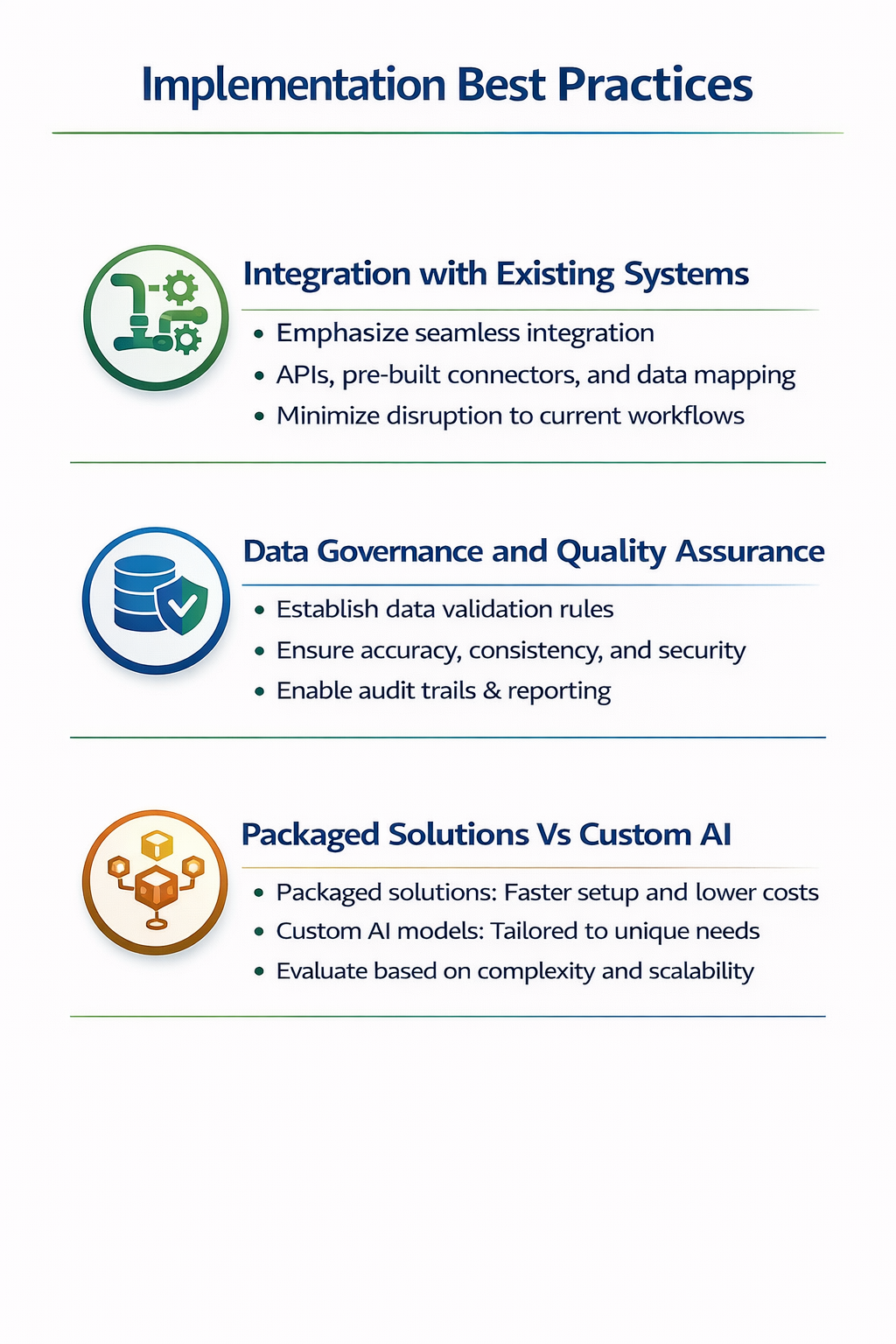
1. Integration with Existing Systems
For AI transaction matching to work well, it needs to plug into your existing finance tools. The system must pull data from ERPs, bank feeds, and payment processors without disrupting operations.
Look for:
- Support for multiple data sources and formats
- Stable integration interfaces that don’t need constant fixes
- Capacity to handle higher transaction volumes as the business grows
2. Data Governance and Quality Assurance
AI can only work with the data it receives. This means poor data quality will lead to poor matching results. Strong data governance helps prevent these issues before they reach reconciliation.
Make sure to have:
- Clear data quality standards
- Validation checks
- Clear ownership of financial data
- Visibility into where data comes from
- Consistent master data for customers, vendors, and accounts
3. Packaged Solutions Vs Custom AI
You should also decide between a pre-built solution and a custom AI model.
Packaged AI solutions work well when:
- You need fast deployment
- The budget is limited
- Standard workflows cover most use cases
However, if you have complex workflows, want to scale long-term, or need better control over data and compliance, opting for custom AI might be a smarter decision.
{{banner1}}
AI Transaction Matching Challenges and Limitations
AI transaction matching can do wonders for efficiency, yes. However, you should also understand limitations like data quality issues, transparency concerns, and adoption barriers.
1. Data Quality Issues
AI works best with clean and reliable data. When transaction details are missing, outdated, or inconsistent, the results suffer. This is a common problem in finance, where data comes from multiple sources.
This problem is further amplified by:
- Legacy platforms feeding data alongside newer systems
- Missing, duplicated, or differently formatted fields
- Unreliable historical data
When these issues go unaddressed, AI may flag incorrect transactions or miss genuine discrepancies.
2. Explainability and Transparency Concerns
Finance teams often need to explain why a transaction was flagged or cleared. This becomes challenging with complex AI models that behave like black boxes. For example, you may face:
- Difficulty explaining model decisions to auditors
- Regulatory pressure to justify every flagged transaction
- Limited visibility into how scores are calculated
To manage this, many organizations use a hybrid approach. AI handles scoring and pattern detection, while rule-based logic adds clarity.
3. Adoption Barriers and Training
Another major challenge is people and skills. Many finance and compliance teams are used to manual processes or rule-based systems. AI requires a different skill set. This gives rise to another set of challenges, like:
- Shortage of AI and data science expertise
- Limited understanding of regulations among AI teams
- Gaps between compliance knowledge and technical execution
Future Trends in AI Transaction Matching
The future of AI transaction matching is driven by agentic AI, predictive anomaly detection, and real-time reconciliations.
1. Agentic AI and Autonomous Workflows
Agentic AI refers to AI agents that can act independently within defined finance and compliance rules. In practice, this means:
- AI agents handle the matching process without constant human input
- Exceptions are analyzed, documented, and routed automatically
- Routine decisions are resolved on the spot
Finance teams get involved only when a human decision is required. This reduces manual workload and allows teams to spend more time on planning and review, rather than day-to-day reconciliation tasks.
2. Predictive Anomaly Detection
Today, most reconciliation tools focus on finding errors after they happen. The next phase moves toward prediction. With predictive anomaly detection,
- AI studies historical data and past issues
- It learns which patterns often lead to mismatches
- Potential anomalies are flagged before they impact books
Instead of reacting during the month-end, finance teams get early signals to make more informed decisions.
3. Real-Time Reconciliation
Real-time reconciliation allows transactions to be matched as they occur. For example,
- Bank statements are matched with internal records instantly
- Discrepancies are identified the moment they appear
- Alerts are sent to finance teams without delay
This reduces last-minute pressure during close cycles. It also improves accuracy, since issues are addressed immediately.
Conclusion
AI has reshaped transaction matching for finance teams by removing much of the manual effort that once slowed the process down. It learns from past decisions, interprets unstructured data, and applies probabilistic logic rather than fixed rules to handle large transaction volumes efficiently.
The result? Less manual effort, early exception detection, and audit-ready records. Platforms like Osfin take this a step ahead with:
- Seamless data ingestion from multiple sources
- Many-to-one, one-to-many transactions, and multi-way reconciliations
- Automatic exception handling
- Compliant, audit-ready workflows
FAQs
1. What is transaction matching using AI?
Transaction matching using AI is the use of artificial intelligence to identify which financial records belong together across different systems. It lets finance teams reconcile data faster, even when information is missing or inconsistent.
2. How does AI improve transaction matching compared to traditional methods?
Traditional methods depend on fixed rules and manual checks. AI improves this by learning from historical matches and handling unclear descriptions.
3. What are the challenges of implementing AI in transaction matching?
Some challenges of implementing AI in transaction matching are poor data quality, difficulty explaining AI decisions to auditors, and a lack of internal AI skills.
4. Which industries benefit most from AI-powered transaction matching?
Industries with high transaction volumes benefit the most from AI-powered transaction matching. For example, banking and fintech, large enterprises, e-commerce and retail, and telecom or subscription-based businesses.
5. What metrics should be used to measure success in AI transaction matching?
You should track metrics like cost savings, ROI, financial close cycle, and compliance scores.