What Are Reconciliation Discrepancies? Causes and Solutions
Reconciliation is how banks and financial institutions make sure their numbers add up. It is the process of comparing internal records with external statements, like bank feeds or vendor reports, to confirm everything matches. However, along the way, differences can show up in amounts, dates, or transaction details.
In this article, we'll learn how to identify, categorize, and resolve these reconciliation discrepancies with 100% accuracy using automation tools like Osfin.
What are Reconciliation Discrepancies?
Reconciliation discrepancies are the points of inconsistency between two financial records that are supposed to line up perfectly. For example, some transaction details in your bank ledgers might not completely match the actual bank statement. There may be a mismatch between amounts, dates, or transaction details, impacting financial accuracy.
For instance, you might record a customer deposit in your ledger. But if the amount hasn't reached the bank yet, the gap in records can turn into a bigger problem,s like revenue leakage or audit failures.
Some Common Causes of Reconciliation Discrepancies
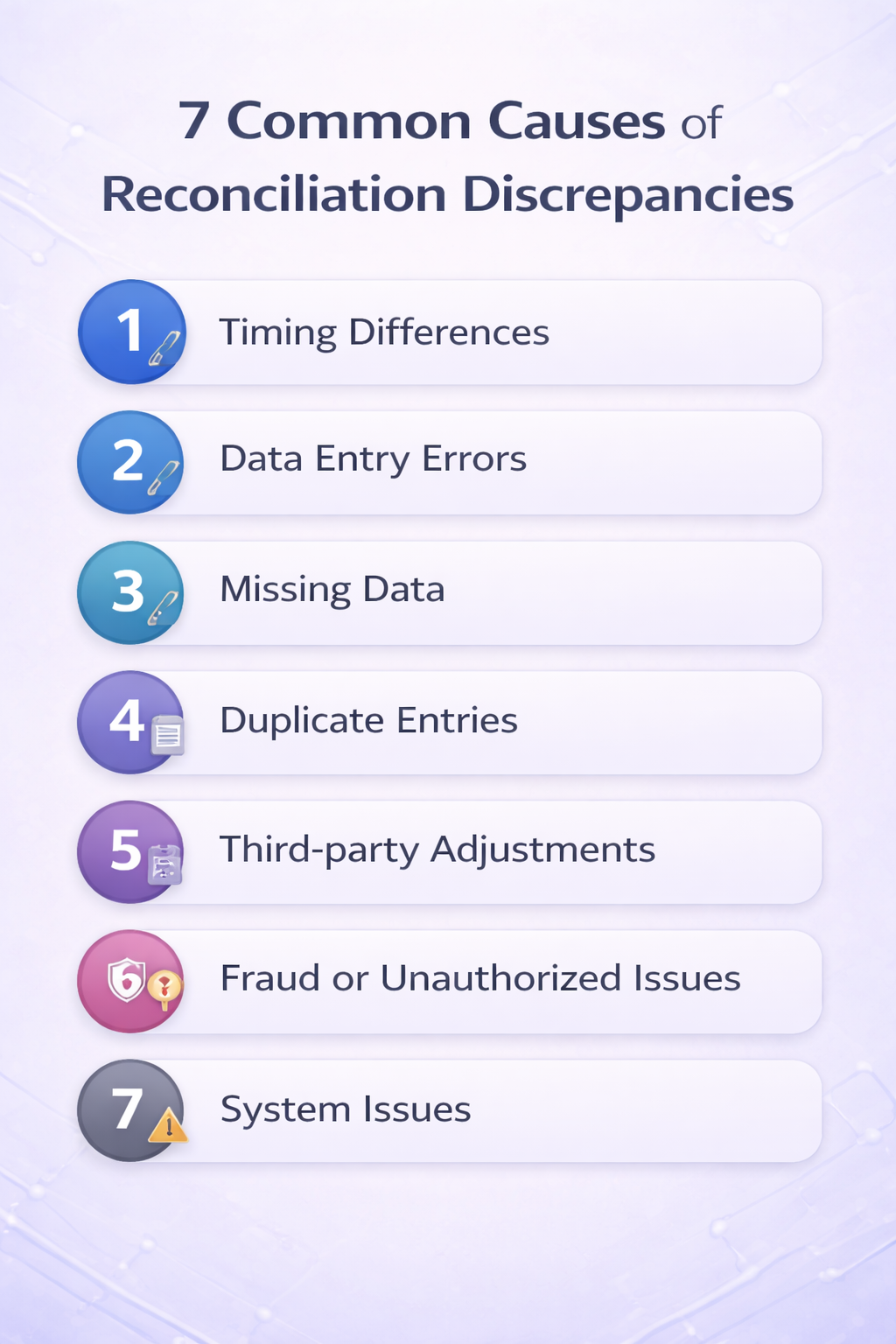
Reconciliation discrepancies occur when internal financial records don't match external statements. This is a common challenge for banks, card providers, and treasury services. Some of the most common causes are timing differences, data entry errors, missing transactions, fraud, and system sync issues.
1. Timing Differences
Sometimes when the deposits are in transit, they might be visible in your ledger but not in the bank statement. You can also see this difference when an outstanding check clears after the period cut-off. Month-end batch delays in treasury services cause these differences, and they usually sort themselves out in the next cycle.
2. Data Entry Errors
These errors result from manual mistakes, such as incorrectly recorded amounts, misposted entries, or selecting the wrong accounts. Card providers use a variety of payment gateways, and minor slips, such as transposed digits in the amount recorded, can lead to significant issues.
3. Missing or Incomplete Transactions
Sometimes, a vendor debit is recorded in one system but is skipped in the bank feed. Or details like reference numbers may not be recorded properly. Banks often miss recording these because of system issues, leaving gaps in transaction matching.
4. Duplicate Entries
Double uploads or even forgotten reversals can inflate balances. This issue is likely to occur when payment processors are dealing with bulk imports.
5. Third-Party Adjustments
From time to time, you might find surprise fees, interest tweaks, or FX conversions in the external records that are not clearly mentioned in the internal ledger. Hence, adjustments are crucial, as global treasury teams that handle multi-currency transactions don't sync data internally in real time.
6. Fraud or Unauthorized Transactions
For potential fraud, like fake charges or manipulating transaction amounts or data, reconciliation is your best defense. Thorough transaction fraud matching helps you spot outliers, identify the banks involved, and review card issuer details to safeguard against fraud and unauthorized transactions.
7. System Integration and ERP Sync Issues
Since transaction data comes from a variety of sources, such as ERPs and multiple payment gateways and processors, you may experience lag in synchronization, API glitches, or even format clashes between ERPs and banks. A large chunk of time is lost in chasing such transaction data.
How to Identify Reconciliation Discrepancies?
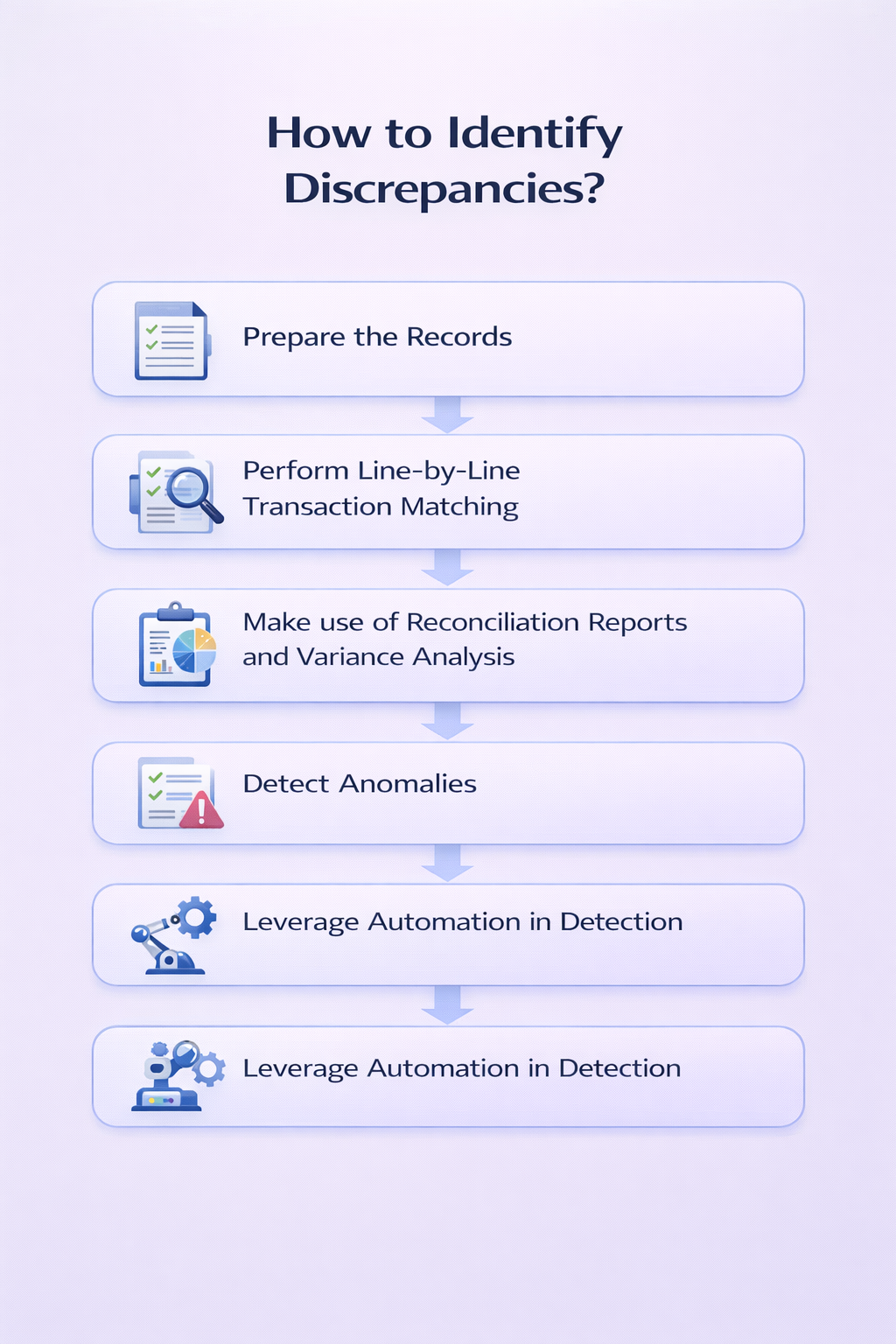
To identify reconciliation discrepancies, you should first start by preparing clean, comparable data, then match and review the exceptions. All banks and financial institutions need to maintain 100% accuracy and audit-ready books; hence, all discrepancies, whether small or big, need to be addressed properly.
1. Preparing Records for Accurate Comparison
You can start by aligning accounting periods to compare the same data ranges across ledgers, bank statements and sub-ledgers. Make sure to maintain consistency in currency data, exchange rates, and formats, and remove test entries or incomplete records before you begin the reconciliation process.
This is exactly where Osfin, a file-format agnostic platform, helps with a streamlined process of data ingestion. It pulls data from any source, regardless of the file type - core banking records, ERPs, spreadsheets, and more. It standardizes and normalizes all consolidated data into a clean, centralized data source. Osfin supports over 170 integrations and implements custom deviation tolerances to clean poor-quality data during the data gathering phase.
2. Line-by-Line Matching Techniques
After the data ingestion process is complete, your teams compare records line by line with the help of shared identifiers like transaction IDs, amounts, dates, or references. A manual reconciliation approach can work for a low amount of data, but it is slow and riddled with errors. For banks and large treasury teams, rule-based matching is a good option because it can handle many-to-one and one-to-many patterns that appear in card settlements and complex cash flows. The unmatched transactions are then passed to the exception-handling tool.
Osfin's reconciliation engine is built to do this at a large scale. It uses logic-based transaction-matching rules that can handle many-to-one, one-to-many, and even 2/3/4/5-way reconciliation scenarios. It can reconcile 30 million records in 15 minutes with 100% accuracy.
3. Using Reconciliation Reports and Variance Analysis
Good reconciliation practices rely on both summary and detailed views. Summary reports can help you see if the total balances match, and detailed reports give you exact transaction-level variances by amount, date, or type. Often, treasury teams perform variance analysis to prioritize what to investigate first, giving precedence to large gaps and mismatches over minor timing issues.
Osfin delivers such reliable and configurable reports with a live dashboard to show what matched and what did not, and why.
4. Identifying Red Flags and Anomalies
Beyond checking routine differences, you should also look for red flags like recurring issues in the same accounts or unusual balance swings from one period to the next. If you observe a pattern like repeated manual write-offs or unexplained FX differences, then you should implement process gaps that warrant escalation.
Osfin flags unmatched exceptions, assigns accurate reasons, and routes the issues to the respective teams to address such anomalies.
5. Role of Automation in Detection
Automation in reconciliation has eased the process of discrepancy detection from a periodic effort into a continuous, reliable method. Such reconciliations run on schedules or events and filter out instant exceptions, rather than waiting until month-end. This also reduces close timelines and cuts manual effort for a consistent control layer across high-volume transactions and treasury operations.
Osfin works on the concept of 'ticketing engine,' and each exception is a trackable ticket. 256-bit encryption, role-based access controls, and two-factor authentication protect all your data and this activity. Osfin operates in line with SOC 2, PCI DSS, ISO 27001, and GDPR requirements, as it is critical for banks and financial institutions.
{{banner3}}
How to Resolve Reconciliation Discrepancies?
To resolve reconciliation discrepancies, you need to follow a simple 3-step process: systematic investigation, revision and adjustments, and finally documentation. This strategy helps you close financial processes with compliance, and automation plays a key role in streamlining these steps. It significantly reduces manual effort and errors in high-volume operations that are performed in banks daily.
- Investigating the Root Cause
The primary step is to trace discrepancies back to their source documents. These are original invoices, bank confirmations, or transaction logs to understand precisely why the records changed.
This investigation enables treasury teams to pinpoint systematic flaws, such as faulty API feeds, before they cause further issues.
- Correcting Errors in Accounting Records
You must correct the accounting records by posting precise entries, like reversing duplicates and accruing for missed amounts. All the corrections you make need to be approved by higher authorities, too. Also, you need to update ledgers in real-time via ERP journals. You should also re-run the matches to verify the fixes.
- Handling Timing-Related Differences
For in-transit deposits or outstanding wires, you should carry them forward to the next period with helpful notes. Treasury services use aged lists to track these differences. And most of the time, such discrepancies self-resolve without altering the transaction history.
- Communicating with External Parties
You should contact the vendors and processors for invoice disputes or chargeback details. Document all queries and responses formally through communication channels like portals or letters for audit proof.
- Documenting and Closing the Reconciliation
Each resolution should be sealed with a full audit trail. Keep necessary records of screenshots, emails, journals, and sign-offs and then close via dashboards. Usually, banks need this for regulatory purposes.
Tools and Automation for Managing Reconciliation Discrepancies
Manual tools handle basic reconciliations. But banks and financial institutions, such as card providers and treasury teams, need automation to manage high-volume discrepancies with 100% accuracy. Automation helps you speed up the process and avoid manual errors.
Manual Reconciliation Using Accounting Software
Card providers endlessly export and import data that can turn overwhelming if you are using spreadsheets. ERP built-ins offer basic matching that can't scale with high-volume transactions.
Automated Reconciliation Solutions
Advanced platforms use rule-based engines for intelligent matching and smart exception routing. These automated solutions ingest diverse data, match at speed, and flag issues with context.
Benefits of Automation Over Manual Processes
Automation delivers - 100% accuracy, reduces processing time from days to minutes for large volumes of transaction data, and helps you scale effortlessly. Automation also strengthens compliance by providing a traceable transaction history and real-time dashboards for live updates.
How to Choose the Right Reconciliation Tool?
To choose a suitable financial reconciliation tool, you need to carefully evaluate volume capacity, integration support, and security features of the tool.
Osfin offers state-of-the-art security features such as 256-bit encryption, role-based access, and two-factor authentication to support powerful reconciliation processes.
{{banner1}}
Real-World Examples of Reconciliation Discrepancies
Real-world cases of transaction discrepancies help you to see how common issues play out in financial institutions and how teams deal with them.
These cases have a common process of detection, finding root causes, and implementing fixes that require the assistance of robust tools.
1. E-commerce Payment Reconciliation
A leading retailer was struggling with payment data ingestion from various gateways. Commissions, refunds, and fees didn't match up, causing delays in their month-end closes.
Osfin changed that with its file-format agnostic platform, connecting to more than 170 sources and pulling in data irrespective of the format. It also applied custom deviation tolerances, cleaning poor data right at ingestion. And its logic-based matching then auto-reconciled 99% of transactions.
2. Timing Mismatches
A leading Indian fintech faced major issues with loan disbursals and repayments across multiple banks. Timing mismatches created more than $100K variances each month. And the financial teams spent weeks looking for the root causes.
Osfin simplified the process by standardizing data from all sources during ingestion. Its reconciliation engine also handled one-to-many repayments in minutes, auto-matching 90% transactions at 100% accuracy.
3. High Volume Trades with Volatile Feeds
A crypto exchange was grappling with high-volume trades and wallet mismatches. Over time, small fee errors and outliers built up to multimillion-dollar exposures, and manual checks just couldn't keep up.
Osfin's platform ingested all the volatile feeds without a hitch. It filtered the noise with custom tolerances and reconciled millions of records fast. Exceptions got clear reasons and were routed automatically.
Conclusion
Reconciling discrepancies and managing them is a crucial task for banks and treasury teams that want reliable numbers and faster closes. Once you understand the common causes and learn how to spot issues early, you are better equipped to investigate, correct, and document discrepancies for your financial institution.
A platform like Osfin helps you move from reactive firefighting to proactive control. It offers more than 170 integrations for data ingestion and reconciles 30 million records in 15 minutes.
To eliminate reconciliation discrepancies with 100% accuracy, schedule a free demo with Osfin today!
FAQs
1. What are reconciliation discrepancies?
The differences between two financial records, such as your internal books and bank statements, are called reconciliation discrepancies. Ideally, both sets should match, but due to various factors such as errors, timing gaps, or missing items, discrepancies may appear.
2. Why do reconciliation discrepancies occur?
Reconciliation discrepancies surface mainly due to human errors like incorrect amounts and duplicate entries. Sometimes, they may also happen due to system issues. These factors lead to an unbalanced ledger and mismatches between records.
3. How often should you perform reconciliations?
Monthly reconciliation is a healthy practice. But the frequency of reconciliation majorly depends on transaction volume. High-volume businesses often need weekly or even daily reconciliation to catch errors early.
4. What tools can help reduce reconciliation errors?
Tools like Osfin offer automation and integration support, which also consolidates data and handles exceptions to reduce reconciliation discrepancies.
5. Are all reconciliation mismatches actually errors?
No. Some reconciliation issues are normal timing differences, uncleared checks, system issues, or undocumented bank fees.