Operational Efficiency: Real-World Examples and Best Practices
Operational efficiency is your secret weapon to perfecting it all:
- Better processes
- Minimal waste of resources and time
- Lower costs
- Higher profitability
- Maximizing value for customers
We could go on and on.
However, achieving operational efficiency requires dedicated effort. You need to regularly review processes, identify areas for improvement, and improve continuously.
Sounds confusing? Worry not!
In this article, we’ll walk you through the best real-world operational efficiency examples so you can take inspiration from the businesses that have nailed it. We’ll also look at the metrics to track and the tools you can use to simplify and speed up the process.
What Does Operational Efficiency Mean in Finance?
Operational efficiency in finance refers to how effectively you can carry out the same work using lesser time and resources. When your processes rely heavily on manual work, legacy systems, or multiple external vendors, even routine activities can become slower. And mistakes? They become harder to avoid. Over time, this slows decision-making and raises costs.
To define operational efficiency in simple terms, it supports an efficient finance function to deliver accurate results with minimal time, effort, and expense. The goal is to cut expenses, yes. However, the focus is equally on fixing gaps in processes and using technology to eliminate repetitive work from start to finish.
And when you achieve strong operational efficiencies, you can enjoy three clear outcomes:
- Better control over costs
- More effective use of people and systems
- Faster responses to market changes
Why Finance Teams Struggle with Operational Efficiency
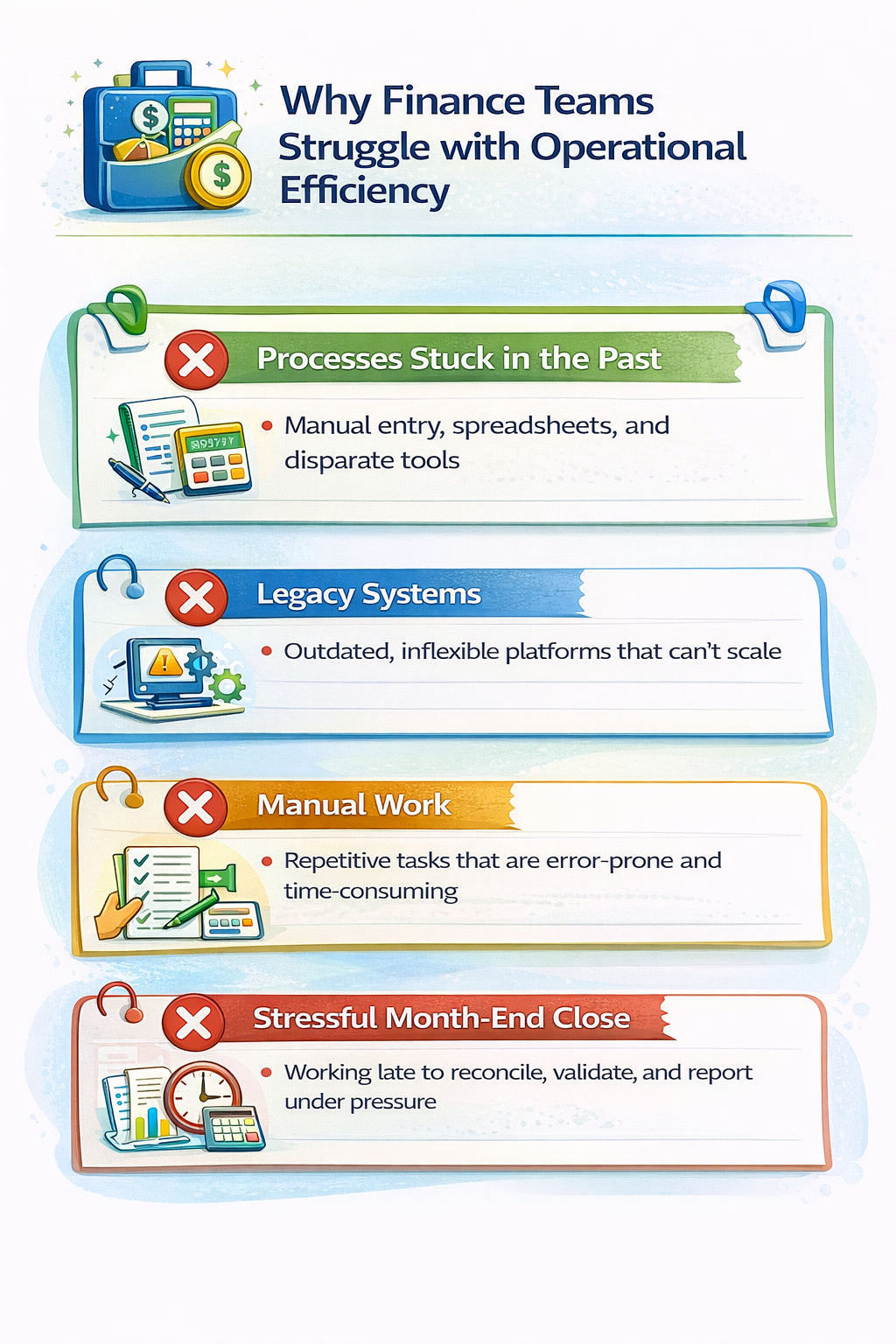
Finance teams face several structural issues that make operational efficiency hard to achieve. Most of these problems build up over time and affect the entire organization:
1. Processes Stuck in the Past
Expenses - be it vendor payments, travel reimbursements, subscriptions, etc. - are now spread across teams, tools, and vendors. However, many finance workflows still depend on outdated systems that were never built for this scale. This leads to more manual effort for billing, invoicing, and reconciliation, and increases the risk of errors, especially around expense reports, which are often sent back due to mistakes.
2. Legacy Systems
Many finance teams still continue to rely on systems that lag behind the tools used by other departments. The lack of real-time data and automation forces teams to manually reconcile information across bank statements, invoices, and internal records. As a result, they spend hours each month on error correction, expense processing, and basic fraud checks instead of higher-value work.
3. Manual Work
Inefficient processes like manual transaction recording, reconciliation, reporting, etc. have consequences that extend beyond the finance team. Employees across the business spend dozens of hours chasing payment updates, sorting receipts, fixing expense issues, and understanding budgets. This hurts overall business operational efficiency.
4. Stressful Month-End Close
Thanks to manual processes and outdated systems, closing the books eats up hours and requires a lot of effort. Yet, many teams aren't confident in the accuracy of their numbers due to late invoices and missing information.
Real-World Operational Efficiency Examples
Operational efficiency sounds good in theory. The real question is how it holds up in practice. Let’s look at real-world examples that show how finance teams have reduced effort, fixed gaps, and improved their day-to-day work.
1. Indian Fintech Company Achieves 90% Reconciliation Automation
A large fintech company in India, with more than 2 million active loans, was struggling to reconcile loan disbursals and collections spread across several systems. Data came from core banking platforms, payment gateways, and collection partners, creating delays and frequent errors. Each monthly reconciliation cycle took up to five days. On top of that, over 5,000 exceptions needed manual checks, slowing reporting and increasing risk.
To fix this, they adopted Osfin’s Intelligent Automation Platform. Data from all sources was brought into one layer, cleaned, and matched using configurable rules.
After going live,
- Reconciliation was completed in under 12 hours
- Auto-reconciliation reached 90%
- Manual work dropped sharply
- Unreconciled items fell by 60%
- Annual savings touched $200K
{{banner1}}
2. Gaming Finance Automation
A leading Indian gaming company processed over 5 million transactions every day. But it struggled to reconcile pay-ins and payouts across multiple platforms. Delays in reconciliation slowed balance updates and withdrawals, putting pressure on the finance team and frustrating players. To fix this, the company adopted Osfin’s Gaming Finance Automation Platform.
The solution pulled data from different sources, cleaned it, and matched transactions automatically. Within just two months,
- Reconciliation time dropped from 12 hours to just one hour
- Auto-reconciliation reached 98%
- Finance-related support tickets fell by 40%
This is one of those operational efficiency examples where faster finance processes directly improved daily operations and customer experience.
3. Indian Bank Cuts Card Reconciliation from Days to Hours
A leading Indian bank serving 25 million card customers processed over 10 million card transactions every day. But its legacy systems struggled to handle data from multiple payment sources. Reconciliation took approximately 120 hours, with over 500 exceptions requiring daily manual review. This slowed reporting and increased risk.
The bank implemented Osfin’s Data Automation Platform to bring all transaction data into one place and automate matching and exception handling.
Within three months,
- Reconciliation time dropped to just three hours
- Exception automation rose from 10% to 95%
- False fraud alerts fell by 70%
- The bank reported estimated annual savings of $500K
4. Crypto Exchange
A cryptocurrency exchange processed over 100,000 transactions daily across blockchains and fiat systems. However, reconciling blockchain data with internal records and wallet balances was time-consuming. Errors were common, and delays made it hard to keep balances accurate and meet reporting needs.
The exchange used Osfin’s crypto reconciliation solution to fix this. Data from blockchains and internal systems was brought together and matched automatically. The system also helped spot unusual transactions early.
After the change,
- 95% of the reconciliation work was automated
- Manual effort dropped by 90%
- Regulatory reports were completed 50% faster
- The finance team could manage daily transactions with more accuracy
{{banner3}}
Metrics That Prove Operational Efficiency Gains
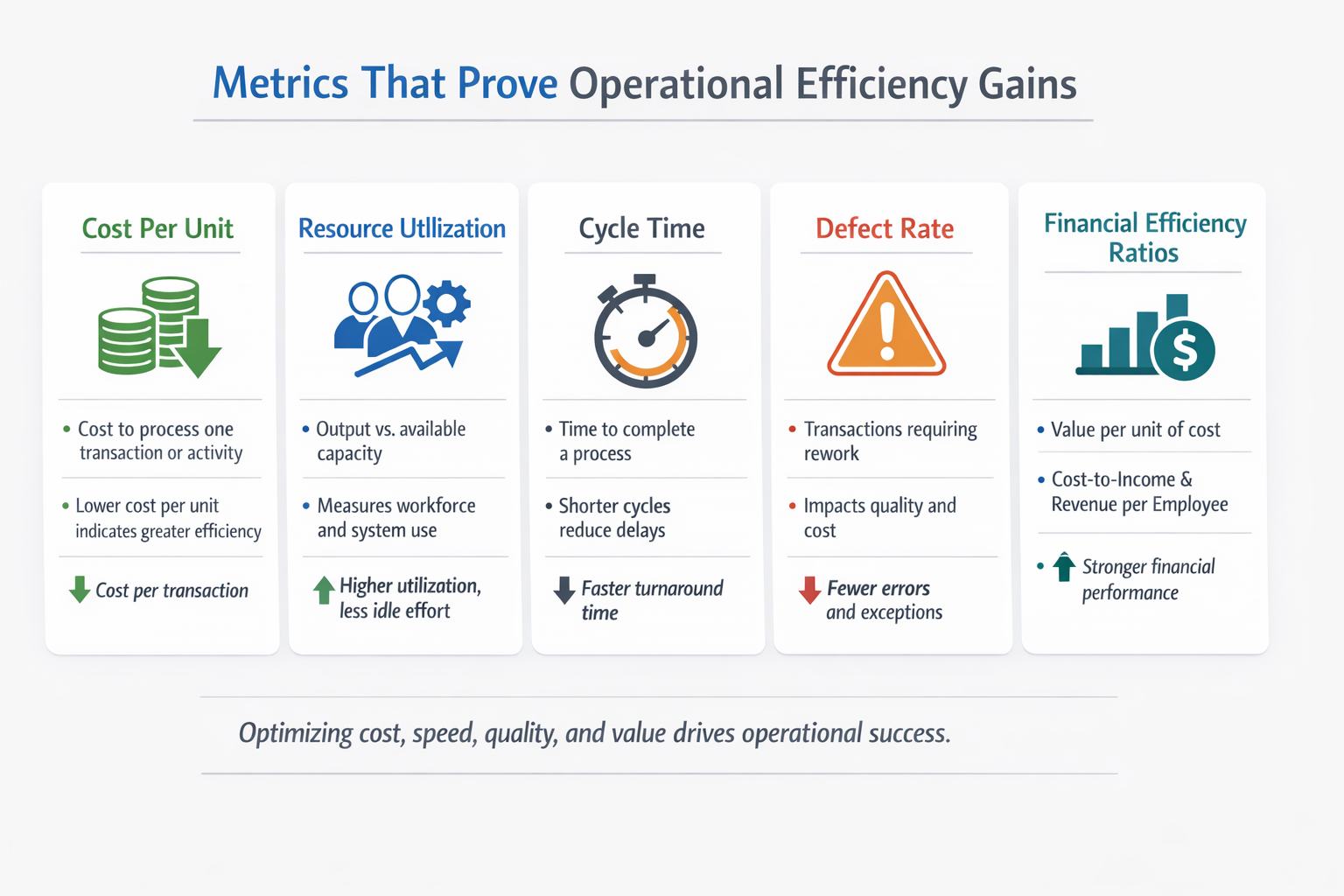
Operational efficiency is measured in numbers. The right metrics show how well your business turns time, people, and money into actual output. They help you see whether your resources are delivering results or going to waste.
These metrics look deep into day-to-day operations. They focus on the steps, effort, and cost behind every result. Unlike high-level numbers like net margin or EBITDA, they explain what's happening on the ground. When margins drop or teams feel stretched, these metrics help you understand why.
Some of the most useful operational efficiency metrics include:
- Cost Per Unit
Cost per unit is basically the total cost behind making one item, including labor and overheads. If it keeps rising over time, it is often a sign that the process has inefficiencies or unnecessary waste that needs to be addressed.
- Resource Utilization
This measures how much of your available capacity is actually used. Low usage means you're paying for idle time or unused tools. Very high usage may mean teams are stretched too thin.
- Cycle Time
It tracks how long a task takes from start to finish. Longer cycle times highlight delays, higher costs, and unhappy customers.
- Quality Metrics
Quality metrics like errors, defects, and customer complaints help identify gaps in operations. Addressing them improves efficiency without increasing costs.
- Financial Efficiency Ratios
Metrics like Return on Assets (ROA) and inventory turnover indicate how efficiently assets are being used. Lower ratios often suggest poor planning or slow-moving inventory.
Why Traditional Tools Fail to Deliver Efficiency
For many years, spreadsheets and legacy systems have been a big part of how finance teams operate. Yes, there was a time when these tools were a big leap forward. They made budgeting and forecasting faster than manual methods. In fact, many finance teams still use spreadsheets to manage their workflows.
However, these tools were built for a different time. Business now moves faster. Data changes constantly. Planning is no longer limited to the finance team.
And traditional tools? They struggle to keep up with this shift.
This means teams using these old tools face the same set of issues:
- Slow, manual processes
- Reconciliation requiring high human intervention
- Data scattered across different systems
- Limited collaboration between teams
- Missed opportunities due to delayed insights
- Inefficient workflows
Not to mention there's a growing gap between what these tools offer and what modern finance teams need. You see, today you need tools that ensure processes are ongoing, connected, and shared across teams. But traditional tools were not made for wide participation or real-time input.
As more and more people get involved in planning and reporting, the inefficiencies only increase. Instead of supporting faster decisions, these tools slow you down, making it harder to respond to change.
How Osfin Drives Operational Efficiency
Osfin helps finance teams reduce manual work and gain better control over complex reconciliation processes. It focuses on speed, accuracy, and visibility across high-volume financial transactions such as lending, payments, insurance, gaming, and market operations.
Here are some of its key features:
- Data Ingestion
Osfin is a file-format agnostic platform that pulls data from multiple sources using 170+ integrations. This means finance teams can import data regardless of structure or format, whether it comes from banks, ERPs, or internal systems. During ingestion, it also applies custom tolerance rules to catch poor-quality data early. Duplicates and outliers are flagged upfront, so issues don't carry forward.
- Reconciliation Process
Osfin matches transactions using logic-based rules. It supports one-to-one, one-to-many, many-to-one, and multi-way reconciliations, including two-way, three-way, four-way, and five-way matching. It can also reconcile up to 30 million records in 15 minutes. Payment gateway reports are matched with commissions, taxes, and fees in a single flow.
- Exception Handling
Osfin automatically identifies and tags unmatched transactions with clear reasons. These are routed to the right team through a built-in ticketing system. Live dashboards show match rates, pending items, and exposure in real time.
- Output and Control
The platform delivers compliance-ready reports with full audit trails. It offers 256-bit encryption, role-based access, maker-checker controls, and two-factor authentication. It also meets SOC 2, PCI DSS, ISO 27001, and GDPR standards.
Best Practices to Improve Operational Efficiency in Finance
Operational efficiency in finance starts with small, practical changes. When everyday processes run smoothly, delays reduce, errors drop, and teams have more time for higher-value tasks. Here are some operational efficiency strategies:
1. Review and Improve Financial Workflows
The first step is to understand how your existing workflow runs. Look closely for steps where work slows down or piles up. Once these gaps are clear, redesign the workflow to ensure all tasks follow a set path with fewer steps and little manual effort.
2. Automate Routine Accounting Work
Automation is your holy grail to bring efficiency to the workflow. Tasks like data entry, reconciliations, and reports take time but rarely need human judgment. Accounting automation helps teams move faster and reduces avoidable errors. This also frees up time for work that actually needs analysis or decision-making.
3. Set Clear Policies and Track KPIs
Predictable work depends on clear approval rules and defined timelines. Tracking KPIs such as DSO or payable turnover can further help you see where processes lag and what needs attention.
4. Improve Data Visibility
When data is easy to access, your team can flag issues early. Use integrated systems that reduce the need to sift through emails and spreadsheets.
5. Standardize Processes Across Teams
When different teams follow the same steps, errors become less frequent, and training becomes simpler. Standard processes also make it easier to spot what can be automated next.
Summing Up
Achieving operational efficiency can help you lower costs, improve accuracy, and make confident decisions. All you need to do is fix core processes, track the right metrics, and move away from outdated tools that slow you down.
This is where purpose-built automation makes a difference. Osfin helps finance teams handle complex reconciliations at scale, reduce manual effort, and stay audit-ready at all times. It ensures you spend less time fixing errors and more time running the business with confidence. Book a demo to see how Osfin can help you improve your financial operations.
FAQs
1. What are some examples of operational efficiency?
Examples of operational efficiency include automating repetitive tasks, setting clear workflows, using technology to handle manual work, and using employee time more effectively.
2. How does technology promote efficiency?
Technology helps you cut down manual effort and process large amounts of data quickly. Additionally, it can identify errors early and monitor work in real-time, saving time, reducing costs, and improving accuracy.
3. What are the barriers to achieving efficiency?
Some barriers to achieving efficiency include outdated tools, manual processes, poor data visibility, and unclear policies.
4. How to use technology to improve operational efficiency?
You can use technology to improve operational efficiency by automating time-consuming and repetitive tasks. It makes it easier to bring data into one place, reduce manual work, and improve visibility.