Challenges and Solutions in Multi-Currency Cash Reconciliation
The global economy has turned into a web of businesses that operate without borders, to a global audience. And this is possible because of multi-currency income, making multi-currency cash reconciliation a core process for financial institutions such as banks, card providers, and treasury services.
Transactions speed across markets in multiple currencies, such as dollars, euros, and pounds, each with unique rules and risks.
And without the right tools and processes, finance teams struggle with challenges such as FX swings, mismatches, and data scatter. In this article, we’ll look at some of the challenges and solutions in multi-currency cash reconciliation and how automation platforms like Osfin help you turn reconciliation into a strategic strength with guaranteed 100% accuracy.
What is Multi-Currency Cash Reconciliation?
Multi-currency cash reconciliation refers to the process of verifying and matching cash transactions across different currencies in a company's accounts. This process helps with accurate financial reporting for organizations that are involved in global businesses and have to deal with transactions from multiple countries.
It involves comparing bank statements, ledger balances, and actual cash holdings in multiple currencies, converting them to a base currency. It helps accurately track foreign exchange gains and losses, spot discrepancies early, and ensure financial records clearly show the organization’s true cash position across all currencies it holds.
Key Challenges in Multi-Currency Cash Reconciliation
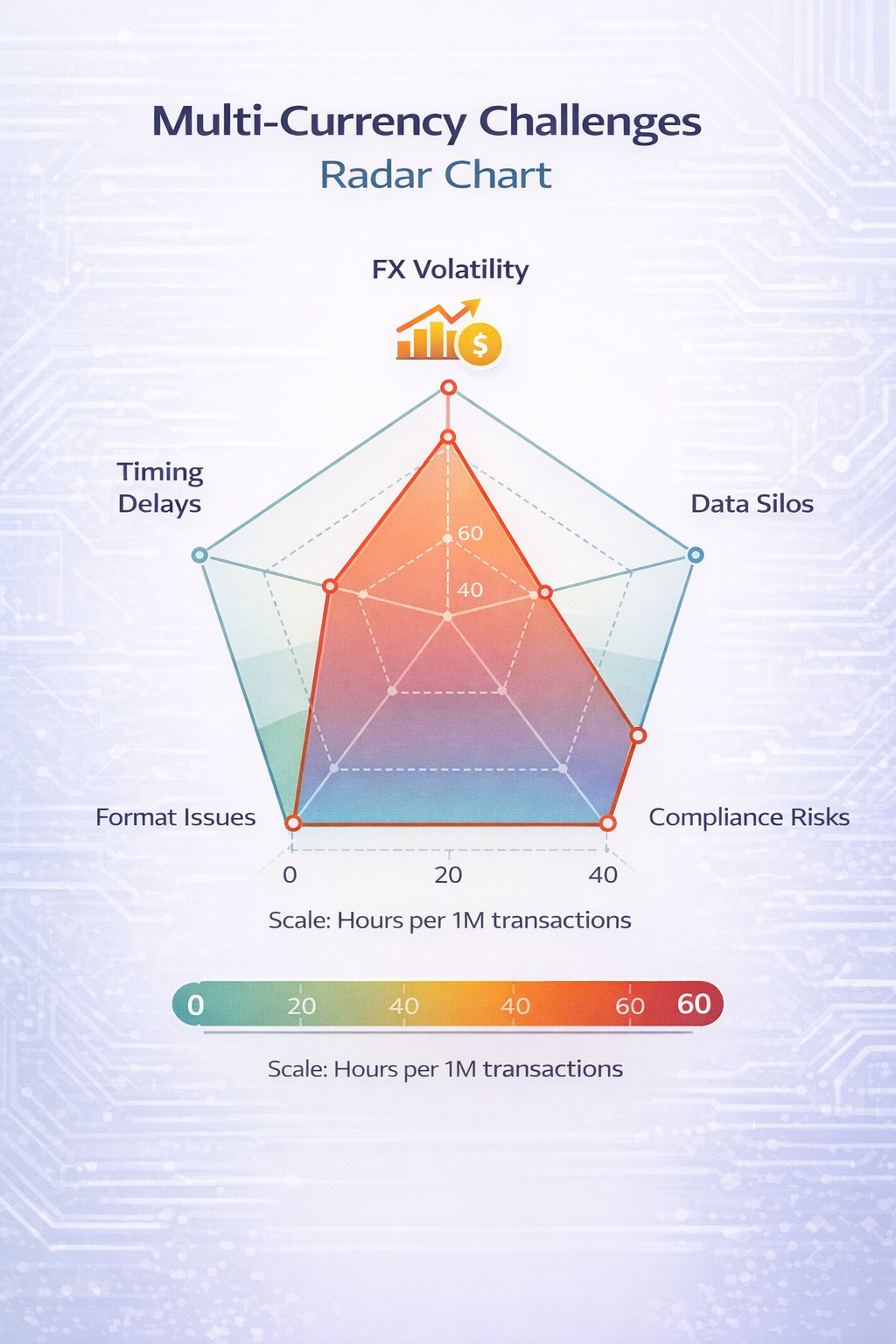
Banks, financial institutions, card providers, and treasury services deal with major hurdles in the multi-currency cash reconciliation process. Rising global transaction volumes are further driving these problems. Errors build up quickly, delays slow teams down, and compliance risks threaten operations every day. Some of these key challenges are as follows.
Fluctuations in Foreign Exchange Rate
FX rates can shift quickly due to market news and global economic changes. That’s why teams use spot rates when trading and average rates for monthly reports. And to close the books, the month-end rates are used. Because of such a wide range of rates, gaps appear, and unrealized differences accumulate from constant swings.
You’ll come to know about the gains or losses only during the settlement. This forces the treasury teams to fix the ledger mismatches manually, which takes hours of your time.
Differences in Timing and Cut-Off Issues
Cross-border payments often settle a few days after the expected date as banks post the funds much later than ERPs record the original entries. And the transactions that straddle period ends run into shifting FX rates. This leads to cash position reports that end up looking wrong across different time zones and systems.
Data Fragmentation Across Systems
You have to pull financial data from multiple ERPs, bank portals and treasury tools all at once. Each system holds its data in separate silos with unique formats. Hence, manual efforts to consolidate everything lead to missed entries or unwanted duplicates. And high transaction volumes turn these small slips into big problems.
Inconsistent Bank Statement Formats
The bank statement format changes from region to region and on the basis of the bank type. SWIFT MT messages work for global flows, and MT940 handles most European banks. The BAI2 format fits U.S. institutions best. The local regulations can add extra fields and codes that can confuse imports and card providers, and treasuries waste a lot of time trying to parse them correctly.
Regulatory and Compliance Constraints
Local laws dictate exact ways to handle FX conversions and reporting. And auditors require complete trials for matches under rules like IFRS, GAAP, or SOX. If any unmatched exposure goes unnoticed or unexplained, then your bank can face heavy fines.
{{banner1}}
Solutions to Multi-Currency Cash Reconciliation Challenges
Banks, financial institutions and card providers can perform effective multi-currency cash reconciliation with proven strategies like automation, standardized FX rates and strong internal controls. These solutions help you cut errors and speed up processes for achieving compliance in global operations.
Standardizing FX Rate Policies
Your treasury team should define clear FX rate sources to back your charges for supported currencies. They set rules for spot rates at transaction time, average rates for monthly reports, and month-end rates for closes. This alignment stops disputes between trading desks and accounting. Implementing global standards helps to keep conversions consistent across books.
Centralizing Cash Data
A single source of truth ends data silos from ERPs, bank portals, and treasury tools. Automation for data ingestion helps you pull all the feeds into a single source without any manual work.
Osfin is a reliable file format agnostic platform that supports more than 170 integrations, which help you import data from multiple sources, irrespective of the format, like CSV or PDF. It also standardizes and normalizes data while applying custom deviation tolerances during data ingestion. This helps to filter poor-quality data before the transaction reconciliation process begins. Osfin detects duplicates and outliers at the point of ingestion to prevent downstream issues for banks.
Automating Reconciliation Processes
Automation uses logic-based matching to pair transactions across currencies. It handles reconciliation processes like many-to-one and one-to-many, even with FX swings or fees.
Osfin’s engine reconciles 30 million records in 15 minutes at 100% accuracy, and auto-reconciles payment gateway reports with commission, tax, and fee breakdowns. Its exception handling automatically flags unmatched transactions and assigns them an accurate reason. These exceptions, such as unmatched transactions, are routed to the appropriate team member via the ticketing and exception handling engine. You can also view live match status, exposure, and exception queues with real-time dashboards.
Implementing Strong Internal Controls
Your teams should segregate duties so that no one person handles full cycles, and implement effective approval checkpoints to catch any breaks or issues early. Banks should also conduct regular reviews and access logs to build audit trails. Such measures ensure protection against fraud and errors in high-volume cash flows.
Leveraging Treasury and Reconciliation Technology
Integrations like ERP and TMS help you feed real-time data into one platform. It also provides visibility into positions across currencies. Osfin improves this with end-to-end workflows that generate compliance-ready reports. This feature helps you maintain audit-proof reconciliation with complete transaction history traceability.
Security and compliance are at the core of this setup. Osfin secures data with 256-bit encryption, role-based access controls, and two-factor authentication. The platform also supports maker-checker flows for critical actions, ensuring that one user prepares and another approves high-impact changes such as rule edits, write-offs, or rate overrides. All automated and manual actions taken on the platform are captured in the audit log.
{{banner3}}
Best Practices for Sustainable Multi-Currency Cash Reconciliation
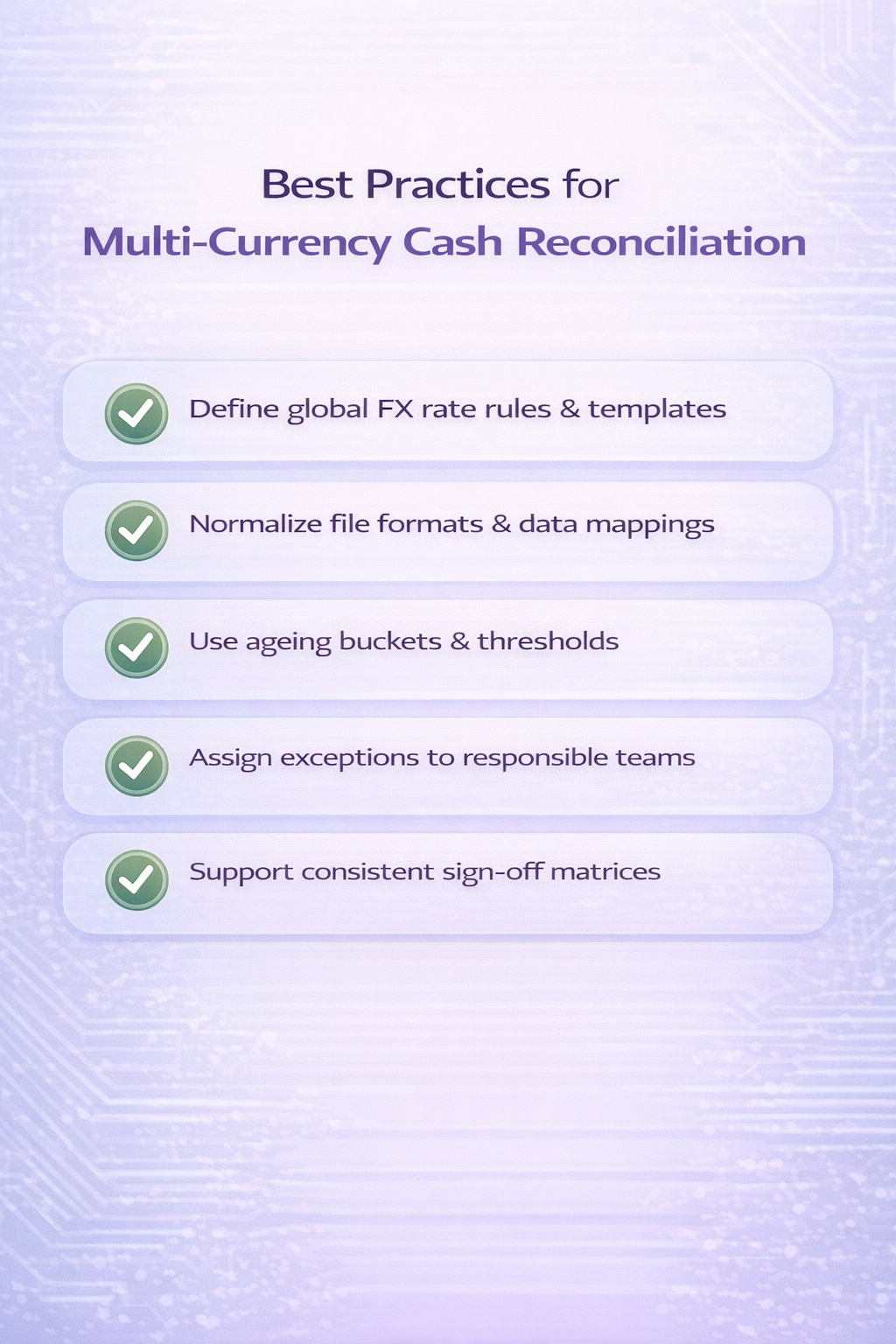
Effective multi-currency cash reconciliation functions on a clear framework, which involves constant monitoring. This helps financial institutions, such as treasury teams, card providers, and banks stay compliant and accurate over time. Here are some best practices that you can implement for sustainable multi-currency cash reconciliation.
Establishing Global Reconciliation Frameworks
Adopting a global reconciliation framework works on the core fundamentals of standardization. This ensures consistency and continuity across approaches globally and helps curb potential errors and issues arising from differences in processes. A globalized financial reconciliation framework also simplifies the training process for new staff members and provides a uniform understanding of the processes involved.
This method defines how to treat FX rates, cut-off timings, file formats, data mappings, and materiality thresholds across all currencies. You can use standard templates for bank file mappings, FX rate selection, and exception ageing rules, so every region works from the same playbook. Your local teams can still adjust to regulatory requirements, but core controls such as sign-off matrices and documentation standards should remain consistent to support audits and group-level reporting.
Continuous Monitoring and Exception Management
The main aim of implementing a continuous monitoring process is to establish a process that performs continuous real-time oversight for immediate correction of discrepancies. Treasury and finance teams should define ageing buckets for unreconciled items, clear thresholds for high-value or FX-sensitive breaks, and explicit ownership so every exception has a responsible resolver.
Conclusion
As a bank or card provider, you have to address a variety of challenges and solutions in multi-currency cash reconciliation, including FX swings, timing gaps, data silos, format issues, and compliance rules. The proven solutions for the same are standardization, centralization, and automation. Effective reconciliation can become a key financial edge that drives trust and growth for your financial institution’s services.
For a 100% accurate multi-currency cash reconciliation, schedule a free Osfin demo today!
FAQs
1. Why is multi-currency cash reconciliation difficult?
Multi-currency cash reconciliation can seem difficult due to a variety of factors such as: volatile exchange rates, international regulations and accounting standards, complex operations across systems and the potential for human error in manual processes.
2. How do foreign exchange rates affect cash reconciliation?
Foreign exchange (FX) rates are the reason behind fluctuations in foreign currency cash balances. This can create gains or losses when you convert to your reporting currency. According to accounting standards, these foreign currency items need to be adjusted at each period-end to reflect the current exchange rate.
3. What tools help with multi-currency cash reconciliation?
For multi-currency cash reconciliation, tools like Osfin offer a file-format agnostic platform with real-time dashboards, exception handling and audit trails for compliance.
4. How can companies reduce reconciliation errors across currencies?
Companies can use automation for processes that handle real-time currency conversions and data matching with specialized software to reduce reconciliation errors across currencies.