Financial Consolidation Platform: Features, Benefits & Top Tools (2026)
TL;DR
- Financial consolidation platform brings together data from subsidiaries into unified statements for banks. It manages eliminations, currency translations, and compliance with IFRS and GAAP.
- We evaluated systems based on scalability, data accuracy, automation, real-time dashboards, and ERP integration for enterprise banks.
- The article includes a detailed list of must-have features like multi-currency support, auto intercompany eliminations, and seamless ERP connectors.
- Financial consolidation platform provides an improved closing process that achieves 50 to 70 percent faster results, together with complete accuracy.
- Some of the top consolidation solution providers are: OneStream, Planful, Oracle EPM, Join, Anaplan, Board, Datarails, SAP EPM, Centage, and LucaNet.
What is a Financial Consolidation Platform?
The main purpose of a financial consolidation platform is to consolidate financial information from multiple locations into one financial report. Most of these systems are specialized for the consolidation of subsidiary financial activities. However, some systems also provide approvals or e-signature capabilities.
Banks dealing with high-volume transactions from diverse sources such as payment gateways, ERPs, and international subsidiaries rely on this technology to close books faster and achieve high-level accuracy.
How Did We Evaluate the Best Financial Consolidation Platform? (Enterprise Criteria)
We focused our review on tools that truly serve banks and financial institutions in high-pressure settings. Scalability topped the list since small errors can disrupt treasury plans or trigger compliance issues. We also considered customer reviews and prioritized automation that typically shortens close cycles by 50-70%.
Key criteria included:
- Scalability and Performance
We prioritized platforms that manage numerous entities and currencies without lag, supporting varied fiscal calendars and real-time processing for cross-border banks.
- Data Ingestion and Accuracy
Top solutions work with any file format and offer multiple integrations to pull, standardize, and clean data upfront. Custom tolerances catch outliers and duplicates early, delivering reliable and accurate inputs every time.
- Reconciliation Process
We’ve picked systems that use automated intercompany matching with logic-based reconciliation methods to identify discrepancies in complex transactions. This enables a faster and more accurate consolidation process.
- Exception Management
Smart workflows flag issues, assign reasons, and provide dashboards for quick resolution. This keeps treasury teams in control during tight deadlines.
- Compliance and Security
Multi-GAAP support, audit trails, encryption, and standards like IFRS/GDPR protect your consolidation data reports and help you earn the approval of regulators effortlessly.
- Workflow and Integration Support
The combination of pre-built ERP connectors and user-friendly interfaces results in reduced setup time. This allows your team to work together in real time without requiring extensive IT support.
- Value and Reviews
Pricing transparency, ROI from faster closes, and verified feedback from financial professionals online prove to be effective for a thorough analysis of the platform’s performance in real-world scenarios.
What are the Key Features to Look for in a Financial Consolidation Platform?
The purpose of consolidation tools is to create automated systems that handle complex operations. This includes intercompany eliminations, currency translations, and ownership adjustments while maintaining precise results for audit-ready reports. The entire process and the reports must also comply with IFRS, GAAP, and other local regulations.
You need to evaluate three essential components in your platform selection process.
- Multi-Currency and Multi-Entity Support
You'll need a platform that effortlessly manages subsidiaries across borders, automatically translating currencies with current exchange rates. The tool should also accommodate varied fiscal calendars or accounting standards. This eliminates manual adjustments, ensuring your group statements reflect accurate, compliant realities no matter how diverse your entities are.
- Automated Intercompany Eliminations
Manual intercompany transaction matching can take up a lot of time, and these top consolidation tools automatically spot and eliminate these transactions to prevent double-counting in consolidated reports.
- Seamless System Integrations
The right platform helps you connect directly to your ERP, accounting tools, and data sources through strong connectors. It also helps you transform inconsistent inputs from different systems, so that everything flows smoothly into a unified report without constant IT fixes.
What are the Benefits of Using a Financial Consolidation Platform?
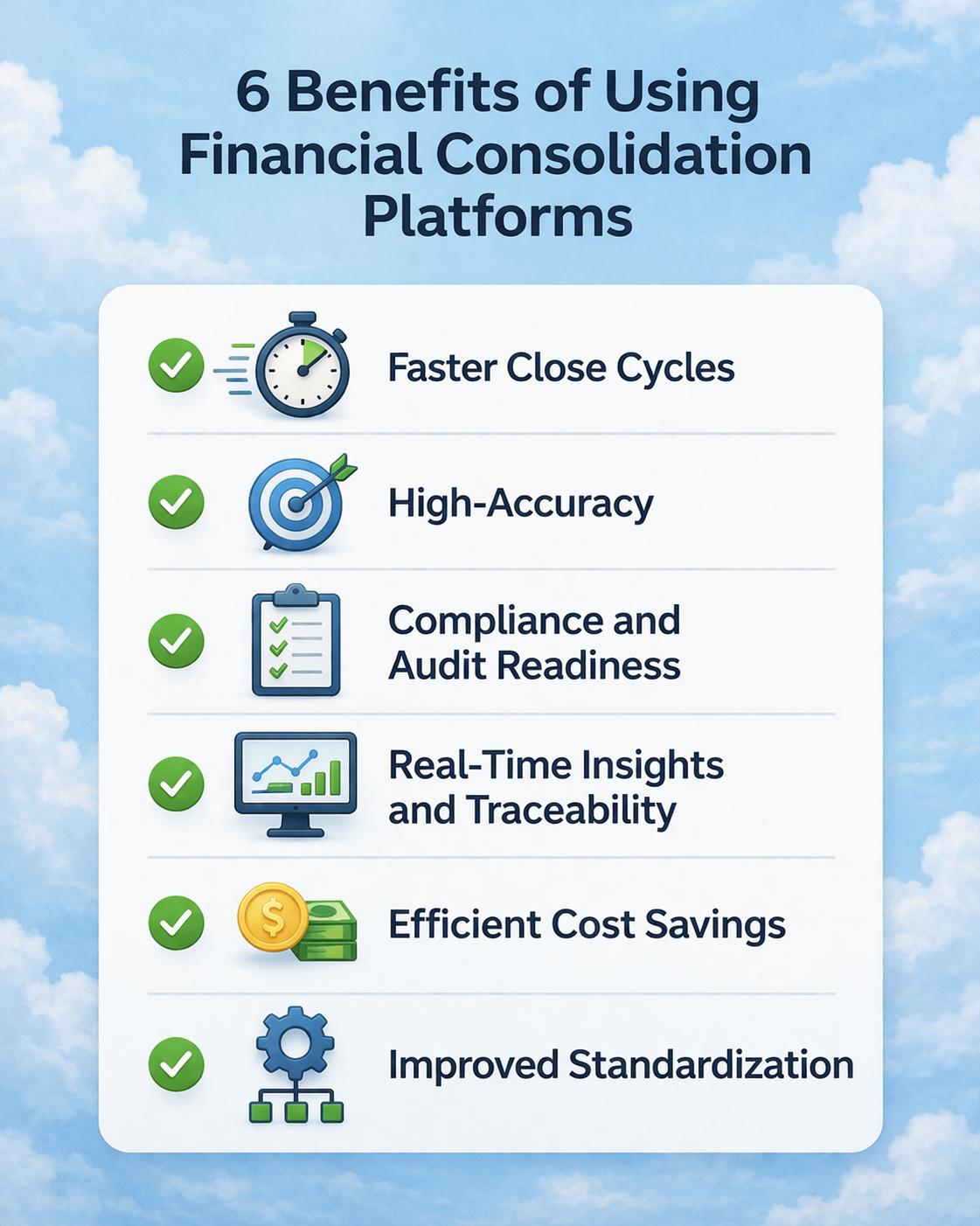
The finest financial consolidation platform delivers value by automating multi-entity reporting into streamlined and compliant processes. This reduces manual workload, boosts accuracy, and unlocks real-time insights to support treasury decisions amid complex global operations and regulations like IFRS and GAAP.
Key benefits include:
1. Faster Close Cycles
You can reduce month-end close time through automated collection, reconciliation of millions of records, and workflow routing, which is vital for banks meeting tight reporting deadlines.
2. High-Accuracy
These tools come with built-in validation, duplicate detection, and logic-based matching to prevent manual mistakes. In addition, your data will stay safe and clean from the point of entry into the system until you have final financial reports that you can trust.
3. Compliance and Audit Readiness
Full traceability, automated regulatory checks, and secure outputs with 256-bit encryption make sure that the platform is ready to handle sensitive data. They also meet global compliance standards to reduce audit prep time.
4. Real-Time Insights and Traceability
These platforms provide helpful features like live dashboards to help you track consolidated performance, exposures, and exceptions across entities.
5. Efficient Cost Savings
Leveraging technology like consolidation platforms can lower your labor costs significantly. This is possible by reallocating teams from routine tasks, and the ability to scale effortlessly without new hires or infrastructure additions.
6. Improved Standardization
Consolidation tools help you enforce consistent processes, charts of accounts, and eliminations. This simplifies acquisitions and cross-border expansions for global financial institutions.
{{banner1}}
Comparison Table for the Best Financial Consolidation Platform
Top 10 Financial Consolidation Platform for 2026
1. OneStream
OneStream offers a unified EPM platform that handles consolidation alongside planning and reporting. Enterprises gain efficiency from its all-in-one approach that scales globally.
Features:
- Automated eliminations and multi-currency translations using real-time rates.
- Journal entry workflows with approval chains and audit trails.
- Native ERP connectors with predictive analytics for forecasting.
Pros:
- Reduces multiple tools and vendor complexity.
- Strong scalability maintains performance at enterprise volume.
Cons:
- Higher learning curve for full feature utilization.
2. Planful
Planful streamlines month-end close with AI-driven insights and continuous planning. Finance teams appreciate its balance of automation and user-friendly design.
Features:
- AI-powered anomaly detection during data load and validation.
- Multi-entity consolidations with ownership percentage calculations.
- Custom reports and dashboards are exportable to PowerPoint/Excel.
Pros:
- Accelerates close cycles while maintaining accuracy.
- Integrates planning directly with actuals.
Cons:
- May require custom configuration for advanced scenarios.
3. Oracle EPM
Oracle EPM integrates well with Oracle ecosystems for enterprise reliability. It's built for organizations needing precision at a massive scale.
Features:
- Smart close tasks with configurable rules and reminders.
- Currency translations are automatically performed using historical/average rates.
- Supplemental data collection for statutory reporting.
Pros:
- Enterprise-grade stability and compliance assurance.
- Flexible deployment options, including hybrid cloud.
Cons:
- Premium pricing reflects its comprehensive scope.
4. Joiin
Joiin specializes in automated group reporting from accounting platforms. Growing firms appreciate its simplicity and speed to value.
Features:
- Direct connections to Xero, QuickBooks, and FreeAgent.
- Multi-company P&L, balance sheets, and cash flow statements.
- White-labeled reports with your branding.
Pros:
- Rapid deployment delivers value within weeks.
- Simple interface requires minimal training.
- Perfect for advisor networks serving multiple clients.
Cons:
- Limited depth for highly complex consolidations.
5. Anaplan
Anaplan excels at connected planning linked to consolidated data. It's ideal when finance needs agility across scenarios.
Features:
- Multi-dimensional modeling for what-if analysis.
- Real-time collaboration across finance and operations.
- API-first architecture for custom integrations.
Pros:
- Enables dynamic what-if planning from actuals.
- Highly adaptable to unique business requirements.
Cons:
- Requires skilled administrators for optimal use.
6. Board
Board blends consolidation with powerful BI visualization tools. Complex organizations value their decision-making capabilities.
Features:
- Offers pre-built connectors for all major ERPs.
- Write-back capabilities from interactive dashboards to source systems.
- Advanced statistical modeling and simulations.
Pros:
- A single platform eliminates Excel dependency completely.
- Democratizes data insights across the organization.
Cons:
- Interface feels dated compared to modern SaaS tools.
7. Datarails
Datarails keeps Excel's flexibility while adding enterprise consolidation. This allows spreadsheet users to transition smoothly to automation.
Features:
- Direct Excel integration with version control.
- Narrative reporting that auto-generates commentary.
- Automated variance analysis across entities.
Pros:
- 80% faster closes without changing team habits.
- Affordable entry point for growing firms.
Cons:
- May outgrow capabilities at a very large scale.
8. SAP EPM
SAP EPM powers S/4HANA group reporting natively. SAP shops gain maximum efficiency from embedded intelligence.
Features:
- Universal journal that provides a single source of truth.
- Real-time statutory consolidations by legal entities.
- Predictive close analytics identifies risks early.
Pros:
- Zero data movement between systems saves millions.
- Future-proof with embedded AI/ML capabilities.
Cons:
- Best value can only be realized within the SAP ecosystem.
9. Centage
Centage merges budgeting, forecasting, and consolidation seamlessly. It enables planning-focused teams to get holistic visibility.
Features:
- Driver-based planning tied directly to actuals.
- Unlimited scenario modeling with what-if sliders.
- NetSuite and QuickBooks optimized connectors.
Pros:
- Bridges planning and reporting gaps perfectly.
- Intuitive design needs minimal training.
Cons:
- Less specialized for pure statutory requirements.
10. LucaNet
LucaNet handles diverse international GAAP requirements effortlessly. Multi-standard environments find it indispensable.
Features:
- Simultaneous IFRS/US-GAAP/HGB reporting from one dataset.
- Flexible ownership structures and minority calculations.
- Integrated tax provision calculations.
Pros:
- Eliminates parallel accounting completely.
- Strong Excel integration maintains analyst productivity.
Cons:
- Processing speed can lag with massive datasets.
How Does Osfin Enhance Financial Consolidation Platforms?
Osfin is a leading financial reconciliation and close platform. It supercharges financial consolidation platforms for banks, financial institutions, card providers, and treasury services by delivering unmatched transactional accuracy and automation at the front end of the consolidation process.
A majority of conventional consolidation platforms struggle with raw, non-standardized data provided by subsidiaries or gateways. This is because they fall short of the functionalities needed to collect, clean, and process data from various platforms and prepare them for reconciliation.
- Finance teams know the drill - messy data from ERPs, payment processors, and international entities leads to weeks of manual cleanup before eliminations or translations can even start. Osfin flips this by acting as a precision layer atop your financial consolidation platform, starting with its file-format agnostic platform that ingests data across JSON, CSV, XML, or proprietary formats. It automatically standardizes and normalizes everything for seamless flow into consolidation workflows.
- During ingestion, Osfin applies custom deviation tolerances to filter poor-quality data right away, detecting duplicates and outliers to prevent any downstream issues that could derail your close. This foundational step guarantees 100% accurate data feeds into your consolidation engine, tailored perfectly for high-volume financial institutions managing cross-border complexities.
- Osfin's logic-based reconciliation then supports many-to-one, one-to-many, and multi-way transactions to reconcile 30 million records in just 15 minutes. This includes auto-reconciling payment gateway reports with detailed commission, tax, and fee breakdowns that are critical for treasury accuracy and intercompany matching.
- Exceptions get automatically flagged with precise reasons, escalated and routed to the right team member through its ticketing and exception handling engine. This entire process is trackable via live dashboards showing match status, exposure, and exception queues for real-time oversight.
- All outputs are then secured using reports and audit trails, which are compliant with the requirements. These features provide complete traceability and a detailed transaction history. They secure data through 256-bit encryption, role-based access controls, and two-factor authentication. Osfin also complies with SOX, PCI-DSS, ISO 27001, and GDPR.
{{banner1.1}}
How to Choose the Right Financial Consolidation Platform?
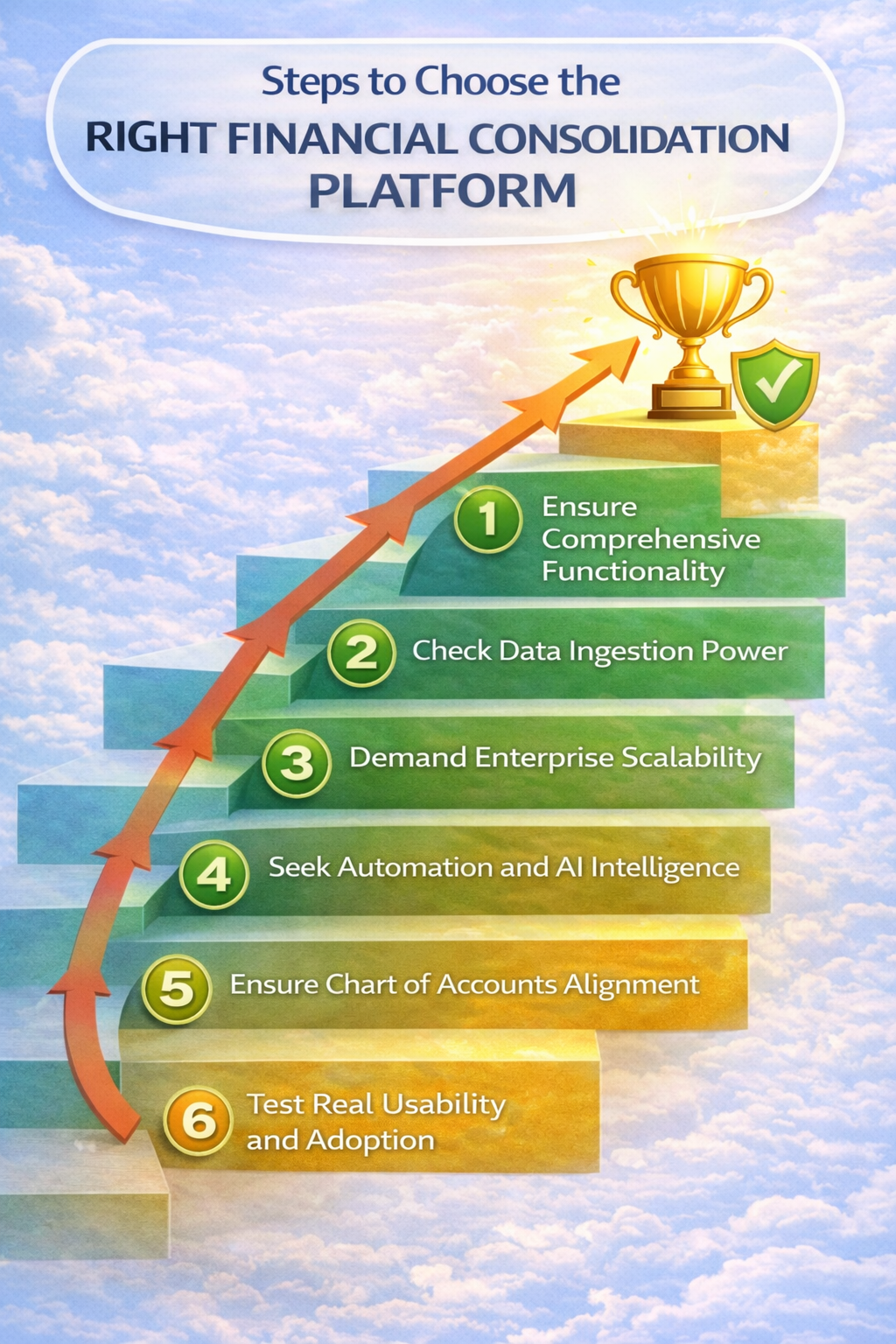
Choosing the best financial consolidation platform is a big decision for banks and financial institutions dealing with multi-entity data, tight deadlines, and strict regulations.
The process gets simpler when you focus on enterprise-grade capabilities that scale with growth, integrate smoothly, and deliver ROI through faster closes. Follow these steps to choose wisely:
- Ensure Comprehensive Functionality: The very first step is performing a complete assessment of your true financial position by tracking your monthly revenues against all monthly expenses, intercompany eliminations, total debt, unallocated capital, and exact currency translations.
- Check Data Ingestion Power: You need a platform that effortlessly connects to ERPs like SAP, Oracle, or NetSuite, and offers APIs to establish connection links. Avoid tools that create data silos that slow your entire financial close process.
- Demand Enterprise Scalability: The platform must handle unlimited entities and reports as your bank grows through M&A. It should be able to process high volumes of records without performance drops or costly reconfigurations.
- Seek Automation and AI Intelligence: With advancements in financial automation technology, you should look for AI-powered anomaly detection that eliminates a significant part of manual work, and user-friendly interfaces for your team.
- Ensure Chart of Accounts Alignment: Choose solutions with auto-mapping that learns from historical data, standardizing accounts across units to eliminate reconciliation headaches upfront.
- Test Real Usability and Adoption: Another exercise is to run a proof-of-concept with your actual data to confirm intuitive design, minimal IT dependency, and quick onboarding.
Trends in Financial Consolidation Platform for 2026
Financial consolidation platforms are changing rapidly to meet the growing needs of financial services, which are governed by various global regulations. Such growing needs include handling large amounts of data and processing it accurately to facilitate decision-making in real time.
Key trends shaping financial consolidation platforms in 2026:
- AI integration and cloud scalability currently dominate the market by reducing close times and embedding predictive analytics for proactive treasury management. Machine learning also automates elimination, anomaly detection, and revenue forecasting, resulting in a significant percentage of error reduction and scenario modeling of treasury stress tests.
- Cloud-based solutions provide real-time multi-GAAP consolidations of hundreds of entities, with multiple currencies and live dashboards that are replacing batch processing.
- Format-agnostic reconciliation platforms like Osfin are facilitating logic-based matching for 30 million records in 15 minutes, and exception ticketing, which is vital for banks.
- Technologies are built with IFRS 18 compliance in mind, and tamper-proof blockchain audit trails. ESG reporting integration is also added to ensure transparency amid CSRD mandates.
- Deep integration APIs with payment gateways auto-reconcile commissions, taxes, and fees, to support hybrid workflows for global institutions.
Final thoughts
Financial consolidation platforms transform how banks, financial institutions, card providers, and treasury teams manage multi-entity reporting with speed, accuracy, and compliance for IFRS/GAAP standards.
Osfin, with its automated reconciliation capabilities, further enhances the consolidation process. It pulls data via more than 170 format-agnostic integrations, cleans with custom tolerances, and reconciles 30 million records in 15 minutes using logic-based matching. It ensures 100% accuracy, flags exceptions with ticketing and dashboards, and delivers secure, compliant reports.
To achieve faster and error-free consolidations, schedule a demo with Osfin today!
FAQs
1. What is a financial consolidation platform?
A financial consolidation platform is a tool that helps you automate data collection from your subsidiaries into unified statements. It also handles eliminations, currency translations, and compliance with IFRS or GAAP. You'll get accurate group reports faster, saving weeks of manual work.
2. What are the differences between a financial consolidation platform and accounting or ERP systems?
A financial consolidation platform is designed to aggregate multiple entities, handle intercompany eliminations, and comply with regulatory requirements, unlike accounting or ERP systems, which are designed to process day-to-day transactions.
3. What are the key features I should look for while choosing a financial consolidation platform in 2026?
The key features to look for while choosing a financial consolidation platform in 2026 are AI-driven automation, cloud-native architecture, and integration with ERP systems.
4. What are the top 10 financial consolidation platform?
The top 10 financial consolidation platforms in 2026 are Oracle EPM, Planful, OneStream, Joiin, Anaplan, Board, Datarails, SAP EPM, Centage, and LucaNet. Osfin supports consolidation processes with accurate and fast financial reconciliation for banks.