Financial Reconciliation for Fintechs: Process, Challenges & Solutions
Every day, in a financial system, an accountant makes some or the other form of error. In fact, according to Gartner, 70% of them do, daily. Another study shows that 94% of spreadsheets used for business decisions contain mistakes.
For fintechs processing millions of transactions daily, these error rates can be a huge cause of concern. Beyond the immediate financial impact, these financial errors can damage your credibility and erode stakeholder trust. Not to mention the increased risk of regulatory penalties and scrutiny.
The best way to counter these challenges is by performing financial reconciliation. A process that compares records from different sources and makes sure they match. If done manually, however, it can be slow and full of errors.
This is where automated solutions like Osfin hold promise, helping teams reconcile more accurately and with far less effort.
In this article, we define financial reconciliation for fintechs, explore its types, outline the step-by-step process for performing it, and explain how Osfin stands out as the best reconciliation software for fintechs.
What is Finance Reconciliation in Fintech?
Finance reconciliation for fintech refers to the process of matching financial records in your internal database with those present in external databases.
In the case of fintechs, the internal records usually represent their internal ledger systems. And the external datasets include records from payment networks, switches, and processors.
The goal of financial reconciliation is to ensure there are no discrepancies between internal and external records. During the matching process, any discrepancies are identified, their root causes are analyzed, and the mismatches are promptly corrected to maintain accuracy.
Financial reconciliations are quite different from a simple balance check. A balance check is a quick verification where you compare total amounts between two systems. Reconciliation in finance, on the other hand, goes much deeper by matching every individual transaction between systems.
Why Financial Reconciliation is Critical for Fintech Companies
The role of financial reconciliation can be gauged from the following points:
Accurate financial reporting: With financial reconciliation done, your transactions are recorded correctly across all of your systems. That translates to zero discrepancies between internal and external records.
Regular audits: Reconciled accounts mean clean, traceable records: a basic necessity for audits. Along with that, reconciliation lowers the time and money that’s needed for preparing audits, keeping down the risk of penalties.
Better decision-making: Correct data forms the base of important business decisions. And without reconciliation, data inconsistencies can distort key metrics, which undoubtedly lead to flawed decisions.
Stellar customer experience: Just like in any other industry, fintech keeps customer expectations at the forefront. Reconciliation backs this as customers view the same data that the company has on record. What’s more, with regular reconciliation, customer-facing teams can identify and resolve discrepancies, reducing complaints and improving satisfaction.
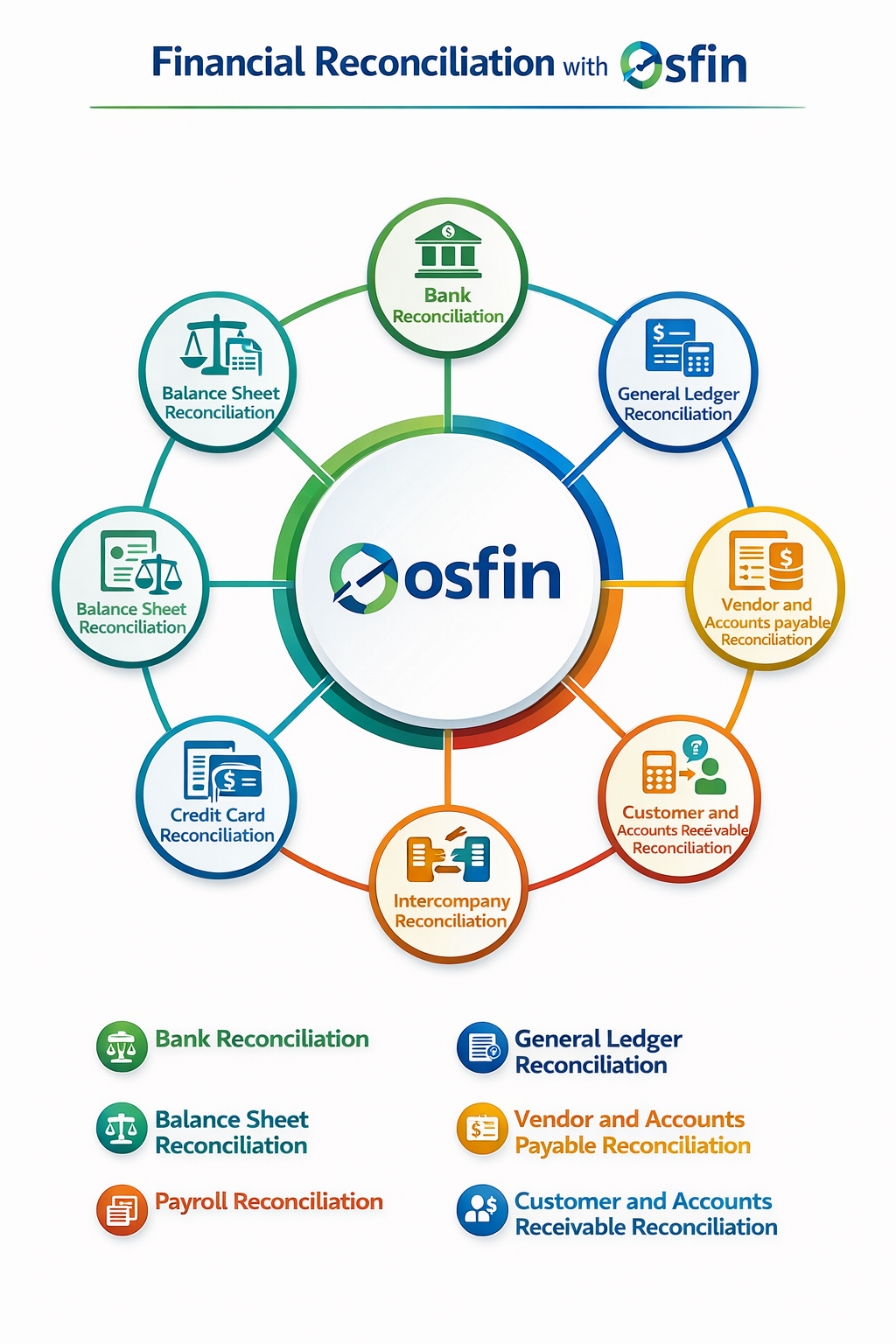
Types of Finance Reconciliation
Common Financial Reconciliation Challenges Faced by Fintechs
While doing reconciliation, fintechs have to often face challenges that can hinder the accuracy and completeness of the process. These include:
1. Varied Data Sources
Fintech companies rarely work with just one system. Data flows in from payment gateways, banking file, internal ledgers, third-party processors, and more. Manually getting all of these sources in the same format is quite a hurdle in reconciliation.
2. Data Entry Errors
Humans make mistakes. That’s bound to happen. But mistakes that might seem minor at first, in a high-volume fintech environment, can pile up quickly. The tricky part is that they often don't surface until much later, making them harder to trace and correct.
3. High Volume of Transactions
Fintech companies process an enormous number of transactions every single day. Reconciling each one manually simply isn't feasible at scale. The sheer volume increases the likelihood of mismatches and is usually where the legacy tools like Excel begin to fail.
4. Timing Differences
Not every transaction settles the moment it's initiated. Payments can take days to clear, bank statements may lag behind internal records, and different systems update at different intervals. These timing gaps create temporary discrepancies that, while often harmless, still need to be identified, explained, and tracked carefully to avoid confusion.
5. Inefficient Communication Between Teams
Reconciliation isn’t something that just burdens the finance team. It touches operations, compliance, customer support, and technology teams too. When these teams work in silos or rely on back-and-forth emails to resolve discrepancies, the process slows down to a great extent. Miscommunication or delayed responses, then, become quite common, and can easily turn a simple mismatch into a prolonged investigation that nobody seems to have time for.
Manual vs Automated Reconciliation for Fintechs
Manual reconciliation has finance teams buried in spreadsheets, cross-checking rows of data line by line, hoping they don't miss something critical. And more often than not, they do. Because that's the reality of asking humans to repeatedly perform a task that is tedious by nature and unforgiving of even the smallest mistake.
As transaction volumes grow, the process gets exponentially harder. The same team managing reconciliation at 10,000 transactions a month will find themselves completely overwhelmed at 100,000. It's slow, error-prone, and pulls talented people away from the strategic work that actually moves the business forward.
Automated reconciliation changes all of that. Here's a side-by-side look at how the two approaches compare:
How Automation Solves Fintech Reconciliation Complexity
Automation basically involves the use of advanced technologies to carry out tasks like integrating data from multiple sources, converting to the same format, matching it across systems, verifying, and aligning it all. In reality, this is how automation addresses various reconciliation complexities:
1. Pulling Data From Everywhere, Seamlessly
Fintechs deal with data scattered across payment gateways, banking files, internal ledgers, and third-party processors. Automation connects all of these sources through intelligent integrations, pulling data in automatically and standardizing it into a consistent format.
2. Eliminating the Human Error Factor
When machines handle data matching and verification, the margin for error drops. Automation applies the same rules, every single time, without getting tired or distracted. Duplicate entries, miskeyed figures, and miscategorized transactions, basically, the usual suspects in manual reconciliation, become far less of a concern.
3. Keeping Up With Transaction Volume
No matter what the volume of your transactions is, automation scales effortlessly alongside your business, ensuring that growth never becomes a reconciliation challenge. What would take a finance team days to work through manually gets resolved in minutes.
4. Bridging Timing Gaps Intelligently
Automation can identify when a payment is still in transit, track pending settlements, and reconcile entries across different update cycles without treating every gap as an error. This is also where the open set concept becomes quite critical, where any unreconciled transaction is kept active and continues to perform across subsequent reconciliation cycles until it is successfully matched. The upside is that timing delays between when a transaction is initiated and when it settles do not disrupt or stall the broader reconciliation process.
5. Delivering Real-Time Financial Visibility
Instead of waiting for end-of-day reports or batch updates, automation provides a live view of the fintech's financial position. Discrepancies are flagged the moment they appear, giving teams the ability to investigate and resolve issues before they gravitate towards bigger problems.
6. Breaking Down Team Silos
Automated reconciliation means everyone works with the same centralized, up-to-date data. Different teams no longer need to chase each other for information or wait on email threads to resolve discrepancies.
And it goes further. Reconciliation engines come with built-in exception handling workflows that automatically flag anomalies and send targeted alerts directly to the responsible parties. This means the right person gets notified the moment something looks off.
The Finance Reconciliation Process for Fintechs (Step-by-Step)
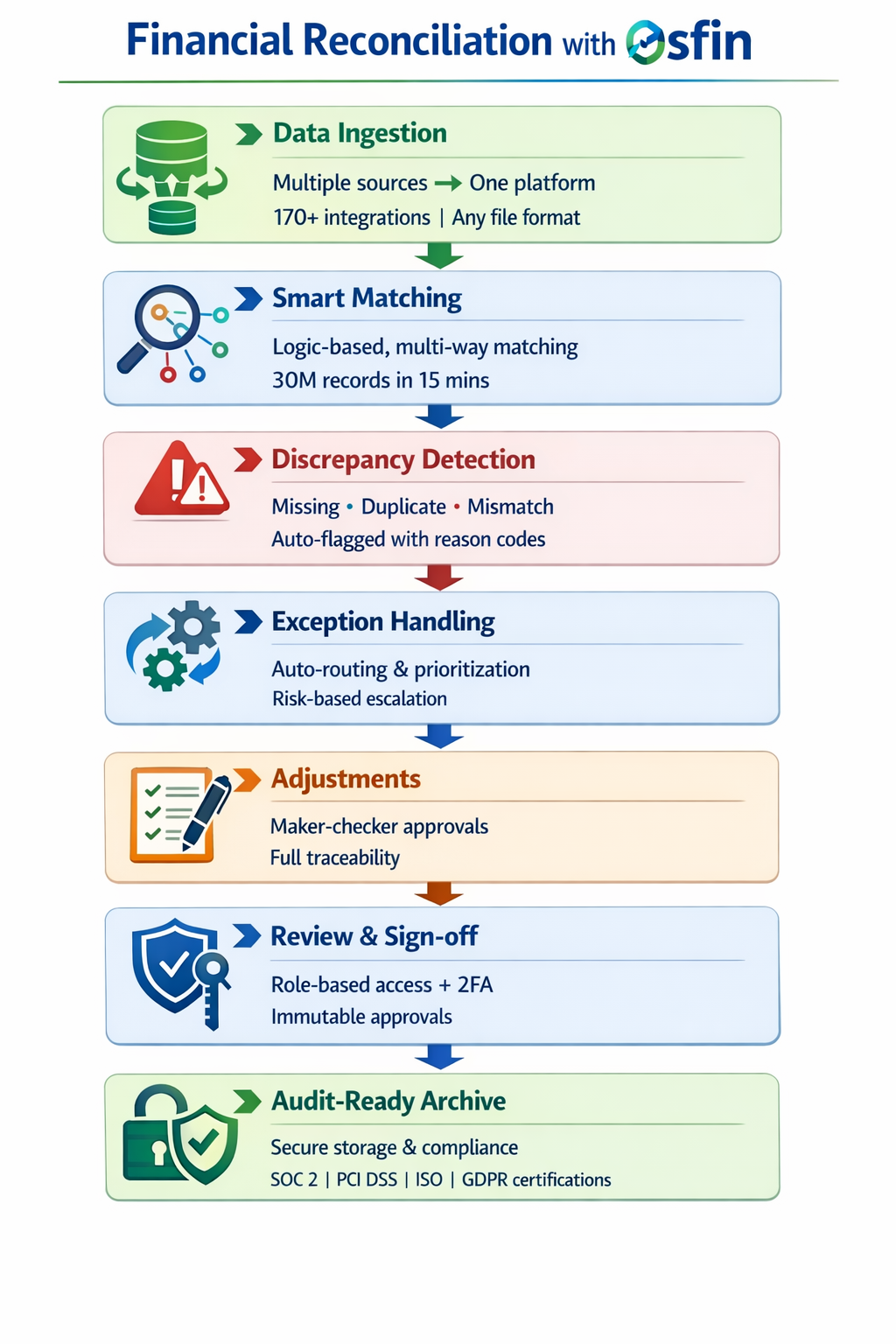
Given below is a complete step-by-step workflow of a financial reconciliation process with Osfin:
Step 1: Data Collection & Preparation
To begin with, all relevant financial data from multiple sources is gathered. You have to extract your internal records, which contain all transactions processed through your platform. Simultaneously, you need to collect external data from payment networks, card schemes, switches, processors, SWIFT and ACH networks, etc.
With reconciliation platforms like Osfin, you can completely avoid the manual effort of data collection. Leveraging its 170+ integrations, it automatically pulls data from multiple sources regardless of the file format.
It’s a file-format agnostic platform, meaning it can handle data in almost every financial format. Be it MT940, ISO 20022, BAI2, XML, CSV, TXT, or JSON. What’s more, during ingestion itself, Osfin applies custom deviation tolerances to flag poor-quality data before it enters the reconciliation process and detects duplicates and outliers at the point of entry. This means minimal chances of discrepancies during matching.
{{banner3}}
Step 2: Transaction Matching
Once the data is ready, the actual matching begins. Transactions are compared line by line between internal and external sources. Each transaction has to be reviewed in such a way that key details like date, amount, reference number, and description, match exactly. And if there are any errors found during this process, they are marked for further investigation and resolution.
With Osfin, the whole matching process becomes much simpler. Its logic-based no-code rule engine takes care of complex reconciliation scenarios that would otherwise take hours of manual work, effectively removing reliance on tech teams. It easily handles many-to-one and one-to-many transactions, and even supports multi-way reconciliations, whether that’s two-way, three-way, or more.
Osfin can reconcile around 30 million records in just 15 minutes. Manually, that’s something that can take days.
Step 3: Identifying Discrepancies
This is where the core of the process really begins. At this stage, the two or more sets of data are matched and any unmatched items are reviewed. Fintech Banks usually divide these discrepancies into:
- Missing transactions that appear in one system but not the other
- Duplicate entries recorded multiple times
- Mismatched items where details like amounts or status differ
Step 4: Investigating Differences
The discrepancies identified earlier have to be investigated for their root causes.
Osfin’s ticketing and exception handling engine automatically informs the appropriate team member about the unmatched transactions. The upside for you is that you don’t have to manually sort and assign exceptions. The system itself escalates high-priority items and ensures accountability through tracked workflows.
Step 5: Making Adjustments and Corrections
Depending on what the investigation reveals, you’ll have to make necessary corrections to match all records. You might have to adjust entries in your internal ledgers, reverse duplicate transactions, or record previously missing items.
Osfin maintains full traceability throughout the adjustment process with detailed transaction history and audit trails. Its maker–checker workflow requires dual authorization before being finalized. This way, there are no unauthorized changes.
Step 6: Reviewing & Approvals
Another best thing about Osfin is automatic generation of detailed compliance reports, which completely bypasses the need to gather information manually. The reports give a proper summary of reconciliation results, the exceptions that are outstanding, and all adjustments made during the period.
Add to that the platform’s role-based access controls that allow only authorized senior managers to access the approval function. And 2FA adds another security layer.
After approval, all sign-offs are recorded with the reviewer's identity, the time it was done, and the exact state of the reconciliation at that moment, so an immutable audit trail is created.
Step 7: Documenting Everything
Osfin’s ability to automatically maintain audit-ready workflows with complete documentation comes in handy here. Combined with that is solid data protection with 256-bit encryption both at rest and in transit, and the platform complies with SOC 2, PCI DSS, ISO 27001, and GDPR requirements.
{{banner1}}
Use Cases by Fintech Type
Every fintech company needs to reconcile the data they have to deal with. But what they reconcile and why looks quite different depending on what they actually do. So, here we are breaking down what reconciliation looks like for different types of fintechs:
- Payment Processors & Gateways: For payment gateways and processors, reconciliation happens for thousands of individual transactions batched into settlement files received from card networks or acquirers. They must reconcile that consolidated settlement figure against every transaction processed, accounting for their own fees, interchange costs, chargebacks, and refunds along the way.
- Lending Platforms: Reconciliation here tracks loan disbursements, repayments, collections, interest calculations, and fees across multiple borrowers and funding sources. Even small discrepancies in repayment or collection records can have serious compliance and reporting implications.
- Insurance Fintechs: For insuretechs, premium collections, claim payouts, and refunds, all need to reconcile cleanly across multiple policy types and payment schedules. Especially when third-party underwriters are involved.
- Crypto & Blockchain Platforms: The primary reconciliation challenge here centers on user deposits and withdrawals. This usually involves ensuring every asset a user deposits on-chain is accurately reflected in their internal platform balance. And that every withdrawal processed off-chain matches the corresponding on-chain transaction. Other than that, these platforms also deal with volatile asset values and, wallet balances, across on-chain and off-chain records.
Wrapping Up
Finance reconciliation involves matching internal financial records against external sources to ensure accuracy and eliminate discrepancies. The reconciliation process, from data ingestion and transaction matching to exception handling and final reporting, forms the backbone of financial integrity and regulatory compliance.
Without reconciliation, errors might go unnoticed, regulatory violations can occur, and your stakeholders can doubt your credibility. It allows you to confidently report your financial position, detect fraud, and maintain operational control.
Where manual reconciliation is painstakingly slow and vulnerable to errors, Osfin delivers speed, 100% accuracy, and easy-to-manage reconciliation workflows.
Join fintechs reconciling billions in transactions seamlessly. Book your Osfin demo now!
FAQs
1) What is reconciliation in fintech?
Finance reconciliation is the process that involves matching your bank's internal transaction records with external sources like payment networks and processors to catch errors. This ensures accuracy and keeps your financial data trustworthy and compliant.
2) How often should fintechs reconcile transactions?
Ideally, fintechs should perform reconciliation daily. They deal with high volumes of transactions, so it gets easier to catch discrepancies and minimize exposure.
3) Can fintechs reconcile in real time?
Fintechs using modern reconciliation platforms can reconcile at real-time or near-real time speed. These systems provide continuous oversight of a fintech's financial position, enabling reconciliations as transactions occur.
4) Why do fintechs need automated reconciliation?
Fintechs move fast and handle a lot of money. Doing reconciliation manually at that speed and scale is impossible. Automated reconciliation keeps everything accurate, flags problems instantly, and frees up the finance team to focus on work that actually grows the business.
5) Is reconciliation required for regulatory compliance?
Regulators expect fintech companies to maintain clean, traceable, and up-to-date financial records at all times. Without consistent reconciliation, gaps and discrepancies in your books can trigger audit findings, penalties, or worse, loss of your operating license. So, yes, reconciliation is extremely necessary to keep your fintech compliant with regulatory frameworks.