Invoice Discrepancies: Causes, Examples & How to Fix Them (2026 Guide)
Reconciliation issues more often than not stem from problems that occur long before a transaction reaches the ledger.
Invoices feed into billing systems, settlement instructions, tax calculations, and internal records. When information from these invoices move down your systems, it is automatically treated as the source of truth. Every error and mismatch gets recorded across all of your files, ledgers and reports.
As a bank or financial institution, this creates avoidable operational friction. Reconciliation teams spend time investigating breaks, clearing exceptions, and tracing issues back through multiple systems, only to discover that the root cause lies upstream.
In this article, we explain what causes invoice discrepancies, the types that commonly show up in financial operations, and how they translate into reconciliation breaks across all of your records.
What Are Invoice Discrepancies?
Invoice discrepancies happen when an invoice processed by you does not align with what is recorded and settled across all of your financial systems. This may be a difference in amounts, tax components, currencies, dates or any reference information.
Once an invoice is added to the system, these inconsistencies can move forward and show up in your settlement and reconciliation processes.
Why Invoice Discrepancies Are Increasing Today
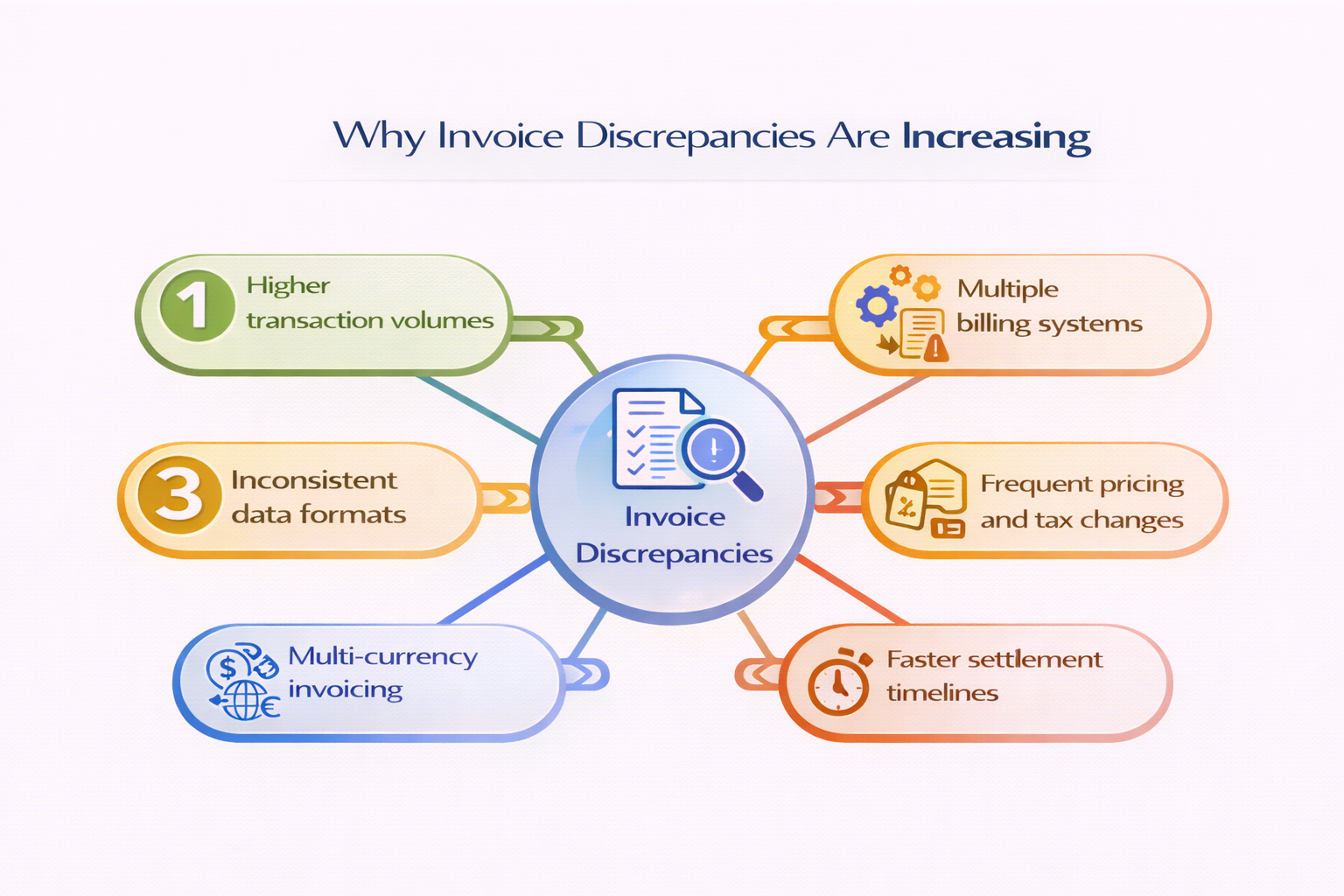
Now, financial operations are more distributed than ever. This means you may not be handling a single source of billing data but multiple input points that feed into your systems across various platforms.
Here is why invoice discrepancies are growing in number today:
- Transaction volumes are up and this in turn increases the chances of minute data mismatches that go unnoticed.
- Invoices are generated across multiple systems. Each of these systems may follow different data formats and validation rules.
- Pricing, fee and tax changes may not be consistently updated across your systems, which means each system records a different set of data.
- Multi-currency invoicing introduces rounding, FX rate, and conversion differences, these can be a source of confusion.
- Most businesses promise faster settlement timelines. This leaves little time for upstream corrections before posting.
Common Causes of Invoice Discrepancies
Invoice discrepancies are usually caused by small issues and gaps in data, timing records and more. These issues compound over time and create issues in settlement and reconciliation processes.
Here are some of the most common causes of discrepancies:
1. Manual data entry and human errors
Most errors in invoice processes usually enter at manual touchpoints. Activities such as invoice creation, corrections, or approvals often involve human input. These stages can introduce typographical errors, missing fields, or incorrect values that later disrupt reconciliation.
2. Misalignment between invoices and reference data
Invoices are expected to align with agreed pricing per vendor/merchant, tax structures, fee models, or contractual terms. When updates to rate cards, pricing logic, or tax rules are not reflected consistently across systems, invoices begin to drift from reference data. These differences may be minor at the document level but can trigger repeated exceptions during reconciliation.
3. System and integration inconsistencies
Invoices are often generated by merchant platforms, processors, or partner systems rather than a single internal system. Differences in data formats, rounding logic, currency handling, or file structures can create inconsistencies as invoice data flows into ledgers and reconciliation tools.
4. Timing gaps and processing delays
Invoice issuance does not always align with transaction execution or settlement timelines. Late invoices, backdated corrections, or reissued documents can clash with already-posted transactions. This timing gap creates situations where transactions reconcile correctly in isolation, but fail when matched against invoice-driven expectations.
5. Duplicate or revised invoices
If you allow reissued or corrected invoices to enter your system without proper versioning, it will add to errors in the invoice processing cycle. Without document control and versions you will not be able to see which invoice is the actual final version that needs to be processed.
6. Currency and FX discrepancies
Invoices raised in one currency and settled in another can introduce mismatches. Differences in exchange rates, conversion timing, or rounding logic can cause invoice amounts to vary from settlement figures, even when transactions are processed correctly.
What is the Hidden Cost of Invoice Discrepancies?
Invoice discrepancies do not stop at the invoice itself. When flawed data enters your invoice processing workflow, it pollutes all the steps downstream. You will first see this issue crop up in your reconciliation cycle. This will force your team to dig through all prior documents and invoices to locate the root cause of the mismatch.
If a mismatch or exception in your invoices is not cleared quickly, it becomes an open item that you have to carry forward. This means that every time you enter a new reconciliation period, your team has to re-examine unresolved issues from previous cycles.
How are Invoice Discrepancies Handled Traditionally?
Traditionally, if an invoice discrepancy is flagged, your team would usually pick it up manually and try to track down the source of the error. Here is the process that is usually followed:
- Reviewing invoice details against contracts, rate cards, and settlement records to identify mismatches
- Exchanging emails and clarifications with merchants, partners, or internal teams to confirm or correct invoice data
- Tracking open discrepancies and follow-ups using spreadsheets or shared documents.
- Posting manual adjustments or corrections in downstream systems to close reconciliation breaks.
This hands-on approach may work for you if you are handling a small number of invoices. However, when your transaction volume increases, your reconciliation cycle can stretch from days to weeks, and becomes difficult to scale. Also, the heavy reliance on human intervention to resolve errors can introduce other human errors into your system.
{{banner1}}
How Can You Prevent Invoice Discrepancies?
Preventing invoice discrepancies starts upstream, before incorrect data has a chance to flow into settlement and reconciliation processes. Here are some ways you can reduce the volume of discrepancies that crop up downstream:
1. Standardise invoice data formats across systems
Create a standard template that you can use for invoices. Keep this standard across your systems and departments. This helps you keep consistent structures for amounts, dates, tax fields, and references, which makes both processing and spotting errors a lot easier. Standardisation can also reduce the number of errors that occur when your data moves between platforms and tools.
2. Align invoices closely with contracts and pricing logic
Your invoices should be created by polling values directly from your approved rate cards, fee models and current tax rules. Connect your systems in a way that values are feeded from one platform to the other automatically without any manual intervention. This way you’ll see fewer errors occurring downstream.
3. Introduce validation checks at the point of invoice creation
If you have a large volume of invoice discrepancies getting flagged during every reconciliation cycle, you need to introduce multiple validation check points during the invoice creation process. These validation points can help double-check for missing fields, incorrect totals or any currency and tax mismatches.
4. Maintain clear version control for revised invoices
Version control is non-negotiable when dealing with revised invoices. Create versioning and documentation systems that your team can use when handling multiple revised invoices to help them identify which document is the final, valid record that should be processed.
5. Improve visibility into invoice changes
You should be able to track exactly when and how invoice data is modified and who is making these changes. This will help trace discrepancies quickly and also will help you identify which fields or processes are contributing to errors that need to be manually corrected every time. You can then set up additional validation rules to prevent these recurring errors that hold up invoice processing.
How to Resolve Invoice Discrepancies Using Automation
Automating your processes can help you shift gears from reactively cleaning up errors to resolving issues even before they show up downstream. Automation allows you to compare invoice-driven expectations against actual transactions across ledgers, CBS, and payment rails in real time, instead of spending hours manually searching for mismatches.
You can set up automated rules that flag amount variances, tax errors, and duplicate invoices immediately. Once these discrepancies are properly tagged and categorized, they can be automatically routed for review without relying on manual handover processes that take time. Automation, when applied consistently, helps your teams identify recurring error patterns. This means you can take steps to correct the issue upstream and reduce exception volumes in your reconciliation cycle.
How Osfin Helps Eliminate Invoice Discrepancies
Invoice discrepancies may originate upstream, but they surface most clearly during payments and financial reconciliation. Osfin addresses this problem by giving banks and financial institutions a structured way to detect, isolate, and resolve invoice-led mismatches across systems without relying on manual workarounds.
Osfin starts by strengthening data quality at the point of ingestion. It is a file format–agnostic platform with 170+ pre-built integrations that allow you to import data from multiple sources, including internal systems, processors, and payment rails, regardless of file format. During ingestion, Osfin applies custom deviation tolerances to filter poor-quality data early and detects duplicates and outliers before they move downstream and create reconciliation breaks.
Once data is ingested, Osfin applies custom logic-based matching to reconcile invoice-driven expectations against actual transaction records. It supports one-to-one, one-to-many, many-to-one, and multi-way reconciliations, including two-way, three-way, four-way, and five-way scenarios. Osfin can reconcile up to 30 million records in 15 minutes and automatically reconciles factoring in different vendor/merchant contracts, commission, tax, and fee breakdowns.
For transactions that do not match, Osfin takes care of exception handling. Unmatched records are automatically flagged and assigned an accurate reason code. These exceptions are escalated and routed to the right team members through Osfin’s built-in ticketing and exception handling engine.
Osfin provides real-time dashboards and configurable reports that give teams clear visibility into reconciliation status, exception volumes, ageing, and resolution progress. Teams can track open items across periods, monitor trends, and identify recurring discrepancy patterns without pulling data from multiple systems or spreadsheets.
Finally, Osfin closes the loop with secure, audit-ready outputs. It delivers compliance-ready reports and maintains complete traceability with detailed transaction history and logs. Data is protected using 256-bit encryption, maker-checker workflows, role-based access control, and two-factor authentication. Osfin complies with SOC 2, PCI DSS, ISO 27001, and GDPR requirements, supporting strong governance across financial operations.
Book a demo to see how Osfin.ai can reduce exceptions, speed up reconciliation cycles, and strengthen financial control.
FAQs
What is an invoice discrepancy?
An invoice discrepancy happens when invoice details like the amount, tax, fees, currency, or references do not align with expected values in your downstream systems. These differences and errors can surface later on and create longer exception cycles in your reconciliation process.
How do invoice discrepancies affect reconciliation?
Invoice discrepancies can create minute mismatches between expected and actual transaction values. These errors show up as value variances and open up exceptions across ledgers and settlement files. This can increase your invoice processing time.
Are invoice discrepancies always caused by invoice errors?
No, invoice errors are not the only source of discrepancies. Some issues may originate from invoice data, while others may be a result of timing issues, system integration issues, currency conversion changes or inconsistent reference data that moves across your system.
Why do invoice discrepancies keep recurring?
Discrepancies in your invoicing processes can keep recurring if you do not identify and fix the root cause of the issue. Fixing only the error manually when it reaches downstream may be possible at smaller volumes. However, as volumes grow, manual fixing may not be practical or possible.
Can invoice discrepancies delay settlement and reporting?
Yes, unresolved invoice-led mismatches can delay settlement closure, carry open balances across periods, and increase effort during financial reporting and audit reviews.