Intercompany Accounting with Agentic AI: A Complete Guide
Intercompany accounting is one of the most complex aspects of enterprise accounting. It is an intricate web of transactions, relationships and data from a variety of sources and in different formats. As financial institutions take steps towards globalization, it is a need of the hour to implement intelligent, efficient solutions.
We also see that AI maturity in finance operations has grown significantly over time. And agentic AI places us at a pivotal point, taking us to the future of automation in the finance industry and its reconciliation operations.
This article is a detailed guide for intercompany accounting with agentic AI and the future of autonomous agents in financial reconciliation.
What does Intercompany Accounting with Agentic AI mean?
Agentic AI works as a collaborative team of independent software agents that work towards specific goals, such as balancing intercompany ledgers across borders. These agents reason, plan, and act on data from GL, AR, AP, and invoices without constant human direction. These agents also collaborate. One handles data pulls, another performs transaction matching, and the third one performs reporting.
They learn from each cycle and improve accuracy on patterns such as delayed settlements. If any major issues are detected, they escalate them for review.
Here, an agent scans one entity's payables against the other entity's receivables. It matches payments, flags FX mismatches and makes adjustments to ensure compliance.
What Makes Agentic AI Different from RPA and Traditional AI?
Agentic AI differs from RPA and traditional AI because of its autonomous, 'observe-think-act' loops. It is goal-driven and competent to make decisions on its own. On the other hand, RPA follows rigid, scripted rules for repetitive tasks. And traditional AI can only perform predefined functions.
From Task Automation to Goal-Driven Execution
RPA can automate simple, repetitive tasks with fixed rules. For example, copying data from one spreadsheet to another.
Agentic AI shifts this basic automation to goal-driven execution, in which you can give direct commands like 'reconcile all intercompany AR/AP balances,' to the agent, and it plans its own steps, adapts to new data, and completes the job. This autonomy helps you cut down on time and stage entirely automated workflows.
Multi-Agent Collaboration in Finance
You can only analyze and predict with traditional AI, just as you can flag potential mismatches. That's how limited its functionality is, and it lacks collaboration. RPA also runs solo scripts without any collaborations.
Agentic AI overcomes this limitation by using multi-agent collaboration. Here, one agent draws GL data from one commodity, while another matches it against another entity's AP. The third agent is for resolving the FX differences.
Continuous Learning Within Guardrails
RPA never improves as it never learns. If you redo a rule change, you end up reprogramming it. RPA doesn't support learning at all. So if you redo a rule change, you indirectly end up reprogramming it entirely. On the other hand, though traditional AI can improve its predictions with more data, it lacks the capacity to act.
Agentic AI learns continuously within the set guardrails to offer and develop its autonomy. It reviews all past intercompany reconciliations, refines the matching logic going forward, and remains compliant with SOX and other international rules. Over the months, you can observe that auto-match rates climb up as agents learn to recognize patterns in invoice delays or currency swings.
The finance team must set boundaries or define rules to guide the agent through the automated learning process. For this, you need to set approval thresholds for large discrepancies, overall control, and agents that evolve over time.
{{banner3.1}}
How Agentic AI Enhances Intercompany Accounting
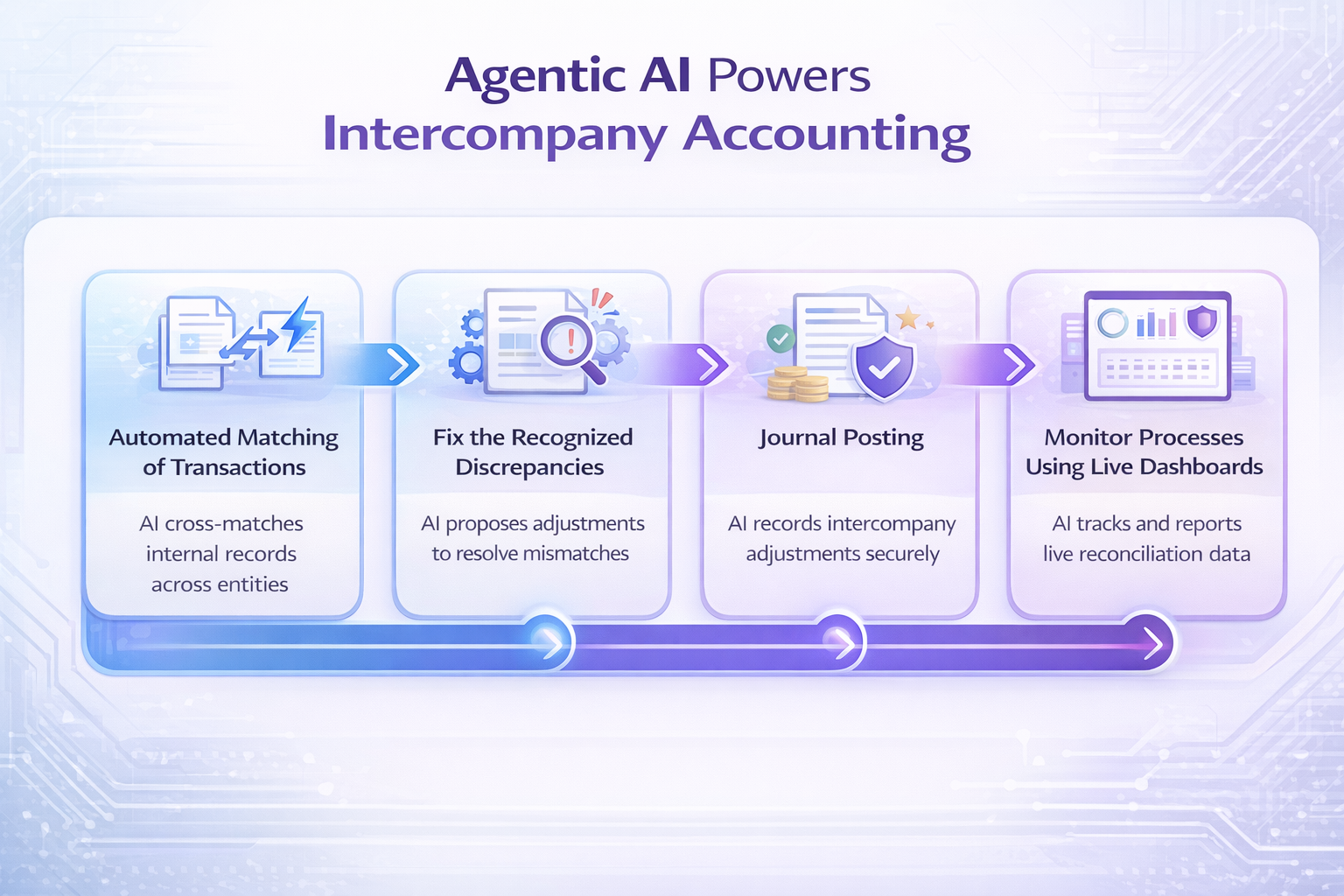
Intercompany accounting gets simplified with the integration of agentic AI. These offer autonomous and self-learning systems that can continuously manage complex transactions. This advancement eliminates unnecessary manual effort and errors, speeding up the financial close process.
Automated Transaction Matching & Reconciliation with Agentic AI
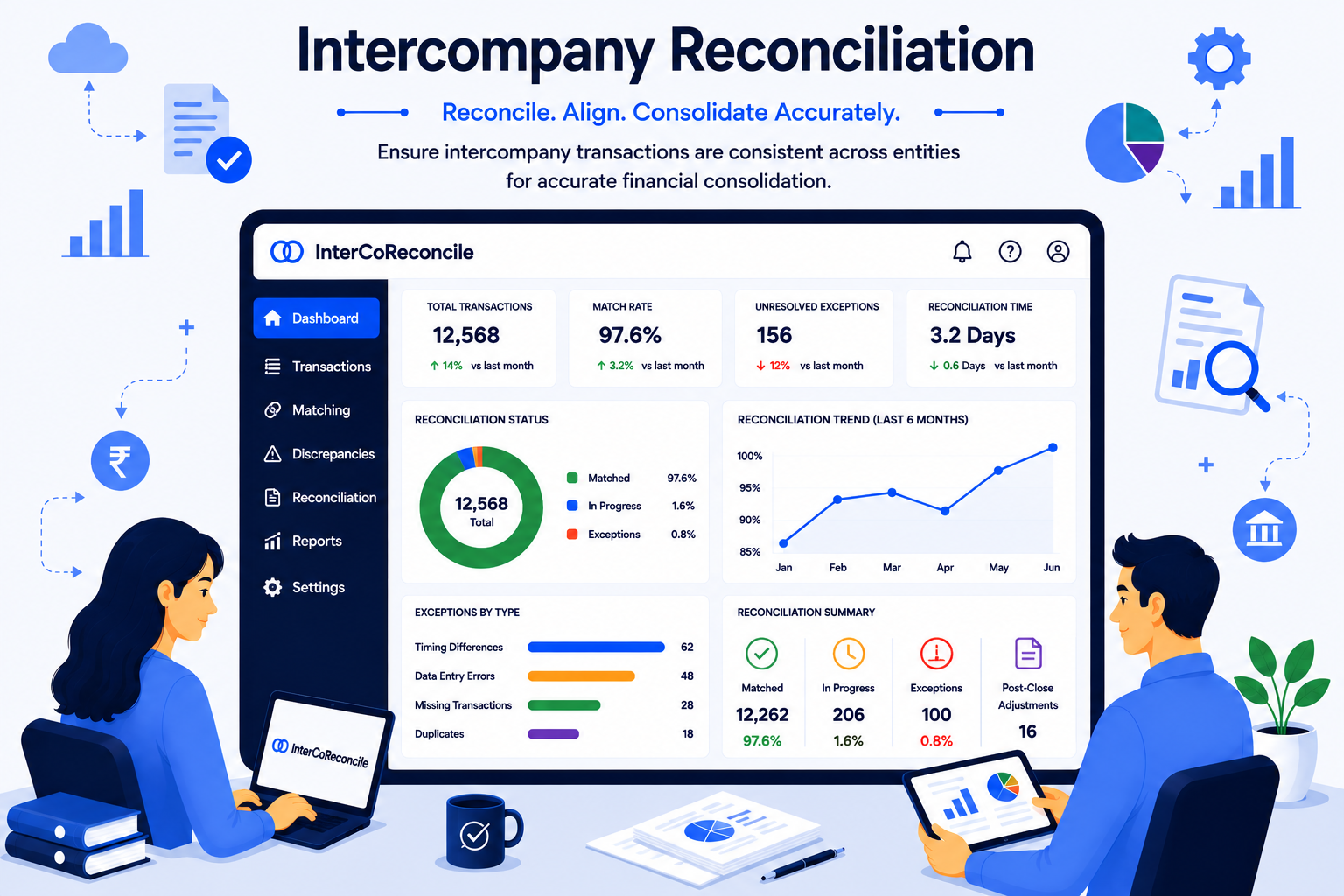
Agentic AI scans ledgers continuously across different legal or organizational units of the financial institution. It performs logic-based transactions matching and can handle many-to-one, one-to-many, or 2/3/4/5-way reconciliations.
Treasury teams can also use agentic AI to process high-volume cross-currency transfers. You can also spot exact matches even when invoice details vary.
Autonomous Discrepancy Resolution
When mismatches like X timing differences, delayed invoices, or transfer pricing gaps occur, the agent jumps in immediately. Agentic AI uses predefined rules with its learned patterns from historical data to resolve issues on its own. Only the most complex and true exceptions are escalated to the team.
Banks benefit from such smart categorization that assigns clear reasons to unmatched items, such as 'currency variance' or 'invoice duplicate.' Also, automated and accurate routing (ticketing) from platforms like Osfin helps convey the errors and alerts to the right teams.
Smart Journal Entry Creation & Posting
Intercompany accounting with agentic AI is a step into the future. Where agents draft precise eliminating entries, apply correct FX rates, and post them directly to ERPs like SAP or Oracle. They also ensure that transfer pricing rules and consolidation logic are aligned perfectly to avoid compliance issues.
Financial institutions like banks can see instant updates to intercompany balances. No more back-and-forth emails or risky manual postings. Such support and accuracy ensure faster consolidations and audit-readiness during reporting seasons.
Real-Time Dashboards & Monitoring
Live dashboards provide 'at-a-glance' views of match status, exposure levels, and exception queues across all entities. Treasury professionals can monitor risks like imbalances in real-time, drill down into some transactions with the help of a real-time dashboard.
You can also use it to notify teams early about potential issues, such as spikes in card settlement variances. This visibility and clear communication turn data into a strategic advantage for competitive banks.
What is the Complete Guide to Intercompany Accounting with Agentic AI?
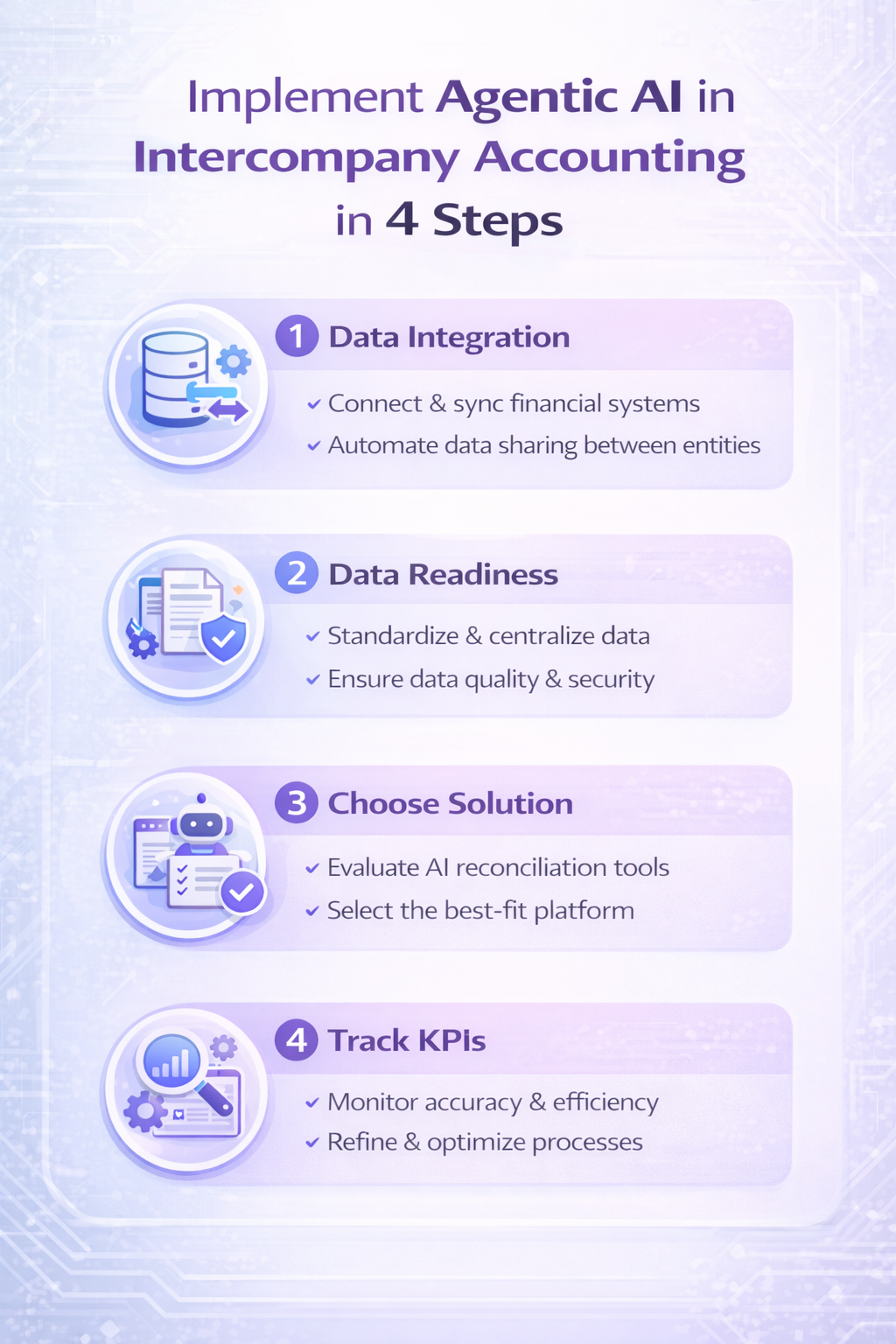
When you implement intercompany accounting with agentic AI, you use autonomous software agents that can perform complex end-to-end tasks, such as transaction matching, with minimal human intervention. This goes beyond traditional automation functionality, as agents learn from past patterns and adapt to changing conditions.
Data Integration Strategies
Agentic AI needs unified multi-ERP connectivity. It pulls data from GL, AR/AP, invoicing, and transfer pricing systems such as SAP or Oracle. You need to create a normalized data layer with role-based access and audit logging. This allows the agents to work freely while remaining completely compliant.
Preparing Your Data for AI Readiness
To prepare your data for AI readiness, you need to define and apply matching rules and eliminate thresholds for all entities. The next step is to use clean reference data from past reconciliations. This helps the agentic AI to spot patterns and fix discrepancies on its own.
Choosing the Right Agentic AI Solution
An agentic AI tool executes tasks on its own, coordinates across entities and learns from results. The right agentic AI solution ensures built-in governance and scalability. You should select a solution with human-in-the-loop controls, configurable approvals, and support for many entities plus regulations.
KPIs to Track Success
To track the success of the system, you need to monitor reconciliation cycle time, auto-match rates and reduction in close days. You need to check error rates, audit exceptions and the shift in finance effort from manual reconciliation to measure accuracy and productivity. The table below demonstrates an example:
{{banner1}}
The Future of Intercompany Accounting with Agentic AI
Agentic AI are intelligent agents that operate with the ability to reason, act and learn. This positions them to revolutionize intercompany accounting processes that are time-consuming and error-prone into real-time, continuous and autonomous governance processes.
From Periodic Close to Continuous Accounting
Agentic AI shifts banks and other financial institutions from calendar-bound, periodic closure to a near-continuous process, in which reconciliations keep running in the background across entities. This means that intercompany mismatches are detected and resolved throughout the month.
Platforms like Osfin make this easy by allowing you to import data from more than 170 sources, in any format and clean it with custom tolerances. It also detects duplicates and outliers early and performs logic-based matching for transaction reconciliation. Osfin has a record of reconciling 30 million records in 15 minutes at 100% accuracy.
Evolving Role of Finance Professionals
All transaction-level tasks like matching, exception routing and journal posting can be automated with Agentic AI. This allows your finance team to shift their efforts from manual execution to oversight and high-value analysis.
Tools like Osfin work as a reliable system of record with role-based access, maker-checker flow, detailed exception reasons and compliance-grade (SOC 2, PCI DSS, GDPR) reporting. The team needs to oversee and advise instead of manually fixing errors.
Conclusion
Agentic AI is a structural capability for intercompany accounting in banks and financial institutions. It simplifies month-end reconciliation cycles into smooth, real-time operations that allow your finance teams to focus more on strategy and growth over spreadsheets.
Adopting intercompany accounting with modern reconciliation platforms like Osfin in your workflow can prove to be a significant financial advantage in today's times. Osfin imports data from more than 170 sources in any format and implements logic-based matching for complex transactions with 100% accuracy.
To build a future-ready intercompany accounting workflow, schedule a personalized demo with Osfin today!
FAQs
1. What is intercompany accounting with agentic AI?
Intercompany accounting with agentic AI is about using autonomous, goal-directed AI systems to manage and automate end-to-end processes. These include recording and reconciliation of transactions between a parent company and its subsidiaries.
2. How is agentic AI different from RPA in intercompany processes?
Agentic AI autonomously plans, reasons and adapts across systems to automate end-to-end processes. On the other hand, RPA automates specific and repetitive rule-based tasks within those processes.
3. Can agentic AI handle intercompany reconciliations autonomously?
Yes. Agentic AI can handle intercompany reconciliations autonomously. It can transform any traditionally manual and time-consuming process into an efficient and self-managed function.
4. Is agentic AI for intercompany accounting compliant with SOX?
Yes. Agentic AI for intercompany accounting can be compliant with SOX only if you implement the specific controls and government frameworks to ensure transparency, security and human oversight.
5. When should enterprises adopt agentic AI for intercompany accounting?
If you are an enterprise that's facing high operational complexity and recurring manual errors that exceed the capabilities of traditional automation, then you should adopt agentic AI for intercompany accounting.