What Is Check Reconciliation? A Complete Guide
Banks and financial institutions depend on check reconciliation to produce traceable, audit-ready financial records. This process is essential to verify transactions between internal ledgers and bank statements. It also helps eliminate errors and block fraud for treasury teams and card providers. You can handle reconciliation for large volumes of transactions with minimal to zero errors by leveraging automation in finance workflows.
In this article, we’ll break down the essentials of check reconciliation, its step-by-step process, and the common hurdles you can avoid with some best practices.
What Is Check Reconciliation?
Check reconciliation matches your internal check records against bank statements. Banks and financial institutions use this process to verify that every check clears correctly.
It involves comparing check numbers, dates, amounts, and payees to identify exactly matching checks and flag checks that are still pending clearance. Treasury teams rely on it to ensure accurate balances and catch errors before they become serious issues. A simple check reconciliation form lists all the necessary details for easy tracking.
Why Check Reconciliation Still Matters Today
Banks and financial institutions perform check reconciliation to detect fraud and ensure proper cash flow. Even today, checks handle a significant portion of B2B payments, making the process essential for treasury services and card providers.
It also uncovers errors such as duplicate payments or timing delays on outstanding checks, and provides audit-ready records to regulators under SOC2 and PCI DSS standards. Check reconciliations also help the treasury team get real-time insights on how to reduce revenue losses from undetectable issues arising from discrepancies and ensure:
- Frauds are detected early, preventing unauthorized check cashing.
- Compliance is met with strict financial regulations.
- Clear visibility for cash positions.
- High-value check processing to minimize errors.
Common Check Reconciliation Challenges
Financial institutions often deal with high volumes of checks. And manual processes simply cannot handle them efficiently. Why? Because they are prone to challenges like data entry errors and timing gaps.
Without proper measures in place, fraud risks can escalate, and duplicates slip through, leading to issues like overpayments. These issues cause delays in reports and can potentially expose treasury services to compliance fines.
Most of the time, teams are struggling with inconsistent data formats across bank statements, which slows down the entire process.
- Human errors can cause significant revenue loss from overlooked discrepancies.
- High volumes of check reconciliation data can overwhelm staff, resulting in missing outliers.
- Timing differences between ledgers and statements can complicate matching.
- If fraud detection lags, unauthorized transactions can go unnoticed.
{{banner3}}
Step-by-Step Check Reconciliation Process
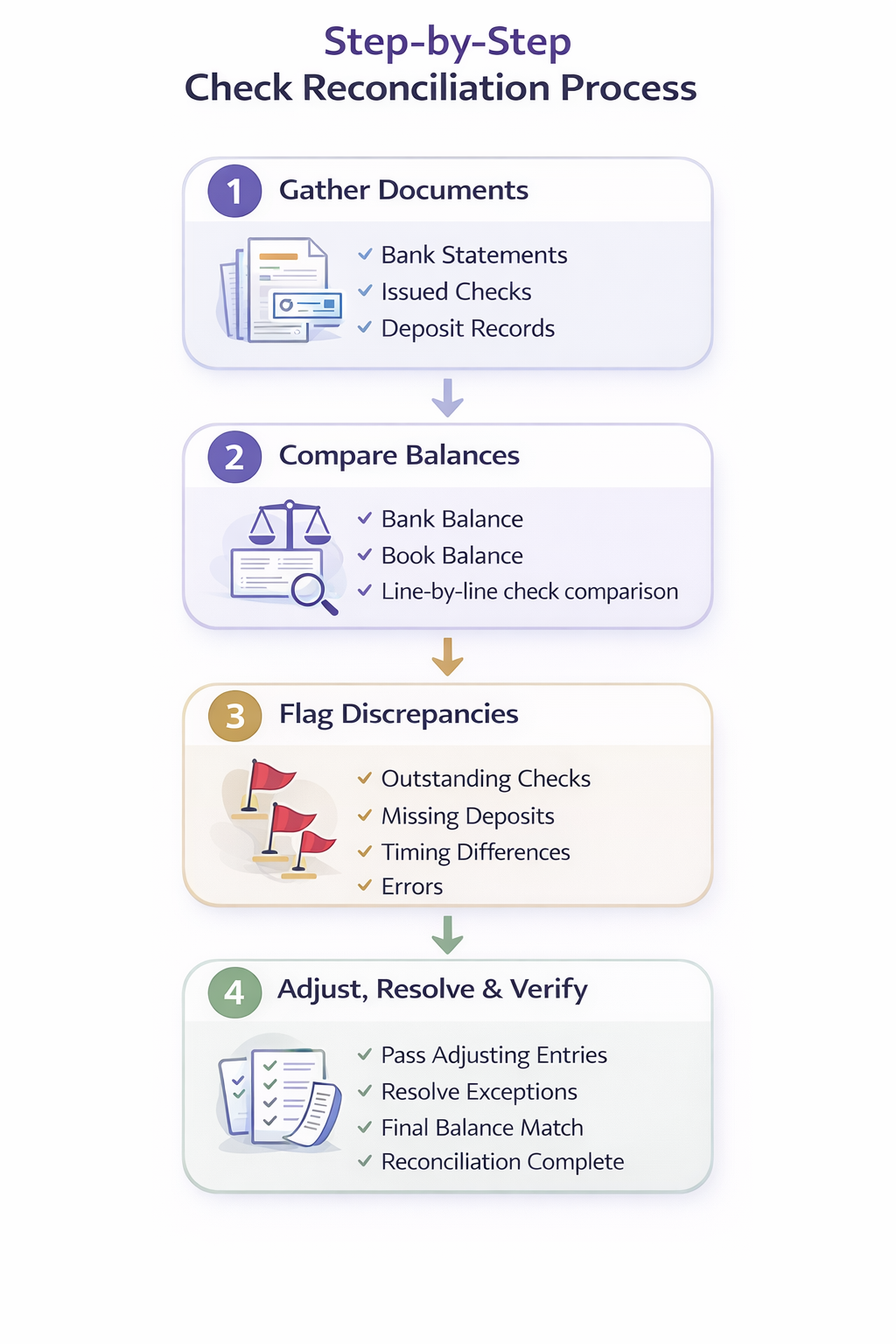
All banks and treasury teams follow a four-step structured process to match internal check records with bank statements. This process includes gathering documents, comparison of records, highlighting discrepancies and making adjustments. These steps ensure accountability and traceability of the reconciled checks and outstanding payments.
Step 1: Gather Documents
The very first step is to collect all the bank statements, internal ledgers, and the check reconciliation form. These documents list all the transactions with crucial details like check numbers, dates, and amounts.
Step 2: Compare Balances
Then, finance teams match the opening balances and review every check against the statement. This helps identify reconciled checks, providing clear traceability of all transactions.
Step 3: Flag Discrepancies
The next step is to identify and check reconciliation items that are not cleared yet. You should also highlight any timing differences and flag any errors, duplicates, or unauthorized entries for further review.
Step 4: Adjust, Resolve, and Verify
All the flagged transactions and errors are then communicated with the necessary adjustments. The finance team recalculates the ending balance and confirms that it aligns perfectly on both sides once the adjustments are made and the errors are resolved.
Once the verification is complete, you need to document all the changes and findings. This report can be used as a future reference and a record for accountable audit trails.
Limitations of Manual Check Reconciliation
Banks and financial institutions struggle with manual check reconciliations as they require significant time to review thousands of checks repeatedly. This process includes limitations like high error rates and inconsistent handling of data.
Staff fatigue can make check reconciliation error-prone, leading to frequent transposition errors and overlooked discrepancies. Without automated checks, these reconciliation processes can fail to scale for treasury services that deal with large volumes of transactions.
These core issues highlight why manual approaches fall short for modern financial operations:
- Prone to human errors like data entry mistakes or misreading check details.
- Time-intensive work that can take days for large batches of reconciled checks.
- Lacks proper duplicate detection, allowing overpayments to slip through.
- Inconsistent bank statement formats can slow down teams.
How Automation Transforms Check Reconciliation
Automation transforms check reconciliation by speeding up matching and eliminating human errors. Banks and financial institutions adopt automated tools so they can process thousands of checks instantly. For example, financial institutions using Osfin can perform reconciliation for 30 million transactions in just 15 minutes.
These systems help you handle check reconciliation seamlessly. They flag exceptions and outstanding checks in real time for treasury teams. Card providers also benefit from such scalable solutions that can easily integrate with their ledgers and bank feeds.
Automation tools like Osfin offer an intuitive live dashboard and traceable audit trails for your financial operations. Some key transformations brought by automation are:
- Instant logic-based matching for reconciled checks across high volumes.
- Automatic duplicate and outlier detection during data import (ingestion).
- Real-time exception routing via ticketing system for quick resolution.
- Compliance-ready reports with full traceability meeting international standards like SOC 2 and PCI DSS.
How Osfin Helps Master Check Reconciliation
Osfin is a file format-agnostic platform that delivers 100% accurate check reconciliation for banks and other financial institutions. This helps you replace manual processes with efficient workflows designed to handle high-volume checks. Osfin offers features like:
Data Ingestion
As a file-format agnostic platform, Osfin can process any file type like PDFs, CSVs or Excel. It also offers more than 170 integrations to import check data from multiple sources, like ledgers and bank statements, regardless of the format.
It also applies custom deviation tolerances during ingestion to filter poor-quality data before the reconciliation process begins. Osfin detects outliers and duplicates at the initial point of ingestion to prevent downstream issues like mismatched or outstanding checks.
Reconciliation Process
Osfin implements logic-based matching that can handle many-to-one or one-to-many transactions. It also supports complex check groupings like 2/3/4/5-way reconciliations. Osfin auto-reconciles all payment gateway reports, including commission, tax, and fee breakdowns, against the bank records swiftly.
Exception Handling
All unmatched transactions are automatically flagged, a clear reason is assigned to them, and the issue is escalated to the respective team through ‘ticketing’ and ‘exception handling engine’. Osfin provides live dashboards that give a summarized, holistic view of match status, exposure, and exception queues for real-time treasury oversight.
Output
The end result is a detailed compliance report and audit-ready workflows. These provide complete traceability and transaction history for every reconciled check. Osfin secures data with 256-bit encryption, role-based access, and two-factor authentication. It also features maker-checker flows to ensure all automated and manual actions taken on the platform are religiously captured in the audit log. Osfin is a platform compliant with international standards like SOC 2, PCI DSS, and GDPR requirements.
{{banner1}}
Best Practices for Accurate Check Reconciliation
Financial institutions like treasury services must implement best practices for accurate check reconciliations. These include performing reconciliations frequently for high-volume accounts and documenting every step with clear audit trails. To handle such large volumes of transaction data, you can leverage automation.
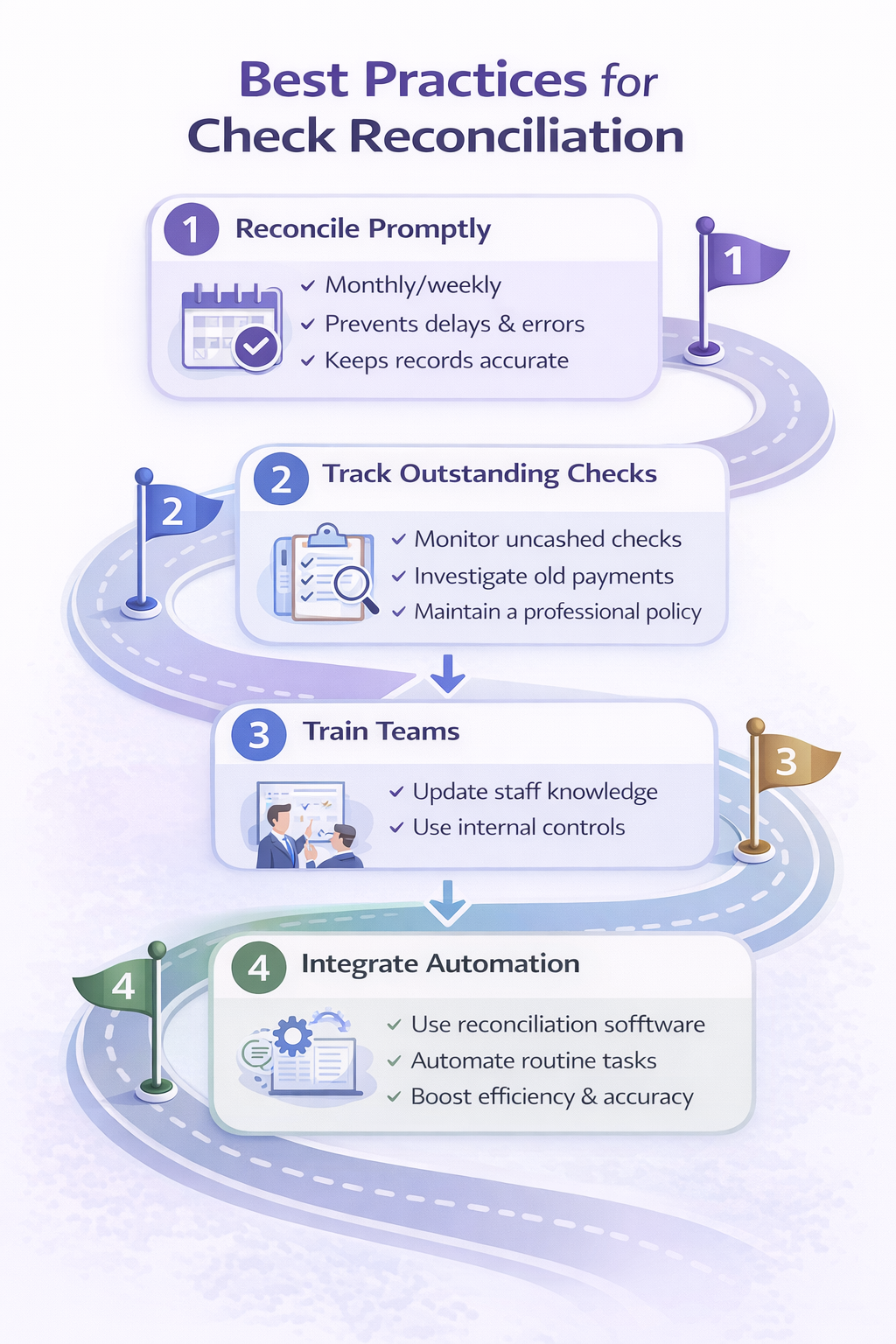
Here are some best practices to master the process:
- Reconcile promptly after receiving bank statements to avoid possibility of fraud.
- Perform weekly tracking for outstanding checks and follow up on the accounts.
- Train teams on common errors like timing differences and duplicate detection.
- Integrate real-time bank feeds and automation for proactive matching and faster reconciled checks.
Check Reconciliation vs Other Reconciliation Types
Check reconciliation is different from account and bank reconciliation in its focus and scope. Banks and financial institutions choose the right type of reconciliation based on specific needs, like tracking reconciled checks.
Check reconciliation targets check-specific items, while bank reconciliation covers all cash transactions. Account reconciliation, on the other hand, applies to ledger comparisons.
Conclusion
Banks, financial institutions, card providers, and treasury services rely on accurate check reconciliation to stay compliant and fraud-proof. And with best practices like frequent reconciliations, you can avoid common challenges such as high volumes, errors, and fraud.
Osfin delivers 100% accuracy with file-agnostic ingestion through more than 170 integrations. It also offers logic-based matching for automation and can reconcile 30 million records in 15 minutes. It is a SOC 2-compliant platform that provides exception handling via ticketing and dashboards for traceable, audit-ready workflows.
For seamless and scalable check reconciliations, schedule a personalized demo with Osfin today!
FAQs on Check Reconciliation
1. What is a reconciled check?
A reconciled check means your internal financial records, like the checkbook and ledger, accurately match the bank’s records. This includes all accounting information related to transactions like deposits, withdrawals, fees, and outstanding checks.
2. How do you handle outstanding checks reconciliation?
To handle outstanding check reconciliation, you must list all issues, including uncleared checks, and then subtract their total from the bank’s ending balance to get an adjusted bank balance. This is then matched with your adjusted book balance while also monitoring for stale checks (over 6 months) that need follow-up to maintain accurate cash flow.
3. What is a check reconciliation form?
A check reconciliation form is a financial tool that allows you to compare your bank statements with your internal records, like a checkbook register or accounting software, for differences. It is crucial for transaction matching, identifying timing differences and correcting mistakes.
4. Why should you automate check reconciliation for banks?
You must automate check reconciliation for banks to improve speed, accuracy and cost efficiency. This helps in eliminating manual errors and frees up staff for higher-value tasks and better cash flow management, fraud detection, and regulatory compliance.