Financial Audit Explained: Steps, Importance & Best Practices
TL;DR
A financial audit is a structured review of a company’s financial statements. It confirms if the numbers accurately reflect its financial position and follow accounting standards like GAAP or IFRS. Auditors look at how transactions are recorded and whether the company’s checks and balances are working properly. They also verify if key reports like the income statement, balance sheet, and cash flow statement are accurate and dependable.
It is important to understand the definition of a financial statement audit as it helps build trust with investors, lenders, regulators, and suppliers. It also helps companies stay on top of legal requirements and reduce financial risks.
There are five main types of financial audits in accounting - external, internal, regulatory, forensic, and operational.
The process involves planning the review, identifying key risks, checking internal controls, testing transactions, reviewing the financial statements, and then issuing the final audit opinion.
Technology helps optimize this process. It can collect data, monitor transactions, and keep records of every change without manual effort. Platforms like Osfin further make large-scale reconciliations easier, reduce manual errors, and help companies stay audit-ready through automation and strong data controls.
What is a Financial Audit?
A financial audit means a formal review of a company’s financial statements. It helps determine if the numbers presented truly reflect the organization’s financial position and performance during a specific period.
At its core, finance accounting auditing is a structured and evidence-based process. Auditors don’t just look for mistakes in reports. They also check how the numbers were calculated and if they follow proper accounting rules like GAAP or IFRS. How? By reviewing the company’s financial reports. This typically includes:
- Looking at how financial information is recorded.
- Reviewing internal controls over financial reporting.
- Verifying the reliability of the financial statements.
The financial auditing process can be carried out by internal auditors, who work within the company, or by external auditors, who are independent of management.
Why Financial Audits Matter?
Financial audits are important because they build trust. They reassure investors, lenders, regulators, and suppliers that the company’s statements are accurate and prepared according to the right standards.
In some cases, audits are legally required. This helps make sure companies follow regulations and stay transparent. Audits also help reduce risk. As a business grows, it handles more transactions, and things become more complex. As a result,
The risk of errors increases.
- Small reconciliation gaps can turn into bigger issues.
- Manual adjustments receive closer review.
- Weak controls may result in formal audit findings.
When you have millions of transactions flowing through accounting systems, even small errors can quickly add up. If balances across different systems do not match, it can raise concerns about the accuracy of financial reporting. Auditors carefully review these differences to understand their cause.
When auditors review financial records, they also look at the systems that keep things under control. For example, they review who approves payments, how tasks are divided between employees, and whether accounts are checked and matched regularly. If these systems are not strong, errors and fraud become more likely. When auditors find such gaps, they mention them clearly in their report. This gives the company a chance to fix the problem early.
At the same time, finance audits can add value internally by identifying areas where reporting can be improved. For example, unclear procedures, outdated controls, or reporting practices that create unnecessary risk.
{{banner3}}
Types of Financial Auditing
Not all financial reporting audits are the same. There are different types of financial audits - external, internal, regulatory, forensic, and operational. Here's how they differ:
1. External Financial Audit
An external financial audit is carried out by an independent audit firm. These auditors don’t work for the company, so they can give an unbiased opinion. In an external financial statement audit process, the auditor reviews:
- Financial statements
- Accounting policies
- Internal controls over financial reporting
The objective is to check if the numbers are accurate and whether the reports follow accepted accounting standards. At the end, the auditor gives a formal opinion in the audit report. Investors, analysts, and regulators use this opinion to judge the company’s financial health.
2. Internal Audit
An internal financial audit is conducted by employees of the organization. They support management by reviewing financial reporting processes and internal controls.
Unlike external auditors, internal auditors work within the company. They identify areas that need improvement before they become serious issues. This includes:
- Reviewing financial reporting systems
- Testing internal controls
- Verifying if policies are followed
Financial internal audit teams often work with external auditors to provide support during the annual audit.
3. Regulatory Audit
Regulatory audits check whether a company is following all laws and industry rules. They may be conducted by government regulators, the company’s own compliance team, or an independent third party. Regulatory audits usually fall into two categories:
- Full-Scope Audits: They examine governance, systems, reporting accuracy, and data integrity.
- Issue-Specific Audits: These target a specific regulation or process.
4. Forensic Audit
Forensic auditing is conducted if a company suspects fraud, embezzlement, or other financial misconduct. It is more investigative in nature. A forensic financial report audit helps gather evidence that may be used in legal proceedings.
Forensic auditors examine financial records in detail and may be required to present their findings in court. However, these audits are not limited to fraud cases. They may also be carried out in situations such as bankruptcy disputes, business closures, or divorce proceedings.
5. Operational Audit
An operational audit looks at how well a company’s day-to-day work is running. While it is similar to an internal audit, its scope is broader. An operational financial report audit review:
- Business goals
- Planning processes
- Operational procedures
- Results achieved
The idea is simple: check if the business is working the way it should. If something is slowing things down or not delivering results, it gets flagged.
How to Do a Financial Audit (Step-by-Step)
Auditing financial reports follows a clear structure, helping the auditor form a well-supported opinion. Here's what the step-by-step financial audit procedure looks like:
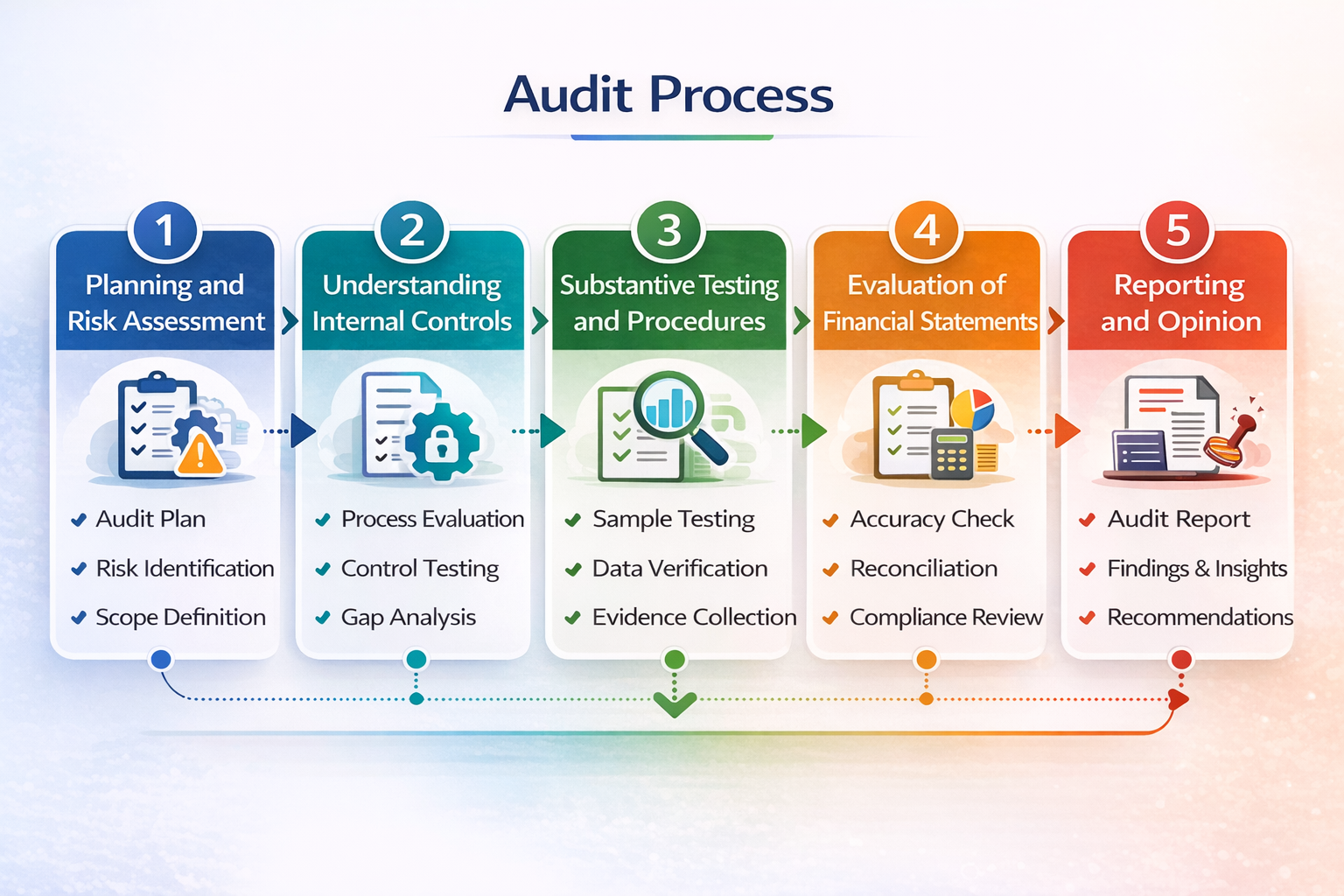
Step 1: Planning and Risk Assessment
Every audit begins with planning. Before reviewing numbers, the auditor takes time to understand the business. This is done by:
- Learning about the company’s industry
- Reviewing past financial statements
- Identifying key financial processes
- Understanding areas where mistakes are more likely
At this stage, the audit also assesses risk. Some accounts carry a higher risk than others. For example, areas involving estimates, large transactions, or complex calculations may require closer attention.
Based on this, the auditor decides what to focus on, how much testing is needed, and when the work will be performed.
Step 2: Understanding Internal Controls
After planning, the auditor studies the company’s internal controls. These are the processes and rules that help prevent errors and fraud. They include:
- Authorization procedures
- Separation of duties
- Access controls
- Reconciliation processes
- Record-keeping practices
The auditor checks if these controls are properly designed and working as intended. For example, they may review whether financial responsibilities are clearly divided between employees.
In some cases, auditors test the controls directly. If they are strong and reliable, the auditor may reduce the amount of detailed testing later. If they are weak, a more detailed review may be required.
Step 3: Substantive Testing and Procedures
Once the auditor understands the risks and controls, the next step is substantive testing. This is where they gather direct evidence about the financial statements. Substantive procedures may include:
- Testing selected transactions
- Reviewing documents
- Comparing financial trends over time
- Checking physical assets
The goal is to confirm that reported balances and transactions are accurate and complete. For example, if inventory is reported on the balance sheet, the auditor may verify its existence and valuation.
Step 4: Evaluation of Financial Statements
Next, the auditor reviews all the findings and the audited financials together. They evaluate whether:
- The financial statements follow accounting standards.
- The disclosures are clear and complete.
- Any errors found are material.
If they identify any issues, they may ask the management to correct them.
Step 5: Reporting and Opinion
The last step is reporting. The auditor drafts an audit report that summarizes the work and presents their opinion:
- Unqualified (clean): Financial statements are fairly presented.
- Qualified: There are specific issues, but the overall statements are mostly reliable.
- Adverse: The financial statements are not fairly presented.
- Disclaimer: The auditor cannot form an opinion due to limited information.
The audit report is then shared with stakeholders and often with the board of directors. It confirms that the financial statements have been independently examined.
Financial Audit Example
Let's see how to conduct a financial statement audit with an example.
Say, there's a garment manufacturing company, ABC Ltd, that has hired an audit firm to review its financial statements.
The first step is for the auditors to understand the business. The auditors first:
- Define the audit's purpose and scope.
- Look at what needs to be reviewed.
- Identify areas that carry a higher risk.
They gather details about how the company operates, records transactions, and prepares financial reports. Then, they move to testing. This involves checking if transactions are recorded properly and if any amounts are incorrect or missing.
Suppose they discover that certain sales entries were recorded without proper supporting documents. Some supplier invoices may also be missing from the books at the time of review.
Root Cause
After further checking, the auditors find that the issue is not intentional fraud but weak internal processes. For example,
- Sales entries were recorded before complete documentation was received.
- Purchase invoices were sometimes delayed in being entered into the system.
- There was limited supervision over how transactions were recorded.
Remediation
The auditors then inform management about these gaps, which is followed by corrective steps, such as:
- Missing documents are collected and verified.
- Incorrect or incomplete entries are corrected.
- Pending supplier invoices are recorded properly.
Control Improvement
The organization doesn't just stop at correcting errors. It also works on strengthening its process by:
- Setting clear documentation rules.
- Introducing reviews before closing monthly accounts.
- Clearly defining responsibilities within the finance team.
By the end of the audit, the auditors are able to form their opinion based on corrected records. The final report then provides stakeholders with a fair view of the company’s financial position.
Common Financial Audit Risks
Financial audits often come with certain risks that go beyond just fraud. These often result from weak processes, poor oversight, and simple human error.
1. Weak Reconciliation Controls
Reconciliation means matching two sets of records. For example, the bank balance should match the company’s cash book. However, if reconciliations are delayed or done casually, differences can go unnoticed. Small errors can grow over time and, if not reviewed each month properly, may only be detected during the audit.
{{banner1.1}}
2. Manual Journal Entries
Manual journal entries are often riskier because they don't follow standard system controls. For example, if someone records an adjustment without proper review, it can skew financial results. Auditors pay close attention to these entries.
3. Incomplete Documentation
Missing supporting documents is another significant risk. For example,
- Expenses that don't have invoices
- Revenue without contracts
- Entries that don't have clear explanations
When documents are incomplete, auditors cannot verify if the transactions are genuine. This often leads to additional questions and expanded testing.
4. Poor Segregation of Duties
In some companies, one person may create, approve, and record a transaction. That creates risk. Without separation of roles, mistakes are harder to detect. Even if no issue exists, the control weakness itself becomes a problem during an audit.
5. IT System Access Risks
Financial systems must be protected. If you don't manage user access properly, employees may have more rights than needed. For example, they may be able to edit data, post accounting entries, or change system settings. Weak controls over password access, system changes, or backups can affect the reliability of financial reports.
6. Revenue Recognition Errors
Revenue is one of the most sensitive areas in an audit. If it is recorded too early, too late, or without proper documents, it can cause a lot of confusion. Companies may also struggle when contracts involve multiple deliverables. If you don't document the timing of recognition clearly, you may need additional adjustments.
7. Inventory Misstatement
Inventory can also be misstated. Old or damaged items may not be written down, or physical stock counts may not match system records. If you don't catch these differences on time, your profit numbers may be impacted.
Financial Audit Requirements
Auditors need clear, complete documents to conduct a financial audit. Some key documents include:
1. Financial Statements
Auditors start by reviewing the main financial reports. These include the balance sheet, income statement, and cash flow statement.
2. Bank Statements and Reconciliations
Auditors review monthly bank statements for the audit period. They also compare them with the company’s records.
3. Accounts Receivable and Accounts Payable Reports
Reports like the AR and AP aging reports help auditors assess collections and liabilities. The AR aging report lists unpaid customer invoices and shows how long they’ve been pending. The AP aging report shows unpaid supplier bills and outstanding obligations.
4. Sales Invoices
Auditors review sales invoices, purchase bills, and supporting documents to confirm reported income and expenses.
5. General Ledger
The general ledger records every financial transaction. It provides a full summary of the company’s financial activity.
6. Payroll Records
Payroll reports, employee contracts, and other details are also required. Auditors review them for tax and labor compliance.
7. Agreements and Contracts
Contracts with customers, suppliers, employees, and landlords help auditors confirm terms and financial obligations.
8. Inventory Reports
Inventory records should show quantities and valuation methods. Auditors verify whether reported values are accurate.
9. Fixed Asset Register
To conduct a financial auditing, you'll need details of all fixed assets. These include equipment, property, vehicles, purchase dates, depreciation schedules, etc.
10. Expense Receipts
Receipts and reimbursement records help auditors confirm that expenses are valid and properly recorded.
Role of Technology & Reconciliation in Financial Audits
As businesses handle more and more data, technology has become an important part of the audit process. It doesn’t replace auditors. Instead, it helps them manage large amounts of information and cuts down the need for manual work.
The right technology also makes reconciliations easier by spotting gaps and mismatches early. Here are some other ways in which technology optimizes financial audits:
1. Automated Data Aggregation
In the past, auditors often worked with spreadsheets and physical records. Today, much of the financial data is stored in digital systems. Technology allows auditors to pull information directly from accounting platforms and databases. This means,
- Financial data can be collected from multiple systems.
- Large datasets can be reviewed at once.
- Manual copying and pasting is reduced.
This reduces the risk of human errors, saves time, and makes it easier to spot missing entries.
2. Continuous Transaction Monitoring
Technology also makes it easier to keep reviewing transactions regularly. Instead of checking only a small sample, auditors can use digital tools to scan entire datasets. This helps flag unusual transactions quickly and identify patterns and trends.
Continuous monitoring also supports stronger internal controls. If issues are identified early, companies can fix them right away before they grow into larger reporting problems.
3. Structured Audit Trails
A structured audit trail is a record of who performed a transaction, when it was recorded, and how it was processed. Technology makes it easier to maintain these trails. Digital systems automatically record:
- User activity
- Changes to financial entries
- Approval history
This improves transparency. Auditors can track transactions end-to-end without juggling paper files or manual explanations. In some cases, technologies such as secure digital ledgers provide tamper-resistant records, reducing the risk of unauthorized changes.
How Platforms Like Osfin Support Audit-Ready Financial Reporting
Reconciliations can be complicated, especially for businesses handling a large number of transactions daily. Add manual work to the mix, and you're at a greater risk of errors, delays, and missing records. This is where platforms like Osfin come in.
Osfin is an enterprise SaaS platform designed to handle complex, high-volume reconciliations. It manages the entire reconciliation process from data ingestion to audit-ready reporting.
1. Data Ingestion
The process begins with importing data. Osfin supports 170+ integrations, allowing companies to pull data from multiple sources. It is format agnostic. This means it can accept files in different formats and layouts without teams having to manually rework them. Once the data is imported, the platform standardizes and normalizes it, so everything follows a consistent structure and gets processed easily.
During ingestion, Osfin also:
- Applies custom deviation tolerances to filter out poor-quality data.
- Detects duplicates and outliers at the source.
- Flags issues before reconciliation begins.
2. Reconciliation Process
Once the data is prepared, the reconciliation process begins. Osfin uses logic-based matching to reconcile transactions. It can handle:
- One-to-one matches.
- Many-to-one and one-to-many transactions.
- Multi-way reconciliations, such as two-way, three-way, four-way, and five-way.
Osfin can reconcile up to 30 million records in 15 minutes. It can also auto-reconcile payment gateway reports, including commission, tax, and fee breakdowns.
3. Exception Handling
Not all transactions match perfectly. When mismatches occur, Osfin automatically flags unmatched transactions and assigns an accurate reason. It then routes these exceptions to the correct team member through its ticketing and exception handling module. This ensures that issues are addressed quickly and by the right stakeholder.
Live dashboards further provide visibility into match status, exposure levels, and pending exception queues. This reduces manual follow-ups and keeps the reconciliation process organized.
4. Output and Audit Readiness
After reconciliation and exception resolution, Osfin generates compliance reports. It keeps detailed, audit-ready workflows with complete traceability and a full record of transaction history.
Osfin protects data with 256-bit encryption, role-based access, and two-factor authentication. The platform also meets SOC 2, PCI DSS, ISO 27001, and GDPR requirements.
{{banner1}}
FAQs
1. What is the meaning of a financial audit?
A financial audit is a review of a company’s financial records to check if they are accurate. It ensures the information is reliable and the company follows the required laws and accounting standards.
2. What is a financial statement audit?
A financial statement audit is the process of reviewing a company’s financial statements to make sure they accurately show the company’s financial position.
3. What are the different types of financial audits?
There are several types of financial audits. Some of the common ones include external, internal, regulatory, forensic, and operational audits.
4. What is included in the financial audit process?
The financial audit process steps include planning, understanding controls, substantive testing, evaluating financial statements, and reporting.
5. How often are financial audits required?
Financial audits are required annually for publicly listed companies. Private companies may also need yearly audits depending on regulations, investors, lenders, or company policies.
6. What does an unqualified audit opinion mean?
An unqualified audit opinion means the auditor believes the financial statements are accurate and fairly presented.
7. Can automation reduce financial audit risk?
Yes. Automation can reduce audit risk by improving data accuracy, reducing manual errors, and creating better audit trails. It also helps teams identify risks earlier through real-time monitoring.
8. What is the difference between internal and external financial audits?
Internal audits are conducted by employees within the company. They focus on improving processes and managing risk. On the other hand, external audits are conducted by independent auditors and provide an objective opinion on financial statements.