FloQast Review: Features, Pros, Cons & Use Cases
TL;DR
- FloQast automates close checklists, basic matching, and ERP syncs for banks and financial teams.
- It helps you eliminate routine month-end time significantly with intuitive collaboration and compliance tools.
- FloQast is most suited for mid-sized treasury services handling standard bank recs and SOX compliance.
- Fintechs with millions of high-volume payments choose advanced, scalable solutions like Osfin for 100% accurate reconciliation.
What is FloQast?
FloQast automates the most critical part of the monthly closing process. It initiates the steps for monthly closing by incorporating the month-end account reconciliations, journal entries, task lists, and variance analyses. It also integrates with popular WMS platforms, including NetSuite, QuickBooks, and Sage Intacct.
Unlike basic spreadsheets, FloQast offers customizable workflows, real-time collaboration tools, and AI-driven matching. This helps speed up review processes and ensure accuracy during high-pressure closes. It is particularly useful for treasury services that manage routine bank statements, providing embedded controls and audit trails. FloQast also delivers impressive team coordination capabilities for growing finance operations.
What are the Key Features of FloQast?
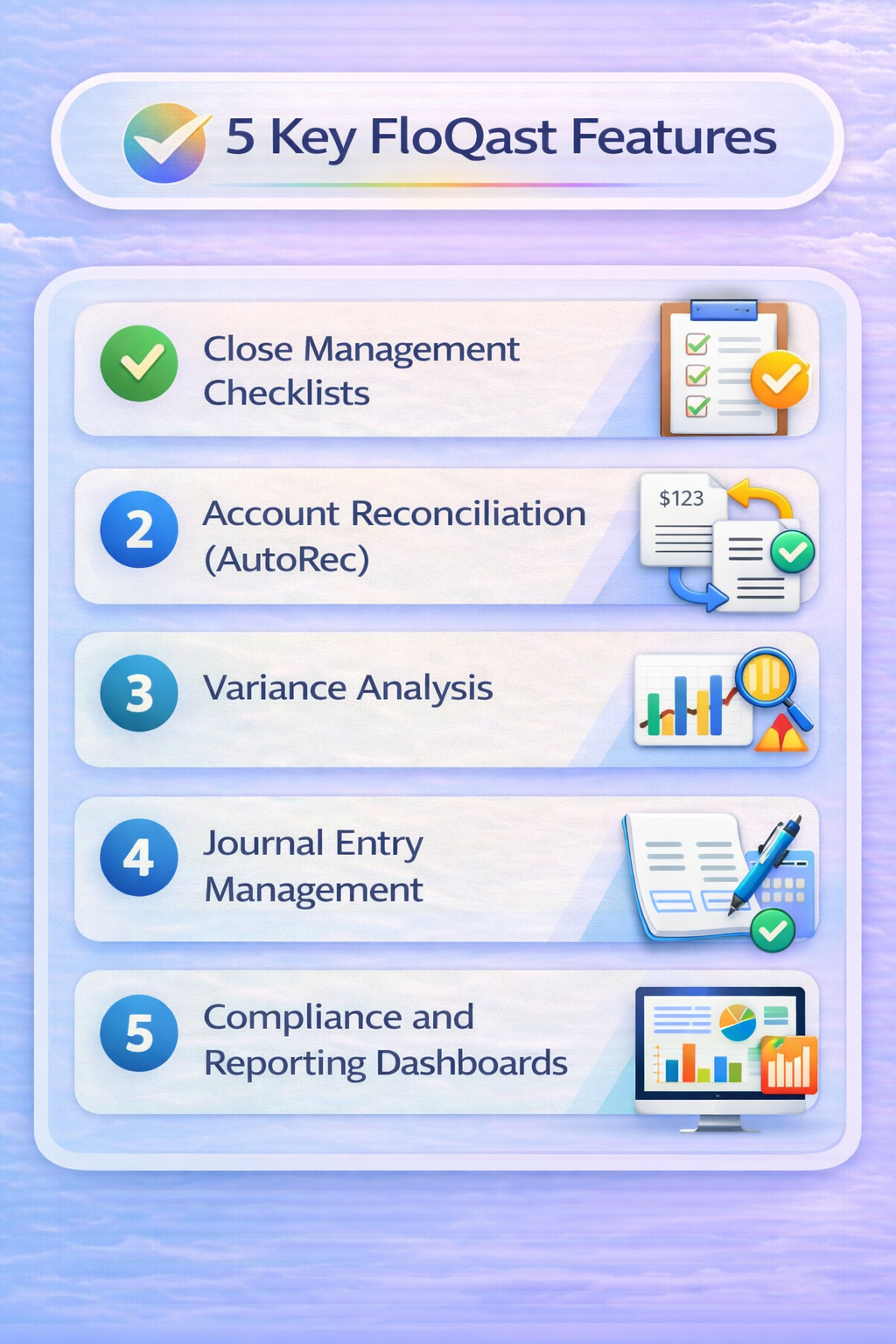
FloQast offers core tools for financial close management that simplify month-end accounting for banks and financial institutions with routine workflows. It emphasizes automation and teamwork to reduce manual tasks in ERP-centric setups.
Key features that stand out include:
- Close Management Checklists
FloQast offers custom task lists to guide your entire financial close from bank reconciliations to final sign-off, with live updates and notifications keeping everyone on track.
- Account Reconciliation (AutoRec)
FloQast uses AI to match account-level transactions like bank statements and subledgers automatically. Though it works best for moderate volumes rather than massive datasets.
- Variance Analysis
You can detect budget or period differences quickly with thresholds and detailed reports, helping resolve flux issues fast in busy financial operations.
- Journal Entry Management
You can create, approve, and post entries straight to your ERP with built-in audit trails, cutting errors in compliance-heavy environments.
- Compliance and Reporting Dashboards
FloQast centralizes SOX controls, audit prep, and progress visuals for exceptions and PBC requests in one easy view.
These features help mid-sized finance teams close books faster, but for high-volume transaction reconciliation in fintechs, Osfin takes it further as a file format agnostic platform with more than 170 integrations from multiple sources like banks, payment gateways, and ERPs without any hassle.
{{banner1}}
What are the Pros of FloQast?
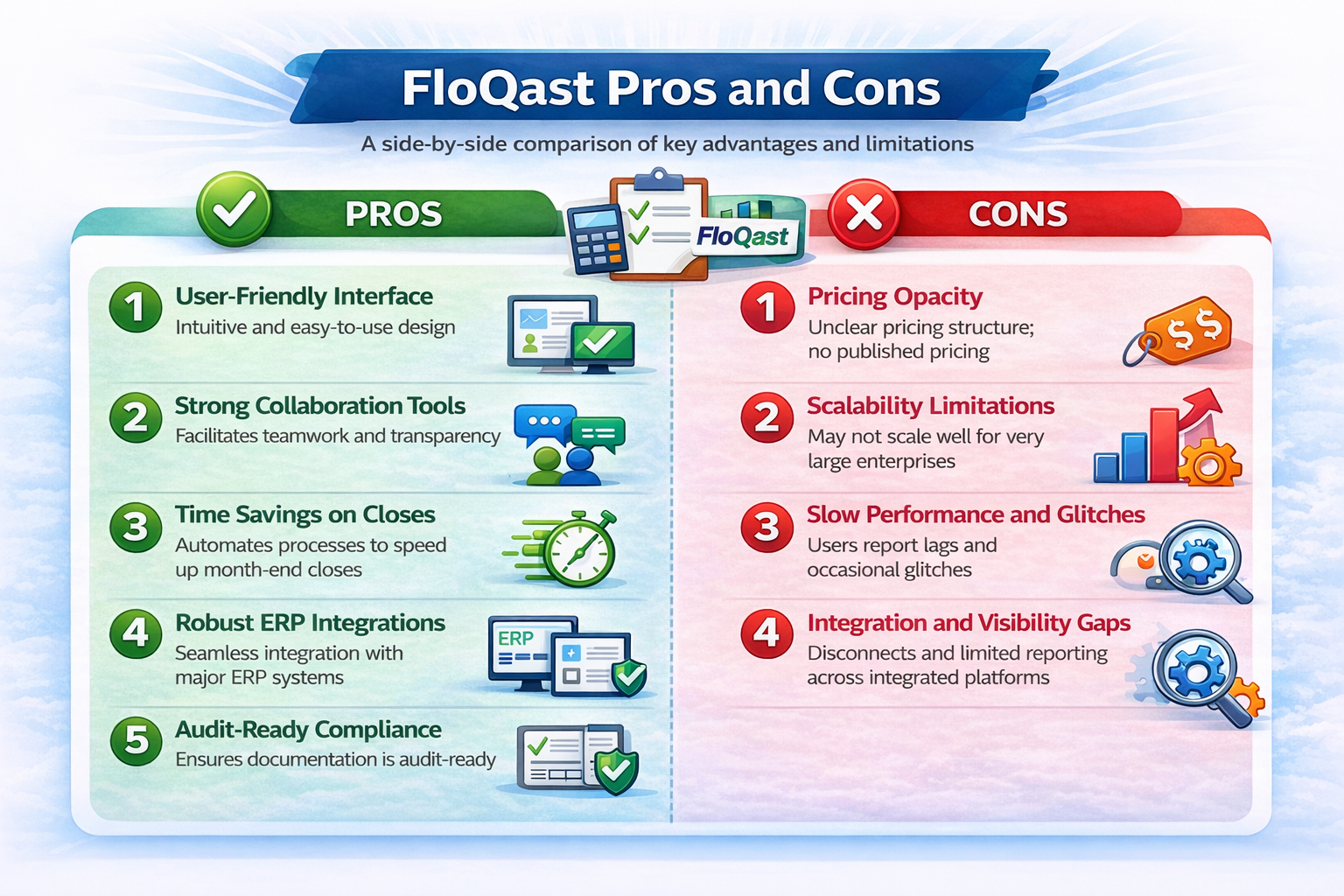
FloQast is a good option for accounting teams in banks and mid-sized financial institutions. It helps make financial close management more efficient and collaborative. Users have praised its intuitive design that replaces chaotic spreadsheets with structured workflows.
Here are the top pros that stand out:
- User-Friendly Interface
FloQast’s simple navigation and drag-and-drop checklists make it easy for new users to adopt the software in their everyday workflow. This helps speed up onboarding for finance teams handling month-end deadlines without a steep learning curve.
- Strong Collaboration Tools
Features like real-time updates, comments, and notifications keep distributed teams aligned. This helps in reducing email chains and ensuring everyone stays on track during busy close periods.
- Time Savings on Closes
You can automate repetitive tasks like reconciliations and variance checks with FloQast. This helps mid-sized businesses cut close times by a significant percentage while maintaining accuracy for routine bank statement matching.
- Robust ERP Integrations
FloQast offers seamless connections to NetSuite, QuickBooks, and Sage. That’s why you can automatically pull data, minimize manual entry errors and provide a single source of truth for financial reporting.
- Audit-Ready Compliance
FloQast comes with built-in controls and full activity trails that simplify SOX preparation and external audits. This is why treasury services can confidently trust their numbers without last-minute scrambles.
What are the Cons of FloQast?
Despite its strengths, FloQast has notable drawbacks that can frustrate accounting teams in enterprise-level financial institutions, especially those dealing with complex or high-volume financial operations.
Key cons of FloQast include:
- Pricing Opacity
Without clear published plans, custom quotes can surprise larger teams with steep costs, making budgeting tricky.
- Scalability Limitations
FloQast can bog down on massive transaction matching or custom entity setups, pushing enterprise-level banks back to Excel sheets and negating the automation promise for million-record workloads.
- Slow Performance and Glitches
Month-end rushes bring lags, slow uploads, and random glitches that throw off tight deadlines for financial institutions counting on smooth closes.
- Integration and Visibility Gaps
ERP links exist, but multiple user reviews highlight that tool-switching feels clunky, and broad visibility across teams stays shallow. This creates oversight headaches in collaborative environments and large-scale enterprises.
These pain points push high-stakes finance teams toward specialized reconciliation platforms. Osfin solves them with accuracy and ease as a file format agnostic platform ingesting any data format like CSV, PDF, and API feeds.
{{banner1.1}}
What are FloQast’s Pricing Plans?
FloQast delivers custom, value-based pricing for financial close management. It is perfect for mid-sized accounting teams in banks, financial institutions, and treasury services. Their philosophy emphasizes tailored packages with comprehensive assessments, scalable AI-powered solutions like Close, Compliance, Reporting, and AI Agents & Transform.
FloQast avoids tier-based pricing and instead offers modular packages during personalized demos to match your unique challenges.
It does not offer a public price list. You need to contact sales for exact figures. This approach suits mid-sized teams but can feel opaque for high-volume fintechs.
What are Some Use Cases for FloQast?
FloQast works well in practical scenarios for accounting teams at financial institutions focused on streamlining month-end financial close management. It's widely used by mid-market companies and controllers to automate checklists, reconciliations, and compliance tasks, reducing close times by up to 20% and delivering accuracy.
Here are some common FloQast use cases:
- Month-End Close Automation: FloQast centralizes task tracking, assigns to-dos, and provides real-time dashboards for progress. This makes it an ideal choice for teams managing bank reconciliations, journal entries, and PBC requests during tight deadlines.
- Account Reconciliation Workflows: It also automates matching for standard accounts like banks and prepaids, with roll-forwards and exception alerts, helping treasury services handle routine statements efficiently.
- Compliance and Control Management: FloQast embeds SOX controls, automates evidence collection, and supports audit prep with full trails. This ensures regulatory readiness for financial institutions.
- Team Collaboration in Remote Setups: FloQast’s real-time visibility and notifications keep distributed finance teams aligned for card providers coordinating multi-entity closes.
- Variance and Reporting Analysis: it spots flux issues and generates consolidated reports, aiding mid-sized banks in FP&A handoffs post-close without manual scrambles.
Who Should Consider FloQast?
FloQast works best for accounting teams in mid-sized banks, financial institutions, and treasury services that prioritize collaborative financial close management over high-volume transaction processing.
It is tailored for controllers and finance professionals in SaaS, tech, and business services handling standard month-end workflows with ERP tools like NetSuite or QuickBooks, serving multiple global companies.
You should consider FloQast if you belong to any of the following segments:
- Mid-Market Accounting Departments: These are teams closing books monthly with routine bank reconciliations and checklists. They seek faster cycles through automation, and FloQast is a good option for growing financial institutions that are standardizing processes.
- Remote or Distributed Finance Groups: These are organizations that need real-time dashboards and notifications to coordinate across time zones, like card providers managing multi-entity compliance without long email threads.
- Compliance-Focused Controllers: SOX-heavy environments that use embedded controls and audit trails. FloQast is ideal for treasury services, prepping PBC lists, and variance analysis in regulated setups.
- ERP-Centric Operations: FloQast is also good for companies that are integrated with NetSuite, Sage, or Microsoft Dynamics and are looking for seamless data pulls for journal entries and reporting. This helps them boost accuracy in mid-tier banking operations.
Who Might Need an Alternative?
High-level financial institutions might outgrow FloQast when dealing with high-volume transactions, complex payment matching, or enterprise-scale compliance demands that exceed its close management focus.
If your operations involve millions of records, many-to-one reconciliations, or real-time exception routing, specialized platforms like Osfin provide deeper automation and scalability.
Some important profiles that need to explore FloQast alternatives:
- High-Volume Transaction Processors: Large-scale banks and fintechs that handle millions of records daily find FloQast's matching too basic, and might require additional aid for factoring in payment gateways with commissions, taxes, and fees.
- Complex Reconciliation Needs: Card providers matching many-to-one or one-to-many transactions need logic-based engines beyond FloQast's AutoRec, especially for treasury services with multi-entity setups.
- Real-Time Exception Managers: Institutions requiring instant flagging, ticketing, and dashboards for unmatched items might hit limits with FloQast's batch workflows during peak volumes.
- Enterprise Compliance Demands: Larger financial ops seeking PCI DSS alongside SOX, with 256-bit encryption and full traceability.
- Cost-Sensitive Scalers: Growing teams who prefer transparent pricing and implementation fees with broader integrations for long-term efficiency.
FloQast vs Modern Reconciliation Platforms
FloQast excels at close management checklists and collaboration for mid-sized enterprises, but for enterprise-grade institutions, modern reconciliation platforms like Osfin outpace it in high-volume transaction automation and complex matching.
This comparison highlights key differences for finance teams evaluating financial close management tools in 2026.
Why are Fintechs Choosing Osfin Over Traditional Enterprise Suites?
Fintechs increasingly pick Osfin over legacy enterprise tools for its specialized speed and accuracy in massive transaction reconciliation. Traditional platforms demand manual fixes and struggle to scale, but Osfin's AI-first approach guarantees 100% accuracy while reducing processing from days to minutes, which is perfect for payment-intensive workflows.
Here are some reasons why finance teams make the switch:
- Seamless Data Ingestion
Traditional platforms struggle with diverse formats, but Osfin is a file format agnostic platform with more than 170 integrations. It collects data in various formats like CSV, PDF, and API feeds without any conversion hassles. It standardizes and normalizes data during ingestion, applies custom deviation tolerances to filter poor-quality entries, and detects duplicates and outliers at the point of ingestion to prevent downstream issues.
- Superfast Reconciliation
Osfin provides an audit-ready workflow as well as access to complete transaction history and compliance reports. Additionally, Osfin has implemented strict security controls so every piece of data is protected for its entire life cycle using 256-bit encryption, role-based access control, and two-factor authentication; each of which is compliant with SOX, PCI DSS, ISO 27001 and GDPR regulations.
- Smart Exception Handling
Legacy tools rely on basic alerts, but Osfin automatically flags unmatched transactions, assigns an accurate reason, and routes unmatched transactions to the appropriate team member. This is possible through its robust ticketing and exception handling engine. It also offers live dashboards that show real-time match status, exposure, and exception queues for real-time oversight.
- Robust, Audit-Ready Outputs
FloQast has trial options, but lacks the robust security found in fintech solutions such as Osfin, which provides a trade-compliant, audit-ready solution with full traceability of records and transaction history. Osfin's data is protected through a combination of security measures, including 256-bit encryption, role-based access, and two-factor authentication.
Final Thoughts
FloQast offers strong financial close automation for banks, financial institutions, card providers, and treasury services dealing with standard month-end processes and ERP connections. You get dependable AI features for checklists, basic matching, and team coordination that cut close times and improve visibility without major disruptions.
However, FloQast can falter on custom setups and massive transaction volumes that are common in complex fintech environments. If your operations involve millions of daily payments needing rapid, guaranteed accuracy, you'll benefit from specialized solutions like Osfin that eliminate these limitations.
Osfin's file format agnostic platform with more than 170 integrations draws data from diverse sources, standardizes it using custom deviation tolerances, and flags duplicates early to ensure clean workflows. That’s one of the reasons why fintechs turn to Osfin for its superior speed and reliability.
Want to experience seamless, high-speed financial operations? Book a demo with Osfin and discover automation that delivers precision throughout your reconciliation process.
FAQs
1. Is FloQast suitable for fintech companies?
You can use FloQast for basic close management in fintechs, but it struggles with high-volume payment matching and complex transactions. As such, banks and card providers handling millions of records can benefit from FloQast alternatives like Osfin.
2. Does FloQast offer real-time reconciliation?
FloQast focuses on batch processing and checklists rather than real-time reconciliation. If you need live dashboards and instant exception handling for treasury services, Osfin delivers that with continuous monitoring and 100% accurate matching.
3. How much does FloQast cost?
FloQast provides tailored pricing on a quote basis and typically offers a subscription model designed for mid-sized teams, allowing scalability through modules. You can get exact costs during a demo.
4. What is the best alternative to FloQast?
If you're seeking superior reconciliation for banks or fintechs, Osfin stands out as the best FloQast alternative. Record processing occurs in just 15 minutes with zero errors. All integrations handle data from various sources without any issues.
5. Is FloQast good for mid-sized businesses?
FloQast is a great choice if you are a mid-sized company looking to improve your monthly month-end closing processes through ERP integrations and collaborative teamwork. In contrast, if you have treasury/card transaction rates above the average monthly transaction volume, then a platform like Osfin will help you achieve scalable automated capabilities.