What Is Loan Tape Reconciliation?
There are times when lending institutions like banks and NBFCs find themselves in a bind and are unable to issue more loans. Banks, with their access to public deposits, may still be able to fund these loans, but NBFCs do not have this option available to them. To resolve this issue, they pool their well-performing loans and sell them to investors as asset-backed securities (ABS) or collateralized loan obligations (CLO).
But how do investors evaluate the risk level, appropriate pricing, and collateral performance of these securities? This is what loan tapes are meant for. And in order to keep their investor’s trust, banks or NBFCs issuing ABS or CLOs must update and reconcile their data regularly.
This article looks into the purpose of loan tape reconciliation, its process, and how it can be enhanced with Osfin.
Key Notes
- Loan tapes contain information on the pool of loans being sold as asset-backed security or collateralized loan obligation. Reconciliation ensures that data on loan tapes matches the lenders' internal records.
- Loan number, borrower information, outstanding balances, interest rates, and payment status are some of the common fields in loan tapes that are reconciled.
- Some of the common challenges faced by reconciliation teams include format errors, duplicate amounts, status discrepancies, and amount mismatch.
- Osfin adds speed and accuracy to loan tape reconciliation by automatically extracting and standardising data from different sources, applying logic-based rules for matching, flagging exceptions and maintaining audit trails throughout the process.
Understanding Loan Tape Reconciliation
Loan tapes are detailed files made by issuers of asset-backed securities or collateralized loan obligations. It contains information on the loan portfolio backing these ABS or CLOs.
The term “loan tape” comes from the fact that at one point, this loan portfolio's information was stored and shared via magnetic data tapes. In modern times, loan tapes often come in CSV format, extracted from loan servicing systems, spreadsheets and, in some cases, from CRMs or in-house system records.
Loan tape reconciliation is the process that ensures the details in the loan tape, including information about the loan, borrower, outstanding balances and other important details, match the lender's internal records.
Key Data Fields Validated During Loan Tape Reconciliation
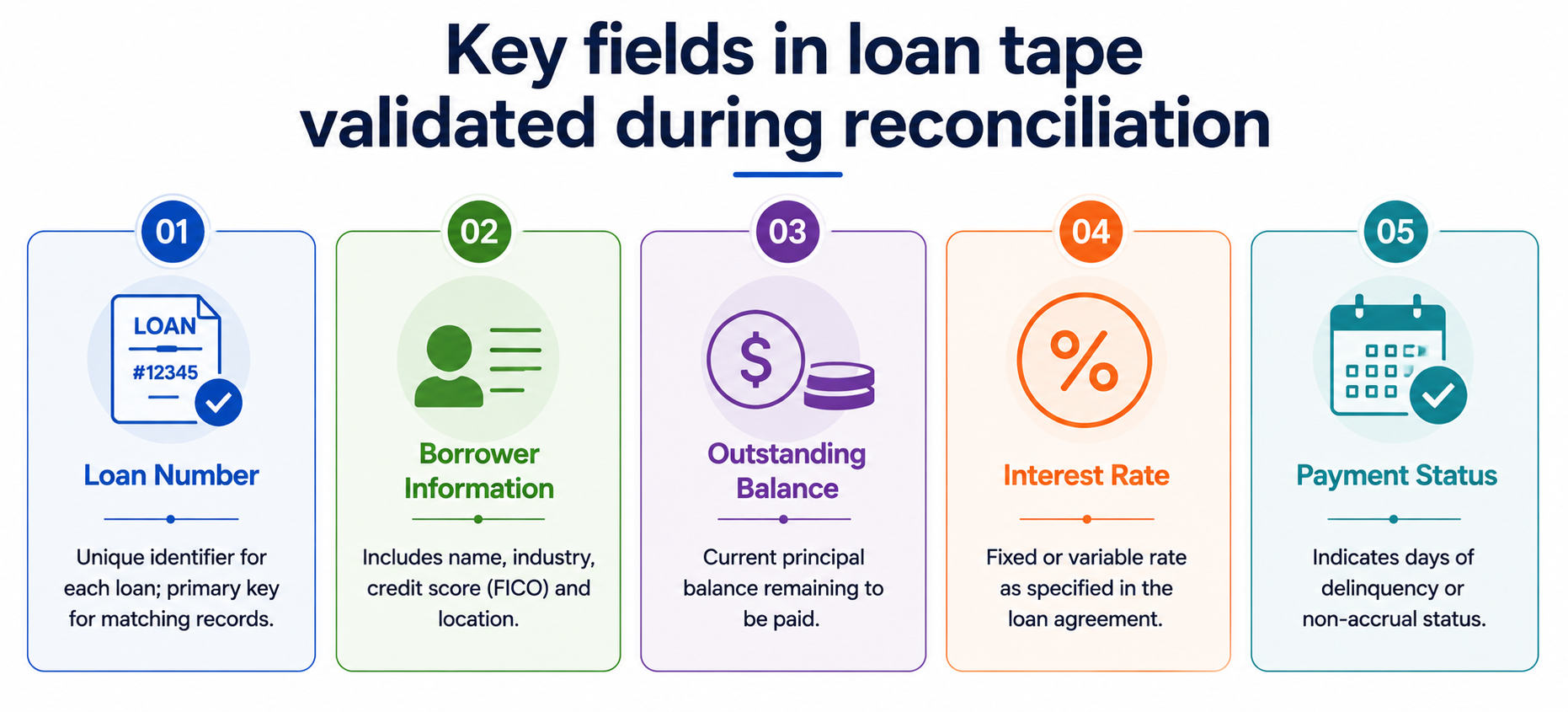
There is no standard format or structure for creating a loan tape; however, the following are some of the fields found in all of them and validated during reconciliation.
1. Loan Number
The loan number is a unique identifier issued to each loan. This serves as the primary key while matching records.
2. Borrower Information
Borrower information would consist of their name, industry, FICO or credit score and their location.
3. Outstanding Balance
This refers to the current principal balance that the borrower has yet to pay.
4. Interest Rate
The interest rate can either be fixed or variable and specified in the loan agreement.
5. Payment Status
Payment status determines the days of delinquency and non-accrual.
{{banner1}}
Purpose of Loan Tape Reconciliation
Loan tapes are important for investors to manage risk and demonstrate the ABS issuer's credibility. Loan tape reconciliation helps financial institutions by serving the following purpose.
1. Ensure Data Accuracy
Loan tapes are only beneficial to investors when the data in them regarding the loans, the borrower or the payment status is correct. Reconciliation ensures that every field in the file matches the lender’s records.
2. Identify Discrepancies
With reconciliation, any variance in outstanding balances, interest rates, delinquency, non-accrual days, or other important information is identified in a timely manner and escalated for resolution.
3. Compliance Requirement
Banks, NBFCs and other financial institutions often use loan tapes for regulatory reporting requirements. Reconciling helps you ensure data accuracy and stay compliant with these regulations.
Loan Tape Reconciliation Process
A structured loan tape reconciliation process typically goes through the following steps.
1 Extract Data
The first step in reconciliation is to gather files and data from all the sources used in the creation of the loan tape.
2. Standardize Data
Most of this data is in different formats. They can come in the form of JSON, PDF, or any other file type. These files need to be standardized before matching.
3. Match Records
Now that the data has been collected and standardized, it is matched against entries in the loan tape to ensure accuracy and consistency.
4. Identify Exceptions
Errors, mismatches, or missing records can always emerge during reconciliation in your loan tape, internal records or loan service system. These exceptions have to be promptly flagged and sent for review.
5. Investigate and Resolve
Discrepancies and errors flagged during matching are sent for review to investigate their root cause and be corrected.
Common Loan Tape Reconciliation Challenges
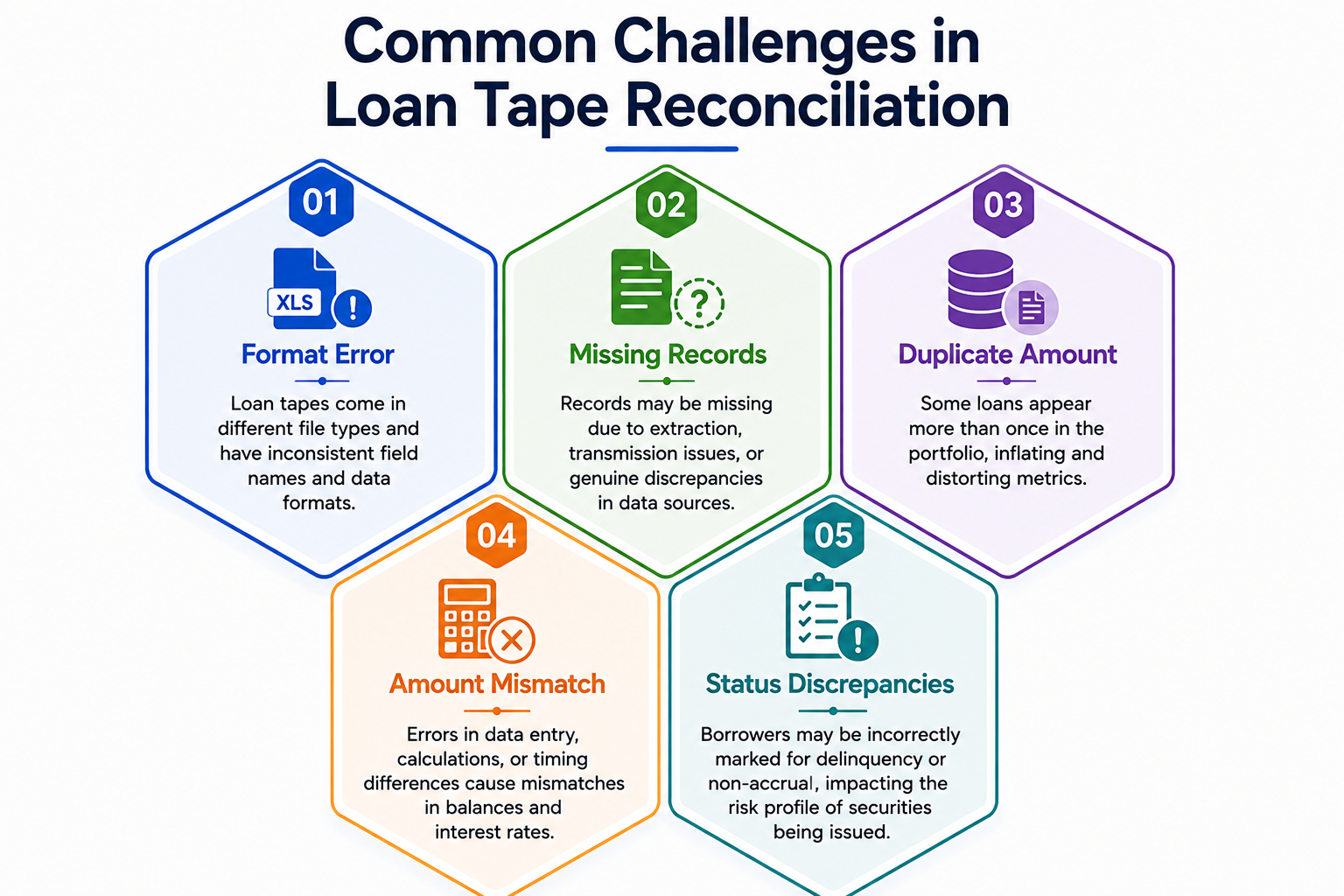
A loan tape consists of hundreds of fields and records gathered from various data sources. The loan tape itself and its data sources can pose multiple challenges for the reconciliation team. Some of them include the following.
1. Format Error
Since there is no standard format or structure for loan tapes, they come in different file types and have inconsistent field names, data formats, etc. Before you begin reconciliation, you first have to standardize the format.
2. Missing Records
There are many instances when some loans end up having missing records due to issues with data extraction or transmission, or it can be a genuine discrepancy present in data sources that must be investigated.
3. Duplicate Amount
Some loans may appear more than once in the loan portfolio, which can inflate and distort its metrics.
4. Amount Mismatch
Incorrect data entry, calculation errors, or timing differences can lead to mismatches in outstanding balances and interest rates
5. Status Discrepancies
Discrepancies can also arise where borrowers with current loans get marked for delinquencies or non-accrual. This can significantly impact the risk profile of securities being issued.
{{banner1.1}}
How Osfin Automates Loan Tape Reconciliation
Challenges that arise from manual loan tape reconciliation can be easily resolved by Osfin’s intelligent automation platform, which offers the following features.
1. File Format Agnostic Ingestion
Osfin is a file format platform and has 170+ connectors that enable it to integrate with different ERPs, loan service systems and more, allowing it to capture data from multiple sources regardless of the format.
2. Multi-Way Reconciliation
It can handle high transaction volumes and apply logic-based matching rules to perform multi-way reconciliation. This includes 2-way, 3-way, 4-way and 5-way reconciliation.
3. Exception Handling Engine
Osfin’s ticketing and exception-handling engine automatically flags any discrepancy found in your loan tape and its related files, assigns them correct reasons and routes them to appropriate personnel for investigation and resolution.
4. Audit-Ready Records
Osfin’s intuitive dashboard gives you real-time status of reconciliation progress and exceptions, along with audit trails that provide complete traceability and transaction history.
5. Data Security
Osfin protects your data with 256-bit encryption, maker-checker flows, role-based access, and two-factor authentication.
Best Practices for Effective Loan Tape Reconciliation
Even though there are many challenges in reconciling loan tapes, the following best practices can help make the process more accurate and reliable.
1. Automate Matching
Manual matching of large loan tapes is not scalable. Investing in an automation platform like Osfin ensures consistency, speed, and accuracy regardless of tape volume.
2. Escalate Exceptions
Mistakes and errors in loan tapes can affect the risk profile of your securities. Every flagged item during reconciliation should be investigated and resolved as soon as possible.
3. Maintain Audit-Trails
Every action in loan tape reconciliation, whether entries, corrections, reviews or approval, should be clearly documented with the user name, date and time. This helps with internal governance and regulatory compliance.
Finishing Off
Loan tapes are the backbone of portfolio transparency for banks, NBFCs, and investors. But they are only as reliable as the reconciliation process behind them. Errors in outstanding balances, payment status, or borrower details can distort risk assessments and create compliance gaps that are costly to fix.
Manual processes simply cannot keep up with the sheer volume and complexity of loan tapes. Osfin can automate the whole loan tape reconciliation cycle.
It can easily capture and standardize data with its 170+ connectors and file-agnostic features, perform lightning-fast reconciliation with logic-based matching rules, and route anomalies to the team, all while keeping audit trails of every action.
{{banner2}}
FAQs
1. What are the key fields investigated in loan tape reconciliation?
The key fields investigated during loan tape reconciliation include the loan number, borrower information, outstanding balance, interest rate, and payment status.
2. Why is loan tape reconciliation necessary?
Loan tapes contain information on the pool of loans that back asset-backed securities or collateralised loan obligations. This is used by investors to assess the security's risk and affects their decision-making. With reconciliation, issuers can ensure the accuracy of the loan tape and promptly identify and address any errors.
3. What is the process of loan tape reconciliation?
Loan tape reconciliation starts with extracting data from different sources, standardising it, matching records in the loan tape with those of external sources, and resolving errors identified in the data.
4. What challenges are encountered in loan tape reconciliation?
Some of the common challenges that arise during loan tape reconciliation include format errors, missing records, duplicate amounts, amount mismatch and status discrepancies.