Intercompany Reconciliation: Process and Best Practices
Large corporations often acquire subsidiaries to expand their businesses domestically and internationally. This is followed by a rapidly growing stream of intercompany transactions. These can include sales of goods or services, asset transfers, royalty payments, etc. All of these need to be recorded in the respective subsidiary ledgers to ensure accurate financial reporting by the parent company.
But how does one ensure that these transactions are consistently recorded across subsidiaries' accounts? With the help of intercompany reconciliation.
This article explores what intercompany reconciliation is, its step-by-step process, common issues and best practices to enhance it.
Key Takeaways:
- Intercompany reconciliation verifies that transactions between two subsidiaries or between a subsidiary and the parent company are consistently recorded in the ledgers of both sides.
- Intercompany Transactions need to be removed from consolidated financial statements as they do not represent economic activity with external customers.
- Mistakes while manually entering data, system differences, timing mismatch and high transaction volumes are some of the common causes of discrepancies in intercompany reconciliation.
- Reconciliation performance can be measured from metrics like reconciliation cycle time, unresolved exception volume, number of post-close adjustments and review turnaround time.
What Is Intercompany Reconciliation?
Intercompany reconciliation is the process of matching transactions between the two subsidiary units owned by the same parent company, or between the subsidiary and the parent company. It ensures that intercompany payables, receivables, loans, and shared expenses are consistent on both sides. This helps prevent and resolve discrepancies that could distort the parent company’s financial consolidation.
Intercompany transactions can include the payment of dividends, the purchase and sale of assets, or borrowing and lending. These can be:
- Downstream: Parent company to subsidiary
- Upstream: Subsidiary to parent company
- Lateral: Two subsidiaries of the same company
Reconciliation verifies that each transaction has a corresponding record in the other entity and that their balances align.
For example, a parent company's HR department processes payroll for three subsidiaries and charges each one a service fee for this support. The fee recorded as an expense in each subsidiary's books must have corresponding revenue recorded by the parent company's HR division.
{{banner1}}
Why Does Intercompany Reconciliation Matter?
At month-end, the parent company consolidates the financial statements of all its subsidiaries into a single report. Since intercompany transactions don't reflect business with external parties, they need to be eliminated during the consolidation process.
Intercompany reconciliation ensures that:
- Receivable and payable balances match across all records of the related entities.
- Discrepancies in intercompany accounts are identified and resolved before consolidation.
- Financial reports meet IFRS and GAAP requirements while preventing the overstatement of revenue and expenses.
What is the Intercompany Reconciliation Process?
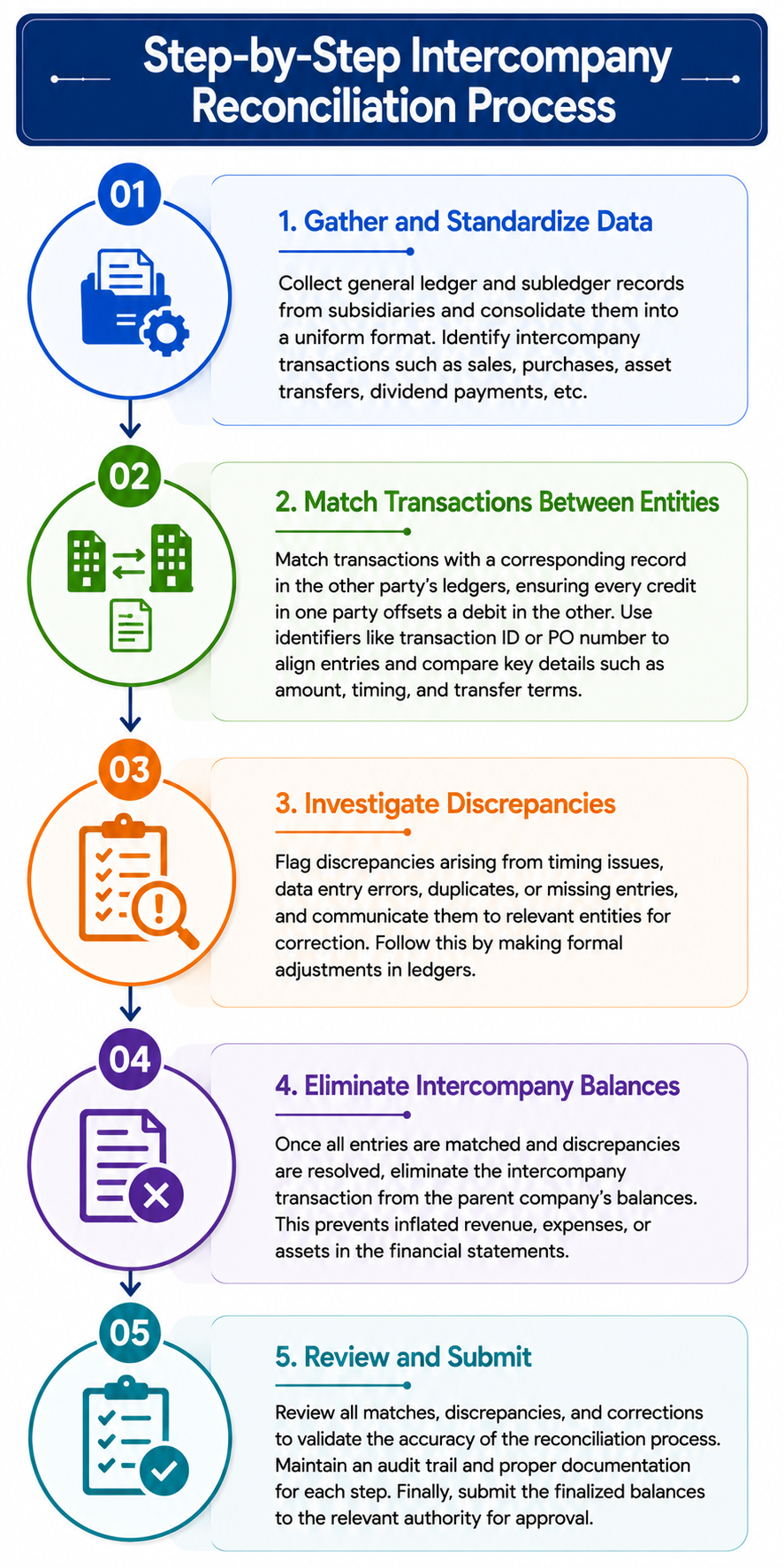
A structured intercompany reconciliation generally follows these 5 steps:
1. Gather and Standardize Data
Start by gathering general ledger and subledger records from subsidiaries' accounting systems and consolidating the data into a uniform format. Locate intercompany transactions like sales and purchases, asset transfers, dividend payments, etc.
2. Match Transactions Between Entities
Match transactions with a corresponding record in the other party’s ledgers, with every credit in one party offsetting a debit in the other. Use identifiers like transaction ID or PO number to align these entries. Compare details like amount, timing, transfer terms, etc., to ensure their alignment.
3. Investigate Discrepancies
Flag discrepancies arising from timing issues, data entry errors, duplicates, or missing entries, and communicate them to relevant entities for correction. Follow this by making formal adjustments in ledgers.
4. Eliminate Intercompany Balances
Once all entries are matched and discrepancies are resolved, eliminate the intercompany transaction from the parent company’s balances. This prevents their financial statements from having inflated revenue, expenses, or assets.
5. Review and Submit
Validate the accuracy of the reconciliation process by reviewing all the matches, discrepancies, and corrections made during the process. Keep an audit trail of each step in the process and back it with proper documentation. At last, submit the finalized balances to the relevant authority for approval.
Manual Vs Automated Intercompany Reconciliation
Organizations with only one or two small entities can easily perform intercompany reconciliation using manual methods. But this is not feasible as they expand.
As the number of subsidiaries increases, so will intercompany transaction volumes. Handling this process using spreadsheets can overwhelm the accounts team, delay financial reporting, and increase the risk of errors going unnoticed.
Automatic intercompany reconciliation addresses this directly by pulling transaction data from the entity’s ERP, applying configurable matching rules, and flagging mismatches. As a result, reconciliations are completed faster with less manual effort.
{{banner1.1}}
What are the Common Causes of Discrepancies in Intercompany Transactions?
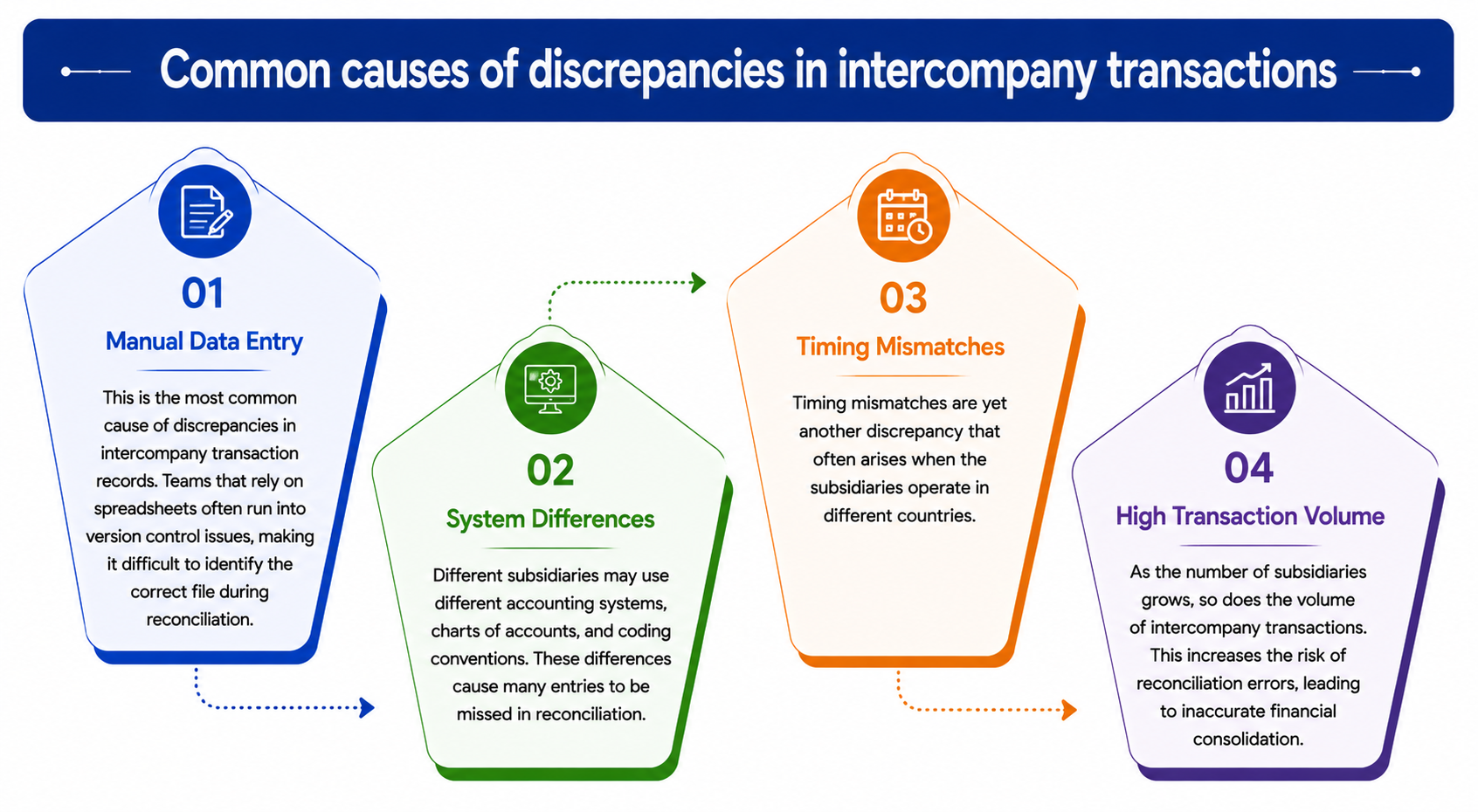
In an intercompany transaction, the revenue of one party must mirror the other party's expense, or a receivable must mirror the other party’s payable. For reconciliation, you have to coordinate with the other party’s accounting team, ERP systems, and time zones. As such, discrepancies are bound to arise.
1. Manual Data Entry
This is the most common cause of discrepancies in intercompany transaction records. Teams that rely on spreadsheets often run into version control issues, making it difficult to identify the correct file during reconciliation.
2. System Differences
While different subsidiaries may operate under the same parent company, their accounting systems do not necessarily have to be the same. Each subsidiary uses its preferred ERP, has a different chart of accounts, and follows a different coding convention. This causes many entries to be missed in reconciliation.
3. Timing Mismatches
Timing mismatches are yet another discrepancy that often arises when the subsidiaries operate in different countries.
4. High Transaction Volume
An organization with only 2 or 3 subsidiaries can easily manage intercompany reconciliation. But when the number of subsidiaries grows, so will the intercompany transaction volume. At that point, the risk of reconciliation errors significantly increases, which will be reflected in inaccurate financial consolidation.
What are the Key Metrics for Measuring Intercompany Reconciliation Performance?
Several metrics can help you assess the performance of your intercompany reconciliation. These include the following:
1. Reconciliation Time
A long reconciliation cycle is often an indication of several bottlenecks arising in data collection, investigation, and review.
2. Volume of Unresolved Exceptions
Exceptions can always arise in the reconciliation process. But a high volume of these transactions at the month-end closing is a sign that your accounts team is using inefficient reconciliation processes.
3. Number of Post-Close Adjustments
This measures how many journal entries had to be corrected and adjusted post-close. A larger number of post-close adjustments is a sign of weak internal control, resulting in an inflated financial report. This exposes you to increased scrutiny from auditors.
4. Review Turnaround Time
This is a measure of how long it takes for a reviewer to approve your reconciliation report. Unclear documents and inconsistent anomaly resolution procedures often cause delays in reviews.
How Does Osfin Automate Intercompany Reconciliation?
Osfin is a low-code automation platform for finance teams managing high-volume, complex transactions. It accelerates data ingestion, matching, and reconciliation with 100% accuracy. Its key features include the following:
1. Data Ingestion
Osfin is a file-format-agnostic platform that can ingest data regardless of its format. With 170+ connectors, it integrates with a wide range of ERPs, ledgers, and internal databases. It filters out duplicates and outliers using custom deviation tolerances at ingestion to avoid downstream issues.
2. Rapid Reconciliation
Osfin reconciles up to 30 million transactions in just 15 minutes. It applies logic-based matching rules to support one-to-many, many-to-one, and multi-way reconciliations, including 2-way, 3-way, 4-way, and 5-way reconciliations.
3. Exception Handling Engine
Unmatched transactions are automatically flagged by Osfin’s ticketing and exception handling engine. They are assigned accurate reasons and routed to the appropriate team member for resolution. It offers live dashboards that show match status, exposure, and exception queues.
4. Output Delivery
Osfin delivers a compliance report at the end of the reconciliation cycle. It maintains an audit-ready workflow with complete traceability and transaction history. It complies with SOC 2, PCI DSS, ISO 27001, and GDPR requirements. To keep your data secure, it provides 256-bit encryption, maker-checker flows, role-based access, and two-factor authentication.
What are the Best Practices for Intercompany Reconciliation?
Intercompany transaction reconciliation can be delayed for various reasons and still result in errors. The following best practices can help you enhance the process and increase its accuracy:
1. Standardize Processes
Formulate consistent rules for the chart of accounts and coding conventions across subsidiaries to eliminate confusion during reconciliation. This also makes it easier to provide documentation for audits.
2. Centralize Data
Instead of allowing siloed spreadsheet-based workflows, opt for a shared platform to centralize the intercompany transaction records.
3. Track KPIs
Regularly track reconciliation KPIs like time per cycle, volume of unresolved entries, and post-close adjustment, to identify bottlenecks that can delay financial consolidation.
4. Automate Reconciliation
As transaction volumes grow and organizations expand across regions, automation platforms like Osfin help simplify reconciliation. They bring together data from multiple systems, reconcile it faster, and provide dashboards for tracking reconciliation KPIs.
Finishing Off
Intercompany reconciliation protects the accuracy of a parent company's consolidated financials. As the number of subsidiaries grows and transaction volume rises, manual reconciliation poses a real risk.
Osfin’s intelligent automation platform streamlines intercompany transaction reconciliation by removing manual processes, speeding up ingestion and matching, and providing real-time visibility into the process with its intuitive dashboards. This helps keep your financial consolidation accurate and audit-ready. Book a demo now!
FAQs
1. What is the purpose of intercompany transaction reconciliation?
The purpose of intercompany transaction reconciliation is to identify and reconcile transactions between subsidiaries before they are eliminated from the parent company's consolidated financial statements. This helps ensure compliance with IFRS and GAAP.
2. What are the three main types of intercompany transactions?
The three main types of intercompany transactions are downstream, and lateral.
3. What are the common causes of discrepancies in intercompany reconciliation?
Manual data entry errors, differences in accounting systems and coding conventions, timing mismatches, and high transaction volumes are some of the most common causes of intercompany reconciliation discrepancies.
4. What KPIs need to be tracked in intercompany transaction reconciliation?
KPIs that help you evaluate intercompany transaction reconciliation include reconciliation time, volume of unresolved discrepancies, number of post-close adjustments, and review turnaround time.