Fixed Asset Reconciliation: Process and Best Practices
A company utilizes many fixed assets in its day-to-day processes. These can include furniture, IT and office equipment, manufacturing plants, etc. All of these have different acquisition costs and accumulated depreciation, and eventually need to be sold, retired, or disposed of.
To keep your financial statements accurate, it is essential that details be recorded and reconciled at regular intervals.
In this article, we’ll look at what fixed asset reconciliation is, its importance, process, and best practices.
Key Takeaways
- Fixed asset reconciliation is the process of matching details in the fixed asset register, such as acquisition cost, depreciation, and disposal, with records in the general ledger.
- Asset reconciliation helps keep your financial reports accurate, maintain internal controls, evaluate asset utilization, and claim tax benefits from depreciation.
- Manual processes, poor documentation, errors in depreciation calculation, and physical asset verification often complicate the reconciliation process.
- Regularly updating records, conducting physical asset verifications, training staff on fixed asset policies, and using Osfin’s intelligent automation platform streamlines fixed asset reconciliation.
What is fixed asset reconciliation?
The accounting standards, such as IFRS and GAAP, require that details pertaining to fixed assets be accurately recorded in the fixed asset records and the general ledger, and that they reflect their physical reality.
Fixed asset reconciliation is the process of matching fixed assets records to entries in the general ledger. It verifies that the acquisition cost, depreciation, and disposal information are consistent in both the records and actually match the physical reality of these long-term investments.
Why is fixed asset reconciliation Important?
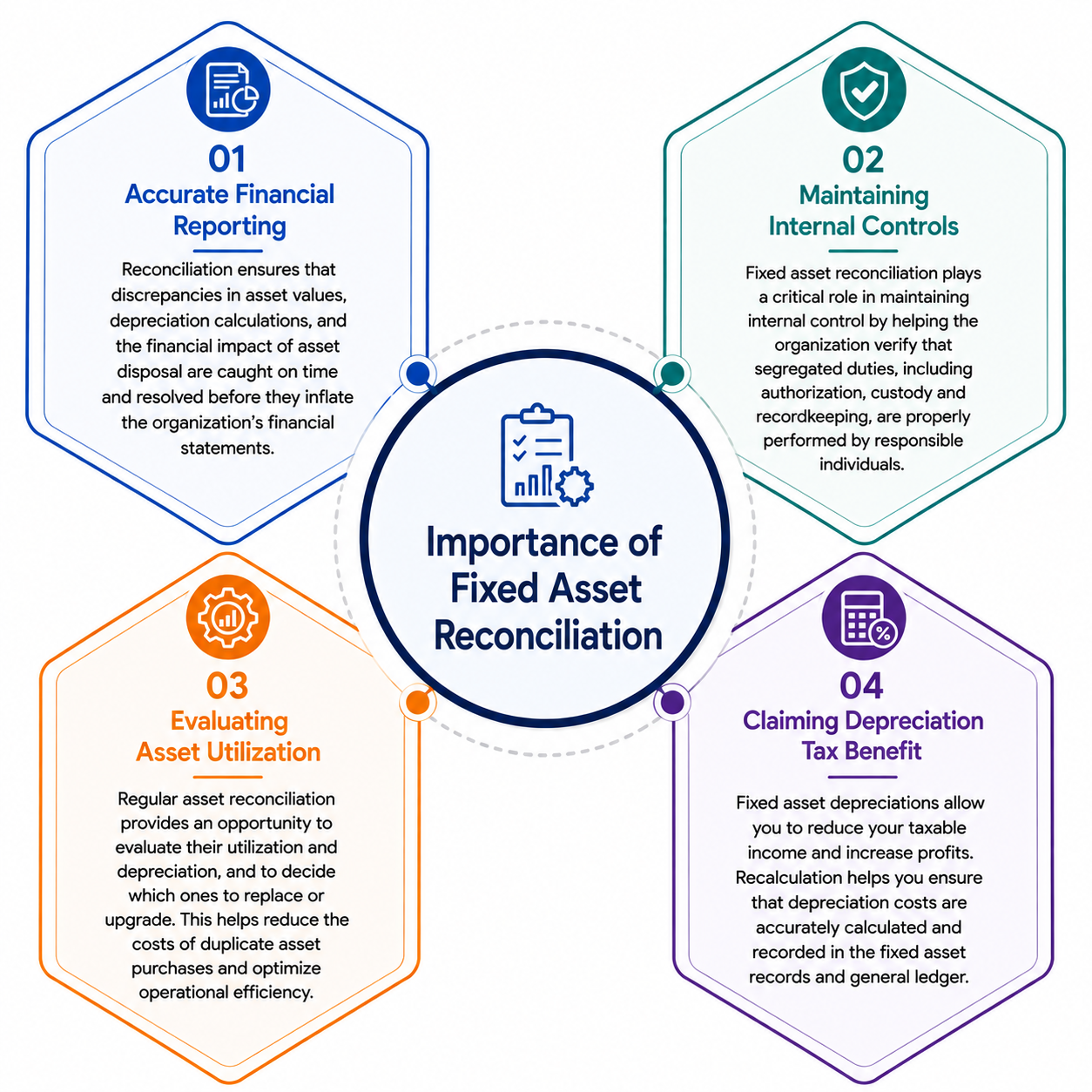
Reconciling fixed assets mainly serves the following four purposes:
1. Accurate Financial Reporting
Financial statements must accurately represent a company’s financial position and performance. Reconciliation ensures that discrepancies in asset values, depreciation calculations, and the financial impact of asset disposal are caught on time and resolved before they inflate the organization’s financial statements.
2. Maintaining Internal Controls
Fixed asset reconciliation plays a critical role in maintaining internal control by helping the organization verify that segregated duties, including authorization, custody and recordkeeping, are properly performed by responsible individuals.
3. Evaluating Asset utilization
Regular asset reconciliation provides an opportunity to evaluate their utilization and depreciation, and to decide which ones to replace or upgrade. This helps reduce the costs of duplicate asset purchases and optimize operational efficiency.
4. Claiming Depreciation Tax Benefit
Fixed asset depreciations allow you to reduce your taxable income and increase profits. Recalculation helps you ensure that depreciation costs are accurately calculated and recorded in the fixed asset records and general ledger.
{{banner1}}
What are the Steps in the Fixed Asset Reconciliation Process?
Fixed assets are spread across different departments and offices of the organization. When you start reconciling them, the process will follow the steps below:
1. Collect Data
Extract data from fixed asset registers and the general ledger in one place. Along with this, gather records about each asset's net book value (NBV).
2. Compare Entries
Compare corresponding entries in the fixed asset register and the general ledger, such as acquisition costs, depreciation calculations, and the financial effects of disposal, etc. Once matched and verified, reconcile the net book value of every asset.
3. Investigate Discrepancies
Flag discrepancies, duplicates, or missing entries in the ledger and register. Escalate them to individuals responsible for recordkeeping and custody. On identifying the cause of these discrepancies, update the records with correct information.
4. Finalize and Report
Create a report of the whole reconciliation process. Document the discrepancies and their resolution, as well as any findings and improvements needed in internal controls. Submit this report to senior management and auditors for review and approval.
What are the Common Challenges of Fixed Asset Reconciliation?
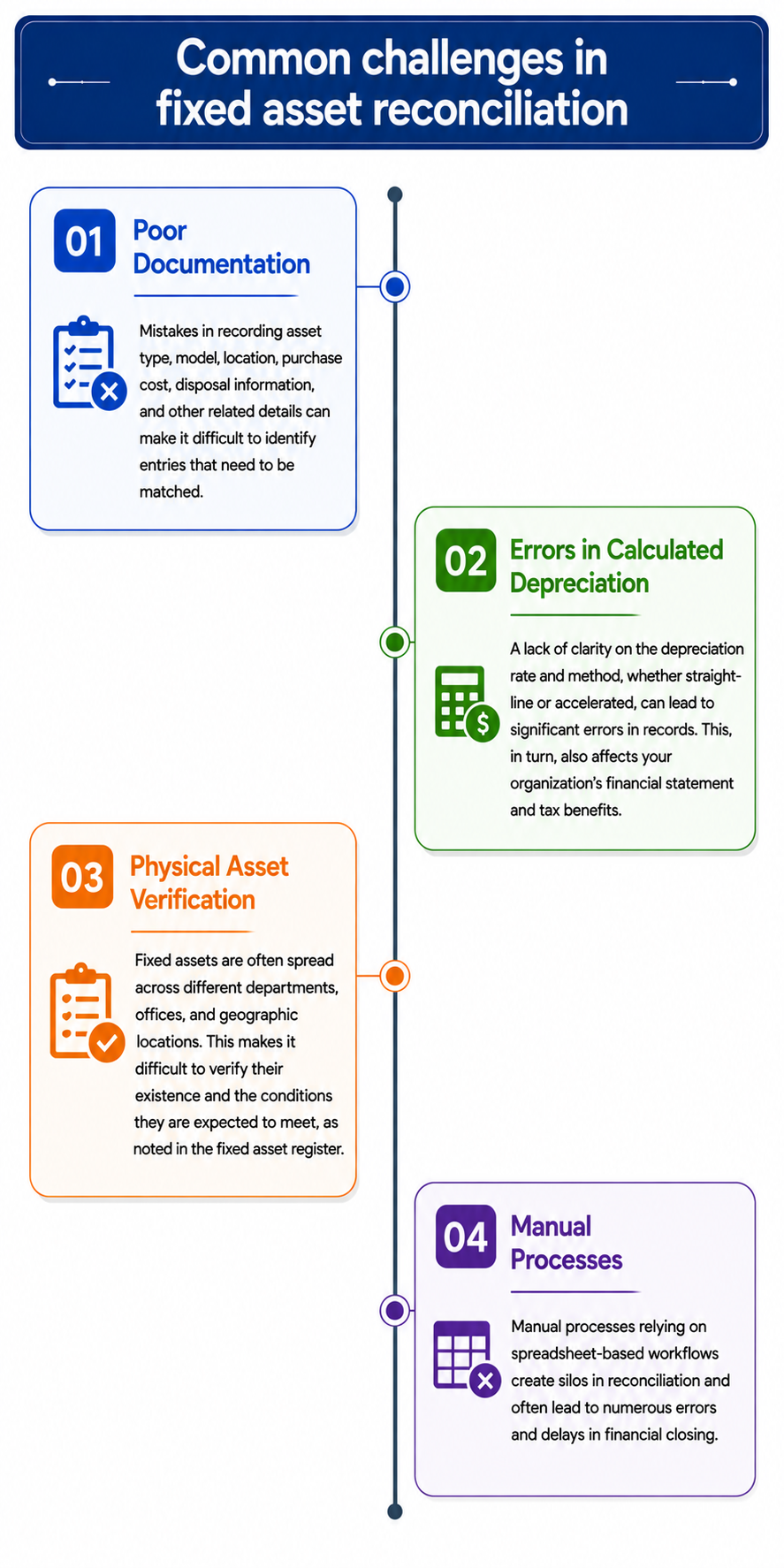
Fixed asset reconciliation is integral to accurate financial consolidation, yet the process is riddled with challenges that can complicate it.
1. Poor Documentation
Mistakes in recording asset type, model, location, purchase cost, disposal information, and other related details can make it difficult to identify entries that need to be matched.
2. Errors in Calculated Depreciation
Organizations need to spread the cost of assets over their useful lifespan instead of recognizing it upfront. This is what depreciation calculations are for. However, a lack of clarity on the depreciation rate and method, whether straight-line or accelerated, can lead to significant errors in records. This, in turn, also affects your organization's financial statement and tax benefits.
3. Physical Asset Verification
Fixed assets are often spread across different departments, offices, and geographic locations. This makes it difficult to verify their existence and the conditions they are expected to meet, as noted in the fixed asset register.
4. Manual Processes
Manual processes relying on spreadsheet-based workflows create silos in reconciliation and often lead to numerous errors and delays in financial closing.
How does Osfin Automate Fixed Asset Reconciliation?
Osfin automates every step of your fixed asset reconciliation, from data ingestion to output delivery, eliminating errors associated with manual processes. This reduces your accounts team’s need for physical verification and staff training. Osfin’s key features include the following:
1. Multi-Source Data Ingestion
Osfin is a file format-agnostic platform with 170+ integrations, meaning it can ingest data in any given format, be it PDF, JSON, XML, etc., from multiple sources. It applies custom deviation tolerances in this phase to filter out duplicate entries and outliers, so that they don’t cause issues in reconciliation.
2. Rapid Reconciliation
Osfin applies logic-based matching rules to reconcile one-to-many, many-to-one, and multi-way transactions, including 2-way, 3-way, 4-way, and 5-way. Osfin is specifically built to handle a high volume of complex financial operations, as it can easily perform 30 million reconciliations in just 15 minutes.
3. Exception Handling
Osfin’s ticketing and exception handling engine automatically flags unmatched transactions, assigns them a reason, and directs them to an appropriate member of the accounts team for investigation and resolution. Its comprehensive dashboard gives you real-time visibility into match status, exception queues, and other actionable insights.
4. Output Delivery
At the end of the reconciliation cycle, Osfin automatically delivers a compliance report. It maintains audit trails of every transaction, authorization, and correction with complete traceability. It keeps your financial data secure with 256-bit encryption, role-based access, and two-factor authentication. It also has certifications for SOC 2, GDPS, PCI DSS, and ISO 27001.
{{banner1.1}}
What are the Best Practices for Fixed Asset Reconciliation?
There are many challenges that can complicate fixed asset reconciliation, but the following best practices can help:
1. Keep Records Updated
Regularly update your fixed asset register and ensure purchase order ID, amounts, and depreciation calculations are accurately recorded in it.
2. Train Staff
Keep your staff trained on policies for asset procurement, custody, and recordkeeping, including how assets are to be classified, what depreciation method they follow, and how they are to be disposed of.
3. Conduct Physical Verification
Conduct physical asset verification on a quarterly or an early basis to verify that what is recorded in the registers and general ledger is consistent with the actual physical asset.
4. Automate Processes
Manual processes often delay the closing cycle as significant time is spent simply entering data into systems. Moreover, they always carry a high risk of errors. Instead, automate the whole fixed asset reconciliation with Osfin, which can capture data from multiple sources and reconcile transactions with 100% accuracy.
Wrapping Up
Fixed asset reconciliation keeps your financial statements accurate and your internal controls strong. But even small errors in depreciation or disposal records can distort the bigger picture. Regular record updates, staff training, physical asset verification, and automated processes can enhance reconciliation and keep your books accurate.
As an intelligent automation platform, Osfin is particularly well-suited to streamlining fixed asset reconciliation. It adds speed to data ingestion, matching, and output delivery, all while improving accuracy and visibility into the process. Book a demo now!
FAQs
1. Why is there a need for fixed asset reconciliation?
Fixed asset reconciliation helps keep your financial statements accurate, maintain internal controls, evaluate asset utilization, and claim tax benefits for depreciation.
2. Which accounting standards require fixed asset reconciliation?
Accounting standards such as IFRS and GAAP require fixed asset reconciliations to report expenses and revenue in consolidated financial statements accurately.
3. What are the steps in the fixed asset reconciliation process?
Fixed asset reconciliation requires you to first collect fixed asset data from registers and the general ledger, match corresponding entries for each asset, investigate and resolve errors, and create a report of the whole process to submit to senior management and auditors.
4. What issues complicate fixed asset reconciliation?
Poor documentation, errors in calculated depreciation, physical asset verification, and manual processes often complicate fixed asset reconciliation.