Payment Reconciliation Blueprint: A Complete Guide
Financial institutions and banks no longer rely on one payment provider. They have to manage many. And each source brings in unique settlement times, formats, and rules. And this leaves treasury teams scrambling and wasting over 120 hours monthly to match incomplete reports, misaligned entries, and hidden revenue gaps.
In this article, we’ll cover the payment reconciliation blueprint, why processes break at scale, the differences between manual and automated reconciliations, and how Osfin saves you the trouble with a guaranteed 100% accuracy.
What is Payment Reconciliation?
Payment reconciliation is a financial process in which the internal records of a financial institution are matched against the external statements from payment gateways, banks and processors. Banks, card providers, and treasury services use a payment reconciliation blueprint to verify inflows, such as customer payments, and outflows, such as refunds.
This process helps you to catch discrepancies such as timing delays, unposted transactions, unaccounted fees, or manual errors ensuring accurate books and cash positions. For high-volume operations, a payment reconciliation blueprint confirms that multi-currency settlements and chargeback deductions align across payment providers.
Without regular reconciliation, even small gaps like duplicate transactions, unrecorded fees or settlement delays can distort reports. This can lead to potential risks like revenue leakage and operational strain that could have far-reaching consequences.
Why Payment Reconciliation Breaks at Scale?
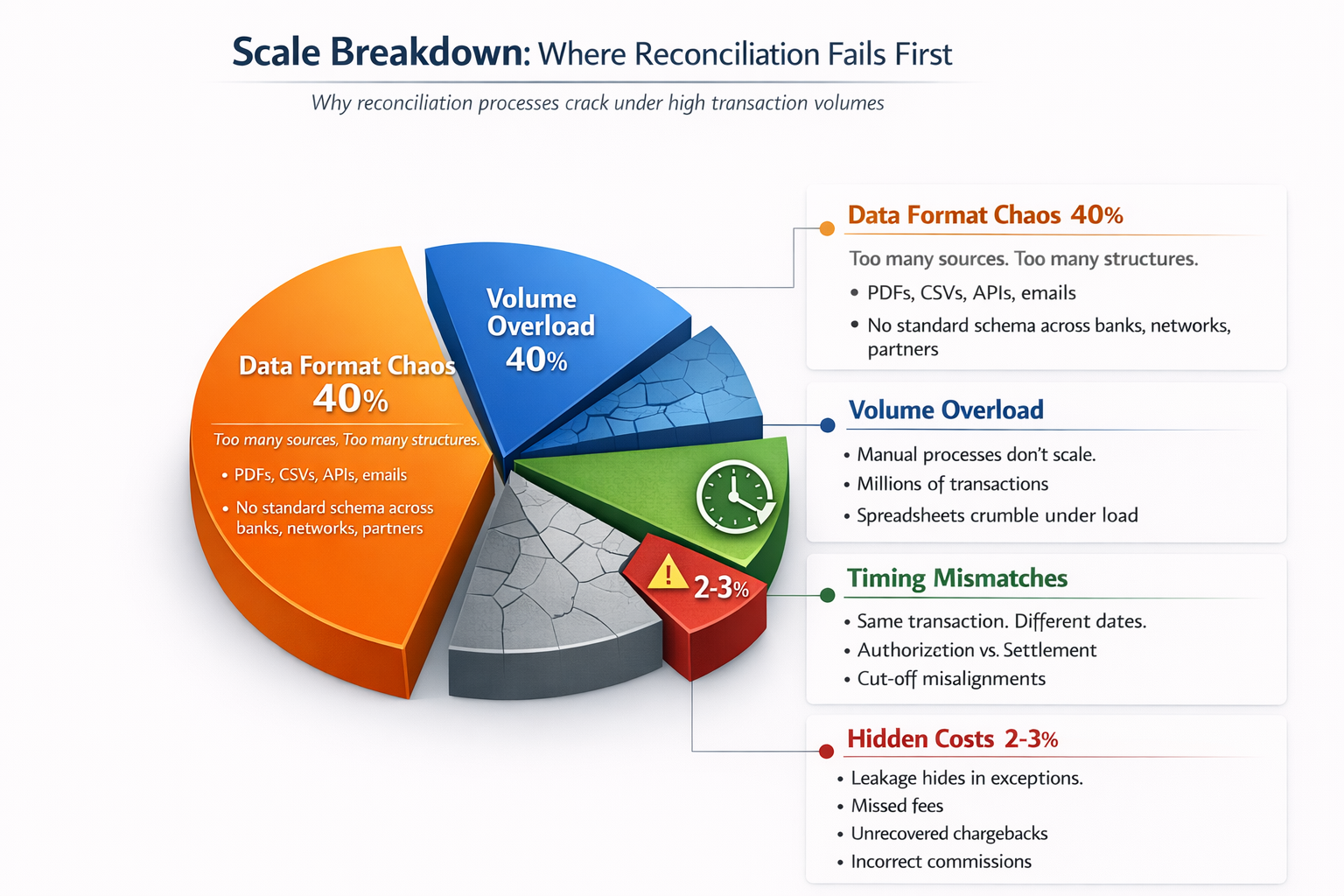
In banks and financial institutions, high-volume transactions overwhelm manual processes. Millions of payments from sources such as payment gateways arrive in various formats and at different times.
Settlement delays, such as T+1 from one provider versus T+7 from another, can create mismatches. These can be compounded by FX fluctuations, hidden fees, taxes, and chargebacks, which distort cash positions for treasury services.
Manual spreadsheets can’t keep up, leading to hours of fatigue-prone data. This also makes way for overlooked errors that snowball into compliance headaches. Also, the card providers struggle with one-to-many merchant splits, where a single settlement fans out to thousands. All this while treasury teams are tackling multi-currency variances that hide true liquidity gaps.
Without automation and a thorough payment reconciliation blueprint, a significant percentage of revenue leakage becomes routine. And this fuels disputes and causes delays in audits under PCI DSS or SOX rules.
These issues manifest in specific operational pain points for financial teams:
- Data Format Chaos: To collect and clean data from payment gateways, manual conversion of CSV/JSON records eats 40% of recon time.
- Volume Overload: Millions of daily transactions exceed Excel limits, causing crashes and incomplete matches.
- Timing Mismatches: Refunds are posted instantly but are settled later, inflating discrepancies by thousands.
- Hidden Costs: Some untracked percentage of fees/taxes per transaction erodes margins and is unnoticed until quarter-end.
- Compliance Traps: SOX violations from untraced exceptions cost hefty fines per incident.
The Payment Reconciliation Blueprint
Financial institutions like banks and card providers need a structured payment reconciliation blueprint to manage multi-provider chaos. This is a four-phase framework that includes data ingestion, transaction record reconciliation, exception handling, and output.
This blueprint helps you turn fragmented data into accurate, compliant financial controls at scale. You can follow this payment reconciliation blueprint to standardize and automate processes and integrate with ERPs for seamless treasury operations.
Phase 1: Data Ingestion
This phase pulls reports from multiple sources despite the varying formats, settlement cycles and currencies. These are then standardized for clean matching of transactions.
Phase 2: Logic-Based Reconciliation
The automatically matched transactions include fees, refunds and chargebacks. These transactions are across providers and scale to millions daily without any manual errors.
Phase 3: Exception Handling
All the mismatches are flagged along with reasons. And then they are routed to the teams in the form of ‘tickets’. Professionals can monitor via live dashboards to resolve these issues within 24 hours.
Phase 4: Compliant Output
In this step, reports are generated with full audit trails. This ensures PCI DSS and SOX adherence through traceable workflows.
{{banner1}}
Common Payment Reconciliation Challenges
Some common payment reconciliation challenges for your financial institution stem from incompatible reporting standards across payment gateways, regulatory pressures and operational silos.
Such unresolved mismatches erode trust and delay financial closings, exposing your firm to audits. And even a minor oversight can lead to millions in losses from unmatched chargebacks or FX errors.
You can use targeted solutions like automation to address these issues head on, but first, it is necessary for your treasury and compliance teams to understand their scope.
Manual vs Automated Payment Reconciliation
Manual payment reconciliation depends on spreadsheets and human efforts, and on the other hand, automated systems use logic and AI for speed and precision, handling millions of transactions seamlessly.
Finance teams waste a great deal of time on manual matching, and this process is even prone to errors from fatigue and limits like Excel’s row caps. When you leverage automation, you get to replace these issues with 100% accuracy and PCI DSS compliance.
How Osfin Powers the Payment Reconciliation Blueprint
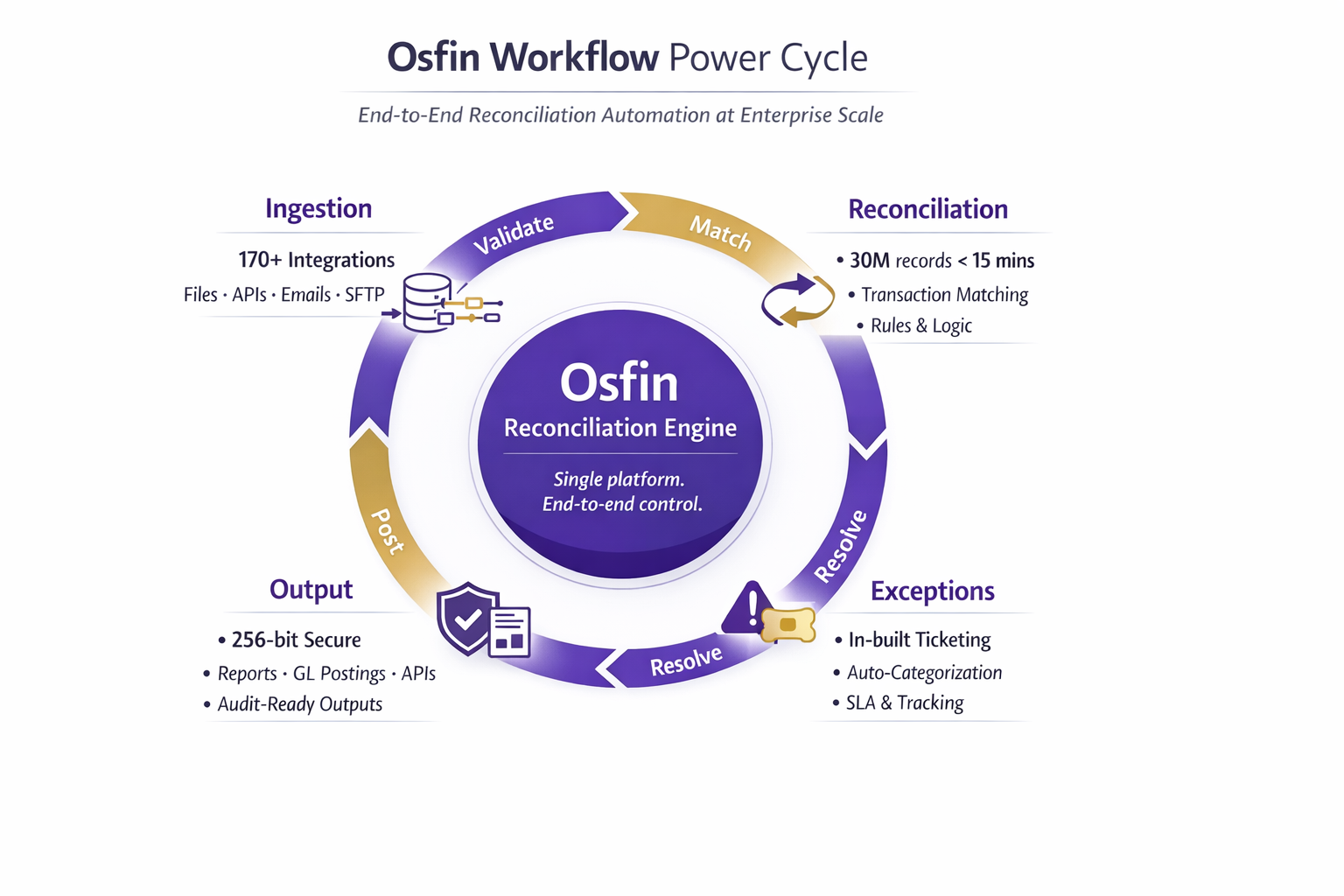
Osfin is a format-agnostic platform that can process data in any format and delivers 100% financial reconciliation accuracy for banks, card providers and other financial institutions like treasury services. It implements the payment reconciliation blueprint through its end-to-end workflow that involves features to support:
Data Ingestion
Osfin supports over 170 integrations to import data from multiple sources like banks, payment gateways- domestic and international, all regardless of the format. It implements custom deviation tolerances during the data ingestion process to filter out poor-quality entries. Osfin also detects duplicates and outliers at this point and ensures clean data flows into the next step - the payments reconciliation process.
Reconciliation Process
At this stage, Osfin makes use of advanced logic-based matching for complex transaction relationships like many-to-one, one-to-many matching and even two, three, four, and five-way financial reconciliations. It auto-reconciles payment gateway reports with commission, tax, and fee breakdowns. And it processes 30 million records in just 15 minutes, making it a reliable and valuable choice for reconciliation for high-volume bank settlements.
Exception Handling
All the unmatched transactions are automatically flagged and are supported by accurate reasons. Through the ticketing systems, they are further escalated to the respective teams. Osfin also provides user-friendly live dashboards to show match status, exposure and exception queues for proactive oversight.
Output
Osfin delivers compliance reports that include audit-ready configurable workflows, full traceability, and transaction history. All your data is secured with 256-bit encryption, role-based access and two-factor authentication features. It also includes maker-checker flows where all the automated and manual actions performed on the platform are religiously captured in the audit log. Such efforts and functionalities offered by Osfin help you comply with world standards like SOC 2, PCI DSS, ISO 27001, and GDPR.
{{banner3}}
Real-World Payment Reconciliation Use Cases
We see that real-world payment reconciliation use cases show how banks, card providers and other financial institutions like treasury teams match high-volume transactions from a variety of payment processors and gateways to their internal records. And by using financial reconciliation tools, these use cases try to achieve 100% accuracy and reduce errors while maintaining audit-ready compliance at scale.
- Bank Gateway Settlements: Ingestion collects reports despite varying T+1/T+7 cycles and format issues. With the logic matching feature of reconciliation tools like Osfin, fees and charges are auto-aligned. And if any exceptions exist, they are flagged with the help of a ticketing system for the teams. All the outputs ensure full traceability for SOX and other audits.
- Card Provider Payouts: Here, automated reconciliation tools like Osfin handle one-to-many merchant splits and standardize formats quickly with data cleaning and remove duplicates. Matching covers commissions and taxes in minutes. At the same time, you can use dashboards to track exposures for PCI DSS compliance.
- Treasury Cross-Border Flows: Payment reconciliation is used here to normalize multi-currency transaction data from various international gateways. Reconciliation tool Osfin processes 30 million records in 15 minutes, showcasing its exceptional speed with zero human error. All foreign exchange outliers are flagged during the initial data ingestion process as per the payment reconciliation blueprint.
- Fintech Processors: If at all the timings of the transaction records don’t line up, auto-reconciling tools help to match refunds with those delayed settlements. The ticketing system here plays a crucial role in escalating chargebacks to the right people. Plus, a full audit trail helps you to avoid huge fines that are associated with unreconciled transactions.
Best Practices for Payment Reconciliation at Scale
You can achieve reliable reconciliation by standardizing processes and embracing fintech reconciliation tools for automation. Executing the payment reconciliation blueprint helps you prevent revenue leaks caused by multi-provider mismatches. Here are some best practices for payment reconciliation at scale:
- You must monitor KPIs such as match rates and exception volumes to stay ahead of compliance risks like SOX or PCI DSS violations.
- Automate logic-based matching for fees, refunds, and chargebacks, targeting a major percentage of auto-reconciliation rates daily.
- Handle exceptions via ticketing, using financial reconciliation tools that provide live dashboards, resolving them within 24 hours to minimize exposure.
- You must maintain audit trails with secure outputs that are compliant with SOC 2 and GDPR for seamless regulatory reporting.
- Train teams on dashboards and review metrics weekly to optimize for growing transaction volumes.
Conclusion
Banks and treasury teams know that payment reconciliation is the backbone of accurate cash flows and compliance in this multi-gateway world of payment collections. And with the help of the payment reconciliation blueprint we outlined, we can help use cases to leverage automation and scale effortlessly.
Osfin stands out as a top choice among financial reconciliation platforms as it powers the payment reconciliation blueprint with 100% accuracy. It offers an ecosystem of tools clubbed together to support every stage of the reconciliation process. This includes more than 170 integrations from a variety of sources, lightning-fast processing of 30 million transaction records, smart exceptional ticketing and ironclad security like 256-bit encryption, role-based access, and maker-checker flows.
Now you can picture your team ditching the grind laced with manual errors for real-time dashboards, zero errors, and audit-ready reports. Such features offered by Osfin let you focus on growth.
Are you ready to implement the payment reconciliation blueprint? Request an Osfin demo today and see how it handles your high-volume flows with zero fuss!
Frequently Asked Questions (FAQs)
1. Why does reconciliation break at scale?
Most of the time, reconciliation breaks at scale because of overwhelming volume and complex transactions that exceed the normal capability of the semi-automated or manual processes.
2. What are the common reconciliation challenges?
Manual errors, high volumes of transactions, timing differences, and system integration issues are a few of the common payment reconciliation challenges faced by financial institutions.
3. How does Osfin power the payment reconciliation blueprint?
Osfin powers the payment reconciliation blueprint with format-agnostic ingestion via more than 170 integrations to extract data from a variety of sources. And it processes massive transaction volumes like 30 million records in 15 minutes with deviation tolerances and ticketing features.
4. What are the real-world benefits for automated payment reconciliation?
Reduced human errors, massive savings on time, enhanced fraud detection, and improved compliance are some of the real-world benefits of automated payment reconciliation.