Supplier Statement Reconciliation: A Complete Guide
Supplier statement reconciliation keeps banks and financial institutions on top of vendor bills. However, growing transaction volumes, lean finance teams, and manual limits have made statement reconciliation tougher than ever. Most teams just check records of the big suppliers, and that invites risks like overpayments, shaky vendor relationships, incorrect reports, and tied-up funds that hurt cash flow.
In this article, we'll look at supplier statement reconciliation, its challenges, types, process, and end with best practices you can implement to ensure maximum accuracy.
What is Supplier Statement Reconciliation?
Supplier statement reconciliation is the process of verifying a supplier’s invoices and statement details against both: your internal records like invoices, credits and approvals along with your bank statements. Once the supplier sends you invoices from their side, you have to compare it line by line against your accounts payable ledger along with your bank statements. If there’s any discrepancy, like mismatched invoices or unrecorded transactions, you can immediately investigate and fix the issue.
Also known as vendor statement reconciliation, this process ensures accuracy in banks, financial institutions, card providers, and treasury teams that deal with numerous vendors, and it also prevents issues like overpayments or missed credits.
Why Supplier Statement Reconciliation is Challenging Today
Supplier statement reconciliation has become quite complex for banks and financial institutions due to high transaction volumes, inconsistent supplier formats, and limited resources. These challenges can lead to missed credits, overpayments, and compliance risks for treasury teams.
These challenges are further amplified by the growing number of payment methods and gateways. This makes reconciling supplier statements a tedious process for institutions with massive transaction volumes. Here are some of the biggest pain points financial teams face:
- Overwhelming Data Volumes: Banks process millions of transaction lines monthly, but manual reviews cover just a small percentage of suppliers, making it easier to overlook hidden issues.
- Inconsistent Formats: Formats like CSV/PDFs, spreadsheets, and emails don’t follow any standard structure. Putting records together from these sources can cost you hours of reformatting before transaction matching even begins.
- Timing Mismatches: It can happen that payments are cleared on your end but lag on theirs, or vice versa. In the system it’s possible that invoices might appear on their books way before yours.
- Payment Delays and Pre-invoice Deductions: It is tough to put together a chain of events like delayed payments or when commissions are taken out before the invoice is raised.
{{banner1}}
Common Causes of Supplier Statement Mismatches
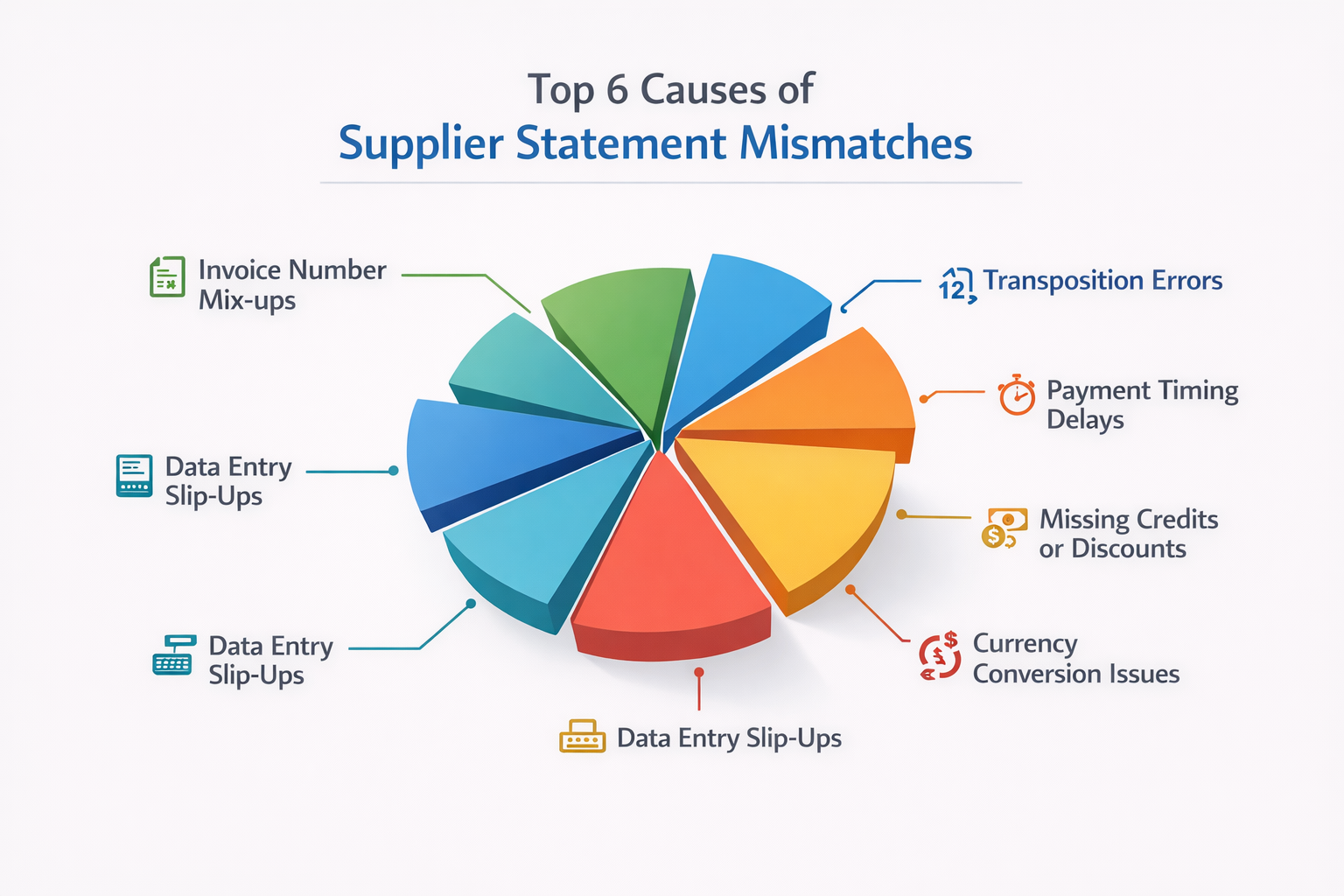
Some common causes behind supplier statement mismatches are invoice number discrepancies, transposition errors, and payment timing delays. These mismatches then invite critical issues like overpayment, cash flow hiccups, and compliance headaches.
- Mix-up in the Invoice Numbers: Your suppliers may be using a different numbering or reference system. That’s why, even a small error can make record matching a tedious task.
- Transposition Errors: Digit swaps from human error creates balance gaps. For example, an amount of $1,450 can be carelessly recorded as $1,540.
- Payment Timing Delays: This situation involves you recording a payment that hasn't been recorded in the supplier’s books yet, or vice versa, causing temporary mismatches.
- Missing Credits or Discounts: Suppliers issue credit notes for returns or rebates, but they may not appear on your AP ledger. This can inflate the outstanding amount.
- Issues in Currency Conversion: Dealing with international vendors comes with exchange rate differences, which can create a gap between recorded and billed amounts.
- Slip-ups in Data-Entry: These include manual input that leads to wrong amounts, misapplied partial payments, or duplicate entries.
Types of Supplier Statement Discrepancies
Supplier statement discrepancies can be of different types - timing differences, data entry errors, missing credits, payment-in-transit issues, etc. It’s important to understand them carefully so you can identify and fix them promptly.
- Timing Discrepancies: This occurs when the invoices are recorded in supplier books on shipment. But your approval process delays the ledger entry for the same. This leads to the misunderstanding that payments are clear from one side only.
- Data Entry Errors: These are manual errors like wrong invoice amounts, supplier codes, or partial payments. These may be applied incorrectly to the transaction records, skewing balances.
- Missing Credits/Notes: Returns, rebates, or corrections show on the supplier’s statement but are not updated in your system yet. This can lead to overstatement of dues.
- Payment-in-Transit Gaps: This happens when you have already sent the funds, but they are not yet processed by the supplier. This can create one-sided entries during transaction reconciliation.
- Currency/Rebate Variances: Factors like exchange rate fluctuations or unposted volume discounts for international vendors can complicate global treasury matching.
- Complex Multi-Entity Issues: Parent-child suppliers or many-to-one transactions may not match easily at times.
Step-by-Step Supplier Statement Reconciliation Process
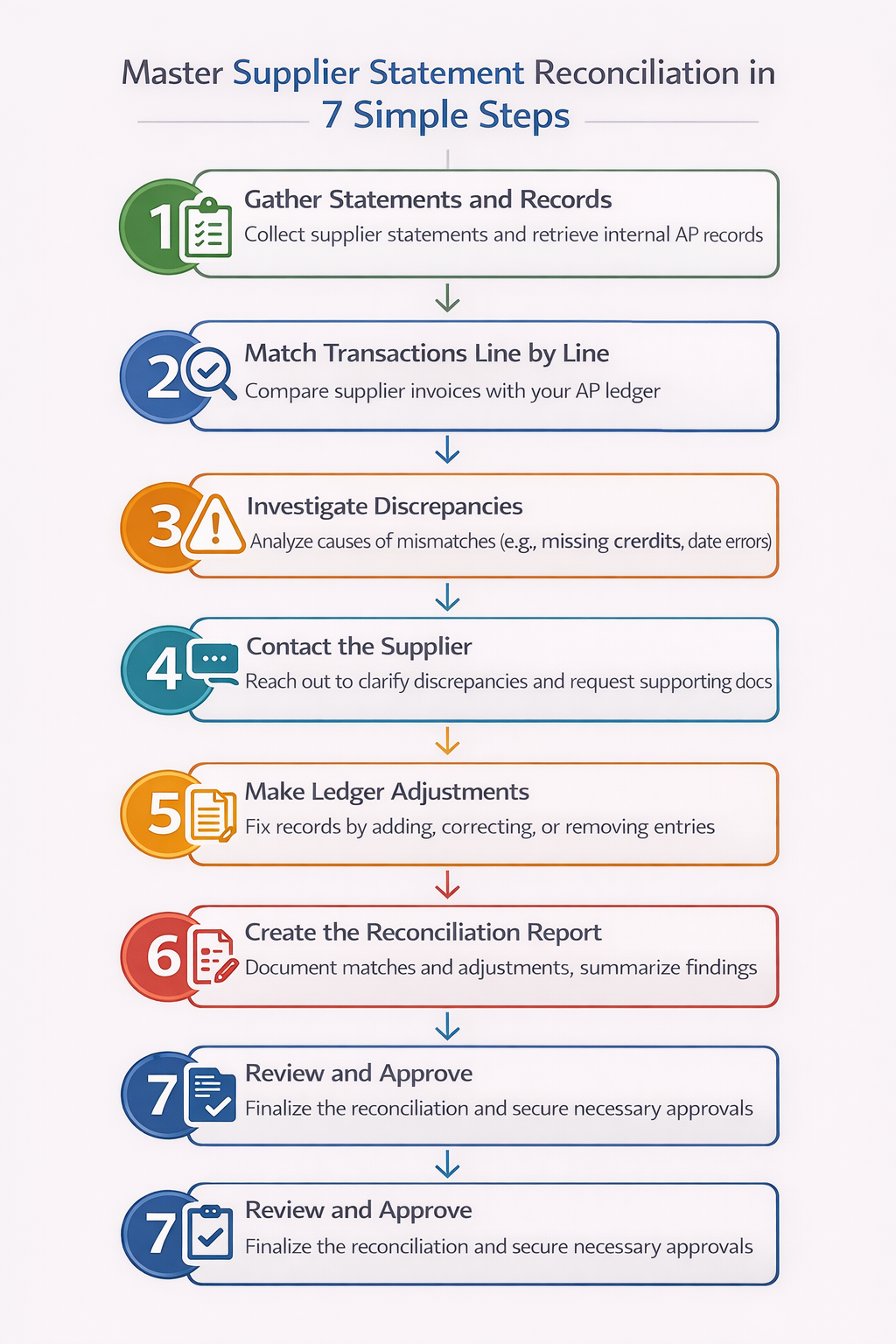
Supplier statement reconciliation follows a clear seven-step process. You gather documents, match line-by-line, investigate mismatches, contact suppliers, adjust ledgers, generate reports, and get approvals. You need to perform each step meticulously for banks' treasury services and other financial institutions to ensure accuracy in the ledger.
Step 1: Gather Statements and Records
Begin by collecting the supplier's statement for the exact period along with the AP ledger, invoices, payments, and credit notes. Make sure the opening balances match on both sides.
Step 2: Match Transactions Line by Line
Go through each item carefully. You can pair invoices by number, amount, and date. Match all payments and credits, and flag anything that doesn't line up.
Step 3: Investigate the Cause of Discrepancies
In this step, all the unmatched transactions are checked for particulars like timing issues, manual errors, or missing documents like purchase orders or receipts.
Step 4: Contact the Supplier
Reach out to the supplier’s accounts team to clarify discrepancies. Ask specific questions about the mismatches and note down all details and agreed resolutions.
Step 5: Make Ledger Adjustments
Update your system with the missing invoices or credits and the correct payment amounts and dates. Make sure to get approval from an authorized person before updating the ledger.
Step 6: Create the Reconciliation Report
After the ledger is updated, prepare a reconciliation report. Mention the starting balance, all changes, reasons for fixes, and the final balanced amount. This acts as proof for audits.
Step 7: Review and Approve
Finally, the financial reconciliation report is sent to a senior official for a final round of scrutiny and sign-off before you close the file.
What are the Limitations of Manual Supplier Statement Reconciliation?
Manual supplier statement reconciliation limits banks and financial institutions to a superficial percentage of vendor coverage. This can cause high error rates, consume days per statement, and lack stability for millions of records. Eventually, these errors fail to provide consistent audit trails for treasury and bank operations.
Manual methods can't keep up in today's high-volume and transaction-rich world. Here are the key limitations faced by financial teams:
- Limited Coverage: Teams reconcile only big vendors and leave a big chunk of transactions unchecked, increasing the risk of missed credits.
- Time Drain: One complex statement can take hours or days, delaying month-end closes for treasury professionals.
- Error Prone: Human error fatigue leads to missed transpositions or duplicates, with no 100% accuracy guarantee.
- No Scalability: It is nearly impossible for banks to handle millions of records across different formats without hiring armies of staff.
- Weak Audit Trails: Inconsistent documentation makes compliance reviews a tedious task for regulators.
- Costly Opportunity Loss: Finance professionals spend more time on matching transactions instead of focusing on strategy.
How Automation Improves Supplier Statement Reconciliation
Automation improves supplier statement reconciliation by guaranteeing 100% vendor coverage, removing manual errors, and speeding up financial reconciliation processes. You can use a financial statement reconciliation software that offers automation and real-time dashboards that integrate seamlessly with the workflow at banks, financial institutions, and treasury services.
Here are some ways in which automation transforms the process of supplier statement reconciliation:
- Full Coverage: Automation helps you reconcile every supplier, and not just the top vendors. This helps in uncovering hidden credits worth millions.
- Impressive Speed: With financial reconciliation software like Osfin, you can effortlessly match 30 million records in 15 minutes.
- State-of-the-art Security: All your transaction data is protected with 256-bit encryption, role-based access, and two-factor authentication. Osfin also ensures compliance with SOC 2, PCI DSS, ISO 27001, and GDPR to ensure safety of your enterprise data.
- Smart Insights: A user-friendly and a live dashboard helps you track match rates, exceptions, and exposure in real-time.
- Easy Integrations: Pulls data from a variety of sources like ERPs, banks, and gateways, irrespective of the formats.
How Osfin Automates Supplier Statement Reconciliation
Osfin, a file format-agnostic platform, automates supplier statement reconciliation for banks, financial institutions, card providers, and treasury services through its complete financial reconciliation workflow. It delivers 100% accuracy on complex vendor matching like 2/3/4/5-way reconciliation, many-to-one and one-to-many transactions.
Here's how it helps with high-volume financial operations:
- Importing Data (Ingestion)
Osfin can handle any format - PDFs, CSVs, ERPs, or bank feeds via more than 170 integrations that pull data from a variety of sources without the need for manual conversions. It then applies custom deviation tolerances during ingestion to filter out poor-quality data before financial reconciliation begins. All duplicates and outliers are detected at the ingestion itself, facilitating clean data for reliable supplier statement reconciliation.
- Reconciliation Process
Logic-based matching handles many-to-one, one-to-many, and multi-way (2/3/4/5-way) transactions and reconciles 30 million records in 15 minutes with a 100% accuracy. It auto-reconciles transaction records with commission, tax, and fee breakdowns for intricate vendor statements in banking workflows.
- Exception Handling
Osfin automatically flags unmatched transactions and assigns them accurate reasons before escalating these 'tickets' to the appropriate team for resolution. It offers a live dashboard that shows match status, exposure, and exception queues for real-time oversight.
- Output
In the end you can generate an audit-ready compliance report that promises complete traceability and an accurate transaction history. All actions taken on the platform, whether automated or manual, are religiously captured in the audit log, and are supported by role-based access, maker-checker flows, 256-bit encryption, and two-factor authentication.
{{banner3}}
Best Practices for Accurate Supplier Statement Reconciliation
Some best practices for accurate supplier statement reconciliation include prioritizing high-value vendors monthly, documenting all interactions, investigating discrepancies immediately, using automation tools, tracking key metrics, and maintaining organized audit trails.
These habits turn a tedious task into a reliable process, helping you build trust with vendors and save money:
- Document Everything: Log all supplier calls, adjustments, and resolutions. These become your audit lifeline and future reference.
- Investigate Promptly: Raise alerts right away for mismatches and resolve them as quickly as possible to stop them from compounding into disputes or aged balances.
- Leverage Automation: Use statement reconciliation software for manual errors, free transaction matching, and speed. This ensures compliance and traceability.
- Track Metrics: Leverage live dashboards to monitor completion rates, resolution times, and discrepancy types. This will help you to spot improvement areas.
- Standardize Processes: You must also set clear rules for data entry and approvals across your treasury team for consistency.
Conclusion
Today, banks deal with massive data volumes from suppliers daily, and manual reconciliation can't keep up. This is why you can’t treat financial automation as an afterthought.
Osfin handles all such requirements effortlessly with support for over 170 integrations, 100% accuracy in matching transactions, a smart exception ticketing engine, and live dashboards that support insightful decisions. It also adds a layer of security to outputs and processes with role-based access, maker-checker workflow, and 256-bit encryption that help you meet compliance.
To see Osfin in action for your treasury team, schedule your personalized demo today!
Frequently Asked Questions (FAQs)
1. What is supplier statement reconciliation?
Supplier statement reconciliation is a process in which you have to compare your company's accounts payable records, like invoices, payments, and credits, with the statements shared by your supplier.
2. Why should I automate vendor statement reconciliation?
Automating vendor statement reconciliation helps you save time, remove duplicate payments or missed credits, and improve accuracy by avoiding manual input errors.
3. How does Osfin improve reconciling supplier statements?
Osfin improves the process of reconciling supplier statements with the help of its AI-powered automation. This technology replaces time-consuming manual processes and offers 100% precision that’s a must for accuracy and efficiency for treasury and card services.
4. What causes common mismatches in supplier statements?
Timing, data entry errors, missing credits, and communication and process issues between the buyer and supplier are some common mismatches seen in supplier statements.