How to Document Your Reconciliation Process for Auditors
Key notes:
- Reconciliation documentation has sources, reconciliation methods, errors found in the process, their resolution, and details related to approvals.
- Auditors use reconciliation records to verify that financial statements are accurate and internal controls are working fine.
- Discrepancies need to have a written explanation about what happened, why it happened, and what was done about it.
- Missing supporting evidence, no approvals, incomplete discrepancy notes, and absent audit trails can invite audit findings.
Reconciliation documents are a collection of all that goes into the reconciliation process. They have the source data used, the method applied, the discrepancies found, the steps taken to resolve them, and the approvals that signed off on the final result.
Auditors then use this trail to verify the accuracy of financial statements. That the controls are working and that nothing was altered without a record.
When that trail is incomplete, even a technically correct reconciliation becomes difficult to defend.
Why Auditors Review Reconciliation Documentation
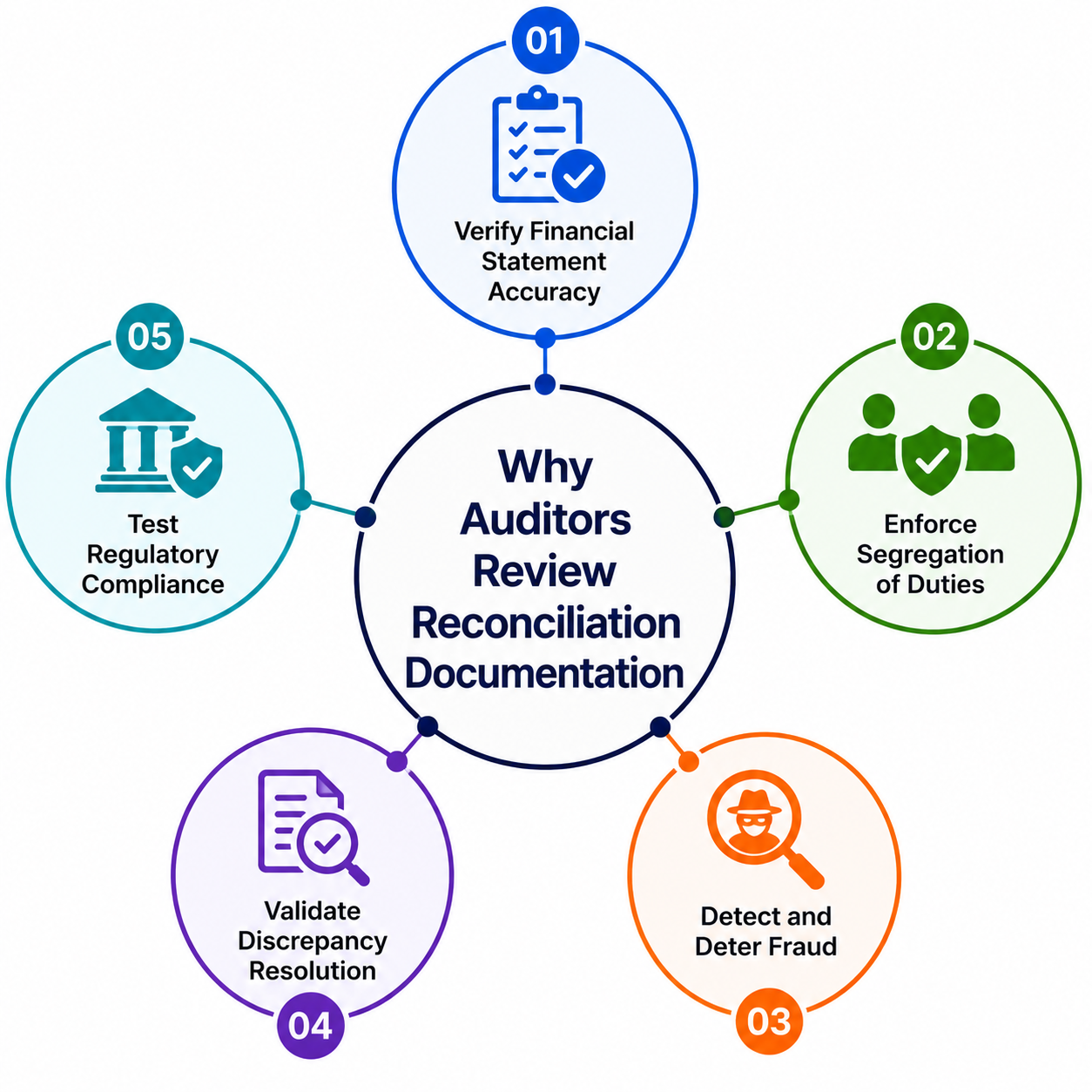
Auditors review reconciliation documents for a variety of reasons.
First, it helps with the verification of the accuracy of financial statements. Documents give them direct evidence that the numbers in the financial statements are traceable back to actual transactions.
Next is the segregation of duties. It's when the person doing reconciliation is not the same one who approves it. Auditors help ensure that.
Another reason is the detection and deterrence of fraud. When an external auditor has to review the work of employees, they tend to have more accountability.
Discrepancies are bound to occur. But if they are identified correctly and proper actions are taken to rectify them is what’s important. Auditors review documents to make sure this has happened as it should.
The final reason is compliance. Most financial institutions have to comply with a series of regulations like SOX, GDPR, SOC, PCI DSS, PSD2, etc. Reconciliation documentation is one of the most direct ways auditors test whether there are controls in place to ensure compliance.
What Auditors Look For in Documentation
While preparing the reconciliation documentation audit, there are some things you can’t omit which auditors specifically look for, such as:
1. Was the reconciliation done on schedule?
Usually, it should be done at the end of every month. But for organizations with high translation volumes, it should be done daily.
2. Are all reconciliations signed by both the preparer and an approver?
This is done to ensure proper oversight of the whole process.
3. Is every step complete and traceable with accurate records?
This is shown via balances compared, a list and explanation of any outstanding items, a description of any discrepancies found along with the cause, corrective action taken, and the date resolved.
4. Is every reconciling item backed by an actual document like an invoice, bank confirmation, approval email, or journal entry?
An internally prepared reconciliation carries limited weight on its own. Auditors look for external or third-party corroboration wherever possible.
5. Why discrepancies happened and what was done to eliminate them?
Each outstanding item needs a clear explanation in the form of timing difference, pending clearance, data entry correction, plus a resolution date or status update.
{{banner1}}
How to Document Reconciliation Process
When an auditor reviews your reconciliation, they are basically trying to understand the process behind it. That means your documentation needs to tell everything. So, this is what you can try out:
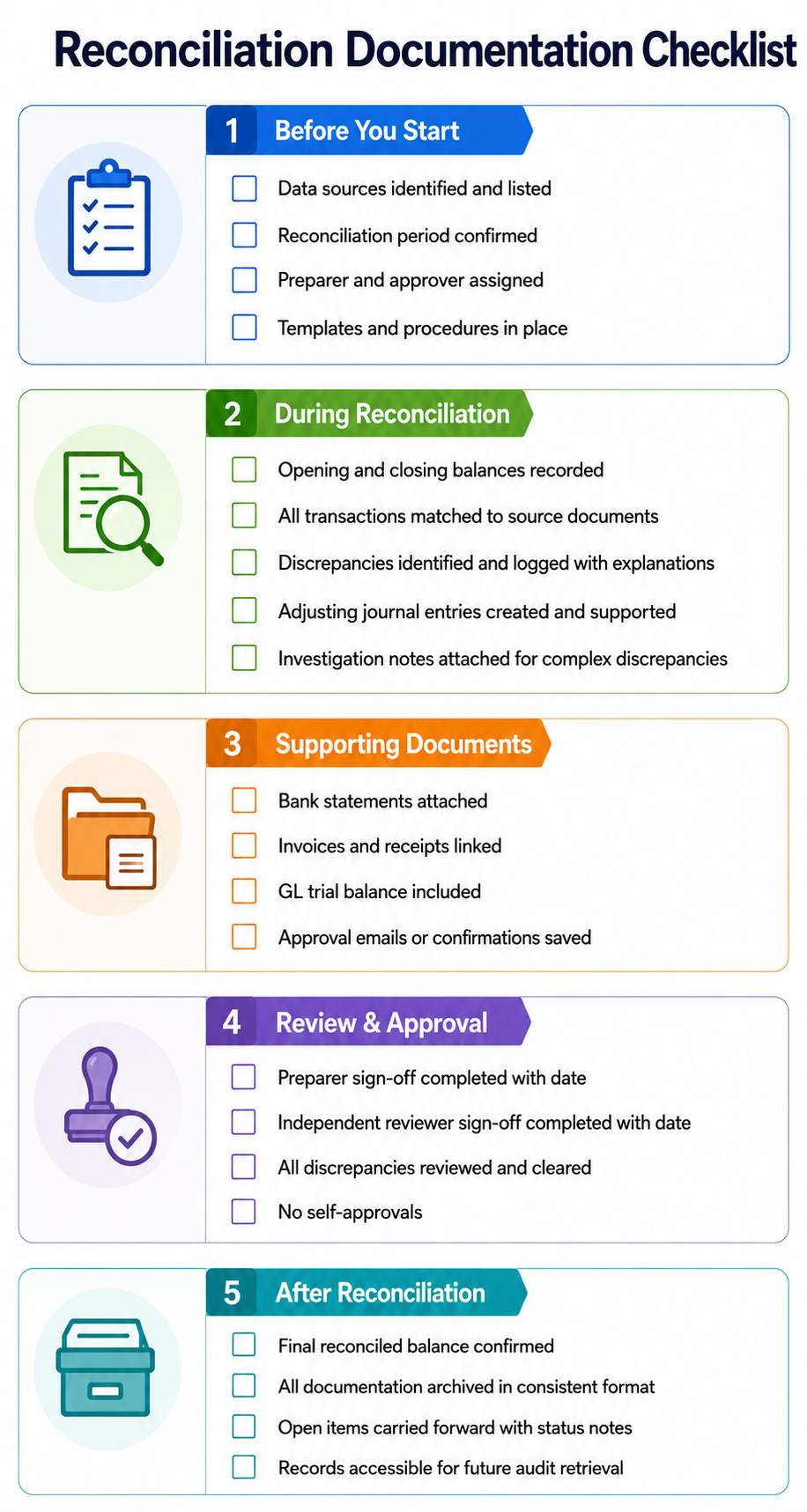
1. Have bank statements, general ledger reports, invoices, receipts, and any other documentation related to the transactions being reconciled ready. Note down the name, the system it comes from, the period it covers, and who is responsible for handling whatever data source you’re using.
2. Create standardized reconciliation procedures and templates for your entire organization. Document the method you’ve used to compare the balances for every account you’re reconciling.
3. Record the entire reconciliation process. Then, record the necessary corrections, each supported by clear documents.
4. Every reconciliation should be reviewed and approved by someone who's not the preparer. This is separation of duties. It solidifies internal controls and brings down the risk of errors or fraud going undetected.
Types of Documentation Required
This list of documents is non-negotiable if you wish to have a successful reconciliation audit procedure:
- The reconciliation document with starting balances, reconciling items, all adjustments made, the final reconciled balance, the preparer's name and date, and the reviewer's name and date.
- Supporting documents like bank statements, subsidiary ledgers, invoices, and the general ledger trial balance.
- Approval evidence by the reviewer who verifies that all discrepancies were investigated and resolved with proper documentation. Who confirms that adjustments are reasonable and properly supported.
- Investigation documents that are prepared in case a discrepancy requires deeper digging.
Common Documentation Mistakes Auditors Flag
Even finance teams with solid reconciliation documentation audit processes can run into audit findings. More often than not, the issue is not the reconciliation itself. It is how it was documented. These are the four most common mistakes auditors flag.
Missing supporting evidence
Not attaching evidence for transactions, approvals, or reconciliations makes verification tough.
Incomplete reconciliation narratives
All the discrepancies need a written explanation that covers what happened, why it happened, and what was done about it.
Missing approvals
A reconciliation signed only by the person who prepared it is considered incomplete. The approval is evidence that a second person with the authority to review the work actually did so.
Insufficient audit trail
A complete audit trail allows auditors to trace any transaction from its origin to the financial statements and back.
Tools for Documenting Reconciliation
These are some tools you can use for your documenting process:
Spreadsheets
Spreadsheets can work for smaller organizations or teams early in building out their finance processes. They can be easily understood and require no additional investment. For low transaction volumes and straightforward accounts, they can work reasonably well.
But there are limitations as well. And they become clearer as your business grows. You can’t properly do version control, there can be formula errors, and the bigger concern is traceability.
Dedicated reconciliation software
With reconciliation platforms like Osfin, every action taken during reconciliation is logged against a specific user ID with a timestamp at the point it happens.
On the documentation side specifically:
- Maker-checker workflows enforce segregation of duties at the system level.
- Complete change history means every amendment creates a new record with the original value preserved.
- Exception handling automatically flags unmatched transactions with a reason code, routes them to the right team member, and tracks resolution.
- Audit-ready compliance reports are automatically created at the end of every reconciliation run, with full transaction traceability.
But documentation is just a part of how Osfin works. It actually handles the full reconciliation workflow. Osfin:
- Ingests data across 170+ integrations in any format
- Runs logic-based GL matching across two-way through five-way reconciliations
- Has the ability to process 30 million records in 15 minutes
{{banner1.1}}
Best Practices for Documenting Reconciliation Process
Follow these best practices to make sure auditors can’t find any loopholes in your reconciliation documentation:
1. Have a policy that’s well-documented. It should explicitly talk about which accounts must be reconciled, how often, and who is accountable for each phase.
2. Create reconciliation templates for different account types that should be used by everyone.
3. Record what steps were taken, which systems were reconciled, who performed each task, and how errors were tackled.
4. Reconcile all important accounts before submitting documents to auditors instead of waiting until the audit begins.
5. Have clear records to improve transparency and a reference for future reconciliations.
{{banner2}}
FAQs
What is reconciliation documentation?
It is the complete record of the reconciliation process. It includes source data, discrepancies found, how they were resolved, and who approved the final result.
Who should approve a reconciliation?
Someone other than the person who prepared it. This is done so a second set of eyes reviews the work before it is finalized.
What happens if documentation is incomplete during an audit?
Auditors will raise a finding. It can be classified as a minor deficiency or a big control weakness, depending on how serious the gap is.
Does automated reconciliation still need documentation?
Yes. The tool generates the audit trail, but a person still needs to review the results and sign off before the reconciliation is considered complete.