What Is Loan Interest Accrual Reconciliation?
The moment a business borrows money, interest starts accumulating immediately. By the end of an accounting period, that accumulated amount has to show up in the books - as a liability if the business is the borrower, or an asset if it's the lender, even though it has not been paid or received yet. This is accrued interest.
Keeping accurate records of interest is important for financial reporting, tax compliance, and audits. However, this is just part of the job. You also need to ensure that the numbers are consistent and correct across every system and ledger.
This is where loan interest accrual reconciliation comes in.
This article talks about what it is, why it matters, some challenges you might face, and best practices to manage it smoothly.
Key Takeaways:
- Loan interest accrual reconciliation is the process of matching interest recorded in your books against loan agreements, lender statements, and financial records to ensure everything is accurate.
- Interest accrues daily from the moment a loan is taken, but is usually paid periodically. This gap is where errors and discrepancies can happen.
- Small errors, from incorrect interest rates or manual entry mistakes, can have a much bigger impact if they aren't caught early.
- Accurate reconciliations depend on regular reviews, system-generated accruals, consistent methods, and thorough documentation.
- Automation handles data ingestion, record matching, exception flagging, and audit trails without manual intervention.
What Is Loan Interest Accrual Reconciliation?
Interest accrual is the interest that builds on a loan over time but hasn't been paid yet. Loan interest accrual reconciliation is the process of comparing and matching that interest across loan agreements, accounting ledgers, bank statements, and financial records to make sure everything lines up.
The goal is to ensure that interest-related amounts match across all records. This helps keep financial reporting reliable and supports audits and business decisions.
What are the Components of Interest Calculation?
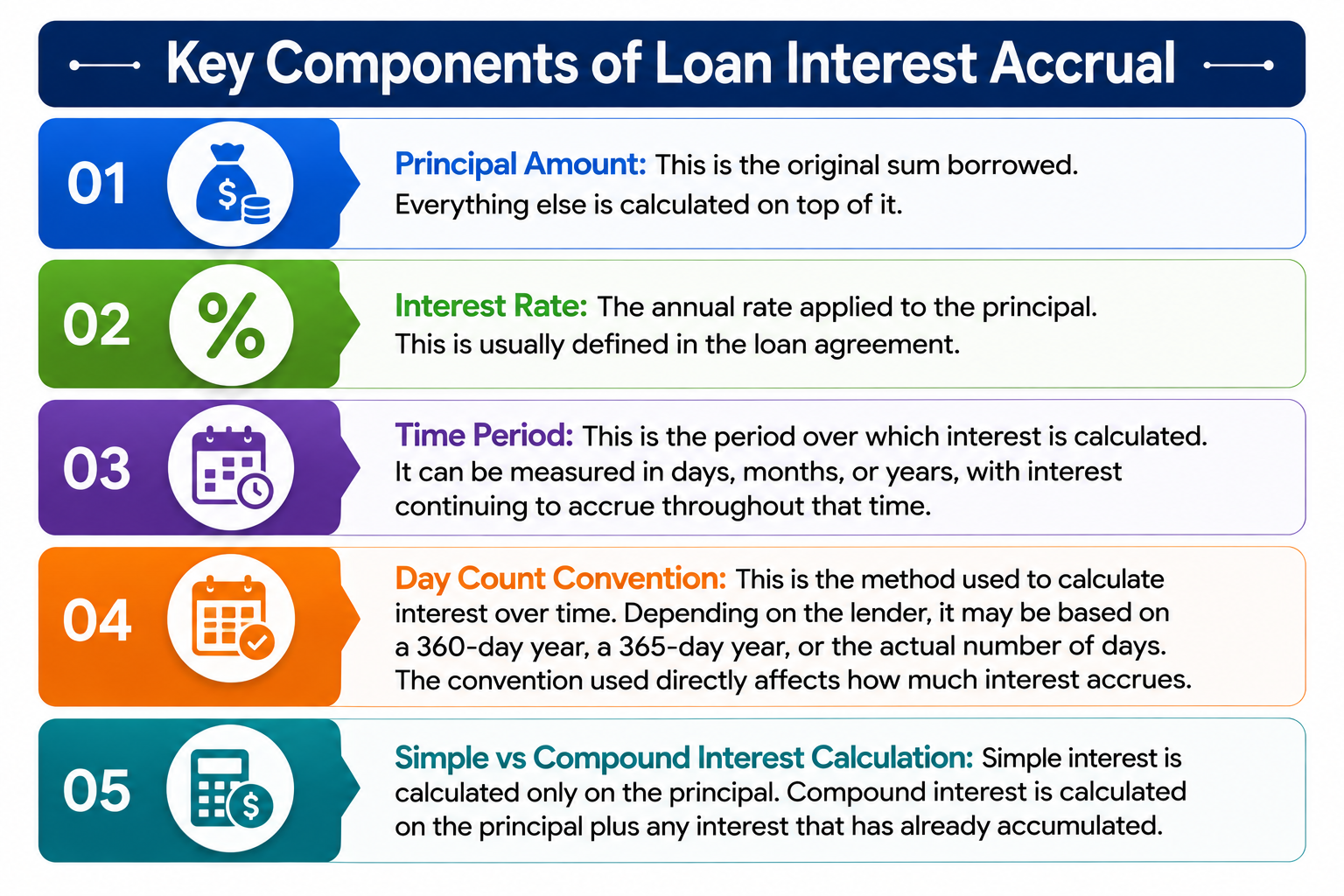
To understand how loan interest accrual reconciliation works, let's first look at its key components:
- Principal Amount: This is the original sum borrowed. Everything else is calculated on top of it.
- Interest Rate: The annual rate applied to the principal. This is usually defined in the loan agreement.
- Time Period: This is the period over which interest is calculated. It can be measured in days, months, or years, with interest continuing to accrue throughout that time.
- Day Count Convention: This is the method used to calculate interest over time. Depending on the lender, it may be based on a 360-day year, a 365-day year, or the actual number of days. The convention used directly affects how much interest accrues.
- Simple vs Compound Interest Calculation: Simple interest is calculated only on the principal. Compound interest is calculated on the principal plus any interest that has already accumulated.
Why Does Loan Interest Accrual Reconciliation Matter?
Since interest accrues daily but is paid periodically, even minor calculation errors can accumulate if they aren't identified early.
Interest also needs to be recorded in the correct accounting period under accrual accounting, regardless of when payment is made or received. If these records aren't reconciled, reporting and tax errors can follow.
Regular reconciliation also catches problems early. For example,
- Wrong rate applications
- Data entry errors
- Payment posting delays
If businesses do not reconcile their interest accrual records regularly, they may lose lender trust and invite audit scrutiny.
{{banner1}}
What is an Example of Loan Interest Accrual Reconciliation?
The following loan interest accrual reconciliation example shows how the process works.
Take a company with a $500,000 loan at 8% annual interest. On paper, the interest for the year should be $40,000.
However, the accounting ledger shows $38,500, while the lender statement shows $40,000.
That's a $1,500 gap.
The finance team has to find out where it went.
Was a payment posted to the wrong account?
Was the split between principal and interest recorded incorrectly?
Is it just a timing difference where a payment made near month-end hadn't been processed by the lender yet?
If it's a timing difference, it'll resolve on its own and just needs to be recorded. Actual errors, on the other hand, need a correcting journal entry.
Manual vs Automated Interest Accrual Reconciliation
Manual reconciliation involves spreadsheets, exported data, and line-by-line matching. And frankly, it can get time-consuming. The process only gets slower as transaction volumes increase. Not to mention the high risk of errors and maintaining audit trails.
Automation handles the same process in minutes. It flags only the exceptions that need human attention and keeps a documented trail throughout.
What are the Common Issues in Loan Interest Accrual Reconciliation?
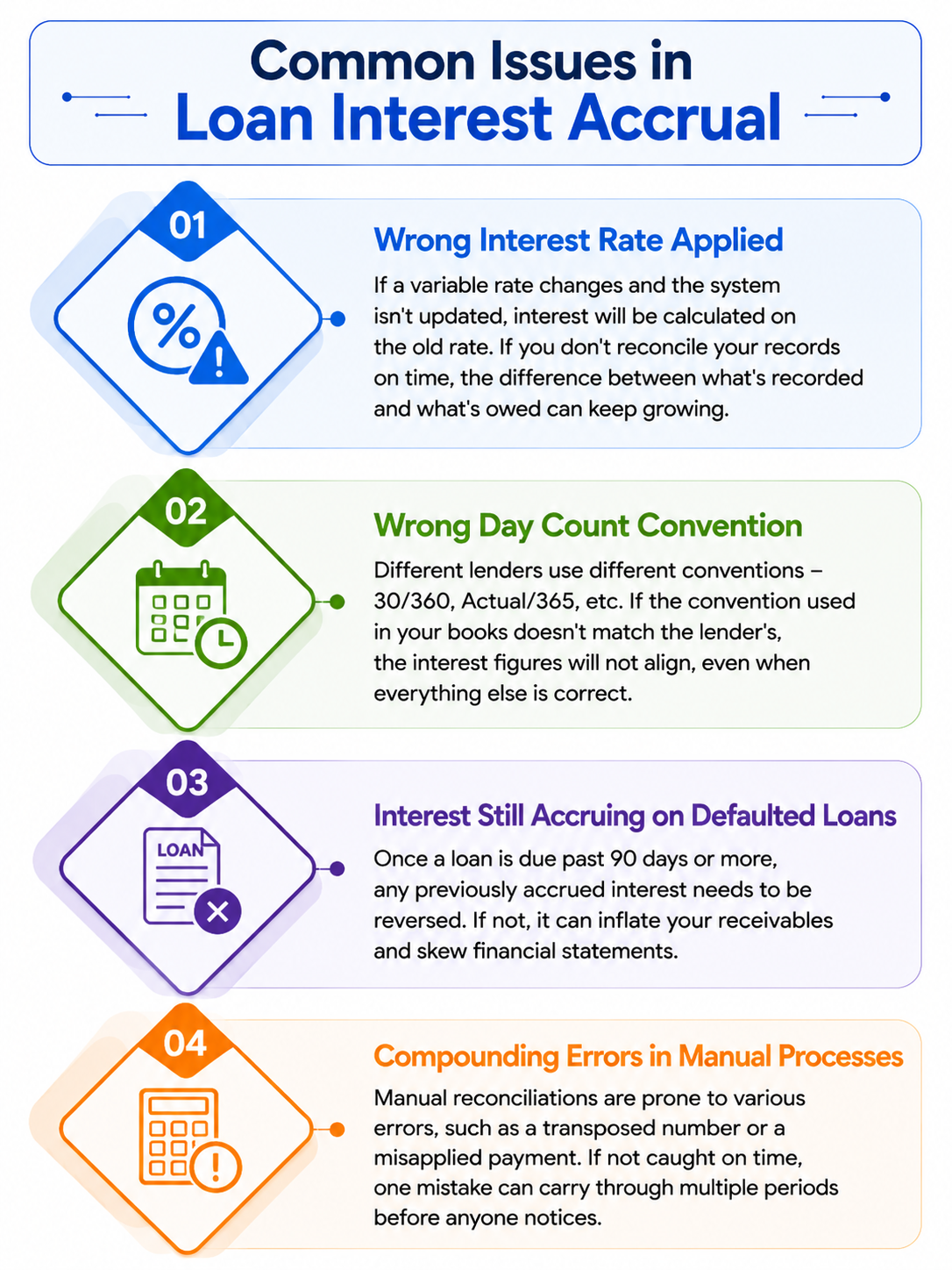
Even small errors in interest accrual can create huge problems later. Here are some common issues you may encounter:
1. Wrong Interest Rate Applied
If a variable rate changes and the system isn't updated, interest will be calculated on the old rate. If you don't reconcile your records on time, the difference between what's recorded and what's owed can keep growing.
2. Wrong Day Count Convention
Different lenders use different conventions - 30/360, Actual/365, etc. If the convention used in your books doesn't match the lender's, the interest figures will not align, even when everything else is correct.
3. Interest Still Accruing on Defaulted Loans
Once a loan is due past 90 days or more, any previously accrued interest needs to be reversed. If not, it can inflate your receivables and skew financial statements.
4. Compounding Errors in Manual Processes
Manual reconciliations are prone to various errors, such as a transposed number or a misapplied payment. If not caught on time, one mistake can carry through multiple periods before anyone notices.
{{banner1.1}}
How Automation Improves Interest Accrual Reconciliation?
Manual reconciliation is slow, and the more transactions there are, the slower it gets. Data has to be formatted and checked line by line. Errors creep in. Audit trails are hard to maintain. Automation handles much of the repetitive work instead.
They connect directly to banks and internal systems and pull everything in on a set schedule. Matching rules then process thousands of transactions in seconds. Teams only need to investigate the records left unmatched by the system.
Nothing gets lost either. Every action is logged automatically, with a time-stamped trail that's ready for auditors without any last-minute scrambling.
What are Some Best Practices for Loan Interest Accrual Reconciliation?
Here are some best practices to help you reconcile loan interest accruals accurately:
- Use system-generated accruals wherever possible. When the system handles routine calculations, monthly figures stay consistent, and the margin for error shrinks.
- Reconcile on a regular cadence. A discrepancy caught early takes minutes to fix. The same one found months later can take hours to trace.
- Document every reconciliation. What was checked, what came up, and how it was resolved. This is what auditors will ask for first.
- Keep the methodology consistent across the team. When everyone follows a different process, gaps appear, and reviews take longer than they should.
How Osfin Automates Loan Interest Accrual Reconciliation?
Osfin handles the entire reconciliation process, from data ingestion to final output, without requiring manual input.
- Data Ingestion
Osfin connects to 170+ data sources and accepts files in any format. This means you don't need to convert or reformat data before it comes in. During ingestion, the platform applies custom deviation tolerances to filter out poor-quality data and flags duplicates before they cause problems.
- Reconciliation
Osfin uses logic-based matching to compare records based on predefined conditions. It supports many-to-one, one-to-many, and multi-way reconciliations across two, three, four, or five data sources, processing up to 30 million records in 15 minutes.
- Exception Handling
Any unmatched transaction is automatically flagged with a reason and routed to the right team member through the built-in ticketing and exception handling engine. Live dashboards show match status, exposure, and exception queues in real time.
- Output
Every reconciliation comes with a compliance report with complete transaction history and full traceability. Data is protected through 256-bit encryption, maker checker flow, role-based access, and two-factor authentication. Osfin meets SOC 2, PCI DSS, ISO 27001, and GDPR requirements as well.
The End Note
Getting loan interest accrual reconciliation right helps ensure accurate financial statements and supports audits and business decisions. However, without the right processes in place, small manual errors can become larger reconciliation issues.
The right technology can make loan interest accrual reconciliation a lot easier. Osfin automates the workflow from data ingestion to exception handling, helping finance teams work more efficiently and accurately.
See it in action. Book a demo with Osfin today.
FAQs
1. What is loan interest accrual?
Loan interest accrual is the process of recording interest as it builds up over time, even before any payment is made. From the day a loan is taken, interest accumulates daily. Accrual accounting requires this to be recorded in the period it occurs.
2. How to record accrued interest on a loan?
At the end of an accounting period, the borrower records a debit to the interest expense account and a credit to the accrued interest payable account. This reflects interest that has been incurred but not yet paid. The entry is reversed at the start of the next period once the actual payment is made.
3. What is accrual reconciliation?
Accrual reconciliation involves matching the interest recorded in your books with the figures in the loan agreement, lender statements, and other financial records. This ensures the accrued interest is complete, accurate, and consistent.
4. How does accrued interest work on a loan?
From the day a loan is disbursed, interest starts accruing. It accumulates daily based on the principal, interest rate, and day count convention. Even if interest is paid monthly, it continues to build every day. That's why the accrued amount must be recorded at the end of each accounting period, whether a payment has been made or not.