What Is Loan Securitization Reconciliation
Loan securitization is slowly gaining traction among Indian banks, NBFCs and other lending institutions that are aiming to raise liquidity for new ventures and disperse risk. It’s evident from the retail asset securitization that saw a 6% year-on-year increase in Q1 of FY2026.
But at the same time, it creates a complex web of data flows from stakeholders that need to remain accurate throughout the life of securitized pools. This is what loan securitization reconciliation is meant for.
In this article, we learn what loan securitization reconciliation is, its importance, some common issues and best practices that enhance it.
What Is Loan Securitization Reconciliation?
Loan securitization reconciliation is the process that verifies the consistency and accuracy of the data related to the pool of collateralised loans. This involves matching records on collection, principal and interest distributions, service reports and trustee data across all the parties involved in the transaction.
Loan securitization reconciliation ensures that the cash flow generated from the underlying loans is correctly calculated, distributed to investors and properly recorded across the system of originators, SPV, servicers, and trustees.
Why Is Loan Securitization Reconciliation Important?
In traditional loan settings, the lender originated the loan, collected repayments and recorded the transaction in their loan servicing system. But when these form the pool of tradable securities, the whole scenario changes.
Now, multiple parties, including the originator, SPV, servicers and trustees, are collecting repayments, managing trenches, distributing them to investors and generating reports on the securitized loan pool. A small error anywhere in this chain can snowball into investor disputes, regulatory scrutiny or financial loss.
Loan securitization reconciliation protects against this by
- Ensuring collections match what was due, EMIs are split according to the amortization schedule, distributions to investors are calculated correctly, and financial records are consistent across all stakeholders.
- Helping detect errors, duplicates and fraudulent transactions.
- Providing an accurate picture of cash flow and providing insights into delinquency and defaults for better risk assessment of the securitized loan pool.
Who Is Involved in Loan Securitization Reconciliation?
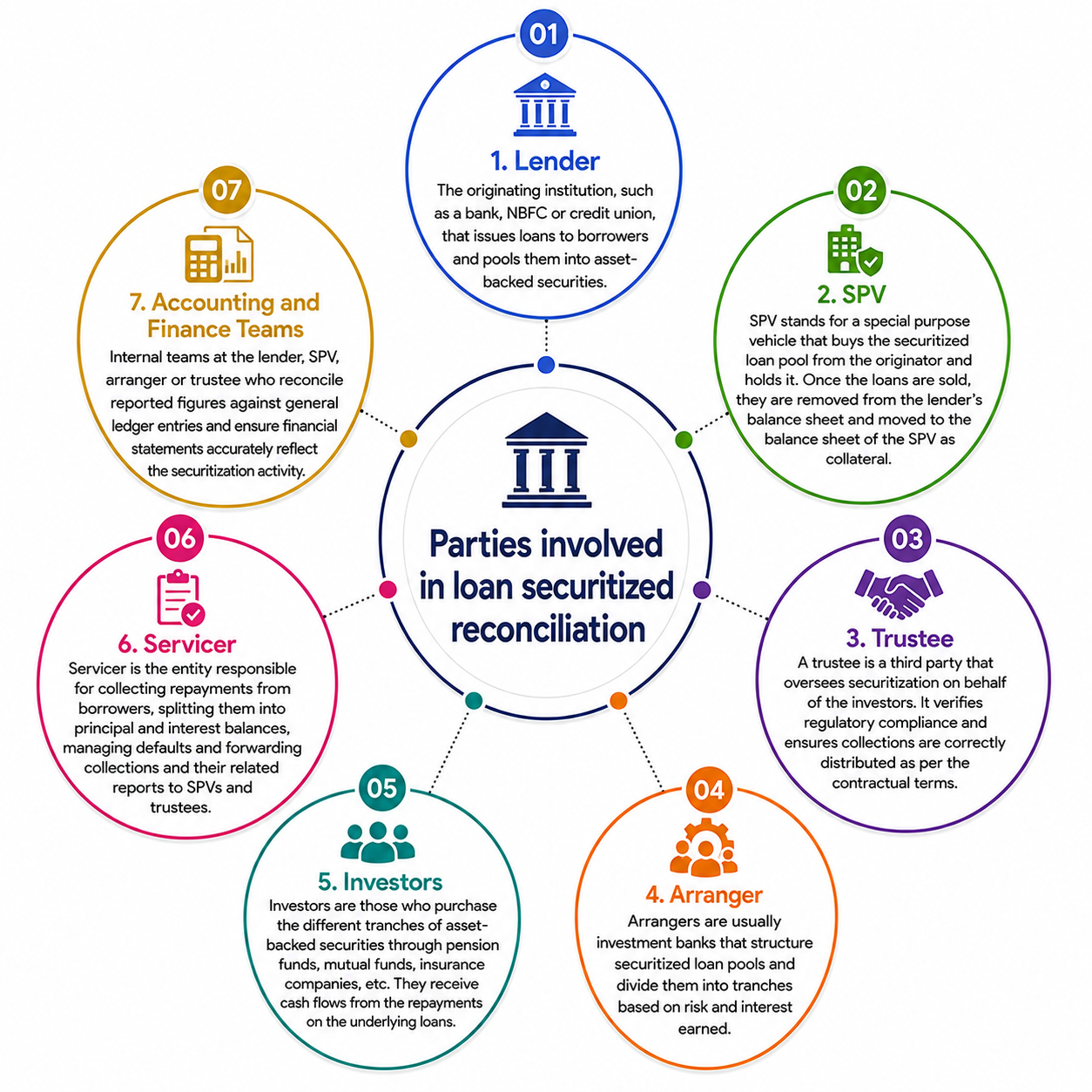
The roles and responsibilities of the securitized loan pool are split across different parties. These include the following.
1. Lender
The originating institution, such as a bank, NBFC or credit union, that issues loans to borrowers and pools them into asset-backed securities.
2. SPV
SPV stands for a special purpose vehicle that buys the securitized loan pool from the originator and holds it. Once the loans are sold, they are removed from the lender’s balance sheet, where they are marketed as loan assets, and moved to the balance sheet of the SPV as collateral.
3. Trustee
A trustee is a third party that oversees securitization on behalf of the investors. It verifies regulatory compliance and ensures collections are correctly distributed as per the contractual terms.
4. Arranger
Arrangers are usually investment banks that structure securitized loan pools and divide them into tranches based on risk and interest earned.
5. Investors
Investors are those who purchase the different tranches of asset-backed securities through pension funds, mutual funds, insurance companies, etc. They receive cash flows from the repayments on the underlying loans.
6. Servicer
Servicer is the entity responsible for collecting repayments from borrowers, splitting them into principal and interest balances, managing defaults and forwarding collections and their related reports to SPVs and trustees.
7. Accounting and Finance Teams
Internal teams at the lender, SPV, arranger or trustee who reconcile reported figures against general ledger entries and ensure financial statements accurately reflect the securitization activity.
What is the Loan Securitization Reconciliation Process?
A loan securitization reconciliation involves the following steps
1. Data Collection
First, the recording pertaining to the securised loan pool is collected from the originators, servicer, arranger and trustee. This would include records of loan terms, repayments, the split between principal and interest, and disbursements to investors.
2. Record Matching
These loan-level records are verified for accuracy and consistency across all stakeholders' systems.
3. Waterfall Distribution
Next, it is ensured that cash flow distributions to investors are accurately calculated and are made in accordance with the waterfall priority.
4. Variance Investigation
The errors, duplications or any other anomalies identified in the reconciliation process are routed to the appropriate members of the accounts and finance teams of the institutions involved in loan securitization for investigation and resolution.
5. Report Generation
Lastly, the entire reconciliation process is documented, including the match rate and any corrections made to the records, for reporting and compliance purposes.
{{banner1}}
Manual vs Automated Loan Securitization Reconciliation
securitized loan pools involve thousands of loans, multiple stakeholders and structured cash-flow distribution across different classes of investors. In manual loan securitization reconciliation, the accounts and finance teams have to gather loan-level data from various parties and match it line by line.
Given the sheer volume of loans and the complexity of waterfall calculations, manual loan securitization reconciliation becomes extremely time-consuming and carries a high risk of errors.
Automated loan securitization reconciliation platforms, on the other hand, integrate with the data systems of all parties, including originators, servicers, SPVs, and trustees, and gather loan pool-related records in a centralised location. They apply matching rules to reconcile records and automatically flag discrepancies for review, reducing errors and saving time in the reconciliation process.
What Are Common Issues in Loan Securitization Reconciliation?
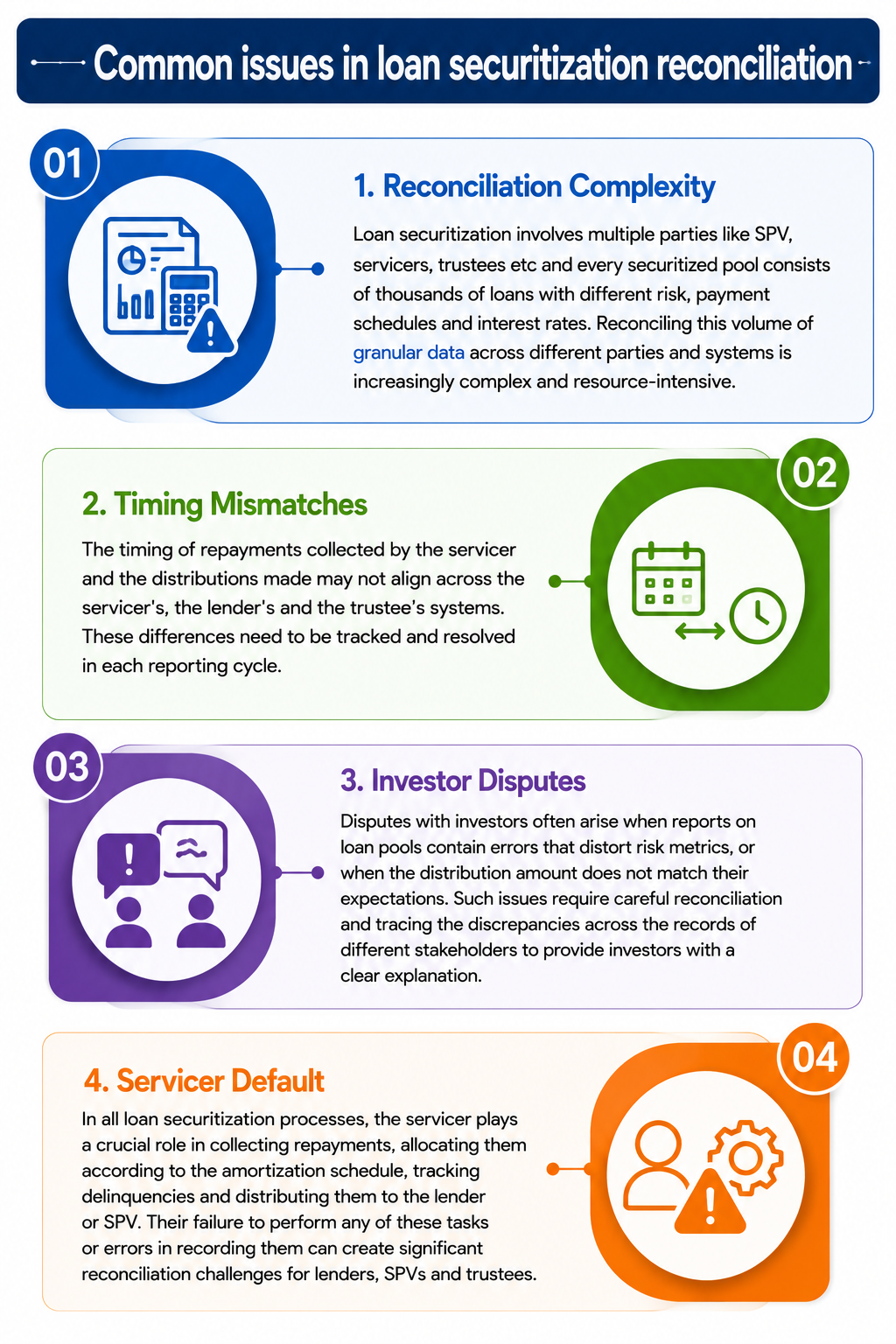
Accounts and finance teams that rely on manual methods for loan securitization reconciliation often encounter the following issues.
1. Reconciliation Complexity
Loan securitization involves multiple parties like SPV, servicers, trustees etc and every securitized pool consists of thousands of loans with different risk, payment schedules and interest rates. Reconciling this volume of granular data across different parties and systems is increasingly complex and resource-intensive.
2. Timing Mismatches
The timing of repayments collected by the servicer and the distributions made may not align across the servicer's, the lender's and the trustee’s systems. These differences need to be tracked and resolved in each reporting cycle.
3. Investor Disputes
Disputes with investors often arise when reports on loan pools contain errors that distort risk metrics, or when the distribution amount does not match their expectations. Such issues require careful reconciliation and tracing the discrepancies across the records of different stakeholders to provide investors with a clear explanation.
4. Servicer Default
In all loan securitization processes, the servicer plays a crucial role in collecting repayments, allocating them according to the amortization schedule, tracking delinquencies and distributing them to the lender or SPV. Their failure to perform any of these tasks or errors in recording them can create significant reconciliation challenges for lenders, SPVs and trustees.
How Does Osfin Automate Loan Securitization Reconciliation?
Osfin is a low-code automation platform that streamlines the reconciliation of high volumes of complex loan data at lightning-fast speed with 100% accuracy. It eliminates manual processes and provides real-time visibility into cash flow with a live dashboard. It comes with the following features to save your time and reduce errors in loan securitization reconciliation.
1. Multi-Source Data Ingestion
Osfin is a file-format-agnostic platform with 170+ integrations. It can easily integrate with the data systems of the lender, SPV, trustee, arrager and servicer and ingest loan-pool records regardless of their format. Duplicates and outliers are filtered out during ingestion using custom deviation tolerances.
2. High-Speed Reconciliation
Osfin is capable of reconciling 30 million transactions in just 15 minutes. It handles one-to-many, many-to-one, and multi-way reconciliation, including 2-way, 3-way, 4-way, and 5-way, by applying logic-based matching rules.
3. Exception Handling Engine
The unmatched transactions are flagged by the ticketing and exception-handling engine, assigned an accurate reason and routed to the appropriate personnel in accounts or the finance team for review and resolution.
4. Output Delivery
At the end of the reconciliation cycle, it generates a compliance report and also maintains the audit-ready workflow that captures each transaction history.
5. Data Security
The transfer of data across different systems and the reconciliation tasks performed on it must be conducted in a secure environment. For this, Osfin offers 256-bit encryption, role-based access and two-factor authentication. It also has global compliance certifications, including SOC 2, GDPR, PCI DSS and ISO 27001.
{{banner1.1}}
What are the Best Practices for Loan securitization Reconciliation?
The complexity and volume of transactions involved in the loan securitization process can overwhelm the accounts and finance teams working on it. Here are some best practices that alleviate this load for them.
1. Reconcile Daily
Every day, thousands of borrowers make repayments on their loans, and each of them is processed by different parties involved in loan securitization. By reconciling daily, you can quickly identify and resolve discrepancies in the records.
2. Standardise Data
Every party having different data formats adds to the complexity of the reconciliation process. By standardising data formats across all their system, the instances of mismatch caused by inconsistent reporting are significantly reduced.
3. Document Exceptions
Errors and discrepancies in reports to investors or trustees can lead to disputes and legal scrutiny by regulatory authorities. Documenting every exception and its resolution supports investor transparency and regulatory audits.
4. Invest in Automation
Manual loan securitization reconciliation will always carry a high risk of errors and consume significant time of the accounts and finance teams working on it. An automation platform like Osfin speeds up data ingestion and reconciliation, while providing real-time visibility into cash flow with intuitive dashboards.
The Bottom Line
The securitization of loans may have increased opportunities for lending institutions to raise liquidity and disperse credit risk, but it has also made the reconciliation process more complex. Dealing with multiple parties and a high volume of securitized pool data can be extremely time-consuming and increase the risk of errors.
Osfin’s intelligent automation platform eliminates manual reconciliation and streamlines the entire process through its 170+ integrations, logic-based matching rules, exception-handling engine, and intuitive dashboard. Book a demo now!
FAQs
1. What is the securitization of a loan?
Securitization of loans refers to the process by which lending institutions pool different debt obligations, like mortgage, auto or student loans and sell them to investors as tradable securities.
2. What is the purpose of securitization?
Banks sell securitized pools of loans in order to raise liquidity for new ventures and distribute credit risk among investors.
3. Who are the parties involved in loan securitization reconciliation?
The parties involved in loan securitization reconciliation include the lender, special purpose vehicle (SPV), trustee, arranger, investors, servicers and accounts & finance teams.
4. What issues are faced in loan securitization reconciliation?
Reconciliation complexity, timing mismatches, investor disputes and servicer defaults are some of the common issues that occur in loan securitization reconciliation.