What Is Subledger Reconciliation? Definition & Process
For finance teams, transactions never really stop. From invoices and payments to payroll and inventory, there are hundreds of entries to track each month.
These entries are recorded in the subledger before they reflect in financial reports.
A subledger records the detailed transaction history for specific accounts before they're entered into the general ledger.
Differences between the subledger and general ledger are fairly common. They can result from missing transactions, duplicate entries, timing differences, or simple posting errors.
This is where general ledger to subledger reconciliation becomes important. What exactly is it? Let's find out.
Key Takeaways:
- The subledger provides the detail behind each general ledger balance. Discrepancies between the two can result in inaccurate reporting.
- Subledger reconciliation is used to confirm that the subledger and general ledger are in sync. Any discrepancies are investigated and corrected as part of the process.
- Reconciliation issues are frequently linked to timing differences, duplicate records, coding mistakes, and systems that don't share data effectively.
- Frequent reconciliations help prevent small issues from carrying over into financial reporting.
- High transaction volumes can quickly turn reconciliation into a time-consuming exercise. Automation helps streamline the process and reduce manual effort.
What is Subledger Reconciliation?
Subledger reconciliation is the process of checking whether subledger activity is accurately reflected in the general ledger. It covers the verification of:
- Invoices
- Payments
- Journal entries
And ensures that aggregated subledger balances line up with the right GL accounts.
When they don't, the gaps can be costly:
- Customer balances may not reflect actual receivables.
- Vendor liabilities could be understated.
- Inventory values may be off.
The general ledger vs subledger reconciliation process covers five core areas:
- Transaction Verification
- General Ledger Alignment
- Exception Management
- Control Checks
- Audit Support
Why is Subledger Reconciliation Critical?
When your subledger and general ledger balances don't align, your financial statements become unreliable. This can also mean:
- Regulatory penalties
- Failed audits
- Lost stakeholder trust
Accurate financial statements depend on accurate underlying records. Subledger reconciliation helps maintain that accuracy while bringing discrepancies to light early.
Not to mention, when leadership is making strategic decisions, they're relying on accurate subledgers to inform their calls. When the underlying numbers are wrong, those decisions can be too.
{{banner1}}
What are the Types of Subledgers?
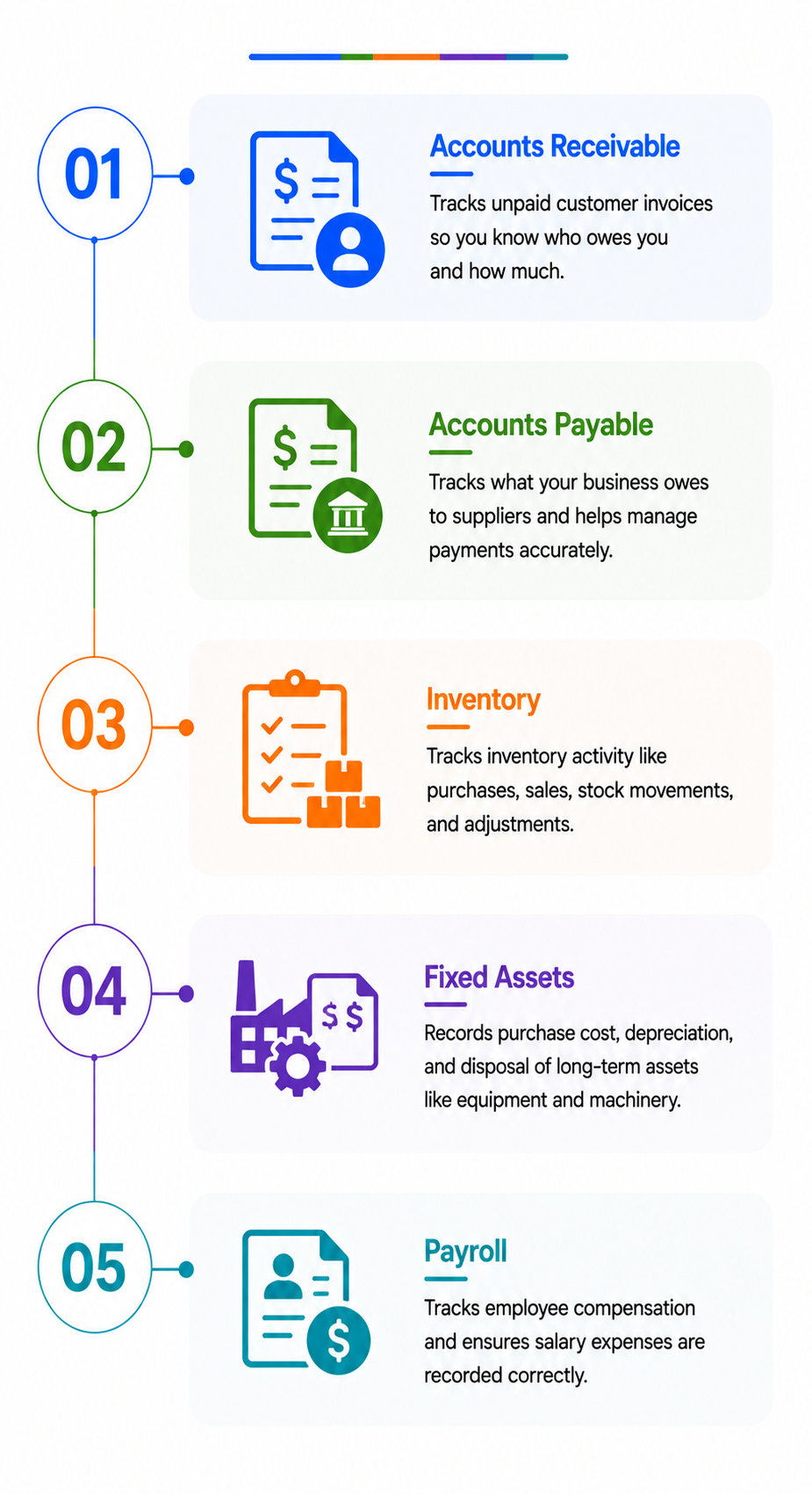
There are different types of subledgers depending on the transaction category. Some common ones include:
1. Accounts Receivable
This subledger type tracks every customer invoice that hasn't been paid yet. It tells you who owes you money and how much.
2. Accounts Payable
While accounts receivable focuses on incoming payments, this subledger tracks what your business owes. It helps the finance team handle supplier payments and avoid expensive mistakes.
3. Inventory
This subledger tracks inventory activity - purchases, sales, stock movements, and adjustments - so you always know what is available.
4. Fixed Assets
It logs details like purchase cost, depreciation, and disposal for long-term assets like equipment and machinery.
5. Payroll
This type tracks employee compensation. It ensures salary expenses are logged correctly before they go into the main ledger.
What is the Subledger Reconciliation Process?
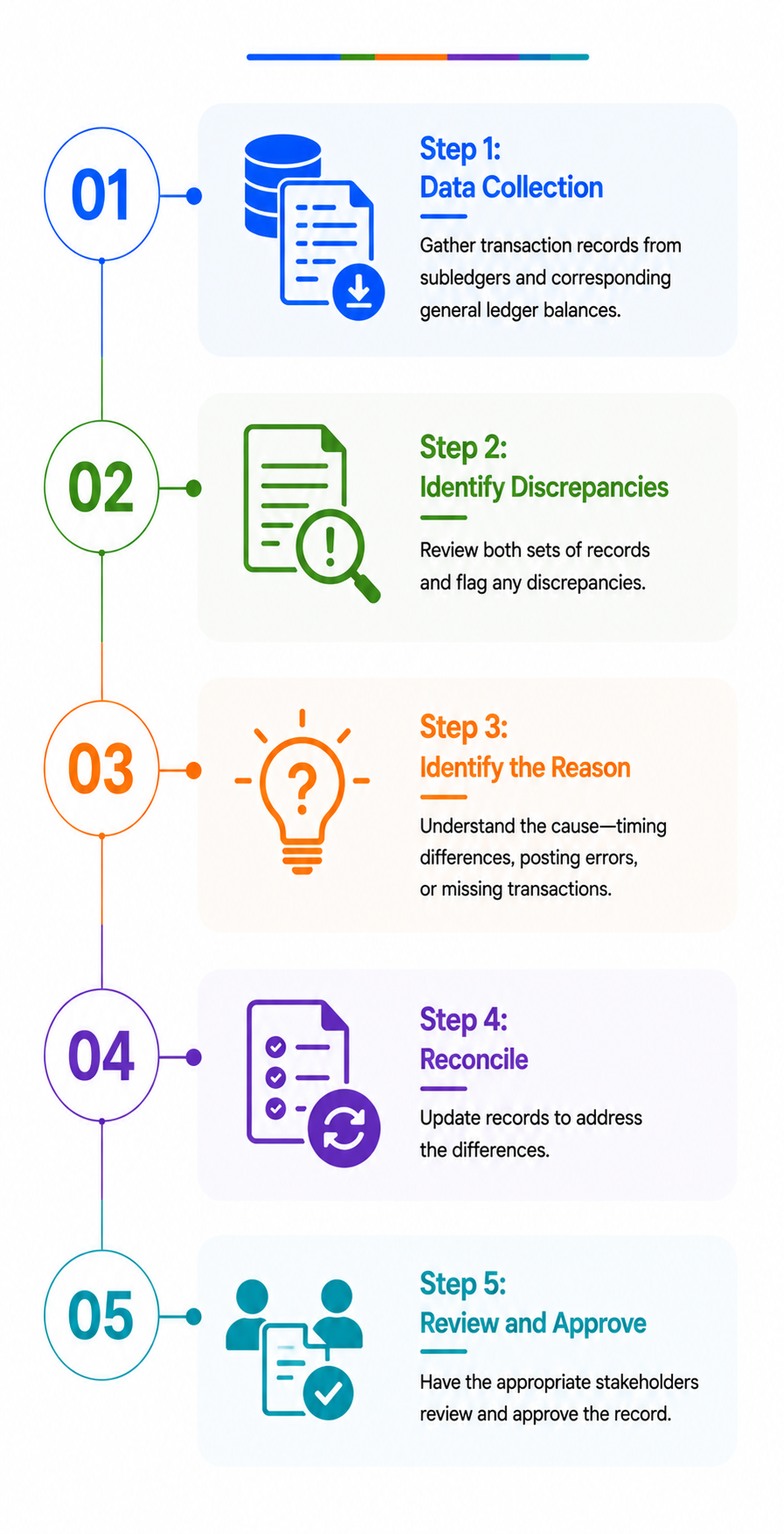
Subledger reconciliation follows a simple process. It usually involves the following steps:
Step 1: Data Collection
Gather transaction records from your subledgers and the corresponding general ledger balances for the period.
Step 2: Identify Discrepancies
Review both sets of records and flag any discrepancies.
Step 3: Identify the Reason
The next step is to understand the discrepancy. Timing differences, posting errors, and missing transactions are often responsible.
Step 4: Reconcile
Update the records to address the differences identified during reconciliation.
Step 5: Review and Approve
Have the appropriate stakeholders review and approve the record.
What are Some Common Issues in Subledger Reconciliation?
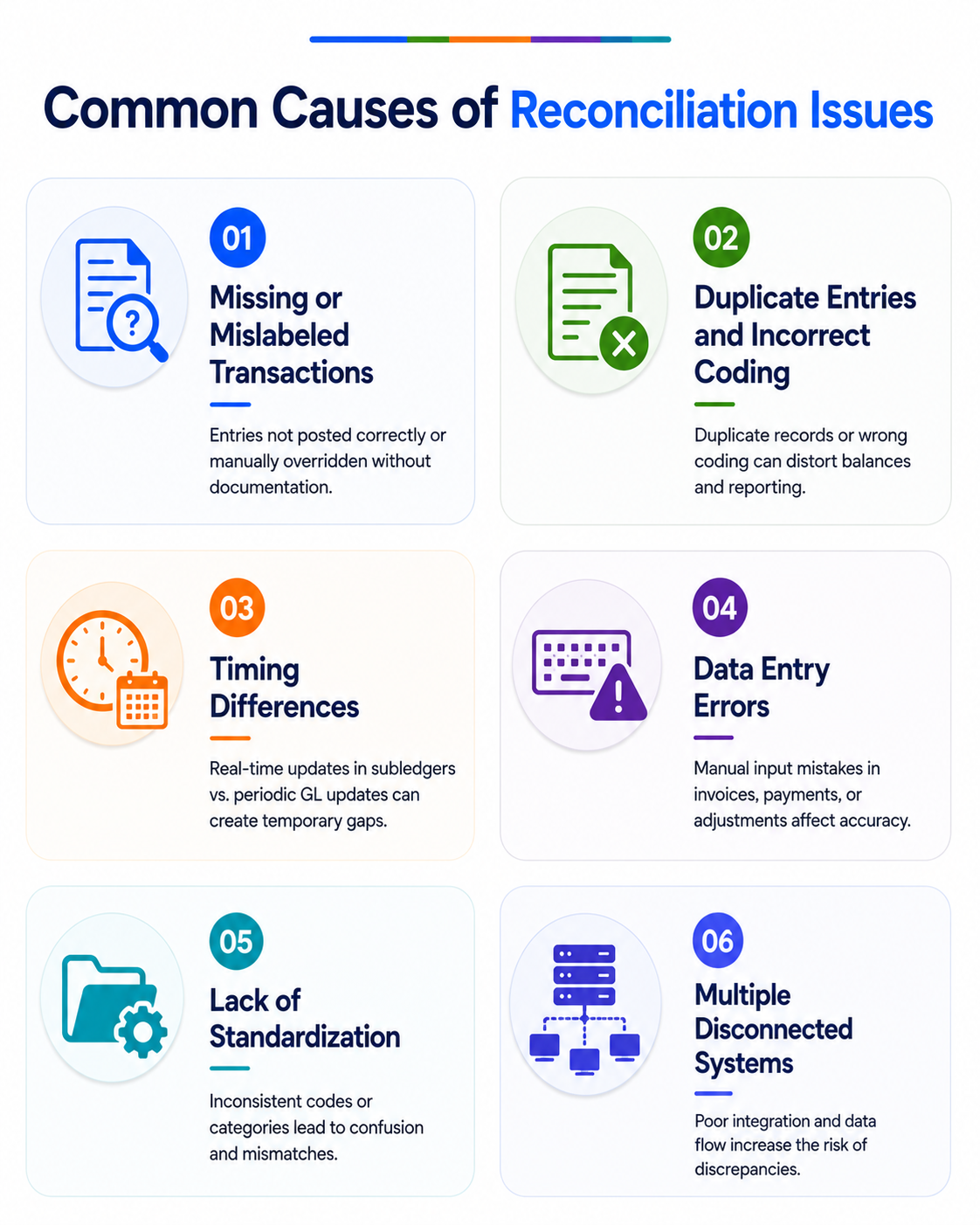
Most finance teams struggle with the same reconciliation issues:
1. Missing or Mislabeled Transactions
This happens when entries are not posted correctly, land in suspense accounts, or get manually overridden without documentation. For example, a payment recorded in AR but never transferred to the GL can create a mismatch.
2. Duplicate Entries and Incorrect Coding
This often comes from batch uploads or weak system checks. A transaction posted to the wrong department or product line can distort account balances without affecting the total amount.
3. Timing Differences
Timing differences are one of the most common causes of reconciliation issues. Subledgers are often updated in real time. However, the general ledger may only be updated periodically. If those delays aren't accounted for, temporary gaps can be mistaken for errors.
4. Data Entry Errors
They arise from manual input of invoices, payments, or adjustments and can affect reconciliation accuracy. Even small mistakes compound quickly when they go unreviewed across multiple periods.
5. Lack of Standardization
If there's no standardization across account codes or categories, it can lead to inconsistencies, making reconciling more difficult.
6. Multiple Disconnected Systems
These increase the risk of discrepancies when the subledger and GL aren't integrated. Without a reliable data flow between systems, errors can slip through.
{{banner1.1}}
Manual vs Automated Subledger Reconciliation
There's nothing wrong with manual reconciliation, but it becomes more challenging as the number of transactions grows. Small errors can quickly get buried in the volume of data.
Automation addresses all those problems. Automated reconciliation tools:
- Connect directly to the general ledger
- Match transactions in real time
- Flag anything unusual
- Keep documentation audit-ready without extra effort
Automation supports stronger internal controls across the reconciliation process. Its impact is even greater when combined with segregation of duties and regular reviews.
What are Some Best Practices for Subledger Reconciliation?
Here are some practical tips to get subledger reconciliation right:
Automate the Process
Growing transaction volumes can make manual reconciliation difficult to manage. Automation helps reduce the workload by matching records and flagging exceptions.
Reconcile Regularly
Monthly reconciliation should be the minimum standard. Waiting too long can make it much harder to identify the source of a discrepancy.
Track Data Lineage
Having access to a record's history can make discrepancy reviews much less time-consuming.
Keep Documentation Clean
Make sure there's a record of the review, any discrepancies identified, and how they were addressed.
Standardize Your Process
When teams use different methods, gaps show up. Standardized procedures help keep the process on track.
How Osfin Automates Subledger-to-GL Reconciliation?
Osfin is a finance automation platform built to handle the entire subledger-to-GL reconciliation process, end to end. Here's how it helps finance teams:
Ingestion: Osfin connects to 170+ data sources and is format-agnostic, meaning it pulls in data regardless of file type or structure and normalizes it into a consistent format. Custom deviation tolerances filter out poor-quality data early, and duplicates or outliers get flagged before they cause downstream problems.
Reconciliation: Its logic-based matching engine handles many-to-one, one-to-many, and multi-way reconciliations, processing up to 30 million records in 15 minutes. It also auto-reconciles payment gateway reports with commission, tax, and fee breakdowns.
Exception Handling: Every unmatched transaction gets an assigned reason and is routed to the right team member through a built-in ticketing engine. Live dashboards provide real-time visibility into match rates, exposure, and outstanding exceptions.
Output: Every reconciliation is backed by a full audit trail and complete transaction history. Data is secured with 256-bit encryption, role-based access, and two-factor authentication, and the platform complies with SOC 2, PCI DSS, ISO 27001, and GDPR.
Wrapping Up
Getting subledger reconciliation right is essential to keeping your financial data trustworthy. It also makes audits easier to manage and provides a more reliable foundation for decision-making.
However, for teams dealing with high transaction volumes, doing this manually can be challenging. That's where automated platforms like Osfin can help.
If you want to see how Osfin handles subledger-to-GL reconciliation, from ingestion to audit trail, book a demo and see it in action.
FAQs
1. What is subledger reconciliation?
Subledger reconciliation is the process of matching subledger activity against the general ledger. This helps catch errors early and maintain confidence in your financial statements.
2. What is the difference between subledger and GL?
Subledgers capture the transaction-level details that support your financial records. The general ledger brings those details together into summarized account balances.
3. What are the common issues with subledger reconciliation?
The most frequent issues are timing differences between when subledgers and the GL update, missing or mislabeled transactions, duplicate entries, and disconnected systems.
4. How to get subledger reconciliation right?
Regular reviews, consistent processes, clear audit records, data traceability, and automation all play an important role.