What Is Treasury Reconciliation? Definition & Examples
Treasury teams often deal with cash, liquidity, and settlements across multiple banking relationships. The challenge is that the data is frequently scattered across spreadsheets and systems. By the time everything is reconciled, the month-end close may already be several days underway.
It's safe to say that treasury reconciliation can be full of friction.
When done right, you have a clearer view of available cash and spend less time investigating discrepancies. When it isn't, idle cash, delayed decisions, and month-end surprises become much more likely.
This article will walk you through what treasury reconciliation is, its importance, and more.
Key Takeaways:
- Treasury reconciliation involves comparing a company's internal financial records with external statements, such as bank records. The process covers cash balances, investments, liabilities, and money moving into and out of the business.
- The process covers five areas: cash accounts, positions, transactions, foreign exchange, and intercompany transfers. Each area provides a different view of the organization's financial activity.
- Manual reconciliation can be time-consuming. Teams spend hours matching transactions in spreadsheets. Plus, the true cash position often isn't known until days into the month-end close.
- Automation reduces the amount of time teams spend on reconciliation and provides a more up-to-date view of cash balances.
What is Treasury Reconciliation?
Treasury reconciliation is the process of checking a company's internal financial records against external statements, like bank records, to make sure everything is accurate, including:
- Cash balances
- Investments
- Liabilities
- Inflows
- Outflows
If something looks off, reconciliation helps trace the issue back to its source.
Accurate reconciliation gives treasury teams a reliable view of their cash position and helps surface issues before they become bigger problems.
Some teams perform treasury reconciliations daily. Others do it weekly or monthly.
Treasury Reconciliation vs Bank Reconciliation
The terms treasury reconciliation and bank reconciliation are frequently confused. In practice, they're two different processes.
In a bank reconciliation, transactions recorded in your books are matched against the bank statement. This helps identify any missing items and confirm that the cash balance is accurate.
The scope of treasury reconciliation extends beyond matching transactions. It consolidates information from banks, ERP systems, and investment platforms to support cash, liquidity, and risk management.
{{banner1}}
What are the Components of Treasury Reconciliation?

Treasury reconciliation covers five different areas - cash accounts, positions, transactions, foreign exchange, and intercompany.
1. Cash Accounts
The most foundational check. Internal ledger balances are matched against actual bank statements, clearing outstanding payments, accounting for deposits still in transit, and picking up any bank fees that weren't recorded internally.
2. Positions
This one is about liquidity visibility. Intraday and end-of-day cash positions are compared against real bank balances to confirm the numbers are clean and forecasted cash isn't being double-counted with transactions that have already cleared.
3. Transactions
Investments, debt drawdowns, disbursements. Every daily financial activity needs to be verified against trade confirmations and the general ledger. The focus here is catching recording errors and making sure nothing unauthorized has slipped through.
4. Foreign Exchange
Any cross-border transaction or hedging contract needs to be booked at the right exchange rate. Internal currency conversions get validated against bank rates and trading platform data to prevent rate mismatches from distorting multi-currency reporting.
5. Intercompany
Within a corporate group, one subsidiary's payable should exactly match another's receivable. This reconciliation is performed before consolidation to ensure both sides of internal transactions are recorded consistently.
Why is Treasury Reconciliation Critical?
When your cash positions aren't accurate, decisions about funding, investing, and borrowing often suffer.
Reconciliation gives treasury teams a clear, current view of what's matched, what isn't, and where the gaps are across banks, entities, and currencies.
- Exceptions get flagged.
- Unauthorized transactions get caught early.
- Prior-day activity gets checked against what was planned.
That visibility also matters beyond just closing the books. Decisions around liquidity, foreign exchange exposure, and working capital are only as good as the data behind them. Reconciliation helps keep that data accurate.
{{banner1.1}}
Treasury Reconciliation Process (Step-By-Step)
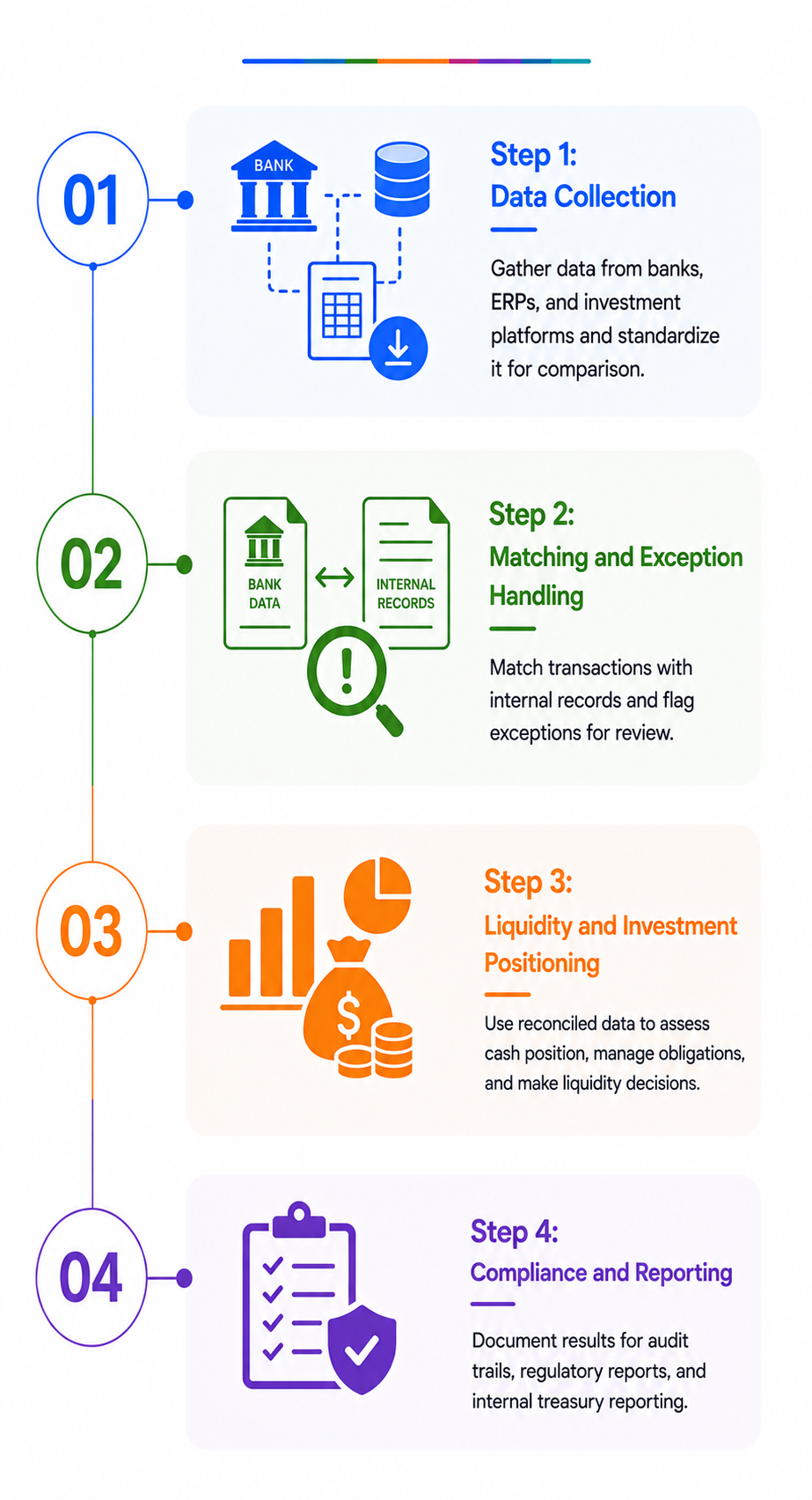
Here's a step-by-step breakdown of the treasury reconciliation process:
Step 1: Data Collection
The process starts by gathering data from various financial systems. Information from banks, ERP systems, and investment platforms is typically formatted differently, so it must be standardized before records can be compared.
Step 2: Matching and Exception Handling
Once the data is in order, transactions get matched against internal records. Anything that doesn't match or looks unusual is set aside for investigation.
Step 3: Liquidity and Investment Positioning
Reconciled data gives treasury teams a clearer understanding of their cash position and financial obligations. They use that visibility to make liquidity decisions throughout the day.
Step 4: Compliance and Reporting
The last step is documentation. The information gathered during reconciliation is used in audit records, regulatory reporting, and internal treasury and finance reports.
What are the Common Challenges in Treasury Reconciliation?
Treasury is at the intersection of finance. From cash flows to bank settlements and FX movements to intercompany transfers, each of these moves at a different speed, through a different channel, and in a different format. As such, treasury reconciliation often comes with challenges like:
1. Data from Multiple Places
Banks don't deliver statements in one standard format. Some use SWIFT, some have their own APIs, and some still send flat files through SFTP in formats that haven't been updated in years. Getting all of it into one system in a clean, consistent state takes significant manual effort. Plus, if items don't match, they end up hidden in spreadsheets until someone looks into them.
2. High Reconciliation Load
High daily transaction volumes mean teams are manually matching bank statements against their ERP every day. When something doesn't match, the investigation happens line by line in Excel. As a result, intercompany flows pile up at month-end, delaying the month-end close.
3. No Real-Time Visibility
You don't know your true cash position until reconciliation is done. For treasury teams that need a current view of available cash, pending settlements, and FX exposures, waiting can be a huge hassle.
4. Weak Controls
Manual processes are hard to audit. You might have:
- Incomplete exception trails
- Payment controls that are difficult to apply consistently
- No solid documentation to back up the auditor's questions
Manual vs Automated Treasury Reconciliation
The difference between manual and automated reconciliation mostly comes down to how long things take and how much you can trust the output.
With manual reconciliation, teams are matching transactions in spreadsheets. It can be time-consuming, especially for high transaction volumes. Errors are also more likely when so much work is done manually.
With automated reconciliation, much of the matching happens in the background. Transactions are compared against internal records as they arrive, while exceptions are flagged for review. A record of every action is maintained automatically.
How Osfin Automates Treasury Reconciliation?
Osfin handles treasury reconciliation across four stages:
- Data Ingestion
Osfin connects with more than 170 data sources, including banks, ERP systems, and flat files. Incoming data is standardized before reconciliation begins, regardless of the format it arrives in. The platform can also detect duplicates, outliers, and other data quality issues early.
- Reconciliation
Once the data is in, Osfin applies logic-based matching. The platform supports complex transaction structures, including one-to-many, many-to-one, and up to five-way reconciliations. It can process up to 30 million records in 15 minutes and automatically reconcile payment gateway reports with commission, tax, and fee components.
- Exception Handling
Unmatched transactions get flagged automatically, each with a reason assigned. From there, they're routed to the right team member through Osfin's ticketing and exception handling module. Live dashboards show match status, open exceptions, and exposure in real time.
- Output
Every reconciliation produces a compliance report with full transaction history and audit trails. Data is secured with 256-bit encryption, role-based access, maker-checker flows, and two-factor authentication. Osfin is compliant with SOC 2, PCI DSS, ISO 27001, and GDPR as well.
What are Some Best Practices for Treasury Reconciliation?
A well-structured reconciliation process starts with a few basic practices:
- Automate Where Possible
Spreadsheets work fine when transaction volumes are low. But as volumes grow, manual matching often gets slow and error-prone. Connecting your banks and ERP through direct feeds lets transactions flow into your cash ledger automatically without manual intervention.
- Reconcile Frequently
Monthly reconciliation is the standard. For teams processing large volumes of transactions, however, that schedule may leave issues sitting unresolved for too long. Reconciling more often helps teams spot and resolve issues sooner.
- Maintain Records
It's worth documenting every adjustment made during reconciliation. Besides creating an audit trail, it can provide useful context when the same problems surface again.
- Build a Standard SOP
A simple standard operating procedure ensures the treasury reconciliation process is consistent. It should cover who gets the data, who does the matching, when it needs to be done, and who signs off at the end.
The End Note
Treasury reconciliation helps finance teams get better visibility into their numbers and make decisions without waiting for the books to catch up. When the process relies on manual work, though, getting those answers can take time.
Osfin automates the entire process, from data ingestion to exception handling, so your team spends less time fixing errors and more time on work that actually matters.
See how it works for your treasury operations. Book a demo with Osfin today.
FAQs
1. What is treasury reconciliation's meaning?
Treasury reconciliation is the process of validating internal financial records against external statements and transaction data. It covers cash balances, investments, liabilities, and cash flows spread across multiple banks and platforms.
2. How is treasury reconciliation different from bank reconciliation?
Bank reconciliation compares transactions and balances for a specific account. Treasury reconciliation consolidates information from multiple banks, ERP systems, and investment platforms. This gives treasury teams a more complete view of cash positions, liquidity, and risk.
3. How does automating treasury reconciliation help?
Manual reconciliation takes hours and is prone to errors. Automation matches transactions as they come in, flags exceptions immediately, and keeps a full audit trail.
4. Why should organizations conduct treasury reconciliation?
Treasury reconciliation gives organizations a reliable view of their financial position. That visibility helps with compliance, makes unusual transactions easier to identify, and supports decisions related to liquidity, funding, and investments.