Trintech Pricing: Plans, Features & Cost
Trintech is one of the more widely adopted account reconciliation platforms in the market. It helps finance teams handle reconciliations, manage the close process more efficiently, and stay on top of compliance requirements. The platform is used by both mid-sized companies and large enterprises, with a strong focus on:
- Financial controls
- Audit requirements
- Regulatory compliance
However, if you are considering investing in the platform for your business, one important question you might be wondering about is the price.
Trintech's pricing isn't publicly available. This can make it difficult to understand what you're signing up for before you talk to their sales team.
In this article, we'll walk you through what Trintech offers, what influences its pricing, and whether it's the right fit for your finance team.
TL;DR:
- Trintech does not make its pricing public. However, available estimates put Adra at roughly $33,000 per year and Cadency at $60,000–$150,000 annually.
- Trintech's products are built for organizations with complex close processes, strict compliance requirements, and high transaction volumes. Smaller organizations with simpler requirements may find the platform more robust than necessary.
- Pricing goes beyond the annual subscription fee. Organizations should also account for implementation, professional services, and custom integrations.
- Alternatives like Osfin.ai offer faster onboarding, 170+ pre-built connectors, and more flexible pricing.
What is Trintech?
Trintech is a financial technology company that builds software for accounting and finance teams. It helps organizations manage the financial close process, covering everything from account reconciliation and transaction matching to journal entries and compliance reporting.
The platform aims to reduce the manual work that slows finance teams down, while bringing more accuracy and control into the close process.
It is primarily used by industries where financial governance is critical, including financial services, healthcare, and retail.
What is Trintech’s Product Lineup?
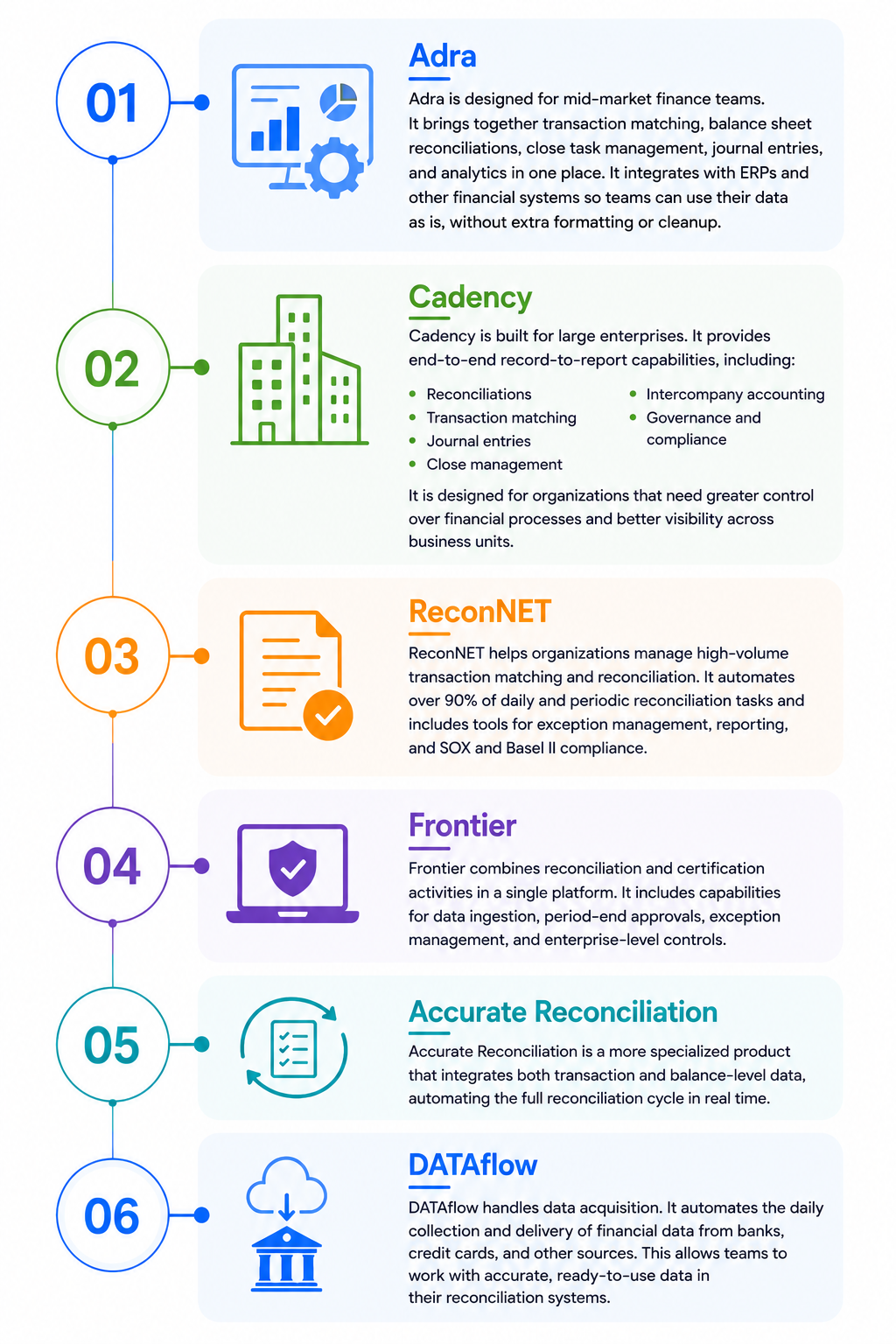
Trintech offers multiple products for different levels of complexity and organizational size:
1. Adra
Adra is designed for mid-market finance teams. It brings together transaction matching, balance sheet reconciliations, close task management, journal entries, and analytics in one place. Its purpose is to minimize the manual work that can make month-end close processes longer and more complex. By integrating with ERPs and other financial systems, Adra lets teams use their data as is, without extra formatting or cleanup.
2. Cadency
Cadency is built for large enterprises. It provides end-to-end record-to-report capabilities, including:
- Reconciliations
- Transaction matching
- Journal entries
- Close management
- Intercompany accounting
- Governance and compliance
It is designed for organizations that need greater control over financial processes and better visibility across business units.
3. ReconNET
ReconNET helps organizations manage high-volume transaction matching and reconciliation. It automates over 90% of daily and periodic reconciliation tasks and includes tools for exception management, reporting, and SOX and Basel II compliance.
4. Frontier
Frontier combines reconciliation and certification activities in a single platform. It includes capabilities for data ingestion, period-end approvals, exception management, and enterprise-level controls.
5. Accurate Reconciliation
Accurate Reconciliation is a more specialized product that integrates both transaction and balance-level data, automating the full reconciliation cycle in real time.
6. DATAflow
DATAflow handles data acquisition It automates the daily collection and delivery of financial data from banks, credit cards, and other sources. This allows teams to work with accurate, ready-to-use data in their reconciliation systems.
What is Trintech’s Pricing Model?
Trintech uses a subscription-based pricing model, but you won't find any numbers on their website. Like most enterprise software, Trintech's pricing is custom and based on your specific situation. The pricing is also influenced by other factors, like:
- Company size
- Number of users
- Modules needed
The modular design can work well for organizations with relatively simple requirements. The downside is that costs can add up as more functionality is added over time. Exact pricing is available only through the sales team.
{{banner1}}
What is Trintech’s Estimated Pricing by Product Tier?
Trintech doesn't make its pricing public. This means there's no way to independently verify the numbers you'll see online. They can be useful for getting a rough sense of cost, but your actual quote may look quite different.
For Adra, third-party sources suggest a one-time payment of around $33,000. For Cadency, which targets larger enterprises, the pricing can come to around $60,000-$150,000 annually.
What is Included in Trintech’s Pricing?
Trintech doesn't disclose its pricing publicly. However, a few factors can influence the amount you'll end up paying:
- Type of Solution
The product you choose, as well as the complexity of your financial operations, are the major factors that influence Trintech's pricing. For example, if you're a mid-sized company using Adra for basic reconciliations, you'll have a very different price point than a global enterprise running Cadency across multiple entities.
At the same time, Trintech's cost also depends on your operations. The more intricate your operations, the higher the implementation and subscription costs are likely to be.
- Number of Users
Trintech's pricing also depends on the size of your team. If more people need access to the platform, you can expect to pay more.
We'd suggest mapping out exactly who on your finance team actually needs access before you discuss pricing, since this can greatly impact the total cost.
- Integration Needs
Most organizations will need Trintech to connect with their existing ERP or other financial systems.
The platform integrates with SAP, Oracle, and NetSuite. However, more complex technology environments may require custom integration work.
What are Trintech’s Implementation and Onboarding Costs?
Trintech doesn't publish implementation fees. Available reports suggest that Adra implementations take roughly five months, but the timeline can be shorter or longer depending on the complexity of the project.
Cadency, on the other hand, has a greater enterprise scope. As such, it usually takes longer and costs more to implement.
What are Some Hidden Costs to Look for?
Trintech's subscription fee isn't the only cost you may be paying. It's important to look past the initial quote and consider what the full cost looks like over time.
Account reconciliation platforms often structure pricing with variable costs that aren't visible right away. For example,
- Per-transaction charges
- Infrastructure fees
- Professional services costs, etc.
These hidden charges can add up over time. So, read the fine print on contract terms carefully. Also, remember that welcome discounts can often make the first year look more affordable than it actually is.
{{banner1.1}}
Trintech Pricing vs. BlackLine, FloQast, and HighRadius
Trintech isn't the only account reconciliation platform out there. Platforms such as BlackLine, FloQast, and HighRadius offer similar capabilities.
Here's how they compare:
Is Trintech Worth the Cost? What are Its Pros and Cons?
Trintech is a strong option for finance teams in compliance-heavy industries. However, it won't be the right fit for every organization.
Pros:
- Finance teams in banking and insurance can benefit from risk-based automation that automatically certifies low-risk accounts.
- As companies add new entities through acquisitions, Trintech helps bring those operations onto a common process.
- The support team is knowledgeable and genuinely helpful.
Cons:
- The platform's interface can feel outdated. Plus, there's a big learning curve.
- Built-in reporting is rigid. Many users end up exporting data just to get the views they need.
- Implementation can become more complex, especially if your data isn't clean.
- There’s no published pricing or free trial. Moreover, the product isn't designed for small teams or simple close processes.
Trintech Alternatives at Different Price Points
Trintech is a solid platform. However, it does come with enterprise-level complexity and high pricing. If you're looking for something with a lower total cost of ownership and faster time to value, alternatives like Osfin.ai are worth a look.
Trintech's onboarding process can be time-consuming, while Osfin is built for faster deployment. It supports 170+ pre-built connectors and accepts data in native formats, eliminating much of the upfront preparation work.
A few other differences:
- Speed: Osfin reconciles up to 30 million records in 15 minutes. Trintech is scalable, but doesn't match that throughput.
- Interface: Osfin uses a no-code interface, which makes adoption faster across the team.
- Pricing: Osfin is built for organizations that need enterprise-grade capabilities without enterprise-level costs.
Trintech can work well for large enterprises with multi-entity environments and strict compliance needs. However, for organizations that value speed, flexibility, and cost efficiency, Osfin may be the more practical choice.
How to Get a Trintech Quote?
Trintech doesn't offer flat-rate pricing. So, you'll have to go through the sales process to get an estimate.
It begins with a demo request on Trintech's website. The sales team will then review your requirements, schedule a discovery call, and prepare a customized proposal.
Wrapping Up
Trintech is well established in the market and is particularly suited to organizations with complex close requirements. That said, the platform can require a significant investment in both budget and implementation effort.
Mid-sized organizations may not need the complexity of a traditional enterprise platform. Alternatives like Osfin.ai offer faster onboarding, 170+ pre-built connectors, and competitive pricing.
Book a demo today to see how Osfin can handle your reconciliation needs.
FAQs
1. What is Trintech's cost?
Trintech doesn't publish its pricing publicly. Third-party estimates put Adra at around $33,000 and Cadency at roughly $60,000 to $150,000 annually. To get an accurate quote, you'll need to contact Trintech's sales team.
2. What is Trintech used for?
Trintech brings together several tools used during the financial close process. These include account reconciliation, transaction matching, journal entries, compliance reporting, and close task management.
3. What are the alternatives for Trintech?
Some Trintech alternatives include Osfin, BlackLine, FloQast, and HighRadius.
4. What is included in Trintech's pricing?
The cost of Trintech includes the product, user count, and complexity of your setup. You may also incur costs for implementation, professional services, and custom development.