AutoRek Review: Features, Pros, Cons & Use Cases
TL; DR
- AutoRek is a reconciliation platform built for large financial institutions. It’s quite good for automation across data ingestion, matching, exception handling, and compliance. But because of limitations like high cost, long implementation timelines, and complexity, smaller or fast-moving businesses may find it too heavy and look for more flexible, quicker alternatives.
- AutoRek is a well known name when it comes to reconciliation. It has been around for over 30 years, serves some of the largest financial institutions in the world, and has the depth to match. But depth comes with certain trade-offs, like long implementation timelines, high costs, and a platform designed primarily for large enterprises with the IT resources to support it.
- For organizations that don't fit that profile, or simply need a faster, more flexible path to automated reconciliation, looking beyond AutoRek is a reasonable next step.
- Here, we perform a complete AutoRek review, from what it does to how well it does it to where its limitations lie and when an alternative is required.
What is AutoRek?
AutoRek is an automated reconciliation platform used to simplify complex reconciliation workflows, data management controls, and compliance obligations of an organization. Suited for financial institutions like asset management companies, capital markets, banks, and insurance and payments organizations, AutoRek addresses challenges like manual reconciliation, fragmented data systems, and changing regulatory requirements.
Key AutoRek Features
AutoRek is built around a few core capabilities that together handle the heavy lifting of reconciliation, data management, and compliance:
1. Data Ingestion: Getting data into the system isn't a manual job here. The platform connects to multiple sources and figures out the format on its own, whether that's a CSV, a bank file, SWIFT messages, or something else entirely. Without any IT involvement, data can flow in live, on a schedule, or in bulk, depending on what the business needs.
2. Intelligent Matching: The platform looks across two data sets and works out what lines up and what doesn't. It reads the data and suggests how matching should be set up, though users can go in and change those rules themselves whenever needed.
3. Exception Management: When something doesn't match, it gets flagged and dropped into a queue. The more pressing items rise to the top, the right people get assigned, and if something's been sitting too long without a resolution, the platform nudges automatically.
4. Auto-Journalling: Once the reconciliation is done, the accounting entries follow without anyone having to create them manually. Rounding differences, write-offs, currency gaps: these all get recorded and tied directly back to the reconciliation they came from. Multi-currency and multi-entity setups are handled too.
5. Real-Time Reporting & Dashboards: The dashboard reflects what's happening right now, reports can be automated to land in inboxes on a set schedule, and if anyone questions a number, the trail back to the original data is right there.
AutoRek Pros
- Teams report in many AutoRek reviews about time savings, with some reducing daily reconciliation work from full-time staff hours down to just minutes.
- It can handle high transaction volumes, which makes it a reliable choice for large-scale financial operations.
- You can set up and manage your own workflows, match rules, and data feeds without needing IT involvement.
AutoRek Cons
- There’s a steep learning curve, especially if users don’t have much experience in automated reconciliation tools.
- Automatic reconciliation works well with structured formats like MT940 or similar feeds. That means teams using varied or unstructured data may need extra manual effort.
- The overall cost of implementation can make it a heavy investment, especially for smaller organizations.
- Connecting the platform to existing systems can be technically complex and more involved than expected.
{{banner1}}
AutoRek Pricing Overview
AutoRek has not published its pricing publicly on the platform’s website. The only route to getting a price is booking a demo directly with their sales team through the website. The actual pricing can depend on transaction volumes, the number of users, the modules you wish to select, implementation complexity, and the size of your organization.
AutoRek Use Cases
Financial institutions deal with reconciliation and data management differently depending on their business. AutoRek is built to handle these across four sectors.
1. Asset Management & Capital Markets
- Matching records between accounting and investment books (ABOR vs IBOR)
- Overseeing and validating net asset values (NAV)
- Managing cash across multiple entities
- Reconciling positions with custodians and brokers
2. Banking
- Reconciling deposit, savings, and lending accounts
- Handling suspense accounts and unresolved exceptions
- General ledger and subledger reconciliations
- Treasury and liquidity oversight
- Regulatory reporting
3. Insurance
- Bordereaux reconciliation and validation
- MGA and IBA cash flow reconciliations
- Reinsurance premium and claims matching
- Remittance and collections tracking
- Compliance with CASS, IFRS 17, and Solvency II
4. Payments
- Reconciling card, rail, scheme, and bank transactions
- Validating processor settlements
- Scheme and rail fee reconciliation
- Safeguarding calculations for e-money institutions and money service businesses
- GL posting and financial reporting
Who Should Consider AutoRek?
Financial institutions like banks, asset managers, and insurers that run very high transaction volumes and have the internal resources to support a lengthy implementation process can consider AutoRek.
It works best for organizations where regulatory compliance across frameworks like CASS, MiFID II, and IFRS 17 is a central concern, and where there's enough budget and IT bandwidth to get the platform properly set up and running.
If the business is already operating at enterprise scale and has the time to invest in onboarding, AutoRek has the depth to handle complex reconciliation needs.
Who Might Need an Alternative?
Businesses that need to get up and running quickly will find AutoRek's implementation timeline a challenge.
Smaller organisations, or those outside the traditional financial services space, may also find it more complex than they need. AutoRek is built with large banks and asset managers in mind, and that focus shows in both its complexity and its cost.
For businesses that want the same reconciliation capability across banking, payments, insurance, and capital markets, but with faster deployment, broader integration options, and a platform that adapts across industries, Osfin is worth a closer look. It covers much of the same ground without the heavy implementation burden, and extends into sectors like fintech, gaming, and retail that AutoRek doesn’t serve.
AutoRek vs Modern Reconciliation Platforms
Osfin is a modern reconciliation platform that eases all the complications of reconciliation, data management and compliance. From real-time data ingestion from innumerable sources, across any format, to creating detailed reports of each and every step for clear audit trails, Osfin seamlessly does the heavy lifting, so teams can devote appropriate time to strategic, high-value work.
{{banner1.1}}
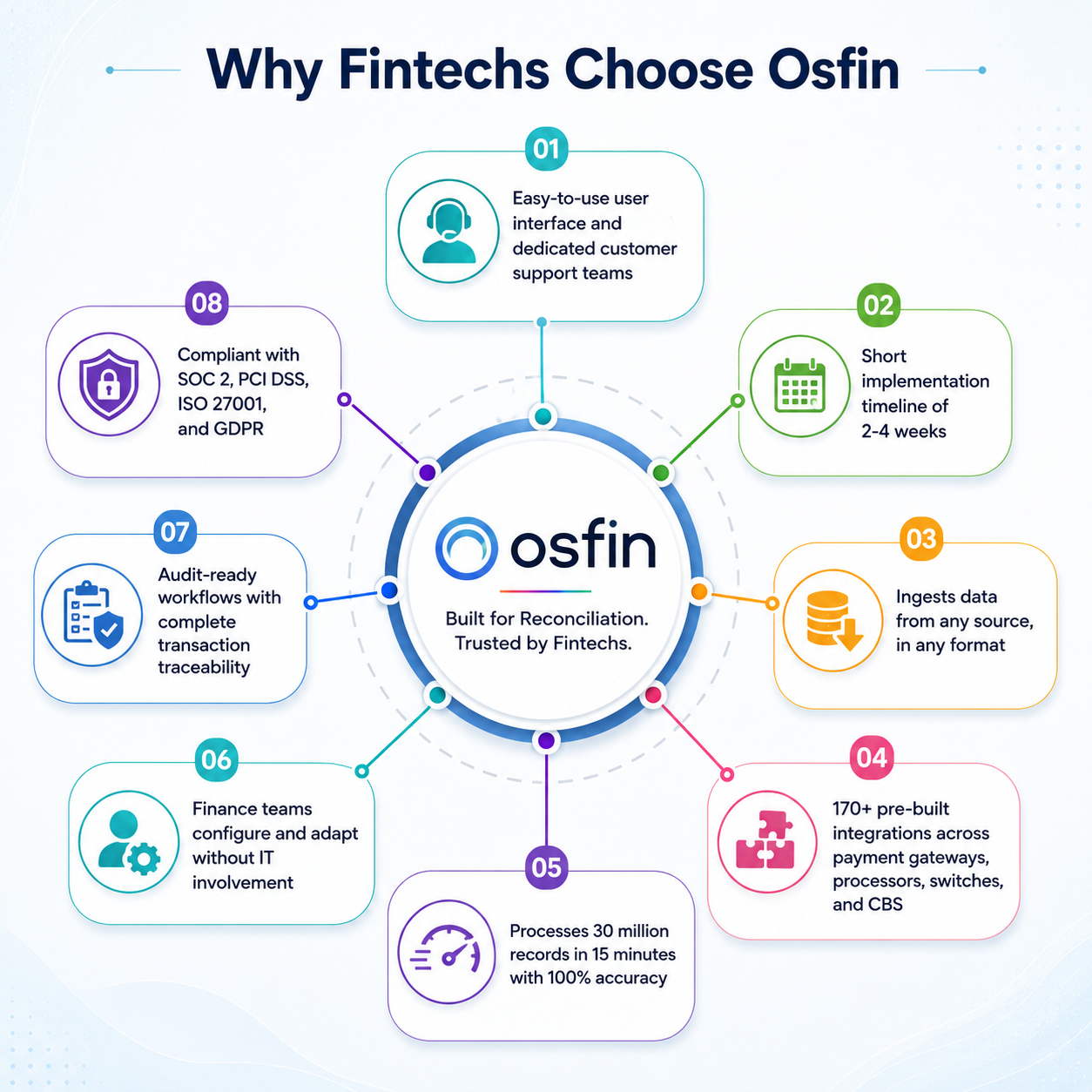
Why Fintechs Are Choosing Osfin Over Traditional Enterprise Suites
For a fintech moving fast, trying to scale, and operating across multiple payment rails and data sources simultaneously, a traditional reconciliation platform often creates more friction than it solves.
Implementation can take months. IT involvement is heavy throughout. The learning curve is steep. And for a fintech that might be processing payments across different sources, operating in multiple markets, and onboarding new partners every quarter, the rigidity of those systems becomes a real operational issue.
Osfin is built to solve all that and more. It’s a reconciliation automation platform built for high-volume, high-complexity financial operations. It easily delivers high processing speed and 100% accuracy without a long implementation timeline and IT involvement.
Osfin handles the entire reconciliation lifecycle in a single, connected workflow:
1. Data Ingestion
Fintechs typically pull data from multiple payment gateways, banking partners, internal ledgers, and third-party processors, often in different formats, on different schedules, and with varying levels of data quality.
Osfin handles this as a file-format agnostic platform. It doesn't matter whether the incoming data is JSON, XML, CSV, XLS, or something else entirely, Osfin ingests it. With over 170 pre-built integrations covering payment gateways, banks, ERPs, and internal databases, connecting data sources is fast and requires minimal engineering effort. But ingestion isn't just about pulling data in. Osfin applies custom deviation tolerances during ingestion to filter out poor-quality data before it ever reaches the reconciliation stage, and detects duplicates and outliers at the point of entry, preventing downstream issues before they have a chance to cause problems.
2. Reconciliation
Once data is in, Osfin's reconciliation engine gets to work using logic-based matching. It handles one-to-many and many-to-one transactions, the kind of complex matching that trips up simpler tools, and supports multi-way reconciliations, including two-way, three-way, four-way, and five-way reconciliations across systems simultaneously. For fintechs managing transactions across multiple processors, banks, and internal ledgers at the same time, this is a meaningful capability.
Speed matters too. Osfin reconciles 30 million records in 15 minutes, a processing rate that allows finance teams to operate in near real time rather than catching up at the end of the day. It also auto-reconciles payment gateway reports with detailed breakdowns of commissions, taxes, and fees, removing another layer of manual work from the process.
3. Exception Handling
Osfin automatically flags unmatched transactions and assigns each one an accurate reason code, so teams aren't starting from scratch when they pick up an exception. From there, the ticketing and exception handling engine escalates and routes each unmatched item to the appropriate team member automatically. Live dashboards give a real-time view of match status, exposure, and exception queues, so nothing gets lost, and nothing sits unresolved longer than it should.
4. Output and Compliance
At the end of the process, Osfin delivers a compliance report and maintains audit-ready workflows with complete traceability and full transaction history.
Data is secured with 256-bit encryption, and the platform enforces a maker-checker flow, role-based access controls, and two-factor authentication throughout. Osfin complies with SOC 2, PCI DSS, ISO 27001, and GDPR requirements, covering the compliance bases that fintechs operating across markets need to demonstrate.
Beyond just how it works, other reasons why fintechs go with Osfin are:
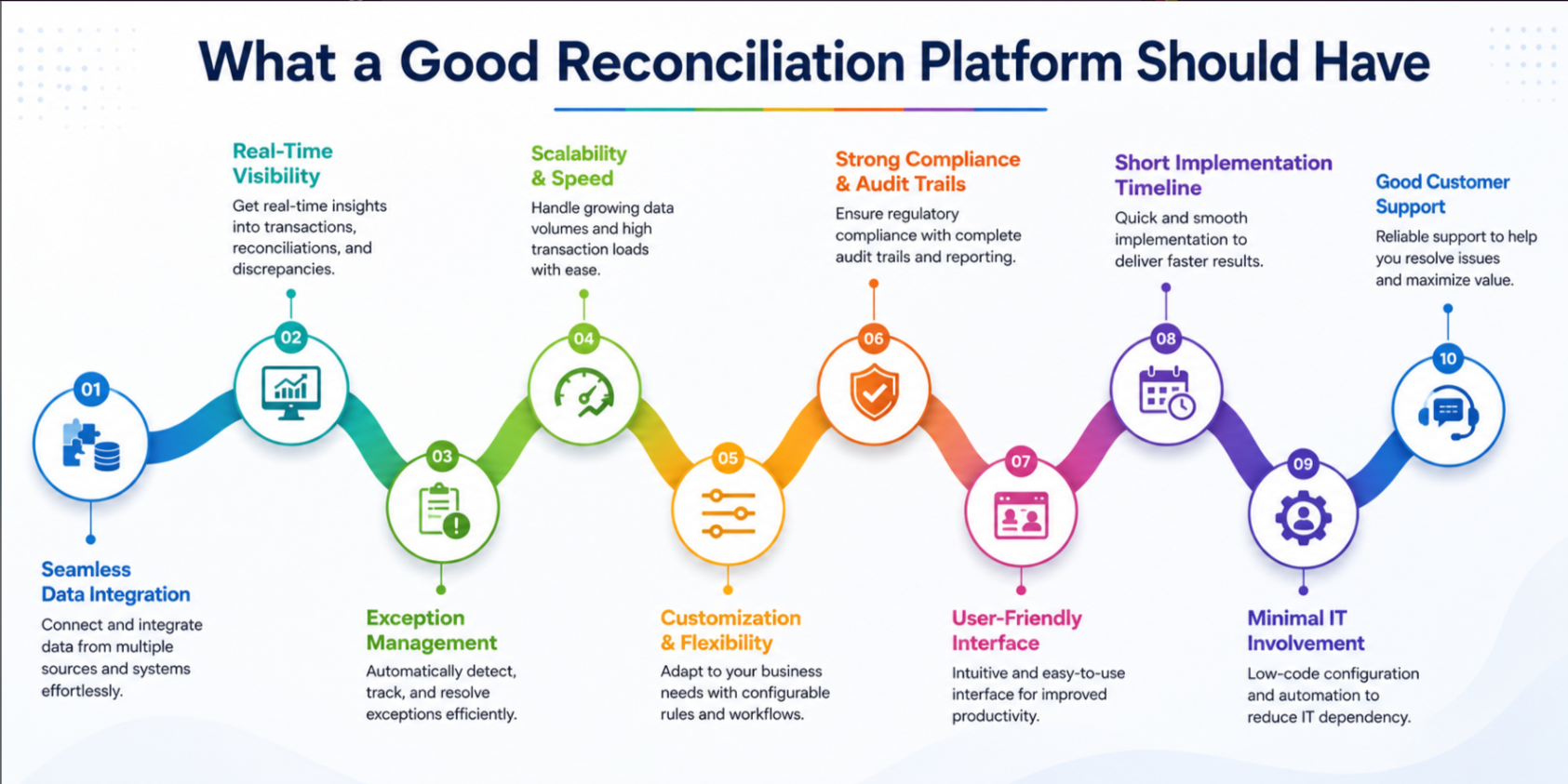
It deploys in weeks: Fintechs can’t afford a six-month implementation window. Osfin typically goes live in two to four weeks, with pre-built connectors doing the heavy lifting on integrations and minimal custom development required from internal teams.
It's built for scale without rebuilding: With rising transaction volumes, new payment types or markets are added. And Osfin scales with the business. There's no need to re-architect the platform every time the business evolves.
Operations teams own it: Traditional enterprise platforms often require IT to get involved whenever something needs to change, a new data source, a new matching rule, or a new report. Osfin is designed for business users. Finance and operations teams can configure, adjust, and manage reconciliation workflows themselves, without raising a ticket.
It covers more ground: While traditional platforms are largely built around the needs of banks and asset managers, Osfin serves fintechs, payments businesses, insurance firms, capital markets, gaming platforms, and retail operations. That breadth means the platform is genuinely built for the variety and pace that fintech businesses operate at, not retrofitted to handle it.
The Bottom Line
No platform is perfect for everyone, and that includes AutoRek. It does what it was built to do – handle complex reconciliation for large financial institutions – and it does it well. But finance teams outside that profile have often been left making do, either with a platform that's too heavy for their needs or with spreadsheets that were never built for the volumes they're dealing with.
Osfin sits in the space between those two extremes. It brings genuine reconciliation capability like fast ingestion, logic-based matching, smart exception handling, and audit-ready output without the implementation burden or the enterprise price tag. For teams that have been looking for something that actually fits, it's worth considering.
{{banner2}}
FAQs
1. Is AutoRek suitable for fintech companies?
AutoRek is built primarily for large banks, asset managers, and insurers. Some fintechs may find it too heavy and complex for their pace. There are more agile platforms better suited to fintech needs.
2. Does AutoRek offer real-time reconciliation?
Yes, AutoRek supports real-time reconciliation alongside batch and scheduled processing. However, real-time capability alone doesn't tell the full story. How quickly the platform deploys and integrates matters just as much.
3. How much does AutoRek cost?
AutoRek doesn't publish pricing. Costs are negotiated directly through their sales team and are likely influenced by transaction volume, number of users, modules selected, and implementation complexity, making it difficult to assess upfront.
4. What are the best alternatives to AutoRek?
Platforms like Osfin offer comparable reconciliation depth with faster deployment, broader industry coverage, and 170+ integrations, making them a strong alternative, particularly for payments, fintech, and high-volume operations.
5. Is AutoRek good for mid-sized businesses?
AutoRek is designed for large enterprises with significant IT resources and budget. Mid-sized businesses may find the implementation too complex and the overall investment difficult to justify relative to their needs.