What Is Continuous Accounting?
As your business grows, so does the number of transactions that you must keep track of. Usually, these are handled at month-end closing, when account teams scramble through different ledgers, bank feeds, payment gateway reports, invoices, etc., making accruals and journal entries, reconciling corresponding records and creating a financial statement for the accounting period.
This traditional approach to accounting often leads to a sudden increase in workload, resulting in errors and, in some cases, delayed closing. So how do businesses tackle this problem? With continuous accounting.
Let’s explore that in this article.
Key Notes
- Continuous accounting spreads financial tasks like reconciliation, journal entries, and accruals evenly across the month instead of piling them up at month-end.
- It relies on automation to handle repetitive, high-volume tasks so your accounts team can focus on more strategic work.
- Real-time reconciliation means discrepancies get caught early, before they become bigger problems.
- Finance leaders get an accurate picture of business performance at any point in the month, not just after close.
- Switching to continuous accounting works best when done in phases, starting with the most repetitive, high-volume tasks first.
What Is Continuous Accounting?
Continuous accounting is a digital take on the financial close, in which tasks traditionally reserved for month-end are performed in real-time and spread throughout the accounting period. It includes applying automation and cloud computation to handle journal entries, reconciliation, accruals and accounting tasks.
It depends on two types of ledgers, the general ledger and subsidiary ledger, which together ensure that all your transactions are recorded, tracked and reported accurately.
The general ledger is a centralized repository of all accounts required to create financial statements, including assets, liabilities, equity, revenue and expense. Subsidiary ledgers, on the other hand, provide detailed information about specific aspects of financial transactions. Some of the common accounts included in this are accounts payable, accounts receivable, fixed assets, and inventory.
Continuous Accounting Vs Traditional Close
Traditional accounting concentrates financial work into a short window at the end of each month. This puts significant pressure on the accounts team, often resulting in missed deadlines and a high amount of errors in the processes.
This repeated cycle of intense close periods followed by relative calm causes accounts teams to burn out, affecting their morale and retention. Moreover, CFOs and other stakeholders have to wait for close to get an accurate picture of the organization’s financial performance.
Continuous accounting optimizes close routines by distributing the workload evenly over the entire period. Journal entries are posted to ledgers as transactions occur, while reconciliation occurs daily or weekly rather than all at once. This increases visibility into accounts, resulting in earlier identification of discrepancies and improved decision-making ability for higher-ups.
{{banner1}}
What Are the Core Principles of Continuous Accounting?
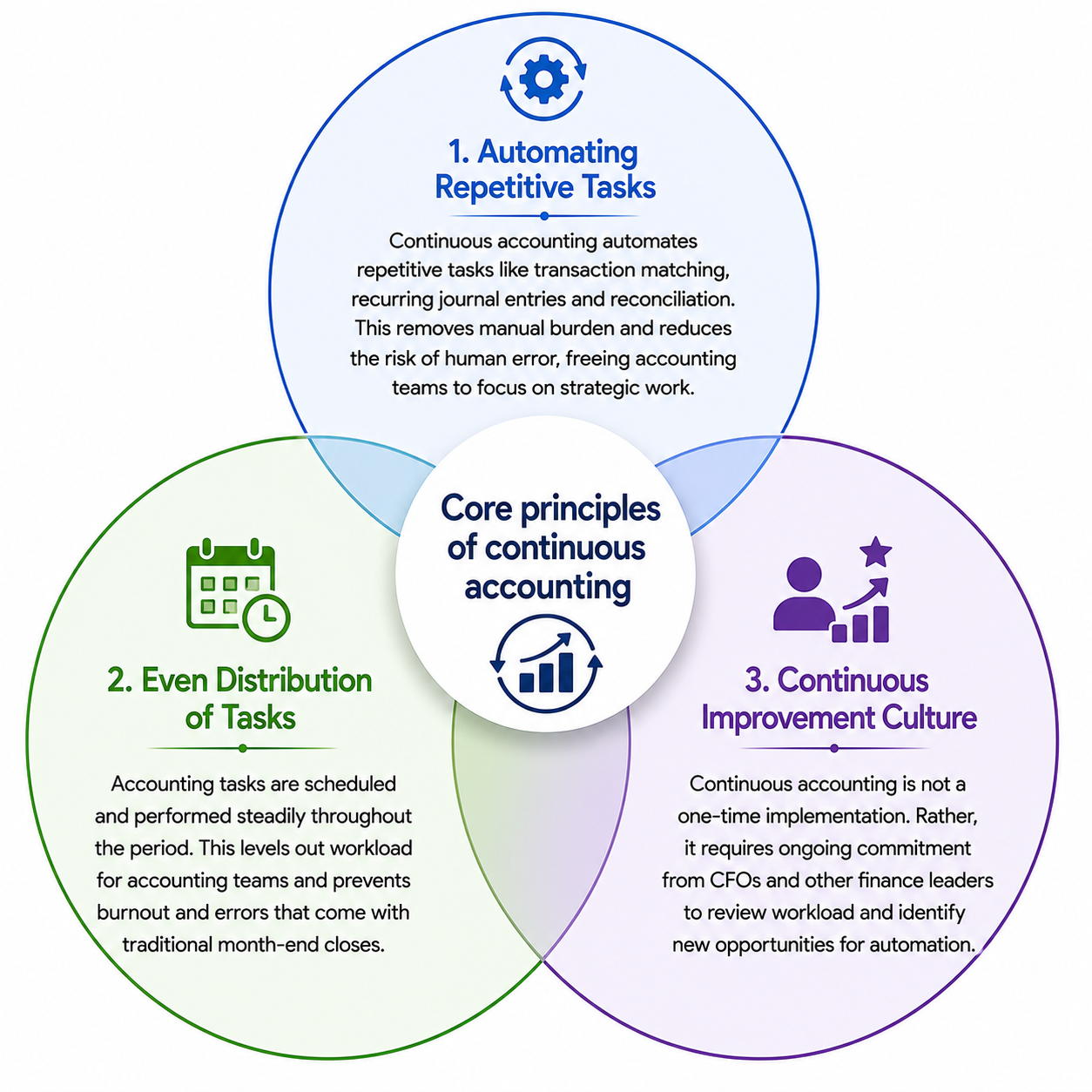
Continuous accounting has a few foundational principles that distinguish it from the traditional approach.
1. Automating Repetitive Tasks
Continuous accounting automates repetitive tasks like transaction matching, recurring journal entries and reconciliation. This removes manual burden and reduces the risk of human error, freeing accounting teams to focus on strategic work.
2. Even Distribution of Tasks
Accounting tasks are scheduled and performed steadily throughout the period. This levels out workload for accounting teams and prevents burnout and errors that come with traditional month-end closes.
3. Continuous Improvement Culture
Continuous accounting is not a one-time implementation. Rather, it requires ongoing commitment from CFOs and other finance leaders to review workload and identify new opportunities for automation.
Which Close Activities Become Continuous?
Most core accounting processes that are repetitive yet crucial to accurate financial consolidation can be made continuous through automation software. These include the following:
1. Account Reconciliation
In continuous accounting, a business’s general ledger accounts are compared and reconciled with external, interdependent statements on a daily or weekly basis rather than waiting until month-end.
2. Transaction Matching
Transactions across internal ledgers, bank feeds, payment gateways, subledgers, etc are automatically matched as they occur.
3. Accrual and Journal Entry
Recurring journal entries and accruals are created and posted to the ledgers regularly throughout the accounting period rather than processed in batches.
4. Intercompany Reconciliation
Transactions between related entries within the same organization are identified, matched and eliminated from financial statements.
5. Cash Allocations
Incoming cash receipts are applied to the appropriate invoices, accounts, or financial obligations in real time.
{{banner1.1}}
What Are the Benefits of Continuous Close?
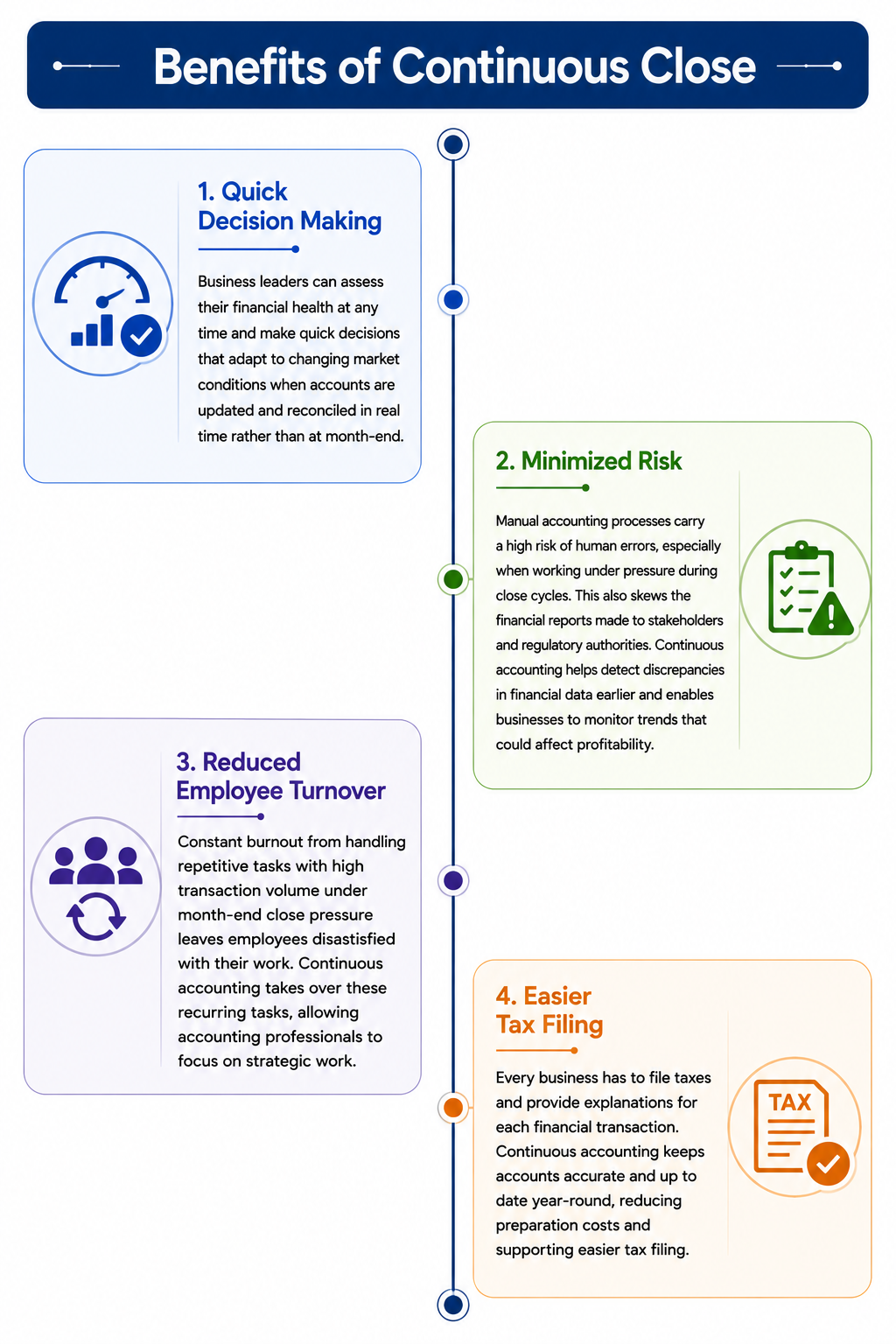
Adopting a continuous approach to month-end close tasks such as reconciliations, journal entries, accruals, etc, offers many benefits for organizations.
1. Quick Decision Making
Business leaders can assess their financial health at any time and make quick decisions that adapt to changing market conditions when accounts are updated and reconciled in real time rather than at month-end.
2. Minimized Risk
Manual accounting processes carry a high risk of human errors, especially when working under pressure during close cycles. This also skews the financial reports made to stakeholders and regulatory authorities. Continuous accounting helps detect discrepancies in financial data earlier and enables businesses to monitor trends that could affect profitability.
3. Reduced Employee Turnover
Constant burnout from handling repetitive tasks with high transaction volume under month-end close pressure leaves employees dissatisfied with their work. Continuous accounting takes over these recurring tasks, allowing accounting professionals to focus on strategic work.
4. Easier Tax Filing
Every business has to file taxes and provide explanations for each financial transaction. Continuous accounting keeps accounts accurate and up to date year-round, reducing preparation costs and supporting easier tax filing.
How Is Continuous Accounting Implemented?
With growing transaction values and increased pressure during the closing cycle, you’d inevitably want to shift to continuous accounting. However, its successful implementation depends on following a structured approach.
1. Evaluate Current Account Cycle
Start by assessing the current accounting cycle and identifying bottlenecks in the closing process. Involve team members and get their views on processes that could benefit from automation.
2. Redesign Processes
Choose automation platforms that support continuous accounting. Work with their teams to redesign the accounting process and break it into smaller, manageable tasks arranged in logical order throughout the period. For instance, Osfin's dedicated support team ensures effective implementation of its automated reconciliation solution and tailors it to fit your workflow.
3. Train Employees
Overhauling traditional accounting methods is bound to come with resistance from your employees. Training them to work with automation solutions and promoting its various benefits leads to easier adoption.
4. Monitor for Improvement
Once the accounts automation solutions have been implemented, monitor their performance across different tasks. Assess their performance indicators like close time, discrepancies and instances of human intervention. Use these metrics to identify areas requiring improvement and make adequate adjustments.
{{banner2}}
What Are the Best Practices for Continuous Accounting?
The following are some that can ease continuous accounting implementation:
1. Enact Continuous Accounting in Phases
Replacing traditional close with a continuous accounting framework with a swift decision can backfire, creating more errors in the workflow. Instead, implement automation tools one by one, starting with high-volume, low-complexity tasks, such as recurring journal entries.
2. Establish Governance Framework
You must establish a governance framework to ensure data accuracy and protect it against manipulation. This includes defining ownership for each transaction, setting validation rules at the source system, and specifying exception-handling procedures.
3. Invest in Training
It becomes easier for employees to adopt a continuous accounting framework within the organization when they are well-trained to use these tools.
4. Review Close Performance
Track the performance of automation tools after each period to identify areas for improvement. Along with this, keep track of open exceptions, approvals, and variances. Resolve them as quickly as possible to avoid issues in close.
Wrapping Up
Continuous accounting shifts your closing process from a single, high-pressure event to a steadier, distributed process that leverages automation. Osfin’s intelligent automation solution assists in this process by reconciling your high volumes of complex financial transactions at lightning-fast speed with 100% accuracy.
Osfin is a file format-agnostic platform with 170+ integrations that capture data from multiple sources, regardless of format and filter out anomalies using custom deviation tolerances. It reconciles one-to-many, many-to-one and multi-way transactions with logic-based matching rules.
It comes with a ticketing and exception handling engine that automatically flags discrepancies and routes them to the appropriate accounts team member for resolution. And at the end of reconciliation, it delivers a compliance report while maintaining an audit-ready workflow.
Book a demo with Osfin now to accelerate your close cycle.
FAQs
1. What are the core principles of continuous accounting?
The core principles of continuous accounting include automating repetitive tasks, evenly distributing accounting tasks and fostering a culture of continuous improvement.
2. What tasks are automated in continuous accounting?
Account reconciliation, transaction matching, accrual and journal entry, intercompany reconciliation and cash allocation are the tasks automated in continuous accounting.
3. What are the benefits of continuous accounting?
Continuous accounting helps businesses make quick data-driven decisions, minimize the risk of errors, reduce employee turnover and ease their tax filing process.
4. How does continuous accounting differ from traditional accounting?
Traditional accounting pushes all the financial close tasks, such as journal entry, reconciliation, accruals, etc at the end of the month, leading to a sudden increase in accounts team workload and often increasing the error rate. Continuous accounting, on the other hand, spreads out these tasks into small, manageable fragments over the whole accounting period.