How to Audit Your Reconciliation Process?
You could be maintaining your financial records as carefully as possible and may still end up with:
- A missed transaction
- Late check clearance
- Duplicate entry
- Number mismatches
These are small errors. However, they compound over time, making it complicated to fix once you find out. Regular audits help catch them before that happens.
Instead of waiting for these errors to show up on their own, you can simply run a structured audit process to catch and correct them early.
In this article, we'll see how to audit your bank reconciliation, so you can verify if your records match and if your financial reporting is accurate.
Key Takeaways:
- No matter how careful you are, your reconciliations may still have mistakes - duplicate entries, missing transactions, uncleared checks. The list is long.
- A reconciliation audit helps flag them and ensure everything is working as intended.
- Auditors most often flag old reconciling items, missing approvals, manual workarounds, and unresolved balances sitting in suspense accounts.
- Audit readiness starts with the reconciliation process itself. Manual processes leave evidence scattered across spreadsheets and inboxes. Automated systems provide a better alternative.
Why Audit Your Reconciliation Process?
Auditing your reconciliation process is how you confirm that your numbers are actually trustworthy. If your organization is subject to internal control reviews, statutory reporting, or SOX compliance, that assurance isn't optional.
The idea is to verify that your financial records can be trusted for both internal decisions and external reporting. This means checking if:
- All transactions are classified consistently.
- Every reconciled number has a reliable paper trail.
- Your internal controls are working properly.
Not running a reconciliation audit can result in small discrepancies being missed, some caused by errors and others by fraud.
{{banner1}}
Who Should Conduct a Reconciliation Audit?
In small businesses, the owner, bookkeeper, or accountant is often responsible for both reconciliation and audit. Larger organizations typically assign this work to the accounting or finance team.
Either way, one rule holds: the person who prepared the reconciliation shouldn't be the one reviewing it.
Reconciliation auditors generally fall into two categories:
1. Internal Auditors
They work within the organization and check if:
- Reconciliation procedures are being followed consistently.
- Documentation is accurate.
- Reviews are happening on schedule.
- They focus on process and controls, not just numbers.
2. External Auditors
These are independent auditors who assess if your financial statements are accurate and meet the required accounting standards.
What are the Key Components of an Audit?
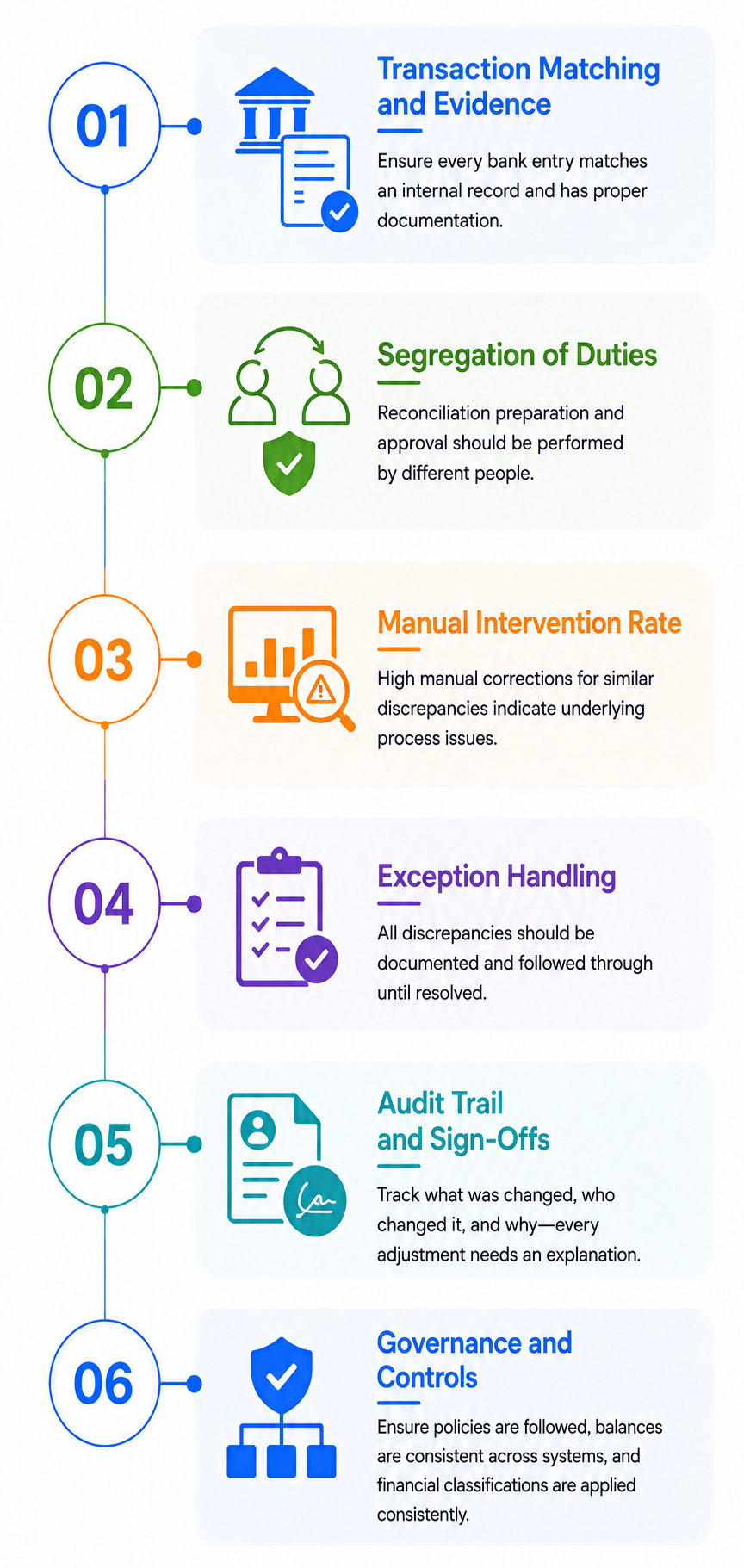
Here are the key components of the audit reconciliation process:
1. Transaction Matching and Evidence
Every bank entry should correspond to an internal record. Auditors also check if each reconciled item has the right documentation to back it.
2. Segregation of Duties
Reconciliation preparation and approval should be handled by different people. Auditors look for this separation as part of their review.
3. Manual Intervention Rate
If the same types of discrepancies keep needing manual corrections, it's worth investigating why they're happening in the first place.
4. Exception Handling
Every discrepancy should be properly documented and followed through until it's resolved.
5. Audit Trail and Sign-Offs
Adjustments should never appear without an explanation. Auditors and reviewers should be able to see what was changed, who changed it, and why the change was necessary.
6. Governance and Controls
Auditors also assess the overall control environment to determine whether:
- Policies are being followed.
- Cash balances are consistently maintained across systems.
- Financial classifications are applied the same way each time.
Step-by-Step Reconciliation Process Audit
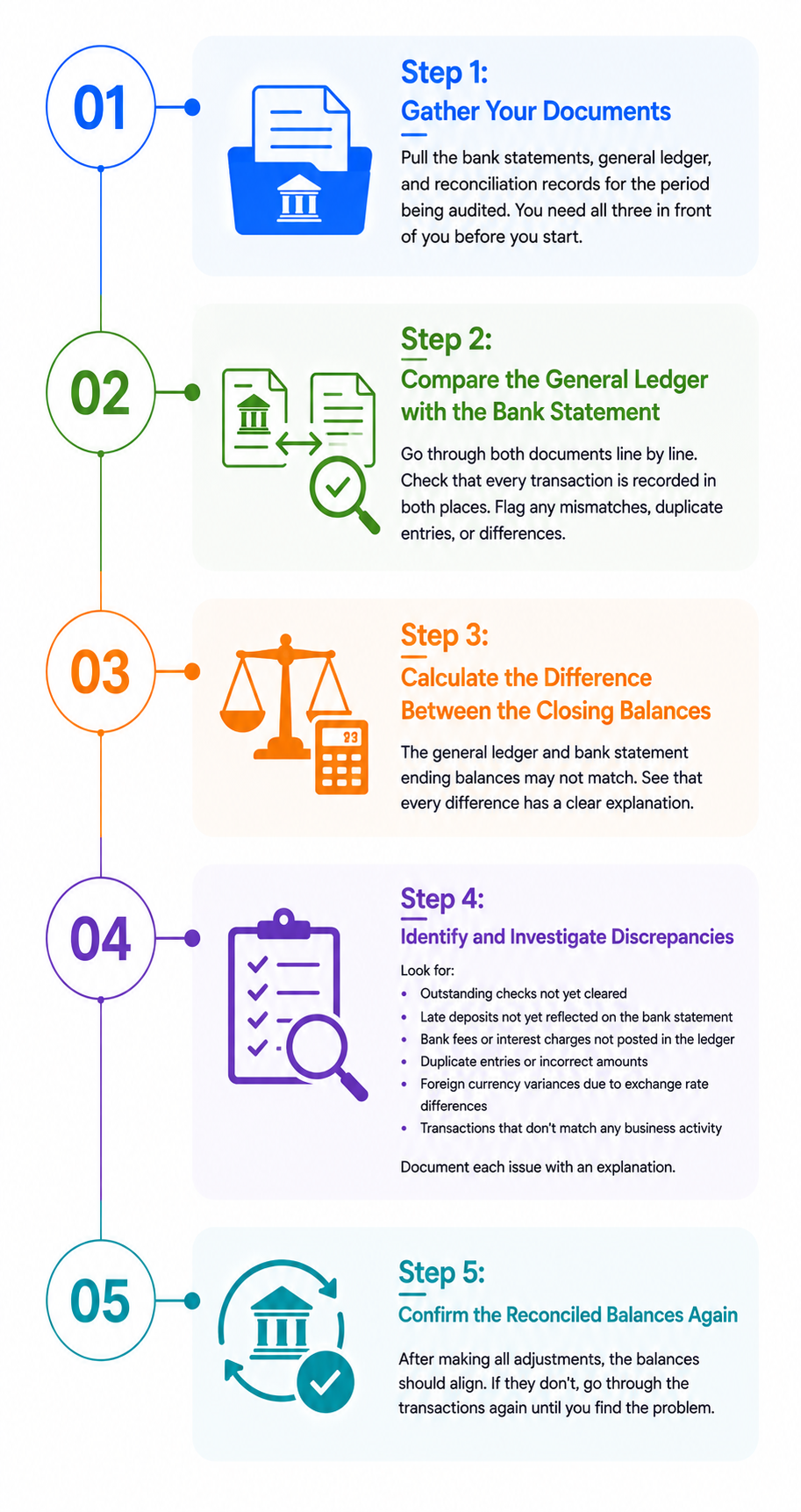
Here’s a step-by-step guide to audit bank reconciliation:
Step 1: Gather Your Documents
The first step is to pull the bank statements, general ledger, and reconciliation records for the period being audited. You need all three in front of you before you start.
Step 2: Compare the General Ledger with the Bank Statement
Go through both these documents line by line. Check that every transaction is recorded in both places. Flag any mismatches, duplicate entries, or differences.
Step 3: Calculate the Difference Between the Closing Balances
Sometimes, the general ledger and bank statement ending balances may not match. That's okay. However, see that every difference has a clear explanation.
Step 4: Identify and Investigate Discrepancies
Look for:
- Outstanding checks that have been issued but haven't cleared yet
- Late deposits not yet reflected on the bank statement
- Bank fees or interest charges that weren't posted in the ledger
- Duplicate entries or incorrect amounts
- Foreign currency variances caused by exchange rate differences between the transaction date and the settlement date
- Transactions that don't match any business activity
Document each issue with an explanation.
Step 5: Confirm the Reconciled Balances Again
After making all adjustments, the balances should align. If they don't, go through the transactions again until you find the problem.
Reconciliation Audit Checklist
Use this bank reconciliation audit checklist before, during, and after your audit:
- Collect all required documents for the audit period - bank statement, general ledger, reconciliation document.
- Compare the final figures on your reconciliation document with the corresponding bank statement. They should match.
- Compare the bank statement and general ledger to ensure every transaction appears in both.
- Calculate the difference between the bank statement ending balance and the general ledger total, and make sure it's reflected properly.
- Match each transaction in the bank statement to a corresponding entry in the general ledger.
- Make a note of transactions that don't match. Document the reason for each one.
- Make sure every difference between the two documents has been identified and explained.
What are Some Common Reconciliation Audit Findings?
Many bank reconciliation audits end up highlighting the same common problems:
- Stale Reconciling Items
These are transactions that have been unresolved for months. They lead to unmatched balances, making every subsequent close harder to manage.
- Missing Approvals
Not every completed reconciliation gets reviewed or signed off. When that step is skipped, it's hard to prove that the figures were properly verified.
- Manual Workarounds
Spreadsheets can work well, but overdependence on them can lead to issues. Each manual step adds another chance for mistakes to be missed.
- Suspense Balances
You may have items parked in suspense or catch-all accounts with no owner and no resolution date. When there's no owner or timeline for resolution, those temporary entries can stick around and affect reporting quality.
Documentation Required for a Reconciliation Audit
You need basic documents like:
- Bank statements for the audit period
- General ledger records
- Canceled checks and deposit slips
- A list of outstanding checks
- Vendor settlement reports and subledger reports
Besides these documents, auditors may require evidence that the reconciliation was performed in line with the required process. This could include:
- Written policies describing the reconciliation process
- Explanations for reconciling items
- Clear sign-offs showing that someone with authority actually reviewed the output
Your working papers should also document the entire review process, including the procedures performed, documents reviewed, and conclusions reached.
Manual vs Automated Reconciliation: Audit Impact
How your reconciliation process is structured can have a big impact on the audit process.
Manual reconciliation often involves spreadsheets, individual judgment, and a significant amount of manual coordination. It comes with an error rate of around 1% to 3%, and audit trails are rarely stored in a single location. That means gathering documentation for an audit can quickly become a challenge.
Automated reconciliation changes that. The system matches most transactions, flags exceptions for human review, and logs every action with a timestamp.
Here's how they impact your audit readiness:
{{banner1.1}}
Tools & Software for Reconciliation Audits
A good reconciliation platform doesn't just speed up the process but also makes the audit significantly easier by building traceability and controls into the workflow from the start.
Osfin is built with exactly this in mind. Here's how it works across the reconciliation lifecycle:
- Data Ingestion
Osfin connects to 170+ data sources and works with data in its native format. It can pull information from banks, ERPs, payment gateways, and other systems without requiring manual formatting. During data ingestion, it applies custom validation rules to identify poor-quality data, while duplicates and outliers are flagged before they can affect the reconciliation process.
- Reconciliation
Matching is logic-based. Osfin also handles complex transaction structures, including one-to-many, many-to-one, and multi-way reconciliations up to five-way. The system processes up to 30 million records in 15 minutes and auto-reconciles payment gateway reports with commission, tax, and fee breakdowns factored in.
- Exception Handling
Unmatched transactions are automatically flagged and tagged with the reason for the exception. It then routes the item to the right team member for resolution. Live dashboards provide real-time visibility into match rates, open exceptions, and overall exposure.
- Output
Osfin records every action with complete transaction history. It secures data with 256-bit encryption, maker-checker flows, role-based access, and two-factor authentication. Osfin also complies with SOC 2, PCI DSS, ISO 27001, and GDPR.
Best Practices for an Audit-Ready Reconciliation Process
Follow these best practices to keep your bank reconciliations audit-ready:
- Reconcile regularly to prevent small discrepancies from piling up.
- Note every adjustment, reconciling item, and sign-off.
- Use a structured checklist to keep the process consistent.
- Keep preparation and approval separate. It's a simple control that's easy to overlook when things get busy.
- If your team is frequently fixing mismatches manually, that's worth looking into.
Wrapping Up
Reconciliation audits aren't something you do once and forget about. They need to be part of your regular process if you want your financial records to stay accurate.
Teams often assume reconciliation problems are caused by individual mistakes. In many cases, the underlying process is the real issue. Osfin can help. Book a demo to learn more.
FAQs
1. What are the 5 steps of bank reconciliation?
The 5 steps of bank reconciliation include:
- Gathering bank statements and general ledger records
- Comparing them line by line
- Calculating the difference between the closing balances
- Flagging and documenting discrepancies
- Confirming that the reconciled balances align
2. What are the common findings of a bank reconciliation audit?
Some common findings are stale reconciling items, missing approvals, and suspense balances.
3. Who conducts a reconciliation audit?
Internal and external auditors conduct the audit. Internal auditors evaluate the reconciliation process and controls. External auditors check financial statements for accuracy and compliance. In smaller businesses, the owner or accountant often manages both.
4. How are automated reconciliations better than manual ones when it comes to audit impact?
Finding supporting documentation is often one of the most time-consuming parts of an audit. With manual reconciliation, the information may be spread across several files and systems. Automated platforms keep that information together from the start.