How to Set Up Segregation of Duties in Reconciliation
Take this common reconciliation scenario. A reconciliation analyst notices a small mismatch every month. Forty dollars here, sixty there. She writes it off and approves her own write-off. An audit, eighteen months later, turns up a fifty-thousand-dollar gap. Not one big theft. Dozens of small ones, each approved by the person who created them.
That's what happens when segregation of duties in reconciliation breaks down.
SoD means splitting financial responsibilities so no one person controls a transaction start to finish. One records it. Another reviews it. A third approves it. Simple in theory, but quite easy to skip on lean teams, where one person quietly ends up wearing three hats.
That gap is where fraud originates. For financial institutions, weak SoD around reconciliation, where CBS data meets data from other third-party sources, is one of the most commonly flagged SOX weaknesses there is.
This piece covers what SoD looks like in reconciliation and how to set it up right, whatever size team you're working with.
Key notes:
- Segregation of duties is the actual fraud check. When one person prepares, reviews, and approves the same reconciliation, there's no second pair of eyes anywhere in the chain.
- Seven roles need to stay separate: preparer, reviewer, approver, record keeper, exception handler, and bank access. Overlap any two of these, and you've created exactly the kind of gap auditors flag as a material weakness.
- Large teams can split duties across four people. Small teams might only manage two with compensating controls filling the gap. Either way, comparison and review has to sit apart from whoever prepares or records.
- Role definitions only work if access controls, approval workflows, and maker-checker flows are actually built into the platform.
Why Segregation of Duties Matters
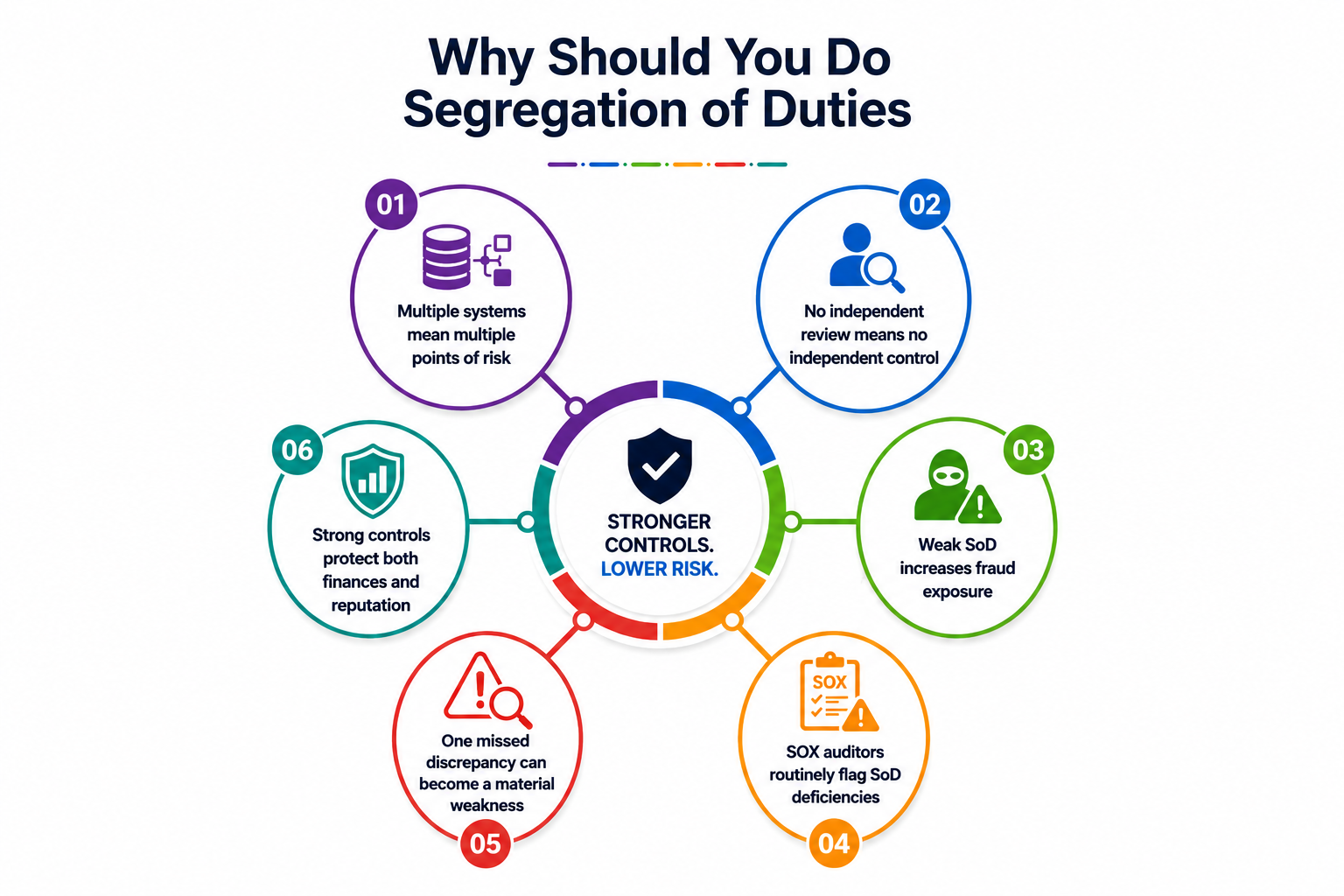
Reconciliation sits at a strange intersection. It's the process meant to catch mistakes, yet it's also one of the easiest places to bury them if the wrong person controls every step. A reconciliation system that pulls data from your CBS and other third-party sources like payment processors, networks, and switches has dozens of touchpoints. Each one is a place where money, or evidence of money, changes hands between systems. If a single person can match a transaction, dismiss a discrepancy, and sign off on the adjustment, that touchpoint becomes a blind spot.
Lack of segregation of duties in reconciliation is one of the most commonly cited weaknesses in SOX 404 assessments, especially where money settles between internal ledgers and external systems. Banks have long relied on maker-checker controls for exactly this reason. One person initiates the transaction. Another verifies it. Nothing moves without both.
What Roles and Access Rights Need Separation?
A reconciliation queue is backed up before month-end close, so the analyst who matched the transactions also clears the exception report, just this once. Nobody flags it. The deadline gets met. And just like that, the same person who found the discrepancy is now the one who decided it wasn't a problem.
That's how roles blur in practice, quietly, under deadline pressure, with good intentions. The fix is naming each function precisely enough that even when things get busy, no one can absorb two jobs without someone noticing.
1. Preparer
The preparer pulls data from your CBS and matches it against payment processors, gateways, networks, and switches. They run the first pass, flag what lines up, and surface what doesn't. This person touches the raw data more than anyone else in the process. That's exactly why they shouldn't be the ones signing off on it later.
2. Reviewer
The reviewer checks the preparer's work before it goes anywhere near approval. They validate the matches, dig into the explanations behind flagged discrepancies, and confirm the supporting documentation actually backs up what's been claimed. If the preparer missed something, this is where it gets caught.
3. Approver
The approver gives the final sign-off. By the time something reaches them, it's already been prepared and reviewed by two separate people. Their job isn't to redo the work. It's to confirm the reconciliation meets your control standards before it's treated as final.
4. Record Keeper
This is the person posting transactions to the general ledger. They shouldn't be the ones reconciling against it. If the same person records a transaction and later checks whether it reconciles, they're effectively grading their own homework. Keep this separate, always.
5. Exception Handler
Every reconciliation throws up breaks. Unmatched transactions, timing differences, and amounts that don't quite line up between your CBS and a payment gateway. The exception handler investigates these. But they shouldn't have approval authority over their own findings. Otherwise, someone could create a discrepancy and clear it themselves, with no one else the wiser.
6. Bank Access
Access to initiate transfers or view live bank-side data is its own category entirely. Someone with the power to move money shouldn't also control how that money gets reconciled. That combination is precisely what maker-checker controls exist to prevent.
Setting Up Segregation of Duties in Reconciliation
Here’s how you can go about setting up segregation of duties in your reconciliation workflow:
1. Map the Reconciliation Process
Start by laying out every step your reconciliation actually goes through, from the moment data lands from your CBS or a payment gateway to the moment a discrepancy gets closed. You can't separate duties properly until you know exactly where each handoff happens, and where they currently don't.
2. Define Roles and Responsibilities
With the process mapped, assign each step to a role, not a person. Preparer, reviewer, approver, record keeper, exception handler. Write down what each role can see, what it can touch, and what it's allowed to sign off on. This becomes your reference point later, when someone asks why a particular access request got denied.
3. Separate Critical Activities
Now look for the combinations that shouldn't exist. Anyone who can record a transaction and also reconcile it. Anyone who can clear an exception and approve their own finding. Anyone with both bank access and GL write access. Flag every one of these overlaps and decide, deliberately, who keeps which half.
4. Implement Role-Based Access Controls
Policy on paper only works if your system enforces it. Configure access so each role can only do what its definition allows, nothing more. A preparer shouldn't have the technical ability to approve, even if they'd never try. Removing the option removes the temptation, and it removes the audit finding too.
5. Approve Workflows
Build the maker-checker chain directly into the system. A reconciliation shouldn't move from prepared to closed without passing through review and approval, in that order, by different people, every time. No exceptions for busy weeks. The moment you allow a workaround, you've reopened the exact gap this whole setup was meant to close.
6. Monitor Compliance
Setting this up once isn't enough. Roles drift as teams change, people leave, and new hires get provisioned in a hurry. Run periodic access reviews, quarterly for anything touching live bank data, and check that the controls on paper still match what's actually happening in the system. If they don't, that's your signal to fix it before an auditor finds it first.
Risks of Poor Segregation of Duties
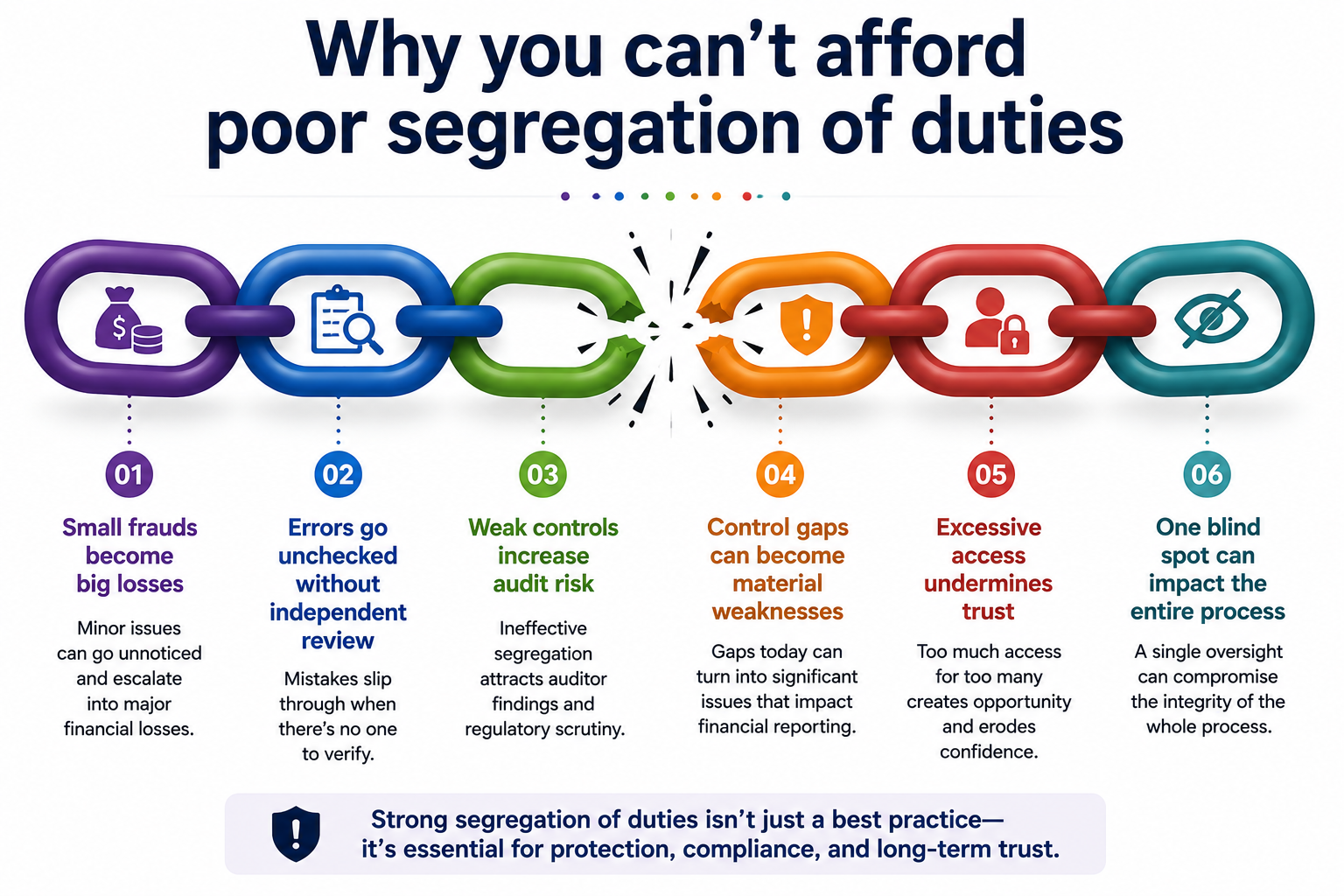
The most obvious risk is fraud, and it's rarely dramatic. It looks like a small, repeated diversion that nobody catches because the person diverting funds is also the person checking whether the books balance. They adjust the entry, clear their own exception, and move on.
Errors carry a quieter version of the same risk. Without a reviewer checking the preparer's work, a mismatched transaction or a wrong GL code doesn't get caught at the source. It just sits there, compounding, until it shows up somewhere much harder to trace, a quarter-end variance, a customer dispute, a regulator's question.
Then there's the audit exposure. Weak SoD is one of the most commonly flagged issues in SOX 404 assessments, and auditors don't treat it lightly. A control gap around how money settles between your CBS and external payment systems can get classified as a material weakness. That triggers disclosure requirements, drives up audit costs, and puts every other control on the books under closer scrutiny.
For financial institutions specifically, there's a layer beyond the balance sheet. Customers and partners trust that reconciliation systems are watching their money carefully. A breach or a misstatement traced back to one person controlling too much of the process doesn't just cost money to fix. It costs the confidence that took years to build, and that's much harder to reconcile.
{{banner1}}
Common SOD Challenges and Solutions
Setting up and keeping your SOD structure intact once the team is short-staffed, the systems multiply, and the deadline doesn't move is where most setups actually break.
1. Challenge: Limited Headcount
Small finance teams often genuinely don't have enough people to fill every role separately. Pushing for a textbook four-way split on a two-person team isn't realistic, and forcing it usually just creates a control that exists on paper but not in practice.
Solution: Lean on compensating controls instead of fighting the headcount. Keep authorization separate from record-keeping at a minimum, that's the one line that shouldn't move. Bring in someone outside daily operations, a manager, or a board member, to review periodically.
2. Challenge: System Access Doesn't Match Role Definitions
A reconciliation platform gets configured once, roles get assigned, and then six months later, someone's promoted, their old access never gets revoked, and now they can both prepare and approve without anyone noticing.
Solution: Tie access directly to role, not to person or tenure. Run access reviews on a fixed schedule, quarterly for anything touching live bank or GL access, and treat every access change as something that needs re-validation, not something that carries over by default.
3. Challenge: Multiple Systems, Inconsistent Controls
A reconciliation process pulling from a CBS, a payment gateway, a switch, and a card network often has SoD enforced differently in each one, or not enforced at all in some. Someone might be locked out of approving in the CBS but have full access in a connected payment system nobody thought to check.
Solution: Map SoD controls across every connected system, not just the primary ledger. If your data reconciliation platform centralizes data from all of them, push the access controls to live at that central layer too, so role enforcement doesn't depend on each upstream system getting it right independently.
4. Challenge: Pushback from the Team
Tightening SoD often reads as distrust to the people it affects. "You think I'd steal from the company?" is a real reaction, and it can stall implementation longer than any technical hurdle.
Solution: Frame it as protection, not suspicion. A clean separation of duties protects the employee too, it removes them from suspicion automatically if something ever does go wrong, since they were never in a position to act alone. Bringing in an outside voice, an auditor or a new policy from leadership, also helps separate the control from any one person's judgment.
{{banner1.1}}
Best Practices for Maintaining Segregation of Duties in Reconciliation
A segregation of duties framework is a lot like reconciliation itself. It isn't something you set up and forget. It only works when it's reviewed, tested, and continuously reinforced.
- Tie every access change to a role review: When someone changes teams or gets promoted, their old reconciliation access shouldn't carry over by default. Build the offboarding step into the same workflow as the role change itself, so it can't get skipped under deadline pressure.
- Run scheduled access audits: Quarterly for anything touching live bank data or GL write access, less frequently for lower-risk systems. Waiting for an annual audit to catch drift means a gap could sit open for the better part of a year before anyone notices.
- Rotate duties periodically, where the role allows it: Someone holding the same reconciliation role for years, with no one else ever stepping into it, becomes a single point of failure even with perfect role definitions. Rotation forces a fresh set of eyes through the process on a regular basis.
- Push enforcement into the system: A written rule that the preparer can't approve their own work means little if the platform technically lets them. Configure the access controls so the system makes the violation impossible, not just discouraged.
- Revisit the structure after every change: A reorganization, a new hire, a departure, each of these is a trigger to re-check whether the original role split still makes sense, not just a scheduled quarterly box to tick.
The Bottom Line
Everything covered here, mapping the process, defining roles, locking down access, building approval chains, monitoring for drift, is real work. It doesn't happen once and stay fixed. Teams change, systems multiply, and the structure needs constant upkeep to hold.
This is exactly the layer a reconciliation platform should be built to carry. Take ingestion. Osfin applies custom deviation tolerances and flags duplicates or outliers the moment data comes in, before a poor-quality record ever reaches a person to misjudge. That alone closes a gap most manual processes never catch until much later.
The matching engine handles two-way, three-way, even five-way reconciliations, logic-based, without needing a human to manually cross-check each leg. When something doesn't match, the platform doesn't leave that exception sitting with whoever happens to be free. It assigns a reason automatically and routes it to the right team member through a dedicated ticketing engine. The person who flagged the discrepancy isn't the one quietly clearing it.
On the output side, the controls like maker-checker flows, role-based access, and 2FA come built in with a complete, audit-ready trail behind every transaction. Osfin also holds SOC 2, PCI DSS, ISO 27001, and GDPR compliance, the kind of groundwork that makes an auditor's job much easier.
{{banner2}}
FAQs
1. Can small teams implement segregation of duties effectively?
Yes. Even with limited headcount, organizations can use compensating controls such as independent management reviews, maker-checker workflows, and periodic access audits. The goal is to ensure critical activities are reviewed by someone other than the preparer.
2. What happens when segregation of duties is weak?
Weak segregation of duties can allow fraud to go undetected, errors to accumulate, and unauthorized activities to occur without oversight. It can also lead to audit findings, regulatory scrutiny, and material weaknesses in internal controls.
3. Which roles should remain separate in the reconciliation process?
Key responsibilities that should remain separate include preparation, review, approval, record keeping, exception handling, and access to banking or general ledger systems. Separating these functions creates independent validation points throughout the reconciliation lifecycle.
4. How do auditors evaluate segregation of duties controls?
Auditors typically review role assignments, system permissions, approval workflows, and access logs. They assess whether any individual can initiate, modify, approve, and record transactions without independent oversight or compensating controls.