Best Data Reconciliation Platforms & Tools in 2026 (Top 10 Compared)
TL;DR
- Today, most modern organizations run on data. It helps them identify trends, uncover patterns, make informed decisions, and stay compliant with regulations.
- However, data typically comes from multiple systems and sources. This means you need to reconcile it to flag and fix errors.
- Manual processes can be time-consuming and prone to errors. This is where a data reconciliation platform comes in.
- Some of the top data reconciliation platforms in 2026 include Osfin, FloQast, Blackline, Trintech Cadency, Numeric, and SkyStem ART.
What is a Data Reconciliation Platform?
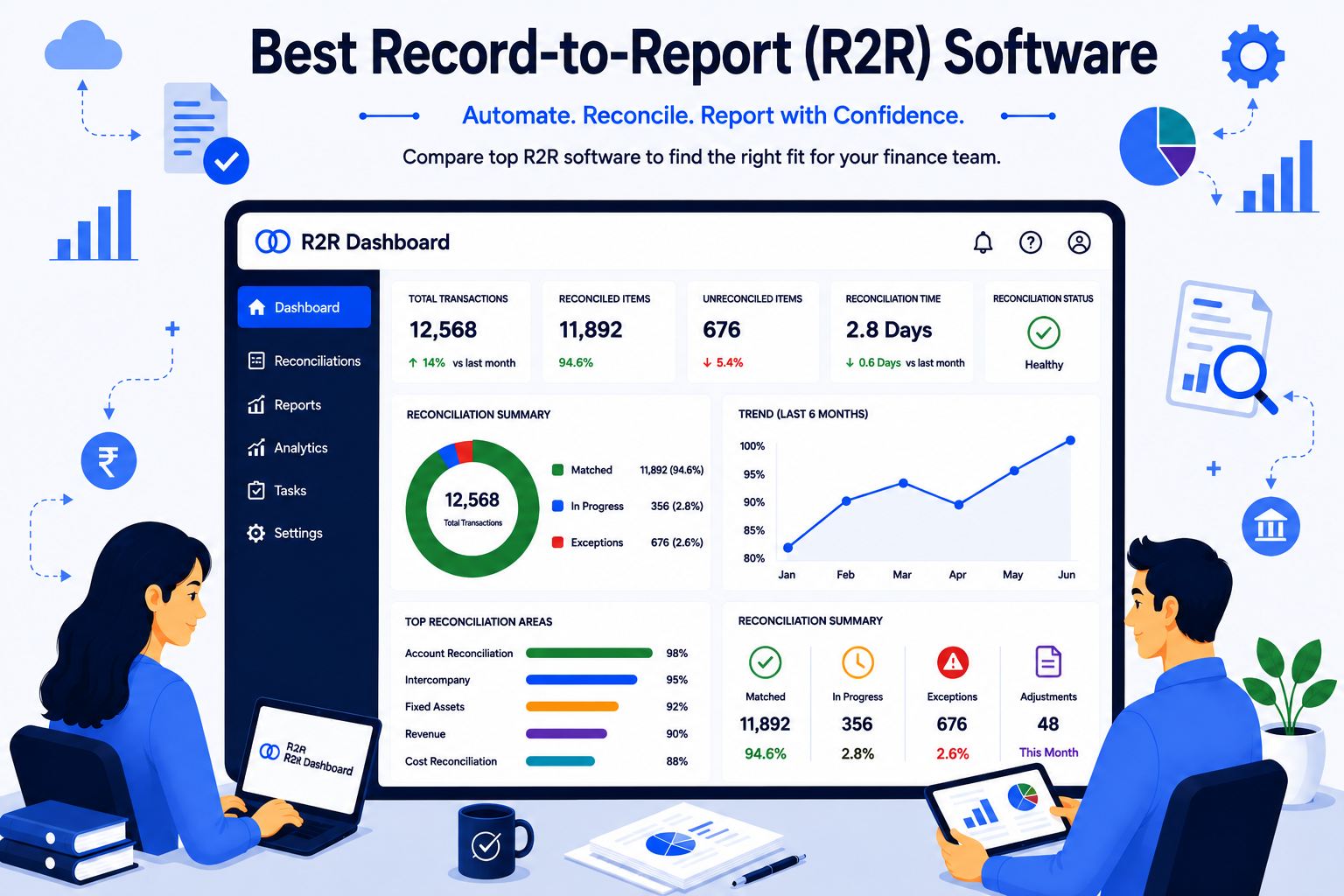
Most finance teams deal with data coming in from multiple systems that don't always agree with each other. A data reconciliation platform helps you sort that out. It compares records across your systems automatically, spots the mismatches, and keeps everything consistent without your team having to comb through it manually. It handles:
- Extracting data from multiple sources and standardizing it.
- Logically matching records across various data sets.
- Flagging discrepancies and outliers for review.
- Generating reports on the reconciled data for compliance and audits.
How We Evaluated the Best Data Reconciliation Platforms and Tools?
Accurate data reconciliation is key to keeping your financial records reliable. This is why the right tool should go beyond just great features. It should also connect seamlessly with your current systems. To find the best platforms, we looked at each one through these questions:
- Can it reduce your manual workload?
- Can it handle data inconsistencies and exceptions?
- Can it integrate well with your existing systems?
Platforms that ticked these boxes made it to our top 10 list.
What are the Key Features to Look for in a Data Reconciliation Platform?
Finance teams deal with large volumes of data every day. A small mistake on their end can lead to hefty penalties and lost trust for the business. To avoid that, go for a data reconciliation platform with features like:
- Support for multiple formats: Since businesses get data in all kinds of formats from different sources, your data reconciliation platform should be able to capture and scan those records.
- Automated reconciliation: Manually matching and reconciling data is error-prone and time-consuming. Look for a platform that automates this process with algorithm-based matching.
- Easy exception handling: It should handle recurring, straightforward discrepancies while directing the complex ones to the team for appropriate action.
- Seamless integration: A data reconciliation platform is only beneficial if it can easily integrate within your business. It should smoothly connect with different ERPs for better data management.
What are the Benefits of Using a Data Reconciliation Platform?
Beyond the human cost, repeated manual entry and matching drives up operational costs and pulls your team away from work that actually moves the business forward. A data reconciliation platform solves this problem. Here's how:
- Accurately capturing data
Data comes in from ERPs, payment processors, bank records, and more, all in different formats. A reconciliation tool pulls it all together and standardizes it into a consistent format.
- Eliminating errors
Manual data reconciliation is a tedious and repetitive task. Missed entries and miscategorized transactions are common errors, but they carry serious financial and legal consequences. Automating the reconciliation process greatly reduces the number of these errors.
- Creating reports
The data automation tool not only reconciles data but also generates comprehensive reports that provide valuable insights, helping businesses make informed decisions.
Comparison table- Data Reconciliation Platform
Top 10 Best Data Reconciliation Platforms for 2026
The top 10 data reconciliation platforms for 2026 include Osfin, FloQast, Blackline, Trintech Cadency, Numeric, Finserv Frontier Reconciliation, Prophix, ReconArt, Solvexia, and SkyStem ART.
1. Osfin
Osfin is a data reconciliation platform that automates and reconciles data for fintech firms, banks, and e-commerce seeking help with large-scale data processing. It is file-format agnostic, supports multi-way reconciliations, and comes with robust security measures.
Key features:
- Data ingestion: Osfin is a file format-agnostic platform with 170+ integrations that can import data in multiple formats from various sources. It standardizes data and applies custom deviations to filter out poor-quality data before reconciliation starts.
- Reconciliation process: The platform compares records using predefined rules. It supports two-way, three-way, and four-way reconciliation and can match one-to-many and many-to-one transactions.
- Exception handling: Osfin’s data reconciliation platform automatically flags anomalies and provides live dashboards that show match status, exposure, and exception queues. It routes these outliers to the appropriate team member with accurate reasons.
- Output: It maintains audit-ready workflows with complete traceability and delivers a compliance report. Its dashboards provide comprehensive, actionable insights into financial data to improve operational efficiency.
- Security: Osfin protects data with 256-bit encryption, role-based access, maker-checker controls, and two-factor authentication. It also meets compliance standards such as SOC 2, PCI DSS, GDPR, and ISO 27001.
{{banner1.1}}
2. FloQast
FloQast is an automation platform for accounting operations. It leverages AI to reconcile data and helps you be audit-ready. It can integrate well with major accounting systems.
Key features:
- Automated reconciliation with the help of AI
- Securely stores data and maintains audit trails
- Simple and user-friendly to navigate
3. Blackline
Blackline is a cloud-based financial operations management platform designed for medium to large enterprises. It gives visibility into data and improves reconciliation accuracy with real-time access and configurable controls.
Key features:
- Automates journal entries and transaction matching
- Handles global, multi-currency environments
- Connects with major ERPs like SAP, Oracle, and NetSuite
4. Trintech Cadency
Cadency is a financial close platform from Trintech with extensive data management capabilities. It integrates account reconciliation, journal entry, and reporting in a single platform.
Key features:
- It uses intelligent rules to match a high volume of transactions
- Automates tasks like data entry, validation and standardization
- Provides a single, clear and audit-compliant dashboard
5. Numeric
Numeric is an AI-driven platform for automating the financial close process. It is designed to accelerate month-end, bank, and intercompany reconciliations.
Key features:
- Eliminates manual data export by connecting with various ERPs
- Uses AI for one-to-one, one-to-many and many-to-one reconciliations
- Alerts users about anomalies and discrepancies
6. Fiserv Frontier Reconciliation
Fiserv Frontier is a reconciliation solution for banks and financial institutions. It helps you manage extremely high transaction volumes and complex data across multiple channels.
Key features:
- Advanced transaction-matching capabilities
- Can handle millions of transactions daily
- Built-in compliance and reporting functionalities
7. Prophix
Prophix is a financial performance management platform that helps finance teams move away from manual spreadsheet work. It automates many financial processes and brings reconciliation tasks into one central system.
Key features:
- Brings data from different sources into one location
- Gives time-stamped audit logs
- Consistent and intuitive user interface
8. ReconArt
ReconArt is a reconciliation platform for mid-sized and large companies. It helps you automate reconciliation workflows, monitor discrepancies, and maintain better control over financial data.
Key features:
- Automated transaction matching.
- Supports custom reconciliation and certification workflows
- Provides detailed reporting and variance analysis
9. Solvexia
Solvexia is a financial automation platform for finance and accounting teams. It automates spreadsheet-based, manual, and data-intensive processes.
Key features:
- Automates dataset comparison, reducing human errors
- Ensures data integrity for financial reporting
- Quickly locates and resolves data discrepancy
10. SkyStem ART
SkyStem ART is a cloud-based platform that automates account reconciliation and financial close activities. It helps you manage large volumes of transactions without relying on manual spreadsheets.
Key features:
- AI-assisted transaction matching capabilities
- Built-in variance analysis
- Maintains detailed audit trails
How Osfin Handles Data Reconciliation
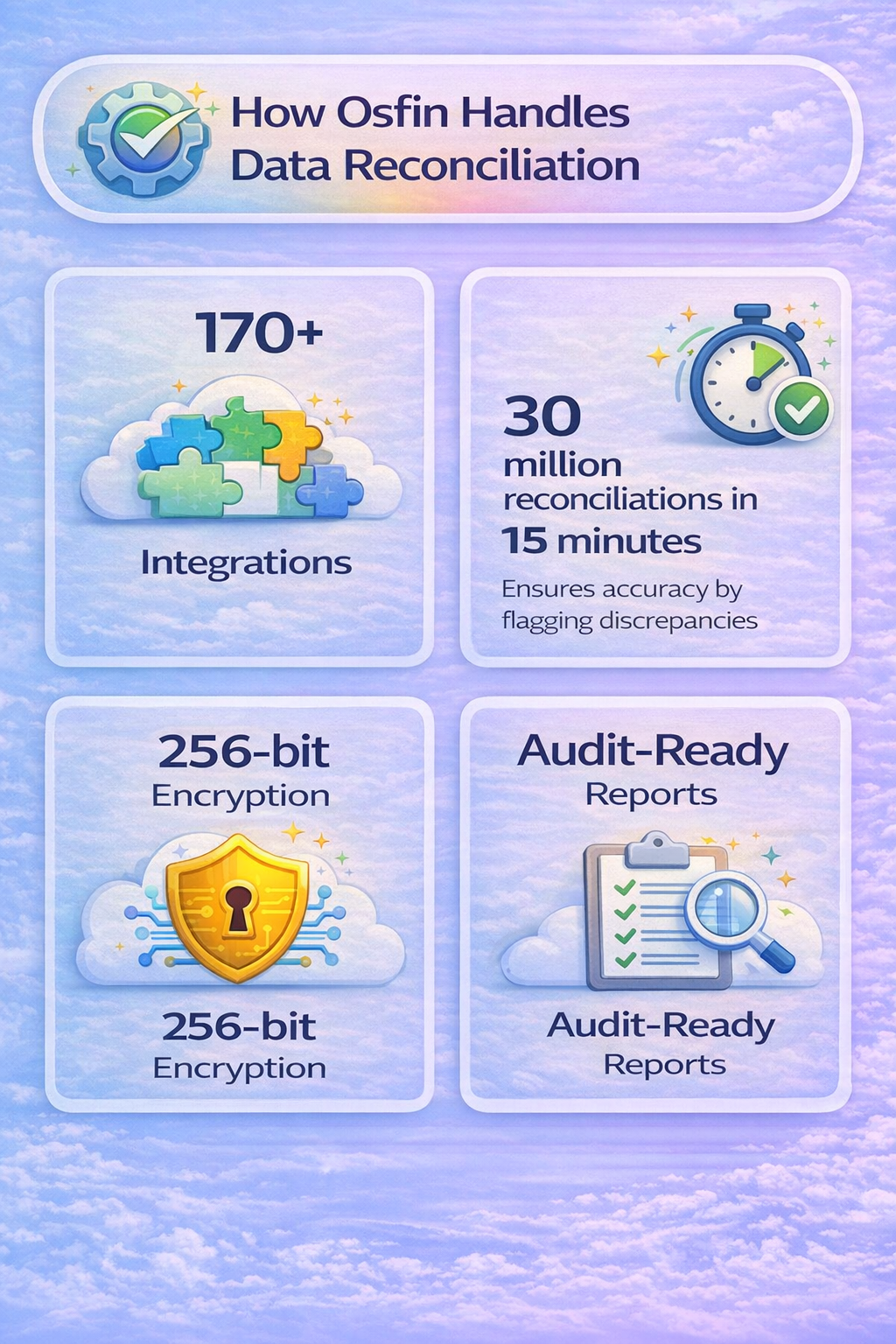
Osfin automates large-scale data reconciliation for fintechs, banks, and enterprises. It can:
- Ingest data from multiple sources using 170+ integrations and varying formats like CSV, XML, PDF, etc. It also standardizes data while removing poor-quality records before reconciliation starts.
- Perform 30 million reconciliations in 15 minutes.
- Support logic-based, one-to-many, many-to-one, and multi-way reconciliations, such as 2-way,3-way,4-way and 5-way.
- Automatically flag unmatched data and route it to the correct person with its exception-handling engine.
- Secure data with 256-bit encryption, two-factor authentication, and maker-checker controls.
- Comply with regulations such as SOC 2, PCI DSS, ISO 27001, and GDPR to keep your business compliant.
- Keep track of all transactions and activity logs for audit-ready workflows and reporting.
How to Choose the Right Data Reconciliation Platform
There are dozens of reconciliation platforms in the market. However, when it comes to selecting the best one, there’s no one-size-fits-all formula. Choosing which platform is worth investing in requires you to carefully consider factors like:
- Supported formats: The data reconciliation tool should be able to work with the data formats your business deals with.
- Flexible reconciliation rules: It should be equipped to perform reconciliation in accordance with the set rules and adapt as needed.
- Exception management: It should automatically resolve discrepancies and flag outliers for a team member to handle.
- Data visibility: It should provide clear, detailed insights into the data and its transaction history.
- Scalability: It should easily handle high volumes of data as your business scales.
{{banner1}}
Trends in Data Reconciliation Platforms for 2026
Data reconciliation tools are changing as businesses deal with larger datasets, multiple systems, and the need for faster financial reporting. To keep up, modern platforms are now moving towards automation, continuous monitoring, and stronger data controls.
- Integration of AI and ML: Data reconciliation platforms are adopting AI and ML technologies to learn from past patterns and apply rules automatically.
- Real-time, continuous reconciliations: Instead of performing month-end data reconciliations, newer platforms perform them daily, enabling real-time handling of discrepancies.
- Stronger data governance: Modern data reconciliation platforms are adding stronger security measures and access controls to protect sensitive data.
Conclusion
Accurate data reconciliation is essential for identifying problems early and ensuring all information is reliable. As transaction volumes grow and businesses rely on multiple systems, manual reconciliation processes often become difficult to manage. They are also prone to errors.
Modern data reconciliation platforms fix that. They handle ingestion, matching, and exception management automatically. Tools like Osfin take it further with 170+ integrations, multi-way reconciliation, and automated exception handling, so your team can stay on top of high volumes.
Book your free trial to see how Osfin can streamline your reconciliation process!
FAQs
1. What is data reconciliation platform?
A data reconciliation platform is a tool that automates the processing of data from different sources and matches it with internal data to find discrepancies and gain insight into business trends.
2. How can the data reconciliation tool help me?
It reduces the need to check data manually. The platform automatically compares records, which saves time and lowers the chances of mistakes.
3. How do I choose the best data reconciliation platform for my business?
You should assess your business needs and select a platform that can easily ingest data in various formats. It should be quick in reconciliation and handle high volumes of data.
4. Which data reconciliation platform is best?
Osfin is the best data reconciliation platform as it can ingest data from different formats like XML, PDF, CSV, etc. It performs multi-way matching and can reconcile 30 million transactions in under 15 minutes.