What Is Lease Reconciliation?
Leasing assets is a common practice among businesses. It can range from small equipment used in manufacturing to whole office space for work. Lease expenses often remained off the books, but now accounting standards like IFRS 16 and ASC 842 require them to be recorded in the balance sheet for better transparency into businesses’ financial position.
With this change, lease reconciliation becomes necessary to keep financial records accurate and avoid errors that could pose compliance issues. Let’s explore that with this article.
What Is Lease Reconciliation?
Lease reconciliation is a process that verifies that different components of lease accounting records, including payment schedules, interest and depreciation expenses, lease liabilities, etc, align with the terms of the lease contract and match the business’s general ledger.
It ensures that every payment and adjustment is correctly recorded, so that the company’s lease obligations are accurately reflected in its financial statements.
What Are the Components of Lease Reconciliation?
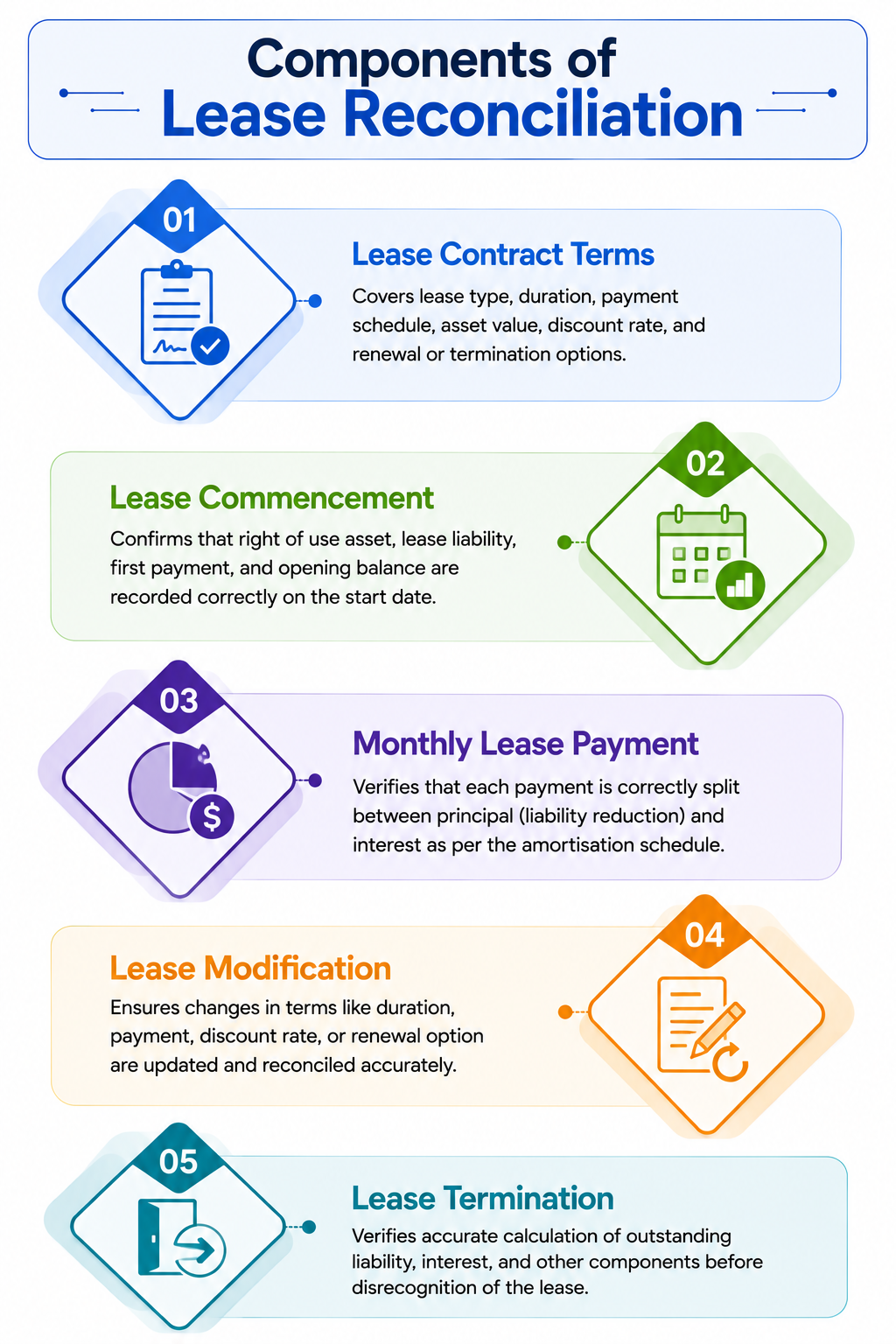
Financing lease differs from an operating lease based on factors such as ownership transfer, bargain purchase, etc. However, in lease reconciliation, the following components will be commonly considered for both types.
1. Lease Contract Terms
The type of lease, duration, payment schedule, asset value, discount rate, and renewal or termination options are all clarified in the lease contract terms.
2. Lease Commencement
Lease commences on the day when the right of use asset and the lease liability are recorded on the balance sheet. Along with this, the first payment against leased assets and the remaining liability are also recorded. Reconciliation confirms that this transaction was calculated and recorded correctly.
3. Monthly Lease Payment
In each monthly lease payment, a portion goes towards the reduction of lease liability and the other towards interest expense. Reconciliation verifies that this split was correctly calculated as per the amortisation schedule and interest rate.
4. Lease Modification
A change in lease terms, whether in lease duration, payment amount, discount rate or renewal option, requires updating current records of lease liability and right of use asset and reconciling them with the modified terms.
5. Lease Termination
When a lease is terminated in the middle of the tenure, all the components of the lease account, including interest expenses, outstanding liability, etc must be calculated accurately before the disrecognition of the account.
{{banner1}}
Why Is Lease Reconciliation Important?
Since IFRS 16 came into effect, businesses have been required to record their lease liabilities in their balance sheets. With this change, it becomes natural for them to take measures to ensure that every entry in the lease account balance matches the terms of the lease contract. This is what reconciliation is meant for. It mainly serves the following purposes
1. Ensure accuracy and consistency of lease-related data across contract terms, general data and financial records.
2. Detect and resolve calculation errors, mismatches, duplicates and other anomalies.
3. Keep lease account data compliant with accounting and financial reporting requirements.
What Are the Steps in the Lease Reconciliation Process?
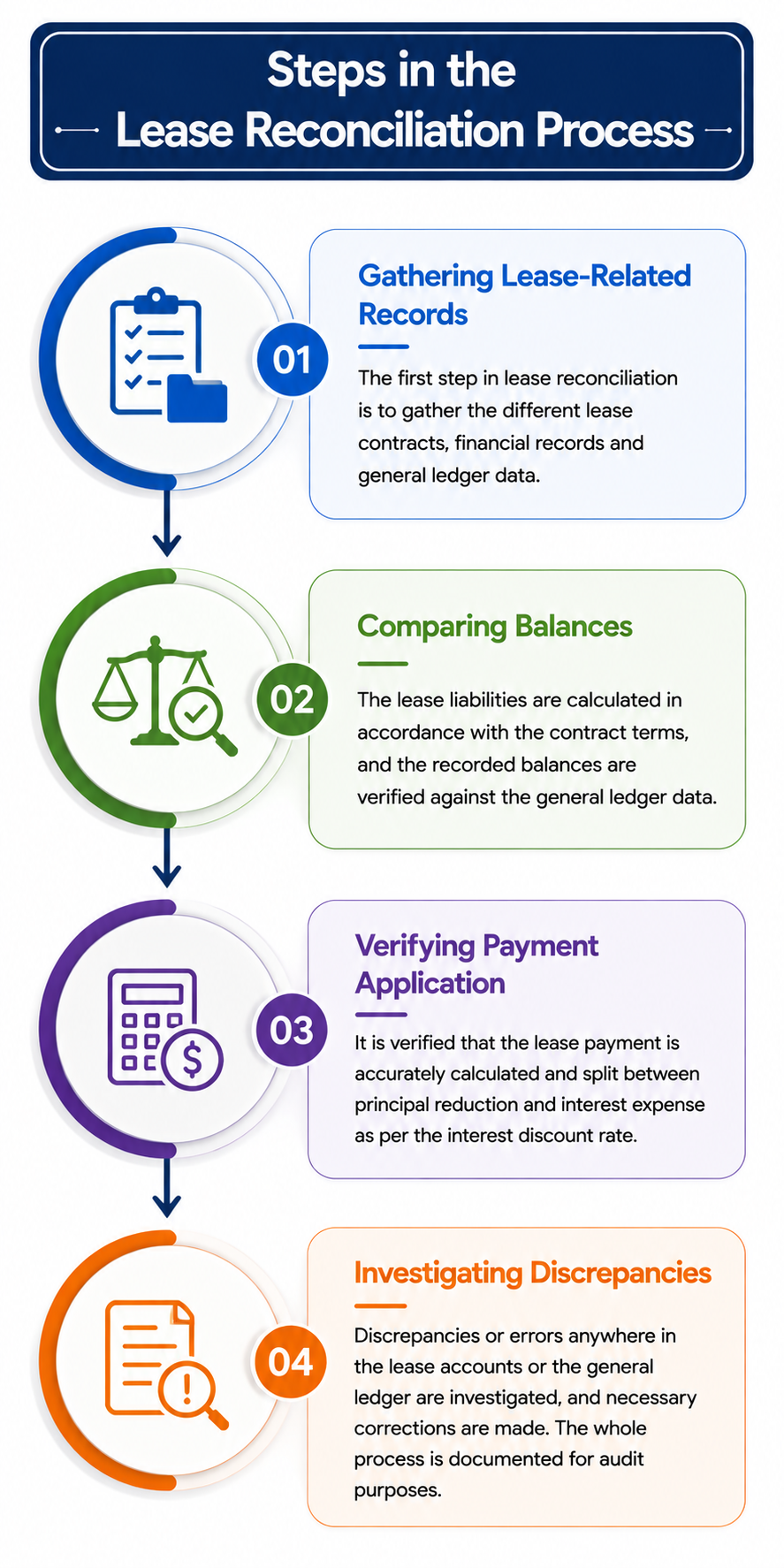
A typical lease reconciliation process consists of the following steps.
1. Gathering Lease-Related Records
The first step in lease reconciliation is to gather the different lease contracts, financial records and general ledger data.
2. Comparing Balances
The lease liabilities are calculated in accordance with the contract terms, and the recorded balances are verified against the general ledger data.
3. Verifying Payment Application
It is verified that the lease payment is accurately calculated and split between principal reduction and interest expense as per the interest discount rate.
4. Investigating Discrepancies
Discrepancies or errors anywhere in the lease accounts or the general ledger are investigated, and necessary corrections are made. The whole process is documented for audit purposes.
Manual Vs Automated Lease Reconciliation
Whether you are a small business or a large enterprise, there’ll be many things that you’ll take on a lease rather than outright purchase. It can be office space, production machinery, delivery vehicles, etc. Each with a different lease agreement, payment schedule and discount rates.
When the month-end comes, the accounts team is under significant pressure to finalise various financial records. However, with the IFRS 16 coming into effect, lease accounting and reconciliation have further increased this pressure. While manual lease reconciliation may seem to work, it is still prone to high amounts of errors during data entry and analysis, and might even delay the closing process with high transaction volumes.
Automated lease reconciliation, on the other hand, helps reduce account team workload by automatically pulling data from lease agreements, general ledgers, payment history, etc, cross-referencing each other's entries and verifying their accuracy. All of this is done in minutes using logic-based matching rules, thus enhancing speed and reducing errors in the lease reconciliation process.
{{banner1.1}}
What Are the Common Issues of Lease Reconciliation?
1. Lease Accounting Complexity
Accounting standards like IFRS 16 and ASC 842 have mandated organisations to recognise leases on balance sheets and provide a transparent picture of a company's financial position. Errors in recording lease liability or splitting payments according to the amortisation schedule can cause issues during reconciliation.
2. System Integration Challenges
Lease data is often separated across different spreadsheets, ERPs and general ledgers. This increases the risk of mismatched entries as account teams have to manually gather data and reconcile it line by line.
3. Lease Modification Handling
Modifications in lease agreements, such as discount rates, renewal or change in payment amounts, require careful remeasurement of the lease liability and right-of-use asset. Being a calculation-intensive process, it can have a significantly high error rate.
How Osfin Automates Lease Reconciliation
Osfin serves businesses across banking, insurance, and more, helping them streamline their financial operations with advanced automation solutions. Its key features include the following.
1. Data Ingestion
Osfin has 170+ connectors that enable it to integrate with various ERPs, accounting systems, general ledger, etc to ingest lease reconciliation data regardless of format. Its custom deviation-tolerance filters out duplicate entries and anomalies at the ingestion stage to avoid downstream issues.
2. Reconciliation
Next, it applies logic-based matching rules that handle one-to-many, many-to-one and multi-way reconciliation, including 2-way, 3-way, 4-way and 5-way.
3. Exception Handling
Unmatched entries are automatically flagged by Osfin’s ticketing and exception-handling engine. They are assigned the correct reasons before being escalated and routed to the appropriate team member for review.
4. Output
Once reconciliation is completed, a compliance report is delivered along with the full transaction history. Osfin keeps your data secure with role-based access, two-factor authentication and 256-bit encryption. It has SOC 2, PCI DSS, GDPR and ISO 27001 certifications, which further support this promise.
Best Practices for Lease Reconciliation
As a comparatively new accounting requirement, lease reconciliation can be challenging for accounts. However, the following best practices can help them enhance lease reconciliation.
1. Reconcile lease accounts frequently so that calculation errors or other mismatched entries can be quickly identified and corrected.
2. Keep your lease term contract, balance sheet, payment history and general ledger data in a centralised repository for easier access during the reconciliation period.
3. Use automation platforms like Osfin that streamline lease reconciliation with automated data ingestion, logic-based matching and audit-ready workflows.
Final Thoughts
Lease reconciliation has become far more demanding since accounting standards demanded that finance be recognised in the balance sheet. Now, accounts teams have to carefully track and calculate every payment, interest expenses, modification and termination to keep financial statements accurate and compliant.
Osfin’s intelligent automation solution eliminates manual reconciliation, speeds up data ingestion and provides real-time cash flow visibility with intuitive dashboards. The platform can reconcile 30 million transactions in 15 minutes with 100% accuracy. Book a demo now and let Osfin streamline your lease reconciliation.
FAQs
1. Why do lease liabilities need to be recognised in balance sheets?
Accounting standards, such as IFRS 16 and ASC 842, have required businesses to recognise lease liabilities on their balance sheets to improve transparency in their financial operations.
2. What is the importance of lease reconciliation?
Since lease accounting has become mandatory, businesses must take measures to keep their lease records accurate. Lease reconciliation is a method that cross-references lease records, ensures their consistency across systems and enables businesses to identify and resolve calculation mistakes, thus helping them stay compliant with financial reporting requirements.
3. What common issues are faced in lease reconciliation?
Some of the common issues faced in reconciliation arise from handling the accounting complexity of IFRS 16 and ASC 842, gathering and matching data spread across different systems, and addressing lease modifications.
4. What is reconciled in lease reconciliation?
The terms of the lease contract, commencement entries in the balance sheet, monthly lease payments, modification in lease terms and disrecognition calculation of termination are some of the things considered in lease reconciliation.