What Is Loan Portfolio Reconciliation?
One of the primary functions of banks and financial institutions is granting loans. These can be personal, commercial, or mortgage loans, each with its own set of risks but also revenue-generation opportunities. Together, they form the loan portfolio of lending institutions.
A loan portfolio helps financial institutions analyze loan performance, manage repayments, make decisions to mitigate credit risk, and maintain financial stability.
Loan portfolio reconciliation is the tool that enables financial institutions to keep their loan portfolio data clean and ensure that every account, balance, and status remains up to date for effective decision-making.
What Is Loan Portfolio Reconciliation?
Loan portfolio reconciliation is the process used by banks, NBFCs, and other lending institutions to match the data in the loan servicing system with the general ledger, external reports, and other sources. This would include matching records pertaining to the number and type of loans granted by the institution, the borrower's FICO score, outstanding balances, repayments, etc.
It is an essential part of the loan portfolio management system as it helps lenders review and verify that the granted loans continue to meet their risk, return, and liquidity requirements. If any discrepancy is observed between the loan portfolio and other records during reconciliation, they can immediately investigate the cause and adjust their lending accordingly.
Which Loan Portfolio Components are Reconciled?
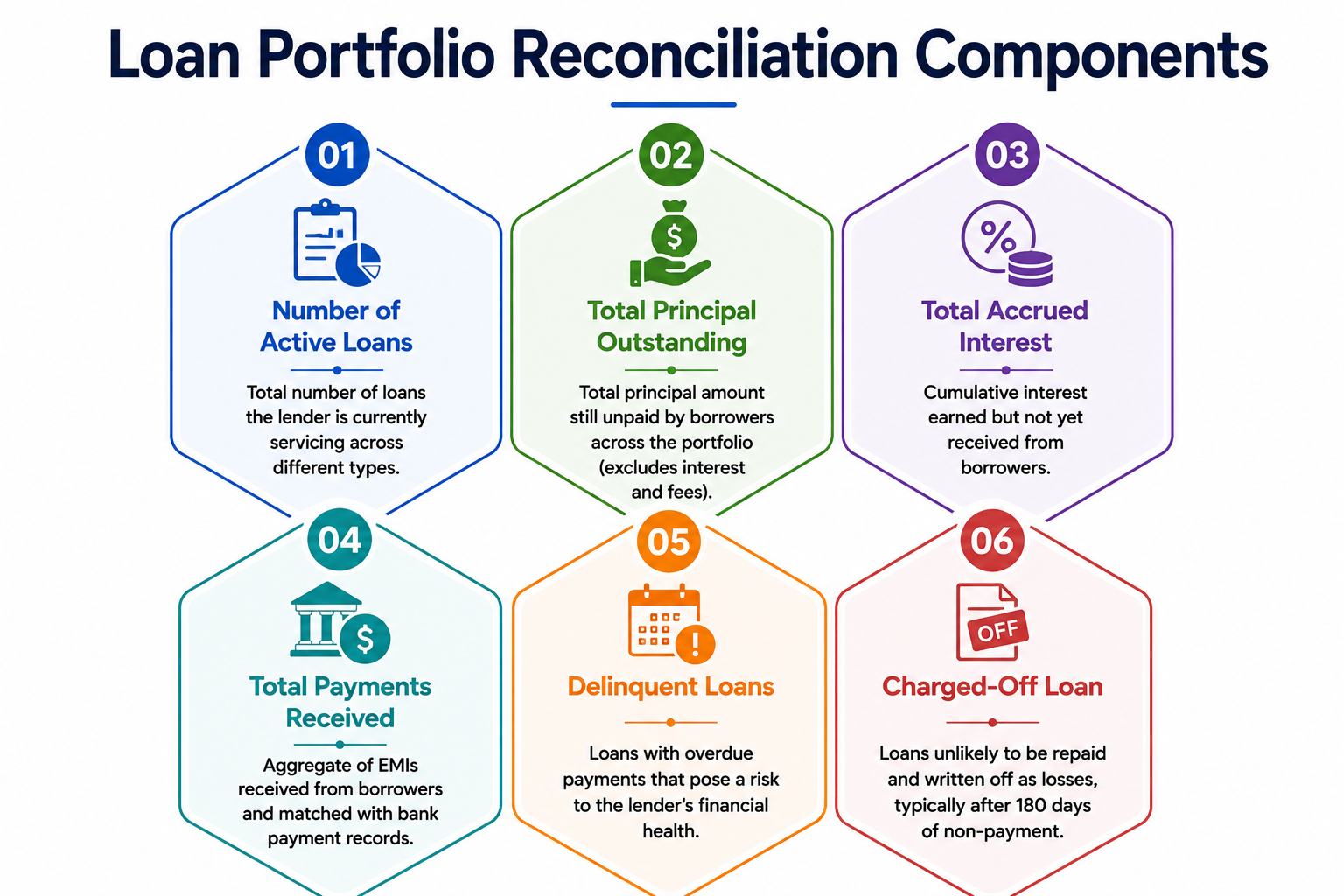
The loan portfolio plays a critical role in helping lenders assess their risk profile and ensure financial stability. It involves many components that are matched and verified during the reconciliation process. Some of the most common and important items to reconcile are as follows:
1. Number of Active Loans
The first and most basic thing to reconcile is the number of loans the lender is currently servicing. Financial institutions grant different types of loans based on their risk appetite and revenue goals.
For example, mortgage loans are secured by real estate property. They add stability to the portfolio, but their low interest rates generate lower profits. Personal loans, on the other hand, are unsecured and carry comparatively high interest rates. They are comparatively riskier but also create opportunities for lenders to generate higher revenue.
2. Total Principal Outstanding
The funds initially disbursed to the borrower are known as the loan principal. In the loan portfolio, total principal outstanding refers to the principal amounts that are yet to be repaid across all borrowers. This excludes interest, fees, or any other charges that may apply to the loan. Total principal outstanding helps determine the liquidity position of the credit institution.
3. Total Accrued Interest
In every EMI, one part of the instalment goes towards paying the principal, while the other goes towards paying the interest. The interest generated on loans is the profit financial institutions earn from extending credit. Total accrued interest refers to the cumulative interest payments owed by borrowers to the lender that have not yet been paid.
4. Total Payments Received
Total payments received are the aggregate of EMIs received from borrowers. These are matched against the bank's incoming payment records during the reconciliation process.
5. Delinquent Loans
Delinquent loans are those in which borrowers' payments have become overdue. They pose a risk to the lender's financial health, requiring the lender to take appropriate action to recover repayments.
6. Charged-Off Loan
Charged-off loans are those that the creditor believes will not be repaid and are counted as losses. This typically follows a period of non-payment for 180 days or six months.
What is the Loan Portfolio Reconciliation Process?
Part of loan portfolio management requires lenders to verify the accuracy of their records pertaining to outstanding loans through reconciliation. This process involves the following steps:
1. Generate Portfolio Report
First, a complete snapshot of the loan portfolio is extracted from the loan servicing system. This should contain details of all active, delinquent, charged-off, and recently closed loans. Along with this, data is gathered from the general ledger, external reports, and other sources relevant to the portfolio.
2. Validate and Compare to GL
Once all records have been collected, a full comparison is run between the loan portfolio and the relevant general ledger accounts, bank records, and other reports. This would include matching and verifying the number of loans, total principal outstanding, accrued interest, repayments, and other fields.
3. Investigate Exceptions
If any errors, unmatched entries, or unusual fluctuations are detected in the portfolio or any other records, they should be escalated for investigation and correction. Letting errors accumulate can result in inaccurate reporting of the lender's risk profile and financial health.
4. Document the Process
After rectifying records and reconciling the loan portfolio against general ledger accounts, create a report documenting the reconciliation process and all the updates made during it.
Segmentation in Portfolio Reconciliation
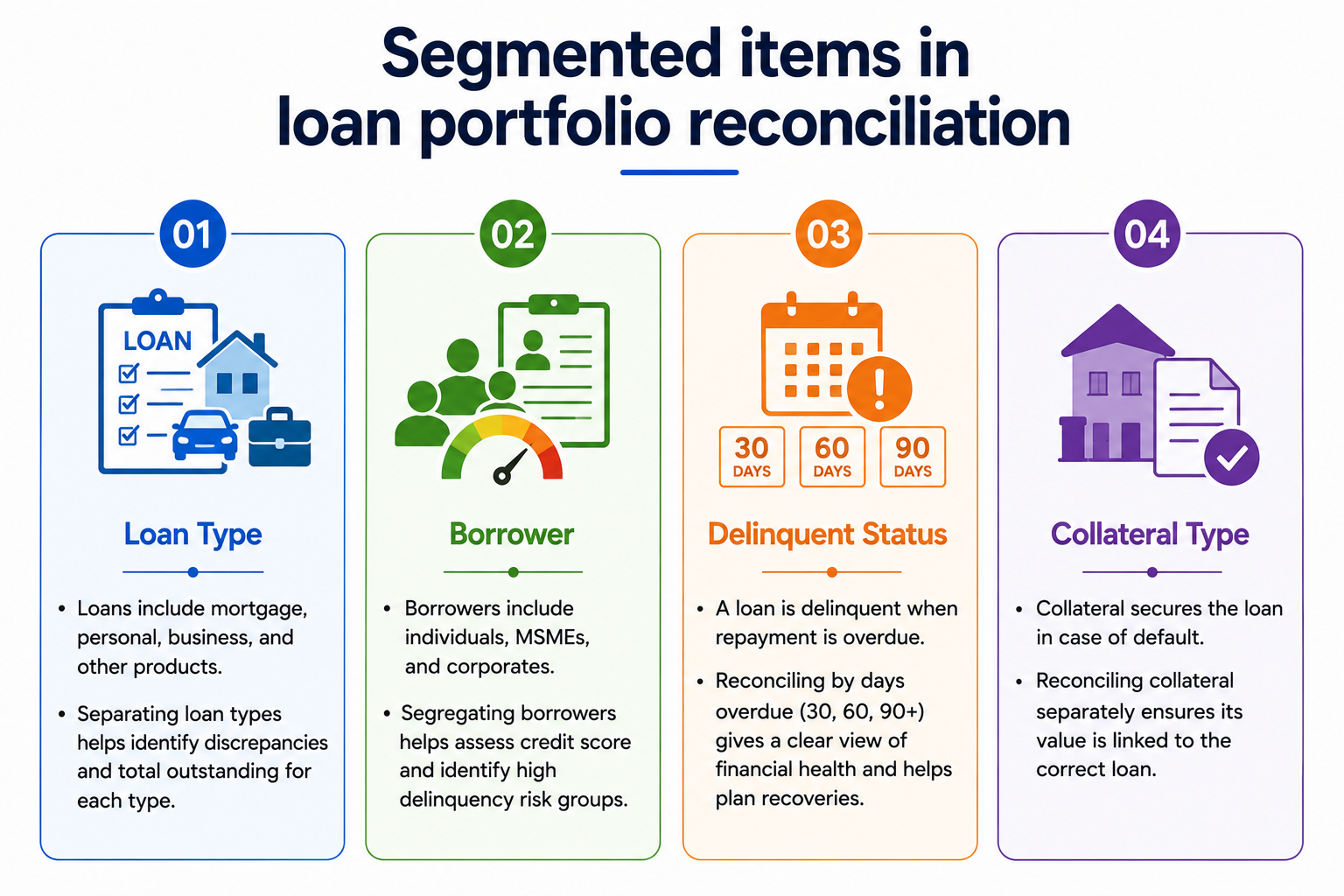
A bank's financial health and risk exposure depend on how well it manages its loan portfolio. For that, you must segregate it into the following categories and identify where issues might be accumulating:
1. Loan Type
Financial institutions grant different types of loans to balance their risk profile. These can be mortgage loans with long terms and real estate as collateral, personal loans with short terms and no collateral, business loans with varying terms and collateral requirements, or other loan products tailored to customer needs.
Separating these out helps reconciliation teams identify discrepancies in their numbers and the total outstanding of each loan type.
2. Borrower
Lenders deal with different types of borrowers, including individuals, MSMEs, and corporates. Each borrower has a different FICO or credit score. Segregating them allows the lender to determine which group has higher delinquency risk.
3. Delinquent Status
A loan is considered delinquent when its repayment is overdue. By separately reconciling current and delinquent loans by number of days overdue (e.g., 30, 60, and 90 days), lenders can gain a clear picture of their financial health and plan for loan recovery and charge-offs accordingly.
4. Collateral Type
Collateral serves as security for lenders when borrowers fail to repay the loan. Reconciling collateral separately ensures its value is linked to the correct loan.
{{banner1}}
What are Some Common Issues in Loan Portfolio Reconciliation?
Loans form a major part of a financial institution’s operations. Although lenders try to ensure accuracy in their loan portfolios, they can still encounter the following issues during reconciliation:
1. Missing Loans
Loans that appear in the loan portfolio may be missing all or some records in internal banking systems, and vice versa.
2. Duplicate Loans
Some loans can appear twice in the loan portfolio. This often results from glitches in the loan servicing system or a genuine data entry error.
3. Closed Loans with Active Status
In some instances, loans that have been fully repaid by the borrower may still show an active status in internal records. This results in an overstated portfolio size and distorted delinquency metrics, and can affect customers’ trust in the lender.
4. Amount Mismatches
Outstanding balances, accrued interest, and repaid amount may not match the general ledger and other records due to calculation errors.
5. Status Discrepancies
Discrepancies can also arise in loan status. A current loan in one record may be classified as delinquent in another. This affects the lender's risk profile.
How Osfin Automates Loan Portfolio Reconciliation?
The high risk of errors and slow processing time of manual reconciliation affect financial institutions' lending decisions and risk mitigation. But with Osfin’s intelligent automation platform, they can speed up loan portfolio reconciliation and enhance its accuracy with the following features:
1. Speedy Data Ingestion
Being a file-format agnostic platform with 170+ connectors, Osfin can extract data from multiple sources, regardless of the format they are stored in. It filters out duplicates and outliers in the data by applying custom deviation tolerances to avoid downstream issues.
2. Multi-Way Reconciliation
Osfin has an impressive record of reconciling 30 million records in 15 minutes. It applies logic-based matching rules to handle one-to-many and many-to-one transactions as well as multi-way reconciliation, including one-way, two-way, three-way, four-way and five-way.
3. Smooth Exception Handling
Exceptions can always arise in reconciliation processes, but with Osfin’s exception handling engine, these are automatically flagged, assigned an appropriate reason, and routed to the appropriate team member for resolution.
4. Audit-Ready Workflows
Once the reconciliation cycle is complete, Osfin maintains audit-ready workflows with complete traceability and transaction history.
5. Data Security
Osfin ensures that your loan portfolio remains secure by providing 256-bit encryption, maker-checker flows, role-based access, and two-factor authentication. It is also SOC 2, PCI DSS, ISO 27001, and GDPR compliant.
{{banner1.1}}
What are the Best Practices for Loan Portfolio Reconciliation?
Risk is an inherent part of extending credit, but a well-managed loan portfolio is what makes all the difference to a financial institution's profitability. The following best practices can help keep loan portfolio management efficient and effective:
1. Monthly Reconciliation
Loan portfolio reconciliation should happen monthly, aligned with the financial closing cycles. This prevents discrepancies from accumulating and causing issues with portfolio evaluations.
2. Trend Analysis
Conduct trend analysis by comparing current portfolio metrics against prior periods to identify rising delinquency rates and shifts in portfolio mix.
3. Exception Investigation
Exceptions can always arise during reconciliation. They should be promptly addressed by assigning them a proper owner and setting a resolution deadline.
4. Audit Trails
Every reconciliation action, including data entry, extraction, matching, adjustments, and exception resolution, should be logged with user records and timestamps.
Wrapping Up
Regularly reviewing and analyzing the loan portfolio is non-negotiable for institutions to manage their risk exposure and profitability. Reconciliation ensures that loan portfolio data remains accurate and updated. Manual processes, however, take up considerable time, resources, and further increase the risk of errors.
This is where Osfin comes into play. It speeds up ingestion with 170+ connectors, filters out duplicates and anomalies with custom deviation, handles matching with logic-based rules, and automates the whole reconciliation process. Book a demo to learn more.
FAQs
1. What are the common components of loan portfolios that are reconciled?
Some of the common components considered in the reconciliation process include the number of active loans, total principal outstanding, total accrued interest, total payments received, delinquent loans, and charged-off loans.
2. What items in the loan portfolio should be separately reconciled?
The types of loan, borrower information, delinquent status, and collateral types should be separately reconciled since the financial institution’s risk exposure depends on each of these components.
3. What issues commonly arise during loan portfolio reconciliation?
Loan reconciliation teams often face issues with missing loans, duplicate loans, closed loans with active status, amount mismatches, and status discrepancies.
4. How can bank management enhance loan portfolio reconciliation?
Bank managers can enhance loan portfolio reconciliation by conducting monthly reconciliations, promptly addressing exceptions, and maintaining an audit trail for every transaction.