What Is Loan Reconciliation? Process & Best Practices
If your business has ever taken a loan, you'd know that the paperwork can be never-ending. First, there's paperwork for receiving the said loan. Then, there's some more after it:
- Payments
- Interest
- Fees
- Settlement
You get the gist.
But how often do your books actually match what your lender shows? For many finance teams, the honest answer is: not as often as they should.
This is why loan reconciliation exists.
In this guide, we'll explore what loan reconciliation involves, why it matters, and how to do it properly.
Key Takeaways:
- Loan reconciliation means making sure your internal loan records match your lender's records. These include principal balances, interest, payments, fees, and disbursements.
- Unresolved discrepancies don't just affect individual accounts. They can also impact the balance sheet, distort financial ratios, and complicate audits.
- Discrepancies in loan reconciliation are either errors, which need a correcting journal entry, or timing differences, which just need to be noted and monitored.
- If you're dealing with a large volume of transactions for loan reconciliation, it's smart to use an automated tool. It can make the process quicker and more accurate without any added effort.
- Some best practices for a smooth loan reconciliation process include reconciling monthly, using standard account naming, and assigning the right person for the job.
What is Loan Reconciliation?
Loan reconciliation is the process of verifying that the loan records in your company's books match your lender's. It involves comparing your internal entries in the general ledger against external documents like:
- Loan statements
- Payment confirmations
- Amortization confirmations
If the balances don't match, you need to look deeper to identify and fix the issue.
The scope of loan reconciliation depends on the type of loan. Short-term debt, like a line of credit, can shift frequently. As such, it needs to be checked often. On the other hand, long-term debt, like a mortgage, involves tracking payments over years and matching each one against a lender's amortization schedule.
Why is Loan Reconciliation Critical?
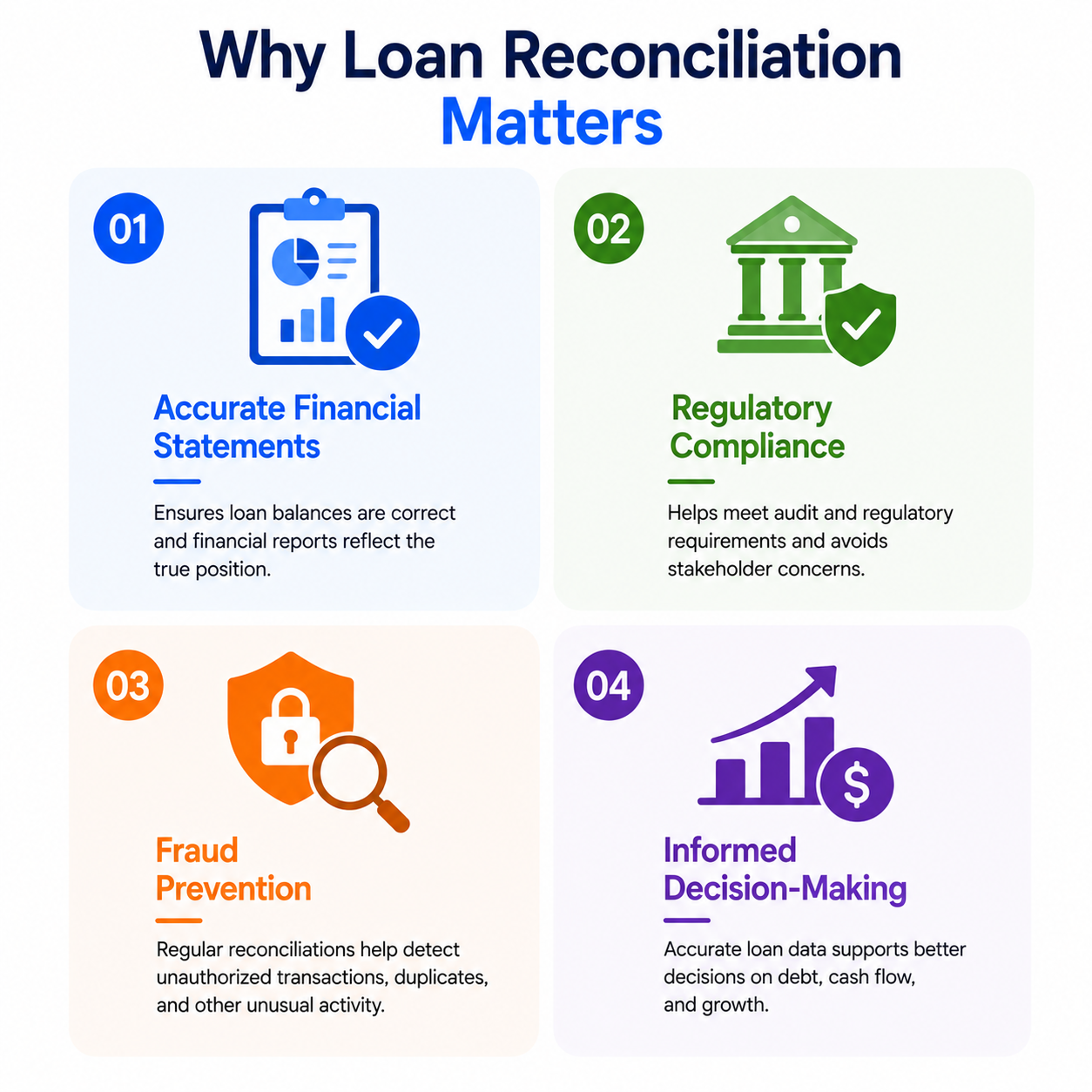
Loan reconciliation is important to ensure your financial records are accurate. But that isn't the only aspect of your business that it affects. Here are some other reasons why it's essential to reconcile loans:
1. Accurate Financial Statements
Business loans are significant liabilities. A mistake in recording a principal payment can lead to an overstated or understated balance sheet position. It can also affect important ratios that lenders and investors rely on during their evaluations.
2. Regulatory Compliance
For publicly traded companies or businesses with loans, the stakes are even higher. Auditors review loan reconciliations carefully. Any discrepancies identified may prompt additional questions and raise concerns among stakeholders.
3. Fraud Prevention
Unauthorized transactions and duplicate payments are more likely to be identified when reconciliations are performed regularly. A monthly review process provides a regular opportunity to investigate anything that looks unusual.
4. Informed Decision-Making
Metrics like debt service coverage ratios and borrowing capacity are only useful if your loan data is accurate. If not, management would be making key decisions based on incorrect numbers.
{{banner1}}
What are the Components of Loan Reconciliation?
Loan reconciliation isn't limited to records of principal and interest payments. It involves several components, such as:
- The outstanding principal balance and any changes to it
- Interest accruals and the actual interest payments made
- Disbursements, fees, and any applicable charges
- Debt issuance or refinancing transactions
- General ledger postings against treasury records
- Covenant-related reporting obligations
A mistake in any one of these can lead to mismatches in the final balance.
What is the Loan Reconciliation Process?
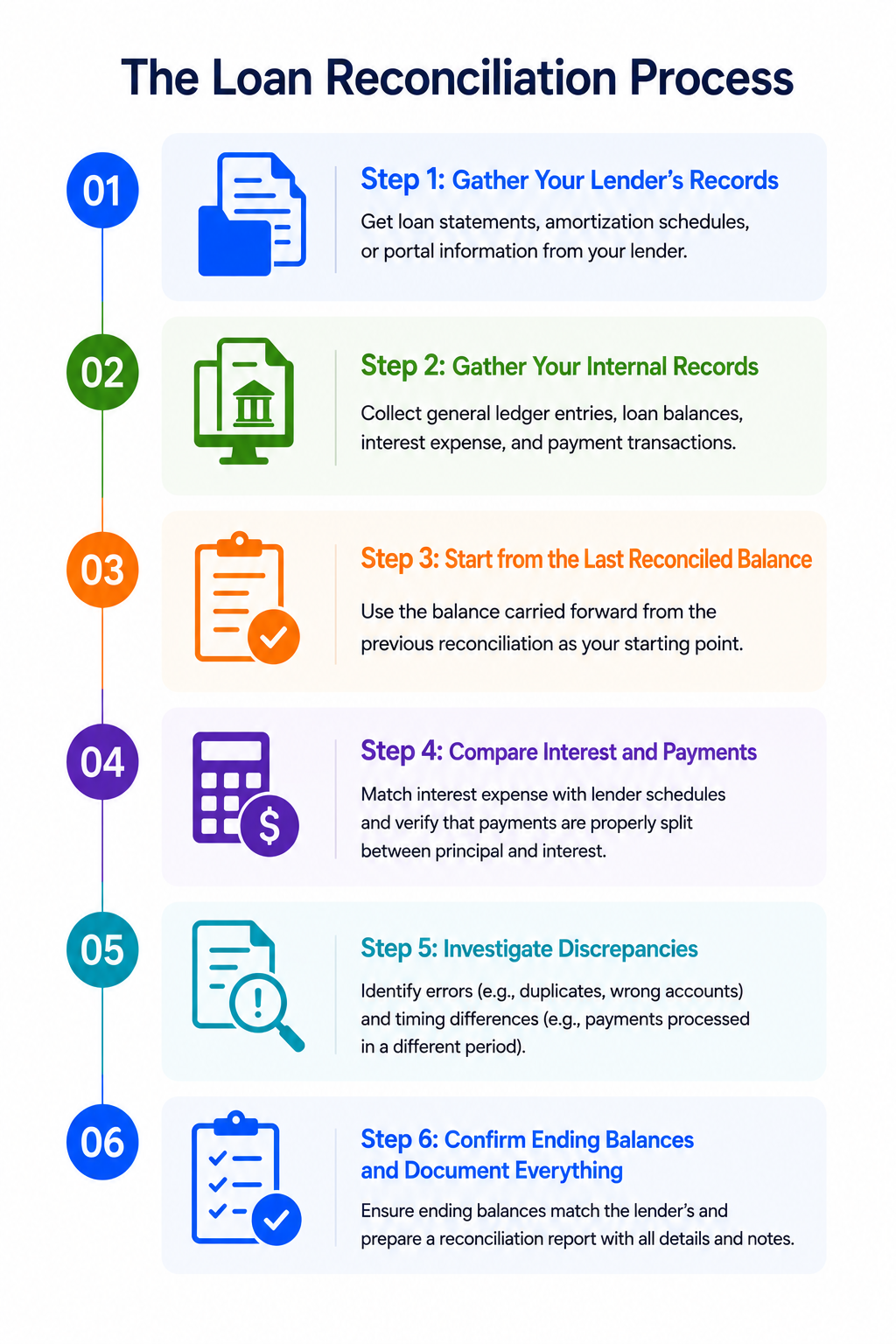
Here's the step-by-step process for how loan reconciliation typically works:
Step 1: Gather Your Lender's Records
Get the loan documentation from your lender for the period you're reconciling. This may include a monthly statement, an amortization schedule, or information from the lender's online portal.
Step 2: Gather Your Internal Records
Collect your general ledger entries for the same period. These include loan balances, interest expense, and any payment transactions or journal entries related to your loan accounts.
Step 3: Start from the Last Reconciled Balance
Begin with the balance carried forward from the previous reconciliation. This provides a reference point for the current period.
Step 4: Compare Interest and Payments
Check if your interest expense matches what the lender's schedule shows. Then verify that individual payments are correctly split between principal and interest on both sides.
Step 5: Investigate Discrepancies
Discrepancies usually fall into two categories:
- Errors that need to be corrected with a journal entry. These include duplicate entries, payments posted to the wrong account, or incorrect principal-interest splits.
- Timing differences, like a payment you made in December that the lender processed in January. They don't need corrections. Just note them.
Step 6: Confirm Ending Balances and Document Everything
Once you've corrected the errors, your ending balance should match the lender's. Prepare a reconciliation report covering all balance changes, payments, interest recorded, and any noted timing differences.
What are the Common Challenges in Loan Reconciliation?
There's no doubt that loan reconciliation isn't important. But that doesn't mean it is without challenges.
1. It is Time-Consuming
When done manually, a single loan reconciliation can take hours. Multiply that across dozens of loans, and you're looking at entire days spent downloading statements, moving data into spreadsheets, and cross-referencing transactions.
2. Errors are Easy to Make
The more loan transactions there are to reconcile, the harder it becomes to avoid mistakes. An incorrect figure or misallocated payment can carry forward from one reporting period to the next if it isn't identified early.
3. Complicated Audits
If you're reconciling loan accounts using spreadsheets, it might be difficult to trace where each report is. Inconsistent formats across team members can raise questions from auditors.
Manual vs Automated Loan Reconciliation
Most manual reconciliations depend on spreadsheets and a significant amount of cross-checking. This can take hours. And the more loans you have, the worse it gets.
Automation makes the entire process quick, efficient, and more accurate.
Example of Loan Reconciliation
How Osfin Automates Loan Reconciliation?
Loan reconciliation often involves high transaction volumes, multiple data sources, and different formats. Osfin is built to handle all of that.
- Data Ingestion
Osfin connects to 170+ data sources and accepts files in any format. It then applies deviation tolerances to filter out poor-quality data before reconciliation starts. It also flags duplicates before they cause problems.
- Reconciliation
Osfin uses logic-based matching that handles complex structures, including many-to-one, one-to-many, and multi-way reconciliations up to five-way. It can process 30 million records in 15 minutes. The platform can also automatically reconcile payment gateway reports with commission, tax, and fee breakdowns.
- Exception Handling
Osfin automatically flags unmatched transactions. It then assigns a reason and routes them to the right team member through its ticketing and exception handling system.
- Output
The platform produces compliance reports with full transaction history for every reconciliation. It secures your data with 256-bit encryption, role-based access, and two-factor authentication. Osfin is also compliant with SOC 2, PCI DSS, ISO 27001, and GDPR.
{{banner1.1}}
What are the Best Practices for Loan Reconciliation?
Loan reconciliation does come with certain challenges. But you can navigate them easily by following some best practices:
1. Reconcile Every Month
Don't wait for the quarter-end. Small discrepancies are easier to overlook when several months of activity are involved. A monthly process helps keep reviews manageable and issues easier to identify.
2. Use Standard Account Names
Using inconsistent labels across records can create confusion and slow down the matching process. So, establish a standard naming convention and stick to it.
3. Assign the Right Person
Loan reconciliation requires someone who understands loan statement formats. Make sure the person responsible knows exactly what they are doing.
4. Use a Checklist
A simple period-by-period checklist can help maintain a consistent process, regardless of who is doing it.
To Sum Up
Accurate loan records are critical to reliable financial reporting. Even small discrepancies can affect balance sheet accuracy or surface during an audit.
Effective loan reconciliation starts with accurate records and timely follow-up on discrepancies. Automation can help streamline that process.
Osfin's automated reconciliation platform is designed to handle millions of records in minutes and maintain a full audit trail for every reconciliation. It also comes with a built-in exception handling engine.
See how that works in practice. Book a demo today.
FAQs
1. What is loan reconciliation meaning?
Loan reconciliation is the process of making sure your company's internal loan records match your lender's books. It covers balances, payments, interest, fees, and any other transactions related to your loans.
2. How do you do a loan reconciliation?
Start by gathering your lender's statements and your internal general ledger records for the same period. Then compare balances, interest, and payments between the two. Any discrepancies should be investigated and either corrected or documented, depending on the cause. The reconciliation should then be formally recorded.
3. Why is loan reconciliation important?
Accurate loan records play an important role in financial reporting and audit compliance. Regular reconciliation can also help identify unauthorized or unexpected transactions.
4. What are the benefits of automating loan reconciliation?
Automation can shorten reconciliation cycles from hours to minutes. It helps standardize the process, reduce manual input, and maintain the records needed for audits. Exceptions are surfaced automatically, and the process can scale as volumes grow.