What is Loan Recovery Reconciliation?
Indian household borrowings have seen a sharp rise over the past few years, with over 28.3 crore outstanding loans. But every credit extended by banks and financial institutions carries the risk of default, which triggers a loan recovery process.
At this point, the lending institution is already facing losses and thus cannot afford to err further by making mistakes in documenting collections, loan recovery rates and recognizing write-offs. This is where loan recovery reconciliation comes in. Let’s explore that in this article.
What Is Loan Recovery Reconciliation?
Loan recovery reconciliation is the process of matching proceeds collected from delinquent and non-performing loans against the original loan balances. It verifies that the amount recovered through collecting agencies or liquidated collateral is applied to the original loan.
Along with this, it ensures that recovery rates, losses and write-offs are accurately calculated and documented in the loan recovery system and general ledger.
What Is the Loan Recovery Reconciliation Process?
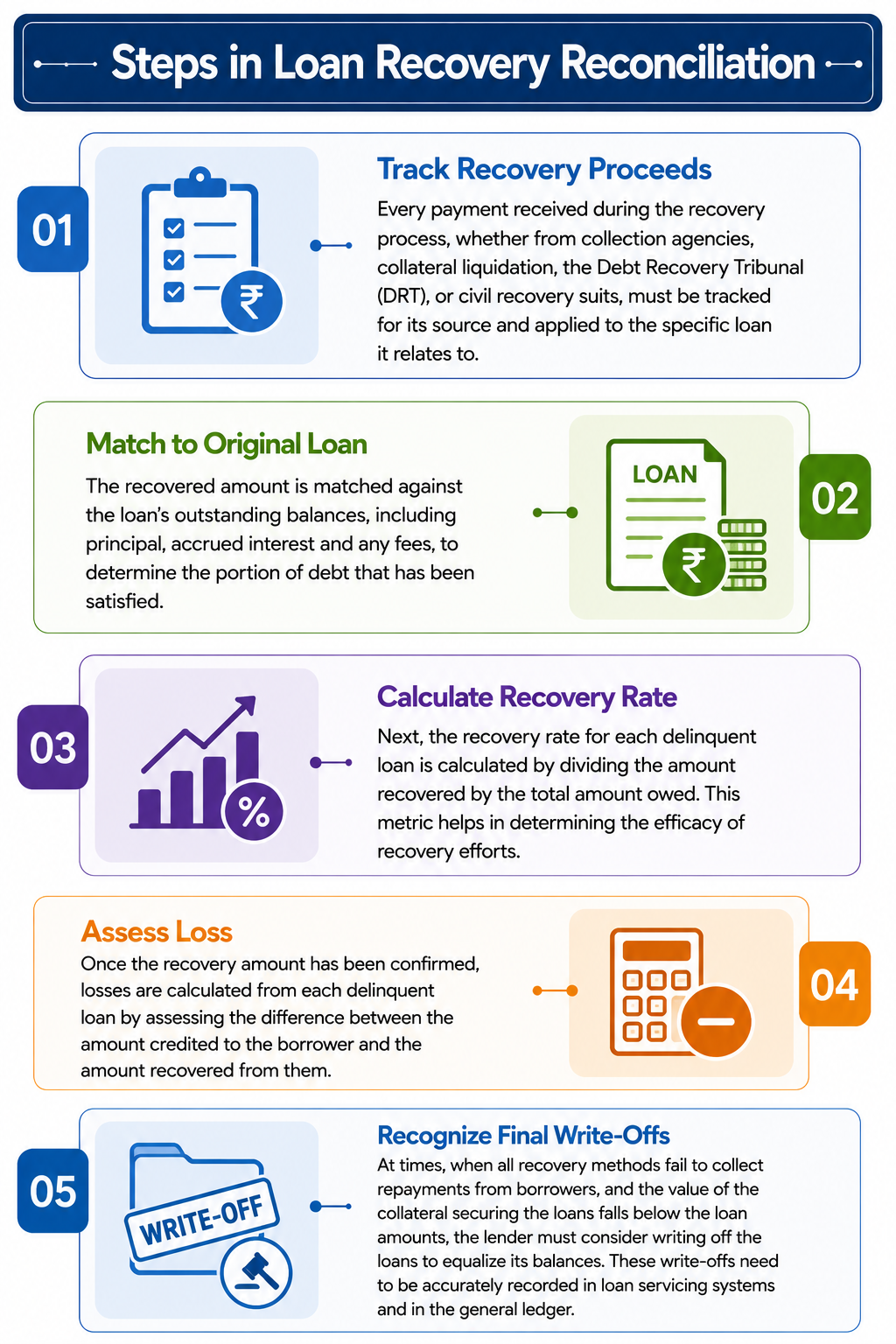
The loan recovery reconciliation follows several steps to verify various aspects. These include the following.
1. Track Recovery Proceeds
Every payment received during the recovery process, whether from collection agencies, collateral liquidation, the Debt Recovery Tribunal (DRT), or civil recovery suits, must be tracked for its source and applied to the specific loan it relates to.
2. Match to Original Loan
The recovered amount is matched against the loan’s outstanding balances, including principal, accrued interest and any fees, to determine the portion of debt that has been satisfied.
3. Calculate Recovery Rate
Next, the recovery rate for each delinquent loan is calculated by dividing the amount recovered by the total amount owed. This metric helps in determining the efficacy of recovery efforts.
4. Assess Loss
Once the recovery amount has been confirmed, losses are calculated from each delinquent loan by assessing the difference between the amount credited to the borrower and the amount recovered from them.
5. Recognize Final Write-Offs
At times, when all recovery methods fail to collect repayments from borrowers, and the value of the collateral securing the loans falls below the loan amounts, the lender must consider writing off the loans to equalize its balances. These write-offs need to be accurately recorded in loan servicing systems and in the general ledger.
{{banner1}}
Example of Loan Recovery Reconciliation
Let’s try to understand the loan recovery reconciliation with the following example.
A borrower defaults on a personal loan with an outstanding balance of $20,000. The collection agency is able to recover $12,000 over the next few months with partial payments.
During reconciliation, the lender confirms that the recovered amount was applied to the right loan account and matches what the collection agency reported. The recovery rate in this case was 60% if the total loan amount and the loss were $ 8,000. The loss amount is written off from the loan portfolio and recorded in the loan servicing system and general ledger.
What Are the Benefits of Loan Recovery Reconciliation?
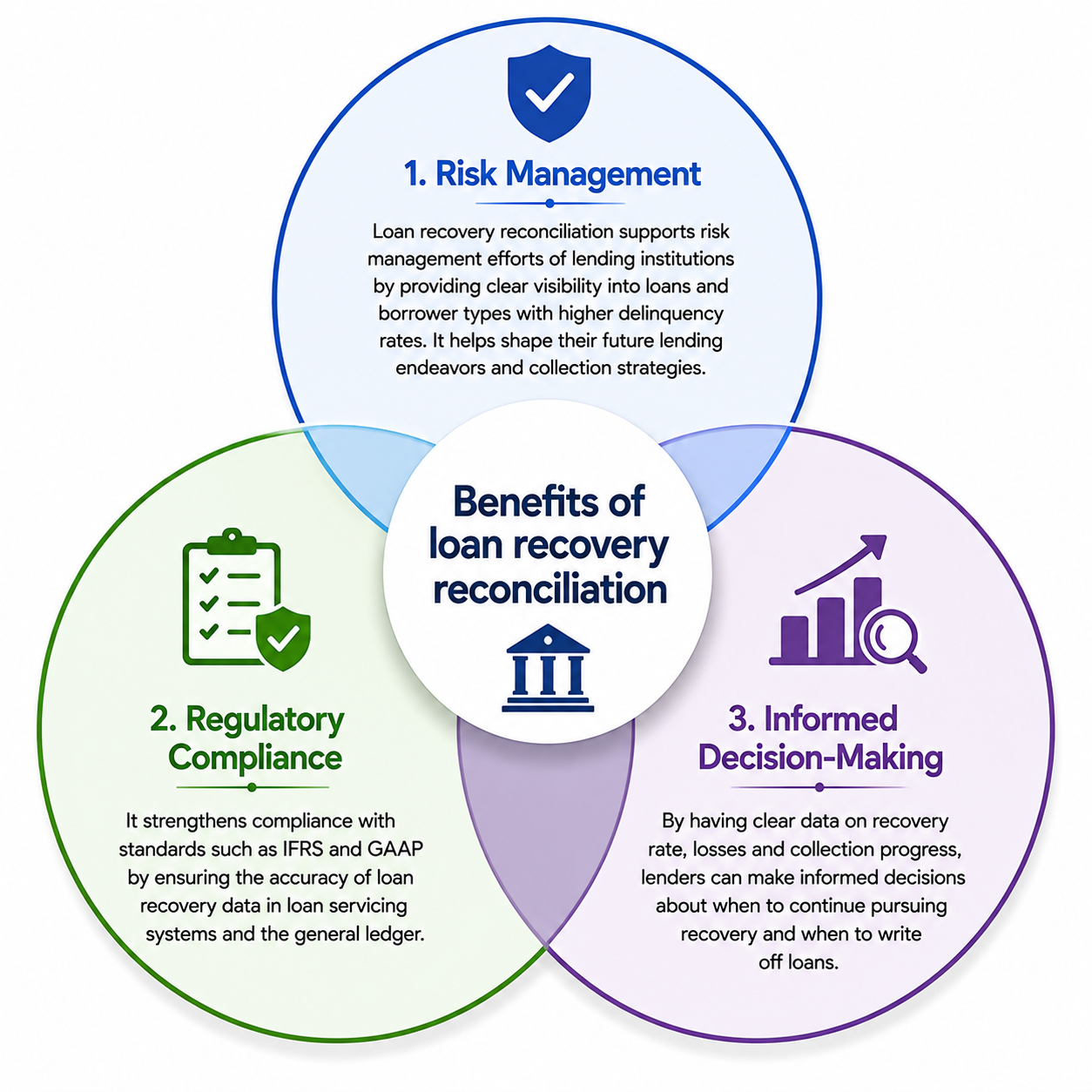
The main purpose of the loan recovery reconciliation is to ensure the accuracy and consistency of the lending institution's records in loan servicing systems and general ledgers. It helps identify errors, duplicates and mismatched entries that may affect the overall financial statement of the lending institution. But the benefits of loan recovery reconciliation extend beyond this.
1. Risk Management
Loan recovery reconciliation supports risk management efforts of lending institutions by providing clear visibility into loans and borrower types with higher delinquency rates. It helps shape their future lending endeavors and collection strategies.
2. Regulatory Compliance
It strengthens compliance with standards such as IFRS and GAAP by ensuring the accuracy of loan recovery data in loan servicing systems and the general ledger.
3. Informed Decision-Making
By having clear data on recovery rate, losses and collection progress, lenders can make informed decisions about when to continue pursuing recovery and when to write off loans.
Manual Vs Automated Loan Recovery Reconciliation
Banks, NBFCs and other lending institutions process thousands of transactions in a day. This includes disbursement, EMIs, recovery collections and other generic customer transactions.
Manually reconciling loan recovery records means pulling data from collection agencies, payment processors and internal systems, then matching them line by line against loan servicing systems and the general ledger. Not only is it a labor-intensive process that consumes significant time from the reconciliation team, but it also carries a high risk of errors due to missed entries and copy-paste mistakes.
Automated reconciliation platforms like Osfin relieve this burden by automatically ingesting loan recovery data from multiple sources, matching it against internal records with pre-configured rules and flagging discrepancies for review. It considerably reduces the time and error rates associated with manual processes.
How Does Osfin Automate Loan Recovery Reconciliation?
Osfin is an intelligent automation platform that reconciles high volumes of transactions with unmatched speed and accuracy. It serves enterprises across banking, fintech, payments & cards, etc, offering them automation solutions customized to their needs. It streamlines loan recovery reconciliation with the following features.
1. Multi-Source Data Ingestion
Osfin is a file-format-agnostic platform that comes with 170+ integrations, allowing it to ingest data regardless of the format from multiple sources, including loan servicing systems, general ledger and other systems. It detects duplicates and anomalies at the point of ingestion using its custom deviation tolerances.
2. Lightning Fast Reconciliation
Osfin can reconcile 30 million transactions within 15 minutes. It applies logic-based matching rules to handle one-to-many, many-to-one and multi-way reconciliations, including 2-way, 3-way, 4-way and 5-way.
3. Exception Handling
Osfin’s built-in ticketing and exception handling engine automatically flags unmatched transactions, assigns them an accurate reason and routes them to the appropriate team member for review. You can access a real-time view of match status, exception queues and other actionable insights through its comprehensive dashboards.
4. Output Delivery
Osfin automatically delivers a compliance report at the end of reconciliation. It maintains an audit-ready workflow with complete traceability and transaction history. It ensures data security with 256-bit encryption, two-factor authentication and role-based access. Along with this, it holds compliance certifications for SOC2, GDPR, PCI DSS and ISO 27001.
{{banner1.1}}
What Are the Best Practices For Loan Recovery Reconciliation?
A few practices consistently help lenders keep their loan recovery reconciliation accurate and manageable.
1. Reconcile Regularly
Reconcile recovery proceeds with internal records on a regular schedule, such as weekly or monthly. This makes it easier to catch and resolve discrepancies early.
2. Document Write-Off
Document the rationale behind every write-off decision, including the recovery efforts made and the final loss calculation, to support both internal review and regulatory audits.
3. Automate Reconciliation
Manual loan recovery reconciliation fails at keeping up with high volumes of transactions, leading to delayed close and errors. Let Osfin accelerate reconciliation for you with automatic data ingestion and matching, while maintaining 100% accuracy.
Finishing Off
As of March 2025, the non-performing loan ratio in India is 2.2%. As such, banks and financial institutions are busy collecting payments for many delinquent loans while writing off others. In this scenario, loan recovery reconciliation helps confirm that recovered amounts, losses and write-offs are accurately recorded in the loan servicing system and general ledger.
However, manual processes simply don't scale as recovery volumes grow. Osfin brings speed and accuracy to loan recovery reconciliation with automated ingestion, matching and exception handling, while maintaining audit trails of every transaction. Book a demo now!
FAQs
1. What methods are deployed by banks to recover loans?
Banks recover delinquent or defaulted loans through collection agencies, collateral liquidation, debt recovery tribunals and civil recovery suits.
2. What are the benefits of loan recovery reconciliation?
Loan recovery reconciliations help lending institutions better manage risk in the loan portfolio, make informed decisions about recovery and write-offs, and comply with accounting standards like IFRS and GAAP.
3. What steps are followed in loan recovery reconciliation?
The steps followed in loan recovery reconciliation consist of tracking recovery proceeds, matching collections to the original loan, calculating the recovery rate, assessing losses and recognizing write-offs.
4. What is meant by loan write-off?
Loan write-off refers to the process of lending institutions removing unrecoverable loans from their balance sheets to equalize it. The loan still remains active and may be pursued by the lender for recovery.