What Is Loan Servicing Reconciliation?
When a loan is approved and disbursed, the real work begins. Month after month, lenders need to collect repayments, update balances, and monitor delinquencies. With the securitization of loans, lenders have now delegated these tasks to third-party loan servicers.
However, lenders are still accountable to the borrowers, investors, and regulatory authorities. Therefore, they must ensure that the loan data recorded by servicers is maintained in accordance with the loan agreement and their internal records. And this is exactly what loan servicing reconciliation is meant for.
What Is Loan Servicing?
Loan servicing is the process of managing the administrative tasks related to the credit extended by the bank. Traditionally, loan servicing was a core function of banks and lending institutions, but nowadays it is outsourced to third parties who take a small percentage of the EMI as their fee. The tasks managed as part of loan servicing include:
- Collecting EMIs and allocating them between principal and interest balances
- Updating the borrower’s outstanding obligations and maintaining repayment history
- Monitoring delinquency and initiating follow-up for overdue payments
- Reporting to investors on the loan portfolios of asset-backed securities
Why is Loan Servicing Reconciliation important?
Before securitization, the lending institution directly handled loan servicing. Now, it falls upon third-party loan servicers to collect payments, allocate funds, report to the ABS investors, and keep a record of every transaction.
The purpose of loan servicing is to ensure that every activity in the loan cycle is conducted in accordance with the agreed-upon terms of the loan and financial reporting standards. As such, reconciliation is necessary to verify the accuracy of the loan servicer’s records and promptly address discrepancies that arise during the process.
Which Components are Reconciled in Loan Servicing?
A comprehensive loan servicing reconciliation covers the following key components:
1. Payments Received vs Recorded
Every payment received by the loan servicer is matched with the lender's payment records.
2. Principal Reduction
With each EMI paid by the borrower, a portion goes towards the repayment of the principal balance. The reduced outstanding principal should match the amounts in the loan's amortization schedule.
3. Interest Accrued
The part of EMI that goes towards paying interest is the lender's profit. This should be accurately calculated and recorded for every period.
4. Balances
The outstanding balances recorded by the loan servicer should match those in the loan servicing system of the lender. Any discrepancies in these balances may result from misapplied payments or calculation errors.
5. Loan Status
The status of the loan, whether current, delinquent or paid off, should consistently match between the systems of the loan servicer and the lender.
{{banner1}}
What is the Loan Servicing Reconciliation Process?
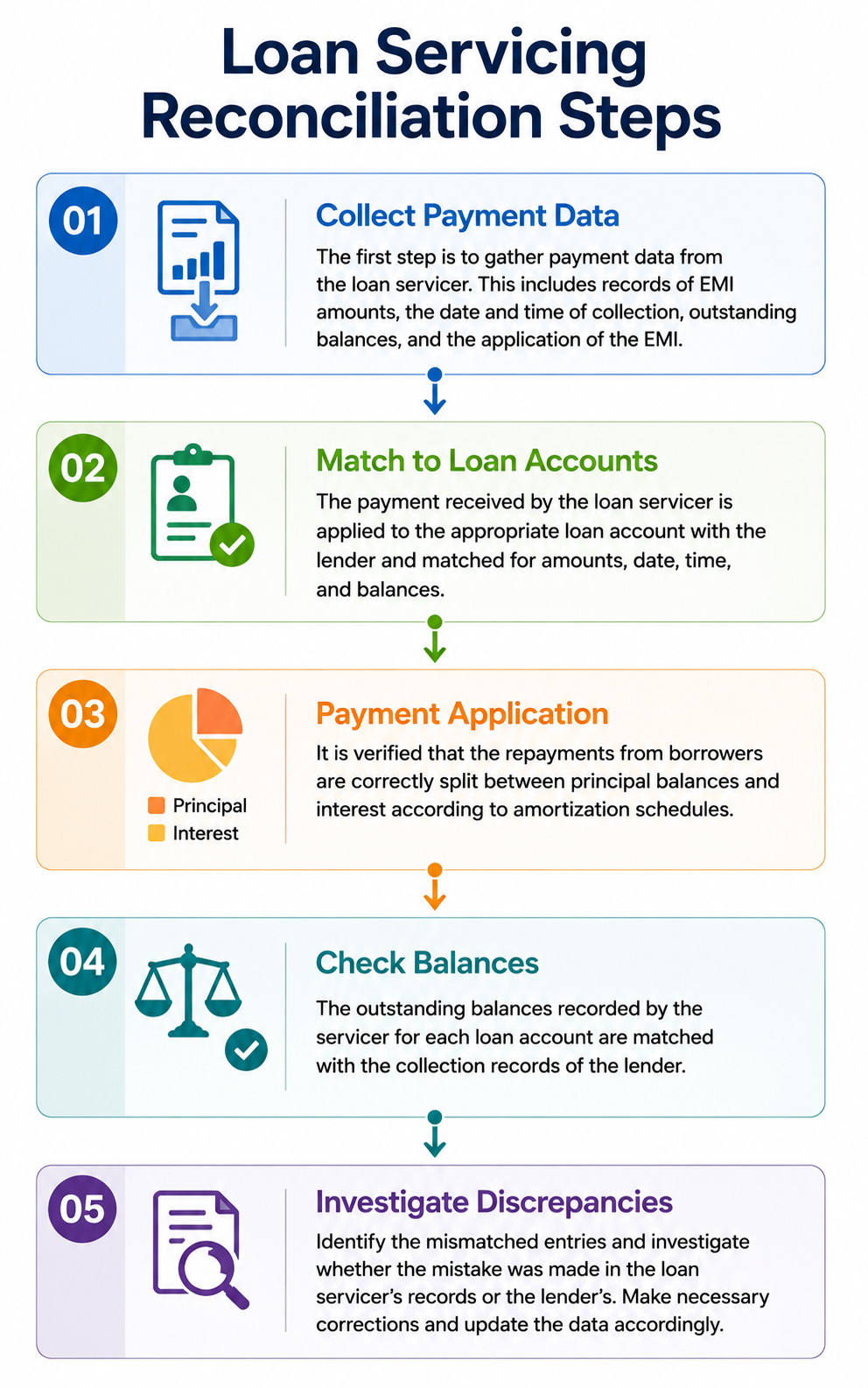
A typical loan servicing reconciliation consists of the following steps:
1. Collect Payment Data
The first step is to gather payment data from the loan servicer. This includes records of EMI amounts, the date and time of collection, outstanding balances, and the application of the EMI.
2. Match to Loan Accounts
The payment received by the loan servicer is applied to the appropriate loan account with the lender and matched for amounts, date, time, and balances.
3. Payment Application
It is verified that the repayments from borrowers are correctly split between principal balances and interest according to amortization schedules.
4. Check Balances
The outstanding balances recorded by the servicer for each loan account are matched with the collection records of the lender.
5. Investigate Discrepancies
Identify the mismatched entries and investigate whether the mistake was made in the loan servicer’s records or the lender’s. Make necessary corrections and update the data accordingly.
What are the Responsibilities of the Loan Servicer?

Since the loan servicer becomes the face that deals with customers, collecting and applying EMIs and reporting to the investors, they bear responsibility for the following:
1. Accurate Record Keeping
The loan servicer has to accurately record the amount of each repayment, the amounts allocated to principal and interest, delinquency days, and the outstanding balances for each customer.
2. Timely Reporting
Loan servicers have to regularly report to the lender and investors about the overall health of the loan portfolio. This includes metrics on credit scores, balances, and defaults.
3. Regulatory Compliance
The activities of the loan servicer should be in line with applicable consumer finance laws, supervisory guidance for disbursement and collection, and data handling requirements.
4. Investor Reporting
It is the responsibility of the loan servicer to report to investors on metrics for securitized loans, including collection status, delinquency, defaults, etc.
5. Borrower Communication
Loan servicers handle all direct communication with borrowers. They are the first to respond to borrowers' queries and also reach out to collect overdue payments.
{{banner1.1}}
What are the Common Issues in Loan Servicing Reconciliation?
Manual processes have a high error rate, and the same holds for loan servicing reconciliation. Some of the common issues it faces include the following:
1. Payment Timing
Loan servicers are the ones who collect payments from borrowers, which are later reported to the lending institution. This often results in different collection times being noted in the systems of the lender and the servicer.
2. Incorrect Account Application
When dealing with high volumes of transactions, some payments are applied to the wrong loan account or split inaccurately between principal and interest balances.
3. Investor Reporting Inaccuracies
Reporting erroneous loan portfolios, containing inaccurate data about collections, outstanding balances, or delinquencies, can inflate the portfolio’s risk and performance metrics. This can erode the investors' confidence in the asset-backed securities.
How Does Osfin Automate Loan Servicing Reconciliation?
Osfin is an intelligent automation platform that is designed for high-speed reconciliation while improving accuracy, visibility, and efficiency across financial operations. It supports loan servicing reconciliation with the following features:
1. Multi-Source Data Ingestion
Osfin’s 170+ connectors and file-format-agnostic architecture allow it to integrate with the systems of both the lender and the servicer to automatically collect reconciliation data, regardless of the file format.
By applying custom deviation tolerances, it filters out duplicates and anomalies, which helps avoid issues during reconciliations.
2. Rapid Reconciliation
Osfin has a proven record of reconciling 30 million transactions in 15 minutes. It applied logic-based matching rules to handle multi-way reconciliation, including 2-way, 3-way, 4-way, and 5-way.
3. Exception Handling Engine
Osfin comes with a ticketing and exception-handling engine that automatically flags unmatched transactions, assigns them accurate reasons, and routes them to the appropriate person for resolution.
4. Audit-Ready Workflow
To help you with regulatory reporting requirements, Osfin maintains audit trails of all the transactions with complete traceability.
5. Data Security
Osfin keeps your data secure throughout the reconciliation process with 256-bit encryption, role-based access, and two-factor authentication. It also complies with PCI-DSS, SOC 2, ISO 27001, and GDPR.
What are the Best Practices for Loan Servicing Reconciliation?
When the task of managing loans and related records is outsourced to a third party, lenders can often lose visibility into how accurately they are being carried out. The following best practices can help address this:
1. Daily Reconciliation
Lending, being one of the primary functions of financial institutions, generates high-volume transactions every day. Reconciliation should be carried out daily to ensure that every number in the lender’s and servicer’s systems matches.
2. Exception Alerts
Use automation platforms like Osfin that send out alerts to the appropriate team member whenever exceptions or unmatched transactions are detected in the reconciliation process.
3. Audit Trail
For compliance purposes and investor reporting, you must have clear answers to who made changes in the loan portfolio, why they were corrected, and when they were updated. Therefore, you must maintain transparent audit trails with user names and timestamps.
4. Regular Reporting
Loan servicers should generate standardized reports at regular intervals and share them with lenders, investors, and regulatory bodies.
Wrapping Up
Lenders may have reduced their loan servicing responsibilities by outsourcing the task to third parties, but this does not reduce their reconciliation burden. However, manual processes fail when dealing with high transaction volumes. This is where Osfin comes into play.
Osfin serves enterprises across banking, insurance, capital markets, etc. and streamlines their financial operation. It eliminates manual reconciliation, speeds up data ingestion and matching, and provides real-time visibility into processes with intuitive dashboards. Book a demo now.
FAQs
1. Who is a loan servicer?
A loan servicer is a third-party institution to which the lender has outsourced the responsibility for managing loan-related tasks, including EMI collection, updating borrowers’ outstanding obligations, handling delinquency, and reporting to investors on loan portfolios.
2. What issues are commonly faced in loan servicing reconciliation?
Some of the issues commonly faced by lenders in loan servicing reconciliation include differences in payment timing, incorrect EMI application, and inaccuracies in the loan portfolio shared with investors.
3. How do errors in loan servicing reconciliation affect asset-backed securities?
Errors in the numbers recorded in the loan portfolio, whether collection amounts, outstanding balances or delinquency days, inflate its risk and performance metrics. This erodes an investor’s trust in the lender issuing asset-backed securities.
4. What fields are considered in loan servicing reconciliation?
In a typical loan servicing reconciliation, the components considered for matching include payments received and recorded, principal amount reduction, accrued interest, outstanding balances, and the loan status.