What Is Microfinance Reconciliation?
Microfinance has slowly become quite an important tool for financial inclusion. The global microfinance market, which was valued at $195.3 billion in 2023, is expected to reach close to $377.1 billion by 2030.
That's a lot of small loans adding up to something massive.
But there's a catch most people outside the industry don't see.
Microfinance runs on volume. There are numerous small loans, repaid in small installments, often collected through a mix of cash, mobile wallets, agents, and digital channels. All of those transactions need to be tracked, matched, and confirmed against multiple sources of truth. Get that wrong, and the consequences aren't just a messy spreadsheet. They show up as wrongly flagged borrowers, distorted portfolio numbers, or money that disappears between collection and deposit.
And that creates the need for microfinance reconciliation.
In this article, we'll break down what microfinance reconciliation actually involves, how it differs from traditional bank reconciliation, the challenges that make it uniquely difficult, and how automation is starting to close the gaps that manual processes can't keep up with.
Key Notes
- Microfinance reconciliation matches internal loan records against data from banks, mobile wallets, payment processors, and field agents, to confirm every transaction is accurately accounted for.
- It's structurally different from traditional bank reconciliation. More accounts, smaller transactions, heavier reliance on cash, and far less standardized documentation.
- Most microfinance reconciliation follows a daily cycle, from field collection and loan level matching to bank deposits, system entry, and final reporting.
- High transaction volume, cash handling, group lending, and patchy digital infrastructure are the biggest challenges institutions face.
- Consistent reconciliation is often what keeps institutions audit ready and eligible for continued funding.
What Is Microfinance Reconciliation?
Microfinance is built on small loans. Sometimes the loans are just a few hundred dollars. They go to people who don't have access to traditional banking. The idea is simple. Give people without a credit history or collateral a way to borrow, build, and repay.
But behind that simple idea is a messy operational reality. Every loan disbursed and every payment collected has to be tracked accurately. And, hence, the need for reconciliation.
Reconciliation is just matching. You take your internal records and check them against records from somewhere else. If the numbers match, great. If they don't, you've found a problem that needs fixing before it turns into a bigger one.
For a typical business, this might mean checking your accounting ledger against your bank statement. Microfinance reconciliation works on the same principle. Just with different sources that are matched.
A microfinance institution, or MFI deals with several moving parts at once:
- Internal loan records (who borrowed how much, and when it's due)
- Payment processor data (for digital repayments)
- Mobile money and wallet provider records (think M-Pesa style services)
- Card network and switch data (for any card-based disbursement or collection)
- Agent or field collection logs (cash collected in person, often far from a branch)
- Bank statements (for the actual movement of funds)
Why Microfinance Reconciliation Matters
In microfinance, getting things wrong has consequences that ripple out further.
Here's why it actually matters.
1. The borrowers have less room for error
Most microfinance customers don't have a financial cushion. They're not the kind of borrower who can absorb a billing mistake and shrug it off.
- If a repayment gets recorded late or not at all, a borrower could get flagged as a defaulter even though they paid on time.
- A missed reconciliation can lead to someone being charged twice for the same installment.
- Wrongly blocked access to a new loan, because old records look unpaid, can derail a small business at exactly the wrong moment.
2. Trust is the entire business model
Microfinance runs on trust.
Borrowers often don't have formal credit histories. Institutions are extending credit based on relationships, group accountability, and a track record built transaction by transaction.
- Lenders need to trust their own data before they can trust a borrower.
- Borrowers need to trust that their payments are being tracked correctly.
- Investors and funding partners need to trust that the institution actually knows its numbers.
Clean reconciliation is what keeps that trust intact on all three sides.
3. Funders and partners expect clean numbers
Many MFIs don't run purely on customer deposits. They rely on a mix of investors, development finance institutions, impact funds, and lending partners to keep capital flowing.
If an institution can't reconcile its own books, it becomes very hard to:
- Pass external audits
- Report accurate portfolio performance to investors
- Qualify for continued or additional funding
4. Fraud and leakage are real risks
Cash handling, multiple intermediaries, and fragmented data sources create more opportunities for things to go missing. Sometimes that's an honest error. Sometimes it isn't.
Reconciliation acts as a check. When done consistently, it surfaces unusual patterns early, like repeated mismatches tied to a specific agent or location, before they turn into a larger loss.
How Microfinance Differs From Traditional Bank Reconciliation
A traditional bank deals with fewer, larger transactions. Most of the data is digital from the start. Microfinance works in the opposite direction. Lots of small transactions, often starting in cash, moving through agents, mobile wallets, and field staff before they ever touch a core system.
Microfinance Reconciliation Process
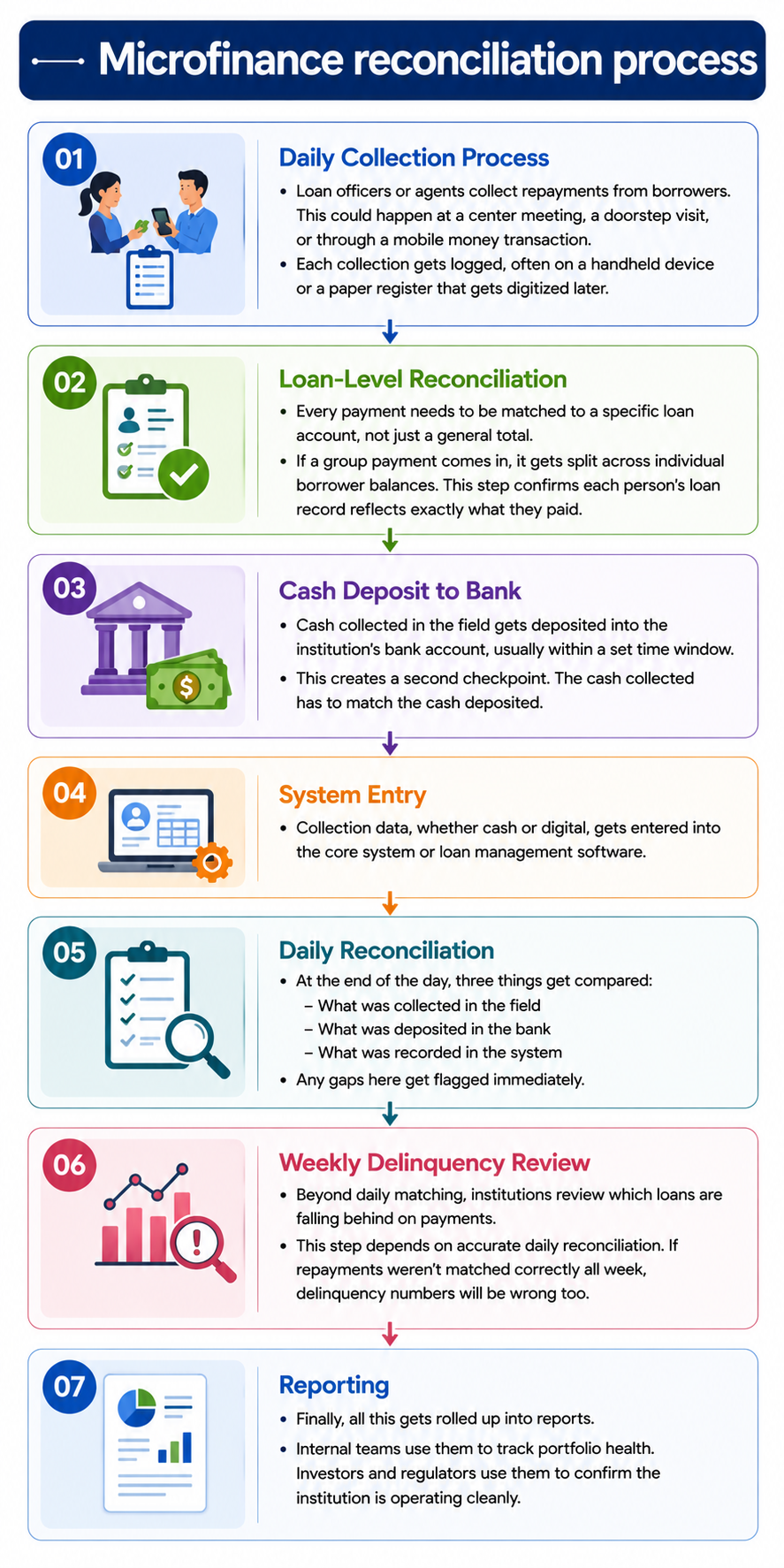
Reconciliation in microfinance is a sequence of steps that repeats every single day.
1. Daily Collection Process
Loan officers or agents collect repayments from borrowers. This could happen at a center meeting, a doorstep visit, or through a mobile money transaction.
Each collection gets logged, often on a handheld device or a paper register that gets digitized later.
2. Loan-Level Reconciliation
Every payment needs to be matched to a specific loan account, not just a general total.
If a group payment comes in, it gets split across individual borrower balances. This step confirms each person's loan record reflects exactly what they paid.
3. Cash Deposit to Bank
Cash collected in the field gets deposited into the institution's bank account, usually within a set time window.
This creates a second checkpoint. The cash collected has to match the cash deposited.
4. System Entry
Collection data, whether cash or digital, gets entered into the core system or loan management software.
5. Daily Reconciliation
At the end of the day, three things get compared:
- What was collected in the field
- What was deposited in the bank
- What was recorded in the system
Any gaps here get flagged immediately.
6. Weekly Delinquency Review
Beyond daily matching, institutions review which loans are falling behind on payments.
This step depends on accurate daily reconciliation. If repayments weren't matched correctly all week, delinquency numbers will be wrong too.
7. Reporting
Finally, all this gets rolled up into reports. Internal teams use them to track portfolio health. Investors and regulators use them to confirm the institution is operating cleanly.
Example of Microfinance Reconciliation
Let's walk through a simple example to see how this actually plays out.
A microfinance institution has a group of 8 borrowers in a small lending circle. Each one owes a weekly repayment of $25. That's $200 total for the group.
A field agent visits, collects the cash, and notes it on a handheld device.
Here's what the agent's log shows after the visit:
- 7 borrowers paid $25 each, on time
- 1 borrower paid only $15, short by $10
Total cash collected: $190.
The agent deposits the $190 into the institution's bank account later that day.
Back at the office, someone enters the collection data into the loan management system. Each of the 8 loan accounts gets updated individually.
Now three things need to line up:
- Field log: $190 collected
- Bank deposit: $190 received
- System entries: 7 accounts marked paid in full, 1 account marked as $15 paid, $10 short
If all three match, the day closes clean.
Say the bank deposit only shows $180, not $190.
That's a $10 mismatch. Reconciliation flags it immediately, and now someone needs to figure out why.
Without daily reconciliation, this $10 gap could sit unnoticed. Multiply that across hundreds of agents and thousands of borrowers, and small gaps like this are exactly how revenue leakage adds up over time.
{{banner1}}
Microfinance Reconciliation Challenges
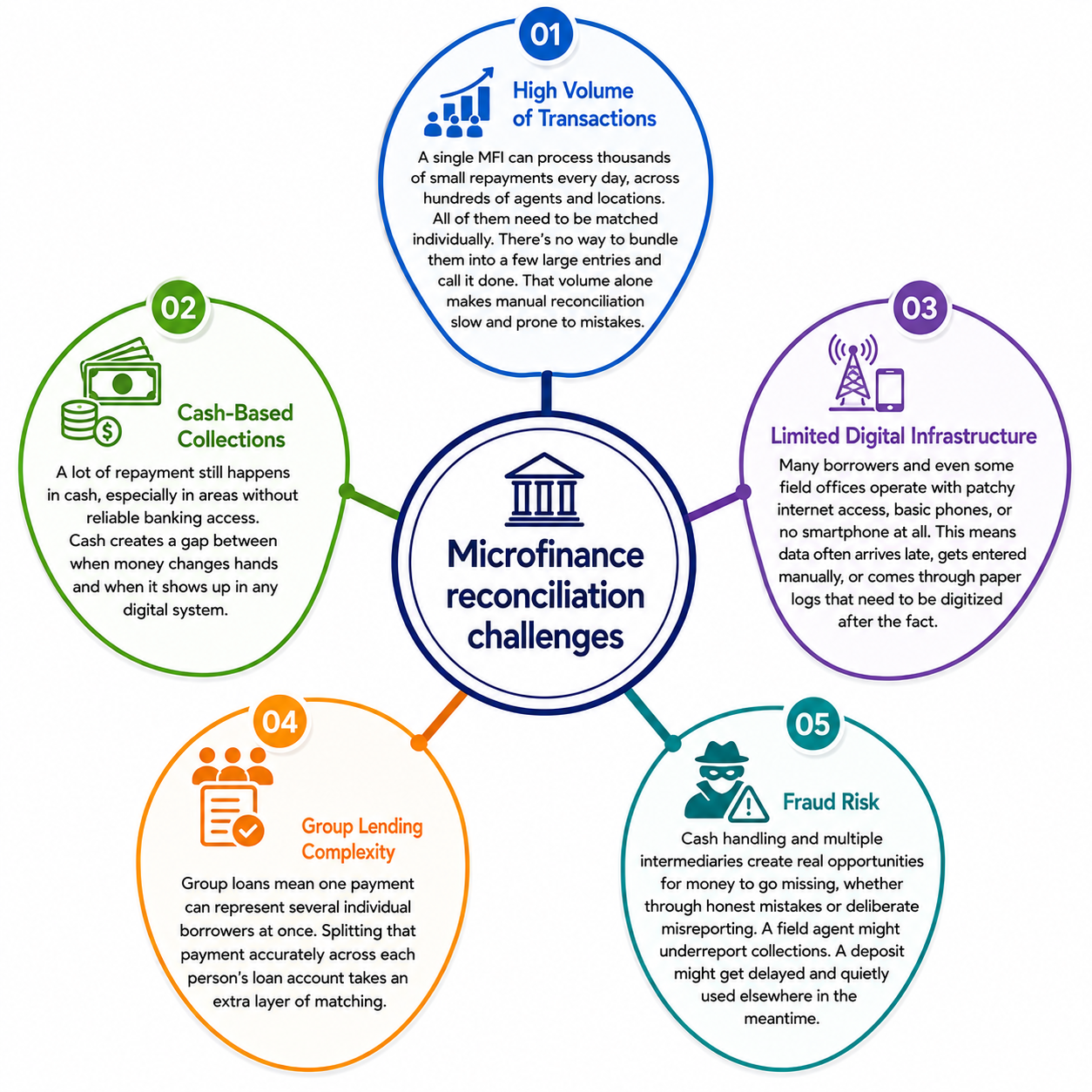
Microfinance reconciliation runs into a specific set of problems again and again, such as:
1. High Volume of Transactions
A single MFI can process thousands of small repayments every day, across hundreds of agents and locations.
All of them need to be matched individually. There's no way to bundle them into a few large entries and call it done. That volume alone makes manual reconciliation slow and prone to mistakes.
2. Cash-Based Collections
A lot of repayment still happens in cash, especially in areas without reliable banking access.
Cash creates a gap between when money changes hands and when it shows up in any digital system.
3. Limited Digital Infrastructure
Many borrowers and even some field offices operate with patchy internet access, basic phones, or no smartphone at all.
This means data often arrives late, gets entered manually, or comes through paper logs that need to be digitized after the fact.
4. Group Lending Complexity
Group loans mean one payment can represent several individual borrowers at once.
Splitting that payment accurately across each person's loan account takes an extra layer of matching.
5. Fraud Risk
Cash handling and multiple intermediaries create real opportunities for money to go missing, whether through honest mistakes or deliberate misreporting.
A field agent might underreport collections. A deposit might get delayed and quietly used elsewhere in the meantime.
How Osfin Automates Microfinance Reconciliation
Microfinance reconciliation involves messy, high-volume, multi-source data. Doing that manually doesn't scale. This is exactly the kind of problem Osfin is built to solve. Its core reconciliation engine is built around the same demands microfinance creates. Scattered data formats, huge transaction volumes, and the need for fast, accurate matching.
Step 1: Bringing the data together
Before any matching can happen, all that scattered data needs to land in one place.
Osfin connects to over 170 systems and data sources, so it doesn't matter if information is coming from a field agent's app, a mobile wallet provider, or a bank statement. The platform is built to handle different file formats without forcing everything into one rigid template first.
It also does some cleanup before reconciliation even starts.
- It applies tolerance settings to filter out low quality or clearly broken data early.
- It catches duplicate entries and unusual outliers right at the point of ingestion.
Step 2: Matching it all up
Once the data is in, Osfin runs the actual matching logic. And this is where microfinance's biggest quirk, group lending, gets handled well.
Osfin's matching engine supports many-to-one and one-to-many transaction matching, along with multi-way reconciliation across two, three, four, or even five different sources at once.
So a single deposit from a lending group can be automatically split and checked against each individual loan balance, instead of someone doing that math by hand.
The platform is also built for speed. It can reconcile 30 million records in about 15 minutes, which matters a lot when you're processing thousands of small transactions daily.
Step 3: Catching what doesn't match
Some transactions won't match cleanly, and that's expected.
When that happens, Osfin flags the unmatched transaction and attaches a reason for why it didn't match. From there, it routes the issue to the right team member automatically through a built-in ticketing system.
Teams also get live dashboards showing what's matched, what's still open, and where financial exposure currently sits.
Step 4: Closing the loop
The final piece is making sure all this work leaves a clean trail behind it.
Osfin generates audit ready reports with full transaction history, so when a funder, auditor, or compliance team asks for proof, it's already there. All the steps in the process are traceable back to its source.
Security sits underneath all of this too. Osfin uses 256-bit encryption, maker checker workflows, role-based access, and two-factor authentication, and it aligns with standards like SOC 2, PCI DSS, ISO 27001, and GDPR.
Best Practices for Microfinance Reconciliation
Good reconciliation doesn't happen by accident. It comes down to a few consistent habits, applied every day without exception.
Reconcile daily
The longer a gap sits unnoticed, the harder it gets to trace. A $10 mismatch is easy to investigate the same day. It's much harder to track down three weeks later, after dozens more transactions have piled on top of it.
Match at the individual loan level
Group totals can look fine even when individual accounts are wrong. If a group of 8 borrowers owes $200 and the institution receives $200, that looks clean on the surface.
But what if one borrower overpaid and another underpaid by the same amount? The total hides the problem. Reconciliation needs to happen at the loan level to catch this kind of thing.
Standardize data collection in the field
Agents using different formats, different devices, or inconsistent logging habits make reconciliation harder than it needs to be.
Setting clear standards for how field data gets captured, and digitizing it as early as possible, reduces the cleanup work later.
Keep documentation audit ready at all times
Funders, auditors, and regulators don't usually give much notice before asking for records.
Maintaining clean, traceable documentation as part of the daily process, rather than scrambling to assemble it later, saves time and protects credibility when it's needed most.
{{banner1.1}}
FAQs
1. Why is reconciliation harder for microfinance institutions than banks?
Microfinance involves high transaction volumes, cash collections, group lending, and limited digital infrastructure. These factors create more data sources and more room for mismatches compared to traditional banking.
2. How often should microfinance institutions reconcile transactions?
Daily reconciliation is best practice. Waiting longer makes small errors harder to trace and allows mismatches to accumulate, eventually distorting portfolio health and delinquency reporting.
3. What causes most reconciliation errors in microfinance?
Cash handling delays, inconsistent field data formats, and group payments that need splitting across multiple borrower accounts are common causes. Limited connectivity in remote areas adds further delays.
4. Can reconciliation help prevent fraud in microfinance?
Yes. Consistent reconciliation surfaces unusual patterns, like repeated mismatches tied to one agent, early. This makes fraud or systemic errors easier to catch before losses grow significant.