What Is Mortgage Reconciliation?
Of all the consumer debt in the U.S., mortgages alone account for 70.1% of it. For banks and lending institutions, this is also the most complex loan to service and reconcile. Mortgage load repayments don’t just consist of principal balances and interest but also escrow deposits for insurance and tax. And with the increasing securitization, investor reports and updating the loan portfolio add yet another burden on the lenders.
Each of these components increases the complexity of reconciliation for lenders. When any of them is handled incorrectly, their impact ripples across borrowers’ accounts, lenders’ books, and the financial reports made to regulatory authorities.
With this article, we aim to understand what mortgage reconciliation is, how it is performed, some common issues faced by borrowers and also how Osfin’s automation platform can enhance the reconciliation process for lenders.
Key Notes
- Mortgage reconciliation is the process of verifying that every mortgage loan transaction recorded in the loan servicing system matches the lender’s general ledger.
- It is important to maintain financial accuracy, stay compliant with regulations, deliver accurate loan portfolio reports to investors, and manage default-related risks.
- Shortfall and surplus in escrow, errors in interest rate, changes in tax estimates, complications with refinancing and adjusting assumable mortgages are some of the common issues faced in mortgage reconciliation.
- Osfin enhances mortgage reconciliation by automating the whole process and matching high volumes of complex mortgage data with 100% accuracy at lightning-fast speed.
What is Mortgage Reconciliation?
Mortgage reconciliation is the process of verifying that every financial transaction related to mortgage loans recorded in the loan servicing system matches those recorded in the lender's general ledger. This would include accurately recording and matching borrowers’ EMI payments, principal balances, interest accruals and funds moved to escrow accounts.
For example, if a borrower pays a $2100 EMI per month on their mortgage, $1050 goes towards the principal, $800 goes towards interest, and the remaining $250 is deposited in an escrow account to pay property taxes and insurance. Mortgage reconciliation ensures that each amount is accurately recorded in the loan servicing system and matches the numbers in the bank’s general ledger.
It should be noted that the principal amount and interest payments vary with each EMI as per the amortisation schedule. Changes can also occur in tax rates and insurance premiums, which require the borrower to adjust their EMI accordingly.
Why is Mortgage Reconciliation Important?
A lender’s task doesn’t end at collecting repayments from borrowers; rather, it is only after this that their task burden increases. Banks and lending institutions have to ensure that payments recorded in the loan servicing system match those in their general ledger. The purpose of mortgage reconciliation is realized with tasks that require banks to maintain this accuracy. These tasks include the following:
1. Financial Accuracy
Mortgage loans are a long-term commitment, as each loan lasts 15-30 years. Errors in either applying payments to principal and interest balances or recording escrow deposits can pile up over time, affecting the borrowers' outstanding balances and the lender's books.
2. Regulatory Compliance
Banks and other lending institutions are obligated to report their income and other financial statements to the regulatory authorities. It must ensure that the numbers mentioned in these reports reflect the actual financial position of the lender.
3. Investor Reporting
Banks that have securitized their mortgage loans create and update loan portfolios, which are given to investors to assess the risk and prices of the asset-backed securities. These loan portfolios must accurately reflect collected repayments, outstanding balances and delinquency days.
4. Risk Management
Whenever a bank extends credit, they run the risk of losing money. Effective mortgage reconciliation ensures that delinquency days and defaults in the repayments are accurately recorded in the loan servicing systems, so that banks can identify them and take appropriate risk mitigation methods to recover the loan.
What Gets Reconciled in Mortgages

A bank or lending institution aiming to run comprehensive mortgage reconciliation must include the following components in the process:
1. Monthly Repayments
In a mortgage loan, a borrower makes a fixed EMI payment every month on the same due date. In reconciliation, this amount is matched with the scheduled payment amount. Any shortfall or overpayment needs to be investigated by the lender.
2. Principal and Interest Amount
In a repayment, a portion goes towards paying the principal balance and the other towards interest. These portions must be allocated as per the amortization schedule of the mortgage.
3. Escrow Deposits
In most mortgage loans, the lender maintains an escrow account for the borrower. These deposits in these escrow accounts are made through a part of the repayments, which go towards paying property tax and insurance premiums. Lenders need to ensure that escrow accounts have sufficient funds to make these payments.
{{banner1}}
Mortgage Reconciliation Process
A typical mortgage reconciliation carried out by banks and lending institutions consists of the following steps:
1. Verify Payment Received
The lender has to verify that the borrower has paid the full monthly EMI on the scheduled due date. This repayment should then be applied to the appropriate loan account.
2. Split Payment to P&I and Escrow
Each EMI in a mortgage loan is split between the principal balances, interest, and escrow deposits. The principal and interest payments change in each EMI and should be applied accordingly as per the amortization schedule.
3. Verify Escrow Calculations
Lenders need to confirm that the escrow deposits are sufficient to pay tax and insurance premiums. If a shortage or overage is observed in escrow accounts due to a change in tax or insurance policy, the lender should inform the borrower of the same to make necessary payment adjustments.
4. Verify Outstanding Balances
With each repayment, the outstanding balance of the borrower decreases. Lenders must verify that these balances are accordingly calculated and adjusted in the loan servicing system and the general ledger.
Escrow Account in Mortgage Reconciliation
Most of the fields in mortgage loans follow a consistent pattern and are easier to reconcile. It is the escrow accounts that throw off the momentum of the reconciliation team and add complexity to the task, as they require constant monitoring across the following dimensions:
1. Taxes
Lending institutions or the loan servicer calculate an estimated property tax amount based on the current policy and accordingly determine the monthly escrow amount that goes towards this payment. However, these estimates can go wrong if the tax policy changes mid-year.
2. Insurance
Similar to taxes, insurance premiums are calculated at the start of the year, and monthly escrow payments are determined accordingly. But if the borrower changes their insurance partners mid-year, the lender would need to make adequate adjustments to escrow deposits.
3. Shortfall and Surplus Adjustments
Changes in tax policy or insurance partners can cause your escrow account to either lack sufficient funds or have more required funds for paying property tax and insurance premiums.
For a shortfall, banks can ask the borrower to make the full payment at once or spread the amount over time and add it to the mortgage payments. In the event of a surplus, lenders can either refund the excess to the borrower or apply it to future collections.
4. Disbursement to Tax and Insurance Providers
Lenders have to disburse the deposits made in escrow accounts to the tax authorities and insurance partners as per the schedule. These transactions should be recorded in the lender’s internal system and reconciled with the general ledger.
{{banner1.1}}
Common Issues in Mortgage Reconciliation
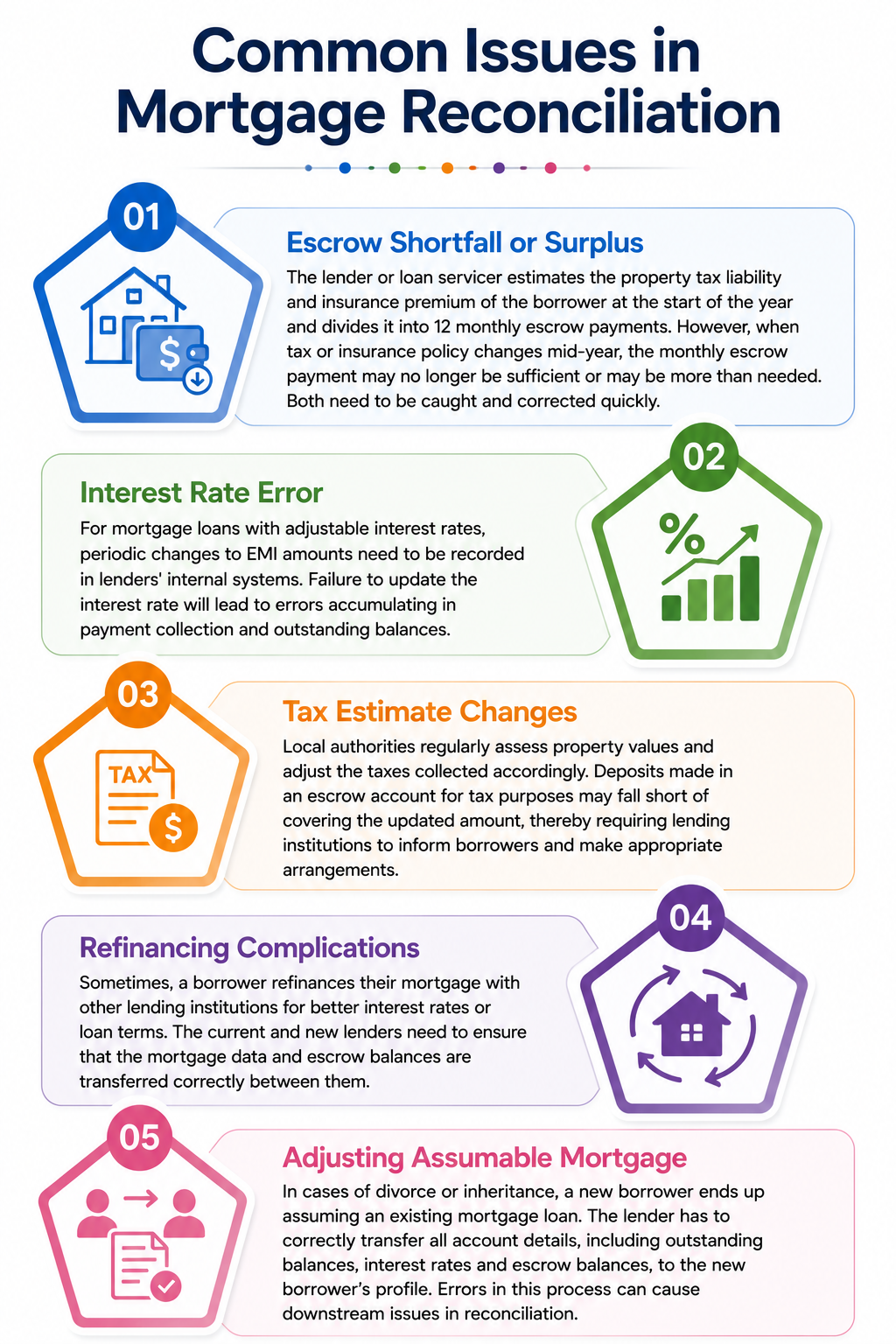
Each component of mortgage reconciliation adds varying degrees of complexity in the process. When lenders carry it out manually, they often come across the following issues:
1. Escrow Shortfall or Surplus
The lender or loan servicer estimates the property tax liability and insurance premium of the borrower at the start of the year and divides it into 12 monthly escrow payments. However, when tax or insurance policy changes mid-year, the monthly escrow payment may no longer be sufficient or may be more than needed. Both need to be caught and corrected quickly.
2. Interest Rate Error
For mortgage loans with adjustable interest rates, periodic changes to EMI amounts need to be recorded in lenders' internal systems. Failure to update the interest rate will lead to errors accumulating in payment collection and outstanding balances.
3. Tax Estimate Changes
Local authorities regularly assess property values and adjust the taxes collected accordingly. Deposits made in an escrow account for tax purposes may fall short of covering the updated amount, thereby requiring lending institutions to inform borrowers and make appropriate arrangements.
4. Refinancing Complications
Sometimes, a borrower refinances their mortgage with other lending institutions for better interest rates or loan terms. The current and new lenders need to ensure that the mortgage data and escrow balances are transferred correctly between them.
5. Adjusting Assumable Mortgage
In cases of divorce or inheritance, a new borrower ends up assuming an existing mortgage loan. The lender has to correctly transfer all account details, including outstanding balances, interest rates and escrow balances, to the new borrower’s profile. Errors in this process can cause downstream issues in reconciliation.
How Osfin Automates Mortgage Reconciliation
The complex nature of mortgage reconciliation makes manual processes particularly slow and error-prone. Osfin’s automation platform is built to handle such complex transactions and reconcile them with 100% accuracy. The following points explain how Osfin streamline mortgage reconciliation for you:
1. Data Ingestion
As a file format-agnostic platform with 170+ integrations, Osfin can extract mortgage-related data from any source, regardless of format. It applies custom deviation tolerance in the ingestion stage itself to filter out duplicates and outliers, which may have caused downstream issues.
2. Reconciliation
Osfin uses logic-based matching rules that can handle one-to-many, many-to-one and multi-way reconciliation, including two-way, three-way, four-way and five-way. This is a lightning-fast process as Osfin can reconcile 30 million transactions in just 15 minutes.
3. Exception Handling
For the transaction that doesn't match, Osfin’s ticketing and exception-handling engines automatically flag them, assign them the correct reason and route them to the correct team members for review. It comes with intuitive dashboards that give you a real-time view of match status and exception queues.
4. Output
Once the reconciliation process completes, Osfin delivers a compliance report and maintains audit-ready workflows with complete traceability and transaction history. It keeps your data secured with 256-bit encryption, role-based access and two-factor authentication. And its global compliance certification, including SOC 2, PCI DSS, ISO 27001 and GDPR, further ensures that your reconciliation process holds up to regulatory scrutiny.
Wrapping Up
Mortgage loans make up a huge portion of a lending institution’s consumer loan portfolio. Each mortgage adds varying degrees of complexity to the reconciliation, slowing down the whole process and even exposing it to a high error rate.
But with Osfin automating mortgage reconciliation, banks and lending institutions can streamline the process and be assured of 100% accuracy. Book a demo now!
FAQs
1. What is the purpose of mortgage reconciliation?
The purpose of mortgage reconciliation is to ensure the financial accuracy of records in the loan servicing system and the general ledger, stay compliant with regulatory reporting, deliver correct details to investors of asset-backed securities, and adequately manage delinquency and default risk.
2. How do escrow accounts increase the complexity of mortgage reconciliation?
Escrow accounts collect deposits for paying property taxes and insurance premiums. At the start of the year, lenders calculate the amount allocated to these payments and divide it over 12 months. However, changes in tax policy or insurance partners can skew the lender’s estimates, leading to a shortfall or surplus in escrow accounts.
3. What components are typically considered in mortgage reconciliation?
Components typically reconciled in a mortgage reconciliation include the monthly payments made by the borrower, the proportion of payments that go toward principal and interest balances, and the deposits made into the escrow account.
4. What issues are commonly observed in mortgage reconciliation?
The issues commonly observed by teams working manually on mortgage reconciliation include shortfalls or surpluses in escrow deposits, errors in interest rates, changes in tax estimates, complications with refinancing, assumptions or new-borrower adjustments.