10+ Best Finance Automation Tools in 2026
TL;DR
- Finance operations play a critical role in deciding how smoothly a business will run. But they are complex and prone to errors. They require long hours dedicated to manually inserting data and matching it with internal systems
- Automated finance software has changed this picture with its ability to automatically capture transactions and reconcile them, all while staying compliant with regulations.
- This article explores the different finance automation tools, such as Osfin, Numeric, Xero, etc. and what features make them stand out. This will help you choose the one that best fits your business needs while providing quality in handling your financial operations.
Still spending hours tracking invoices, reconciling spreadsheets, or entering data? More than wasting time, you could be leaving the door open for errors that can cause problems later. Not to mention, manual processes keep your team stuck in the weeds instead of doing work that actually moves the business forward.
That's where finance automation tools come in. They provide speed, reduce errors, and give your team the time to focus on more important tasks.
But which tool should you consider? We'll help you narrow down your choices with the top options you can explore in 2026.
What is Finance Automation?
Finance covers many operations, such as accounting, budgeting, cash flow management and forecasting. At its core, financial operations involve recording transactions, reconciling payable & receivables data, resolving outliers, and maintaining audit trails of every action for compliance purposes. They play a significant role in a business's financial planning and policy-making.
For the longest time, these operations have been performed manually by finance teams, keeping them on tenterhooks while they chase month-end closing. Not only is it prone to human error, but it also takes time away from better resource planning and business growth.
Finance automation has changed the rules of this game. This AI-enabled technology automatically captures every transaction, reconciles them with internal data and delivers valuable insights about business performance. Finance automation tools can easily resolve recurring errors and duplicates in the data, while directing only the complex ones to finance teams. They have been proven to shorten month-end close timelines and allow finance teams to focus on what matters most.
What Makes the Best Finance Automation Platform?
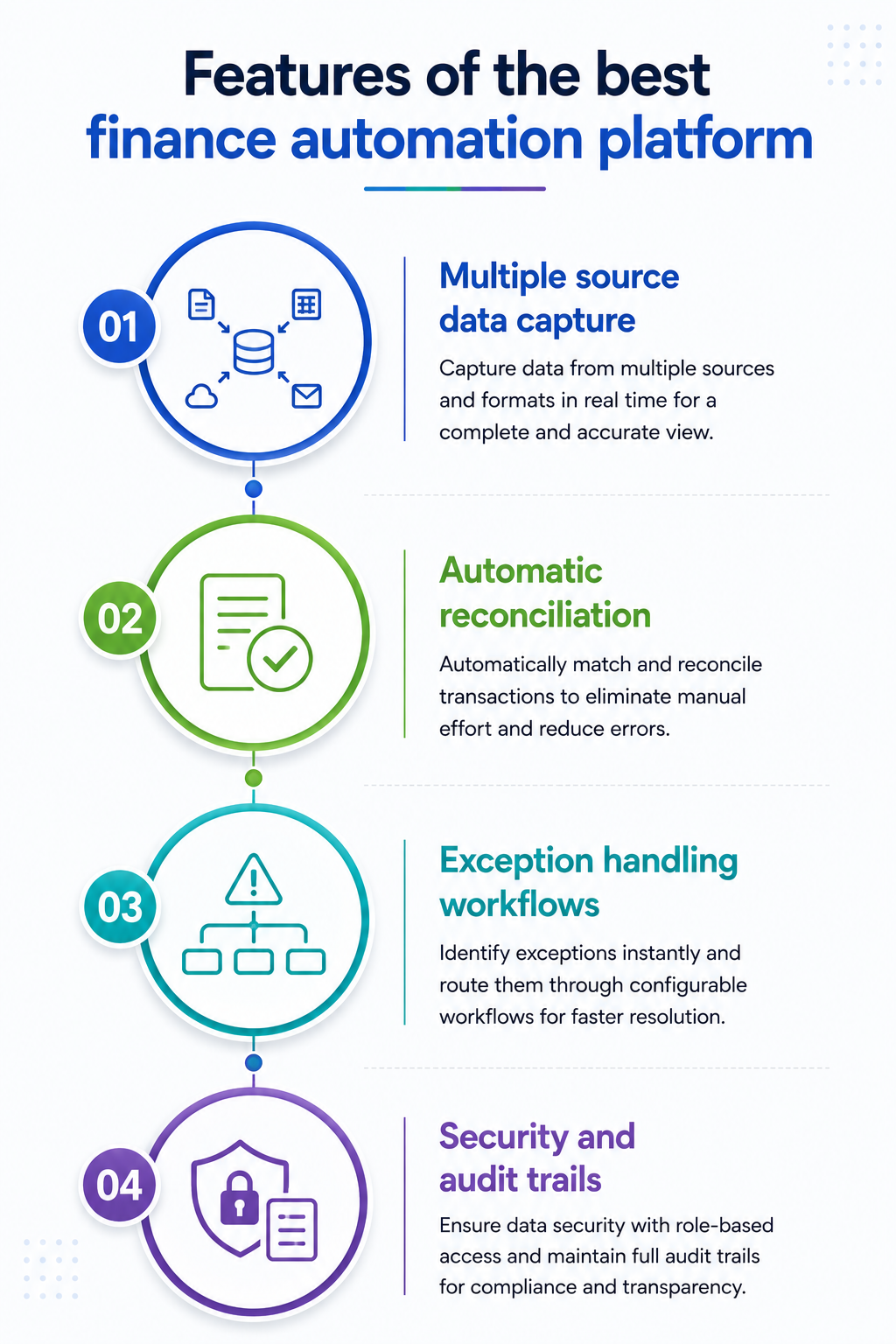
While there are many options for finance automation tools, the right one can only be determined by considering your business needs and operational scale. But even then, the best finance automation platform shares some common features. These are:
1.Multiple Source Data Capture
Automated financial platforms must be able to import data from multiple sources, such as ERPs and banking platforms, and filter out poor or duplicate data during ingestion.
2.Automatic Reconciliation
The most complex and error-prone task in financial operations is reconciling data. A good platform would automate this process using pre-configured rules to perform multi-way matching.
3.Exception Handling Workflows
Many anomalies and discrepancies arise during the reconciliation process. Investigating the source of these breaks can consume a lot of time for finance teams. Finance automation tools should have the capacity to handle all such recurring and straightforward discrepancies while directing the complex ones to the team.
4.Security and Audit Trails
Sensitive financial data must be protected by the platform through encryption and role-based access controls. It should help you stay audit-ready by keeping logs of every transaction with a time-stamp and user ID.
10+ Best Finance Automation Tools in 2026
We have created a list of 10+ automation platforms to help you find the one suitable for your business needs.
1.Osfin.ai
Osfin is a global financial operations platform that serves enterprises across banking, payments, fintech, insurance, capital markets, gaming platforms, and retail. It eliminates manual reconciliation, speeds up data ingestion and matching, reduces revenue leakage, and provides real-time cash flow visibility through its intuitive dashboards and reporting.
Osfin can handle multi-entity and multi-channel operations, including SKU-level visibility, state-wise charges and taxes, multi-gateway payment flows, and multi-channel retail transactions. It streamlines the workflow of finance teams with lightning-fast ingestion, matching and output delivery.
Key Features
- File format agnostic platform that supports 170+ integrations with banks, ERPs, ledgers, and internal databases.
- Handles one-to-many, many-to-one transactions and multi-way reconciliations, such as two-way, three-way, four-way and five-way.
- Applies custom deviation tolerances to detect outliers and exceptions, routing them to the appropriate team member.
- Intelligent interface gives actionable insights into financial data.
- Compliant with SOC 2, PCI DSS, ISO 27001, and GDPR requirements.
2.Numeric
Numeric is an AI-powered financial close platform. It caters to various industries like banks, fintech, financial companies, etc. and streamlines their month-end accounting. Numeric automates journal entries and provides collaborative dashboards for smooth team collaboration.
Key Features
- AI-rules match transactions and send an alert for anomalies.
- Automates reconciliation, drafts flux explanations, and identifies core drivers of variance.
3.Solvexia
Solvexia is a no-code automation platform that streamlines reconciliation, payment approvals, actuarial processes, and various time-consuming tasks. It is used by insurers, investment managers, banks, FMCG, etc.
Key Features
- Supports multiple formats of data, including Excel, JSON, XML, etc.
- Performs rule-based matching for high-volume transactions within minutes
- Provides structured workflows that support approvals, reviews and audit trails.
- Code-free configuration allows users to build, modify, and maintain automated processes.
4.HighRadius
HighRadius is a financial close management platform built for large, multi-entity organizations. It uses agentic AI to sync GL, sub-ledger and external systems. It’s an ERP-agnostic platform that delivers actionable insights and financial excellence. Its primary products include Order-to-Cash (O2C), treasury management, and credit/cash collection.
Key Features
- Uses pre-built AI to automate key close and reconciliation tasks.
- Analyses data to recommend data-driven decision making.
- Reduces AP function through touchless invoice processing, compliance checks, and smart supplier communication.
- Streamlines treasury payments, provides cash visibility, and forecasting that unlock liquidity potential.
5.Stampli
Stampli is an AI-driven financial operations platform. It delivers end-to-end capabilities across payments, corporate cards, accounts payable, etc. It adapts to finance teams' workflows and embeds directly into ERP systems. Stampli drives business growth and process efficiency by automating core finance tasks.
Key features
- AI assistant, Billy the Bot, learns cost accounting roles and business processes that automate manual AP processes.
- Automatic 2-way and 3-way matching at the line level that reduces exceptions and speeds reviews.
- Keeps a complete audit trail by preserving an immutable record of every action, change, approval, and communication.
6.Vena
Vena is committed to providing businesses with innovative finance planning and analysis solutions. It is an AI-powered planning platform within the Microsoft ecosystem. It empowers teams with technology to gain actionable insights and drive better business outcomes by aligning resources accordingly. Vena uses a 100% native Excel interface that significantly reduces the learning curve for organizations.
Key Features
- Directly connects with existing systems and automatically consolidates data in one central location.
- Pre-built templates and an intuitive reconciliation checklist speed up financial close management.
- Provides smart security by letting you control user access with data permissions.
7.Blackline
Blackline is a cloud-based financial operations management platform that empowers businesses to achieve digital transformation. It enables efficient workflows by unifying data and processes, automating repetitive tasks and enhancing accountability through greater visibility. Blackline provides solutions for financial close, accounts receivable, and intercompany accounting to large and mid-sized companies.
Key features
- Ingest transaction-level data from third-party systems such as ERPs, banks, payroll providers, lease accounting, etc.
- Account validation, threshold-based approvals, and end-to-end audit trails ensure compliance and mitigate risks.
- Real-time dashboards improve visibility across financial close tasks that help avoid bottlenecks and catch overdue tasks.
8.FreshBooks
FreshBooks streamlines financial operations with its cloud-based accounting platform. It is designed for small businesses in sectors like IT, creative, legal, marketing, construction, etc. Its features include invoicing, expense management, time-tracking, and financial reporting. FreshBooks streamlines billing and payments by automating processes like recurring invoices, accepting online payments, and setting up late payment reminders.
Key Features
- Creates auto-recurring invoices and payment reminders.
- Advanced reporting helps gain financial insights and track revenue, expenses, profit & loss.
- Provides a detailed record of all system activity for accountability and compliance purposes.
- Identifies potential errors before finalizing financial statements.
9.FloQast
FloQast streamlines end-to-end accounting operations. It reduces deadline-oriented stress by providing the accounts team with real-time, top-down insights into goals, tasks, and bottlenecks. FloQast leverages AI for close management, reconciliation, and compliance activities, improving your overall accuracy, visibility, and collaboration.
Key Features
- Uses AI to customize and streamline transaction matching.
- Auto-detects variance drivers and writes flux explanation.
- Direct integration with leading ERP systems like Oracle NetSuite, SAP, and Xero.
10. Xero
Xero is a cloud-based accounting platform that primarily targets small businesses. It streamlines bookkeeping processes and simplifies financial management while ensuring compliance with regional tax regulations.
Key Features
- Automates data ingestion from multiple sources, including banks and e-commerce platforms.
- Adapts to user patterns for bookkeeping and simplifies it to a click-to-confirm operation that automatically inputs data.
- Facilitates faster payments with customizable online invoices with integrated “pay now” buttons.
11.BILL AP/AR
BILL is designed to streamline the financial operations of small and mid-sized businesses. It digitizes and automates invoice capture, reconciling transactions, scheduling payments, and managing expense reports. BILL facilitates accurate bookkeeping and provides greater visibility and control over a company’s cash flow.
Key Features
- Automatically codes multi-line items and captures the key invoice fields with accuracy.
- Tailors workflow approvals to business rules while handling the routing itself.
- Predictive AI detects suspicious activity and fraud by monitoring transactions.
Why Do Most Finance Automation Tools Fall Short?
Most finance process automation tools promise to deliver prominent results, but end up failing miserably. They offer many features yet lack depth, or they are simply not suited to scale with your business needs. Some of these shortcomings are:
- Some finance automation platforms are unable to connect with existing ERPs, banks, and payment systems. In other cases, it can only capture data in a certain format. This creates data silos, requiring the team to manually enter data in the system, which consequently defeats the purpose of investing in a finance automation tool.
- Limited matching capabilities are yet another challenge in finance automation. These platforms programs only perform basic two-way or three-way matching, which is not sufficient to detect transaction variance or fraud.
- A financial automation platform may not always fit the operational scale of a business. Some are designed to handle complex transactions for large businesses, while others are specifically designed for small businesses and cannot handle voluminous data.
Where Osfin Fits in the Finance Automation Stack
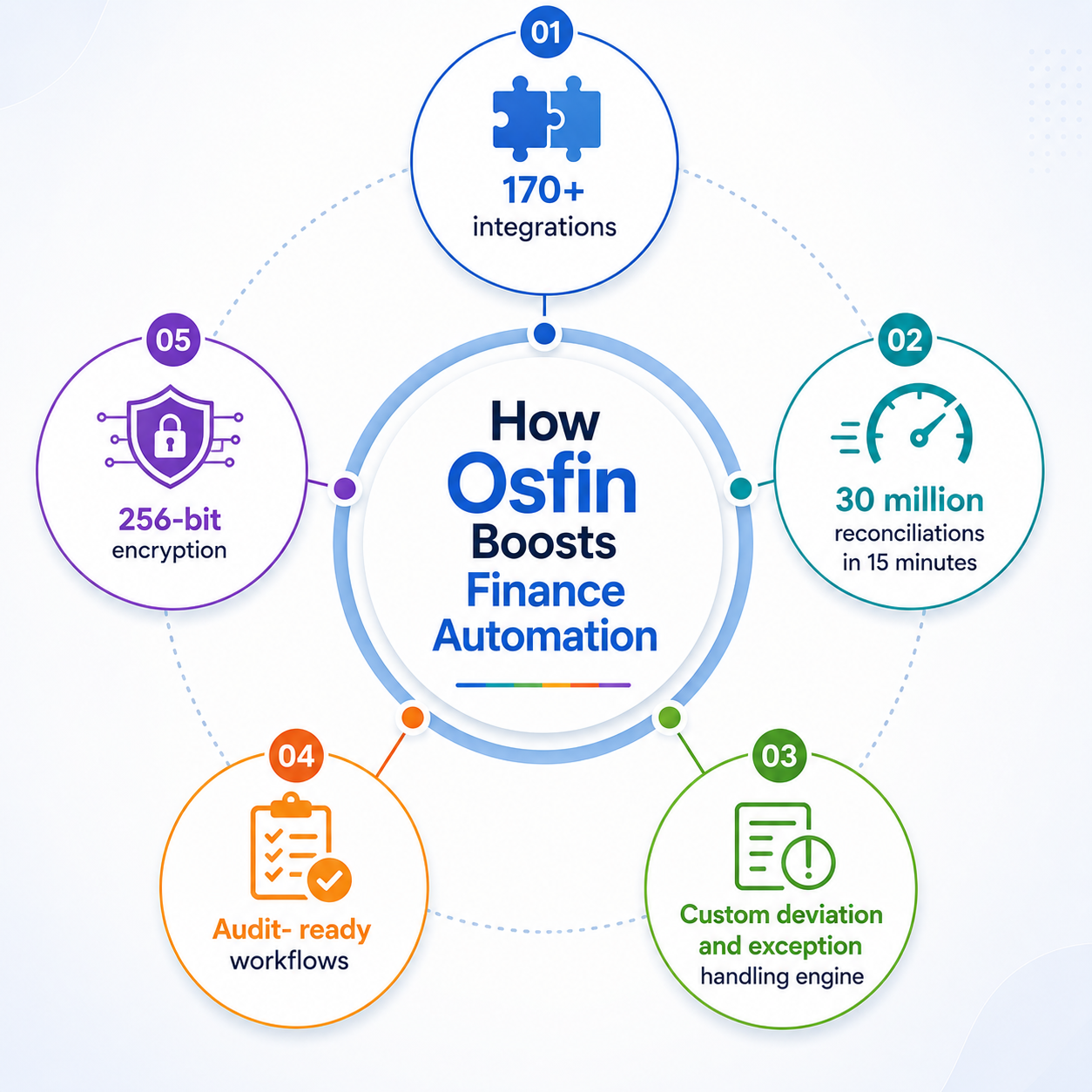
Osfin provides cutting-edge finance automation solutions for businesses that handle high-volume, complex financial transactions. It streamlines your finance operations and brings greater efficiency, accuracy, and clarity. Osfin’s capability can be measured in the following functions:
1.Data Ingestion
Being a file-format-agnostic platform, Osfin can process data in formats such as XML, PDF, DOCX, etc. It offers streamlined integration with 170+ connectors to ERPs, ledgers, banks, payment gateways, and internal databases.
2.Reconciliation
Osfin performs 30 million reconciliations in 15 minutes with 100% accuracy. It can handle one-to-many, many-to-one, and multi-way reconciliations such as two-way, three-way, four-way, and five-way.
3.Exception Handling
Osfin applies custom deviation tolerances to filter out discrepancies and automates resolution. The remaining anomalies are assigned accurate reasons and routed to the appropriate team member via the ticketing and exception handling engine.
4.Insightful Reports
Osfin provides comprehensive dashboards with live status for cash flow, payout validation, exception tracking, and performance insights across systems and partners. It makes compliance easy by maintaining audit-ready workflows with complete traceability and transaction history.
5.Security
Osfin understands the need for security in financial operations. It ensures security with 256-bit encryption, maker-checker flows, role-based access, and two-factor authentication. It also complies with PCI DSS, SOC 2, GDPR and ISO 27001 requirements.
{{banner1}}
How to Choose the Right Finance Automation Tool?
A business invests in a finance automation tool to fulfil its need for speed and accuracy in its operations. It is only natural that the finance process automation platform you choose can:
- Seamlessly integrate your ERP platforms, such as Oracle, NetSuite, SAP, and non-ERP platforms like bank and credit feeds.
- Capture data in multiple formats and reduce your burden of manually entering data.
- Detect fraud and anomalies in data and direct them to the right team member.
- Scale with your business and handle a large volume of transactions.
- Offer strong security features.
The Future of Finance Automation
Finance automation is rapidly evolving and poised to change the way finance teams operate. Some of these changes are:
- AI Adoption: AI is proving to increase the performance of finance operations. It continually reduces manual intervention in reconciliation, error detection, and month-end closing.
- Real-Time Forecast: Finance automation paves the way for businesses to move from static planning to making rolling forecasts that adapt to changing dynamics.
- Cloud-Nativity: Rather than building their own finance automation platforms, businesses are moving towards cloud platforms. Faster deployment cycles, lower infrastructure costs, and greater scalability are the reasons for its adoption.
Wrapping up
For the longest time, finance operations have been a headache for businesses. It requires long hours dedicated to repetitive, manual work that doesn’t hold much value in itself but can lead to significant losses in case of errors. Finance automation platforms change that.
The best tools grow with your business, handle high-volume transactions, and connect with the tools you already use. That's where Osfin stands out. With its 170+ integrations, 100% reconciliation accuracy, intelligent insights and 256-bit data encryption, it is built for finance teams that need complete visibility and accuracy.
Ready to see what that looks like in practice? Book a demo today!
FAQs
1.What is finance automation platform?
Finance automation platform is the technology that performs key financial operations by automatically capturing data from multiple sources, reconciling it, and providing valuable insights into business performance.
2.How to select the best financial automation platform?
To select the best financial automation platform, you must consider its integration capabilities, supported data formats, exception handling capabilities, and security measures.
3.What are the top finance automation tools?
There are many finance automation tools out there, but the top ones include Osfin, Xero, and Blackline.