FloQast Pricing: Cost & Plans Explained
Most organizations today are prioritizing speed as much as accuracy. In fact, Gartner research reveals that about 60% of CFOs are scaling their automation and AI investments by 10% or more to shorten their financial cycles.
As the global accounting software market grows to a projected $42 billion by 2032, automated reconciliation platforms have now become an intelligent strategy rather than a convenient choice.
In this guide, we explore the features, packages, and costs of one such accounting transformation platform, FlowQast, and compare it with more product-led alternatives like Osfin, so you can understand which suits your business needs.
What is FloQast?
FloQast is an accounting transformation platform that is powered by AI agents. It leverages automation and AI to streamline accounting workflows, including reconciliations, task management, and recordkeeping, for quicker month-end closures and audits.
It is generally used by medium to large-sized enterprises looking to shift from conventional processes like:
- Manual entries and workflows
- Spreadsheet reconciliations
- Email-based communication
- Fragmented ERP systems
FloQast brings all of these features in an audit-ready platform designed for structured accounting systems.
What Can You Do with FloQast?
The primary focus of FloQast is close management, along with connected compliance and accurate reporting. Here are some key capabilities of FloQast:
1. Close Management for the Month-End
FloQast supports end-to-end transformation of accounting workflows by automating checklists, progress tracking, and task assignments in a single dashboard, which helps finance teams with effective close management.
2. Automated Reconciliation
FloQast completely eliminates the need for manual spreadsheets through automated reconciliations and transaction matching. This process enhances productivity and improves accuracy.
3. Integrated Compliance
FloQast offers direct integrations with multiple ERP systems, reducing the need to log in to bank portals and simplifying the consolidation of your financial data into a single platform.
It also includes audit-ready documentation features like version control and approval workflows.
4. Reporting and Real-Time Analytics
FloQast integrates controls into existing workflows, such as Close and Ops. Control execution evidence syncs in real-time, giving compliance and audit teams visibility while ensuring control owners can mitigate risks and maintain reporting throughout.
5. Workflow Collaboration
With FlowQast’s modern interface, accounting teams can collaborate on task assignments, reconciliations, and approvals in real-time, supporting teamwork, accuracy, and clear role definitions.
FloQast Pricing Details: What We Know
FlowQast does not list complete pricing, which means you need to request a quote from their sales team to evaluate the exact costs. As pricing is customized, it depends on factors such as company size, ERP integrations, and more.
FloQast's Feature Breakdown by Pricing Tiers
While FloQast does not list transparent pricing packages, it generally follows a tiered structure that offers features suited to the model you choose, based on your business needs. Their common tailored packages include:
What Drives FloQast's Costs Up?
Apart from being a premium platform, there are also some other factors that can significantly drive your costs while considering FloQast. They are:
1. ERP integration: Integration and implementation costs are separate, which increases the overall cost, especially if you choose complex integrations.
2. Additional modules: Advanced features like AI automation or compliance management often require additional subscriptions.
3. Training sessions: Training and extra support packages may increase the overall pricing. Even though this is optional, basic training is required for accounting teams.
4. Customization: Organizations with more challenging workflows may require customization services based on their specific needs. This adds to the initial cost.
{{banner1}}
Is FloQast Pricing Negotiable?
Yes, FloQast pricing is generally negotiable because it is customized and not fixed. Financial institutions can negotiate pricing based on the following factors:
- Contract length
- Number of users
- ERP integrations
- Implementation scope
- Additional modules
Pros and Cons of FloQast
Like most automation tools, FloQast also comes with certain pros and cons with respect to functionality and implementation. They are highlighted in the table below:
FloQast's Strengths
FloQast is popular for a number of reasons as a close-management platform. Its major strengths include:
- Effective close management: FloQast really simplifies the month-end close process through automation, strong alerts, and centralized documentation. You can easily get visibility across all your reconciliations without any unnecessary dependencies.
- User-friendly interface: Its user-friendly and modern interface allows users to implement FloQast with basic training. Its intuitive UI helps accountants reduce timelines with fast adoption.
- ERP Integration: Its deep connectivity with multiple ERP systems and other accounting tools helps in holding the financial data and converting it into actionable workflows.
- Audit-ready reporting: FloQast unifies compliance, risk, and audit through continuous control accountability, centralized audit evidence collection and improved collaboration with teams. This helps your enterprise stay ahead of any risks with real-time monitoring.
FloQast's Weaknesses
- Limited pricing transparency: FloQast does not publish its full pricing structure, which can make it difficult for businesses to evaluate costs. It generally follows a tiered format, but the final cost can only be determined on request and specific needs.
- Performance and Implementation: There could be occasional slow data refresh rates while dealing with large volumes of data. Managing complex, multi-entry reconciliations could be accompanied by a few functionality gaps.
- Higher costs for smaller teams: FloQast is generally considered a premium product, so costs can be higher for smaller accounting teams. They also may not have access to all the advanced features in the business plan.
- Limited support: Complex reconciliations might not have much support to rely on. Additionally, while automating, FloQast still uses some Excel-based processes, which may lead to some manual dependencies.
When Should You Reconsider FloQast?
FloQast can be a good choice for financial organizations trying to structure their close management, but it may not be the right fit if you have requirements like:
- Processing millions of transactions frequently
- Reconciliation with higher accuracy is your main focus
- You need multi-party systems
- You want exception handling that can detect as well as reroute
- Your accounting team needs more data visibility
In these cases, dedicated reconciliation platforms may provide more scalable automation.
{{banner1.1}}
A Better Alternative: Osfin for Product-Led Growth
For enterprises handling millions of complex reconciliations, large volumes of data, and transactions across multiple financial systems, Osfin offers a more effective approach that doesn't compromise efficiency or accuracy.
Here is a clear comparison of all features:
Osfin is a Better Fit for Product-Led Growth
Product-led businesses, especially industries like fintech, banking, and other such financial institutions, often generate millions of transactions daily, which require reconciliations with both speed and accuracy.
These companies usually require:
- High-speed reconciliations across multiple systems
- Cross-system visibility and accountability
- Automated exception workflows with alerts
- Scalable infrastructure for future growth
Osfin is especially built to support these complex environments by enabling teams to reconcile large datasets quickly and accurately without implementation challenges.
Osfin Offers Better Value than FloQast
While FloQast offers strong close management, Osfin is meant to support the long-term growth of an organization, along with offering scope for scalability. It offers better value with the following features:
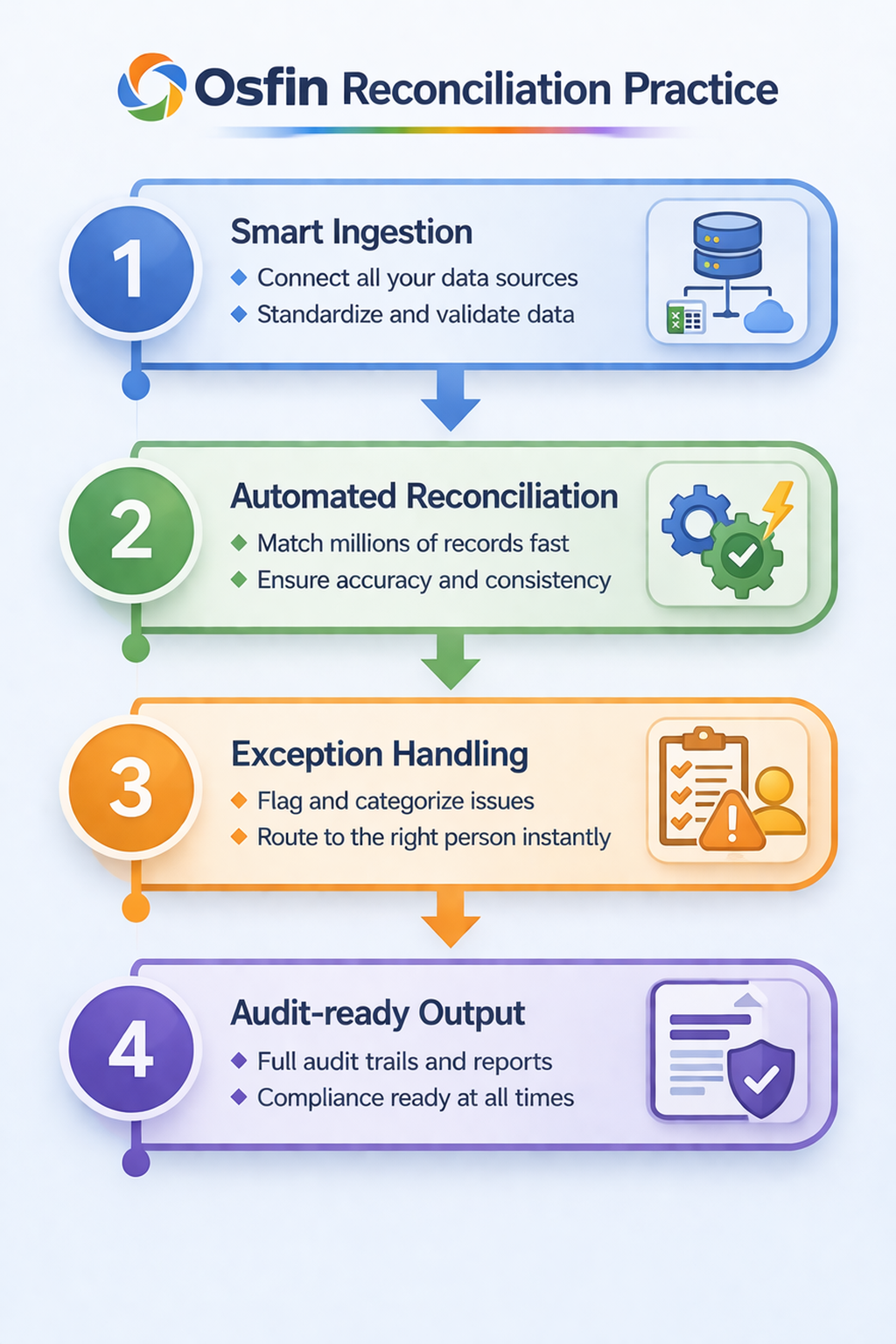
1. Importing data (ingestion) : Osfin supports 170+ integrations that help import data from multiple sources regardless of format, applies custom deviation tolerances during ingestion to filter poor-quality data before reconciliation, and detects duplicates at the point of ingestion to mitigate risks.
2. Reconciliation process: Osfin follows logic-based matching by handling many-to-one, one-to-many transactions and multi-way reconciliations. It has the capability to reconcile 30 million records in 15 minutes with 100% accuracy.
3. Exception handling: Osfin automatically flags unmatched transactions and assigns them an accurate reason, and routes unmatched transactions to the appropriate team through the ticketing and exception handling engine.
4. Output: Osfin delivers a compliance report and maintains audit-ready workflows with complete traceability and transaction history, secures data with 256-bit encryption, maker checker flow, role-based access, and two-factor authentication. It also complies with SOC 2, PCI DSS, ISO 27001, and GDPR requirements.
Choose What Truly Serves Your Growth!
FloQast remains a strong choice for organizations looking to organize their financial month-end close processes, but for enterprises managing complex reconciliation workflows, specialized reconciliation platforms like Osfin can offer greater operational control and accuracy.
Osfin helps finance teams move beyond manual reconciliation and fragmented workflows by delivering automated matching, exception management, and audit-ready reporting across large databases.
If your organization is ready to modernize financial operations and simplify reconciliations, the right platform can make all the difference.
{{banner3}}
FAQs
1. Is FloQast suitable for large enterprises?
Yes, FloQAst is useful for large enterprises for financial close workflow automation, ERP integrations, and effective compliance features, but if your organization consistently deals with large volumes of transactions and accurate reconciliation is a major challenge, you should consider more efficient alternatives like Osfin.
2. What are the best alternatives to FloQast?
If you are looking for modern enterprise solutions that offer efficient financial reconciliation automation, platforms such as Osfin can be a strong alternative to FloQast. You should always go for a platform that addresses your business needs.
3. Does Osfin offer real-time reconciliation?
Yes, Osfin uses logic-based matching to automatically reconcile transactions in real time. It supports one-to-one, one-to-many, or many-to-many matching across high volumes, and can process up to 30 million records in 15 minutes.
4. What systems does Osfin integrate with?
Osfin offers 170+ pre-built connectors spanning payment gateways, banks, ledgers, and internal databases. It’s also a file-format agnostic platform, meaning it supports any file format, be it Excel, CSV, JSON, or XML.