What Is BNPL Reconciliation?
BNPL, or buy now, pay later, has become a popular payment method for high-value consumer purchases like smartphones, home appliances, luxury clothing, etc. They enhance customer experience by allowing them to pay for purchased goods in installments.
However, BNPL providers must correctly settle funds to merchants after deducting their fees while tracking customers' repayments. This multi-step payment structure can often be challenging to reconcile.
In this article, we’ll understand what BNPL is, why its reconciliation matters, and common challenges that affect reconciliation.
What Is BNPL (Buy Now, Pay Later)?
BNPL, also known as buy now, pay later, is a type of short-term loan, often offered on e-commerce platforms and sometimes in stores. It allows consumers to purchase goods and pay for them in installments spread over 15 days or a few months.
BNPL loans are often interest-free, but the terms can vary depending on the provider and repayment plan. Its convenience and interest-free nature have made it a popular choice among consumers to purchase expensive items like premium smartphones, luxury apparel, home appliances, and other consumer purchases.
Once a transaction is completed, the BNPL provider pays the full amount to the merchant after deducting their fees and then collects repayments from the customer according to the agreed-upon schedule.
What Is BNPL Reconciliation?
BNPL reconciliation is the process that verifies that every transaction in the BNPL lifecycle, including initial purchase, merchant settlement, and scheduled installment payments, is correctly recorded and consistent across the provider’s systems. This involves matching records for merchant settlement and consumer repayment history and correcting errors in them.
What Is the Importance of BNPL Reconciliation?
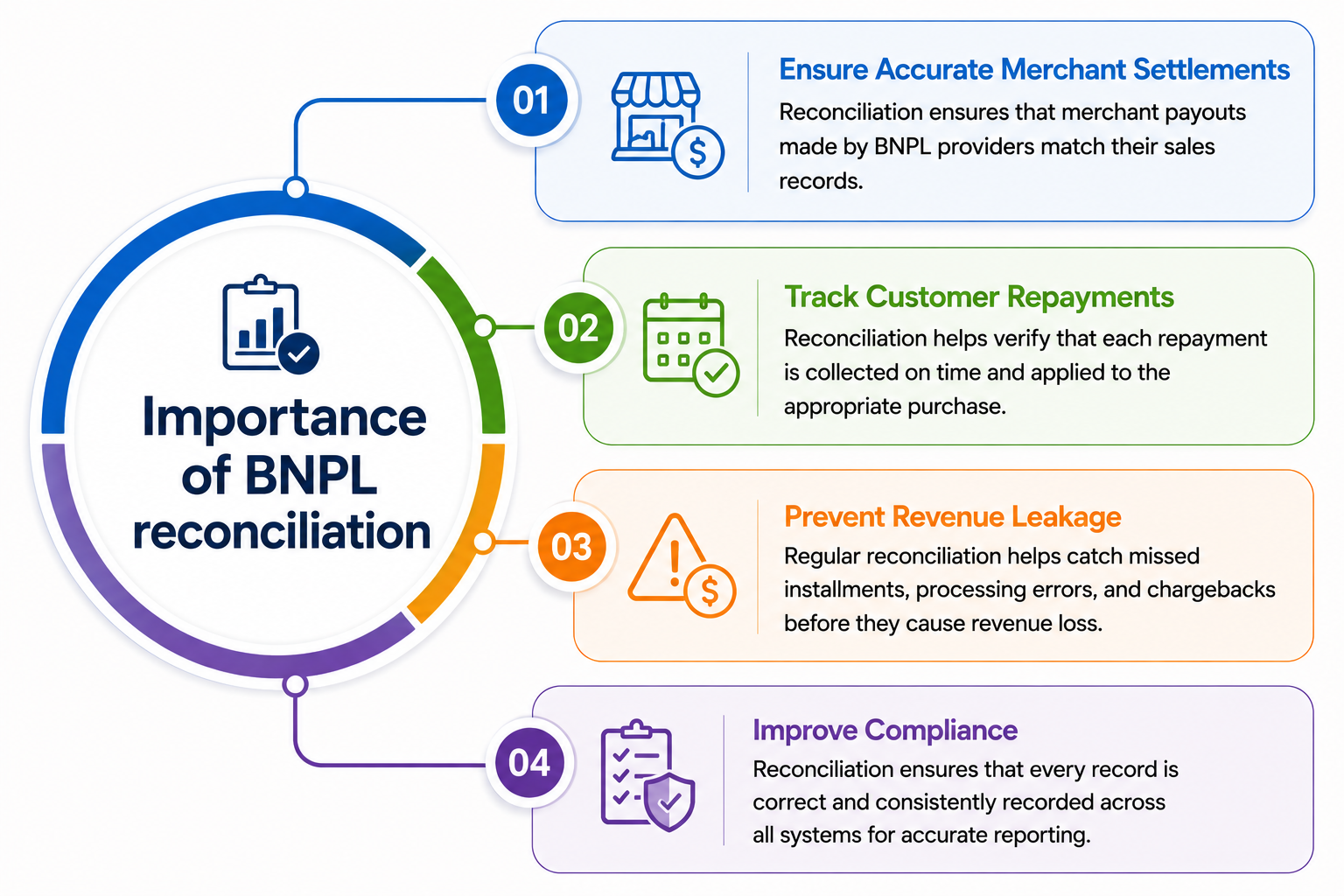
Buy now, pay later models ease payment burden for customers, but transactions carried out by the BNPL provider in the background can be complicated. BNPL reconciliation helps keep track of these transactions.
1. Ensure Accurate Merchant Settlements
Merchants that offer BNPL at checkout have to be paid the full purchase amount by the provider, even before the customer has completed their installments. Reconciliation ensures that merchant payouts made by BNPL providers match their sales records.
2. Track Customer Repayments
Every BNPL purchase is followed by a series of installment payments due on different dates. BNPL reconciliation helps verify that each repayment is collected on time and applied to the appropriate purchase.
3. Prevent Revenue Leakage
Missed installments, processing errors, and unnoticed chargebacks can result in loss of revenue. Regular BNPL reconciliation helps in catching these gaps before they accumulate and cause issues.
4. Improve Compliance
BNPL providers are required to report their finances to regulatory authorities. Reconciliation ensures that every record in their books is correct and consistently recorded across all systems.
{{banner1}}
What Is the BNPL Reconciliation Process?
A typical BNPL reconciliation process consists of the following steps:
1. Match Merchant Settlement
Merchants are paid by the BNPL providers soon after a customer makes a purchase. This amount is settled in the merchant’s account in 1 or 2 days. This transaction recorded in the merchant’s system must match the corresponding entry in the BNPL provider’s system.
2. Track Repayments
Hundreds of BNPL purchases take place every day, each with a different payment amount and due date. Each transaction and its status is individually tracked in reconciliation.
3. Verify Payment Schedule
It is ensured that repayments are being collected according to the agreed-upon instalment schedule.
4. Identify Defaults
Instalments that remain unpaid past their due date are identified and routed for collection follow-ups.
What Are the Common Challenges in BNPL Reconciliation?
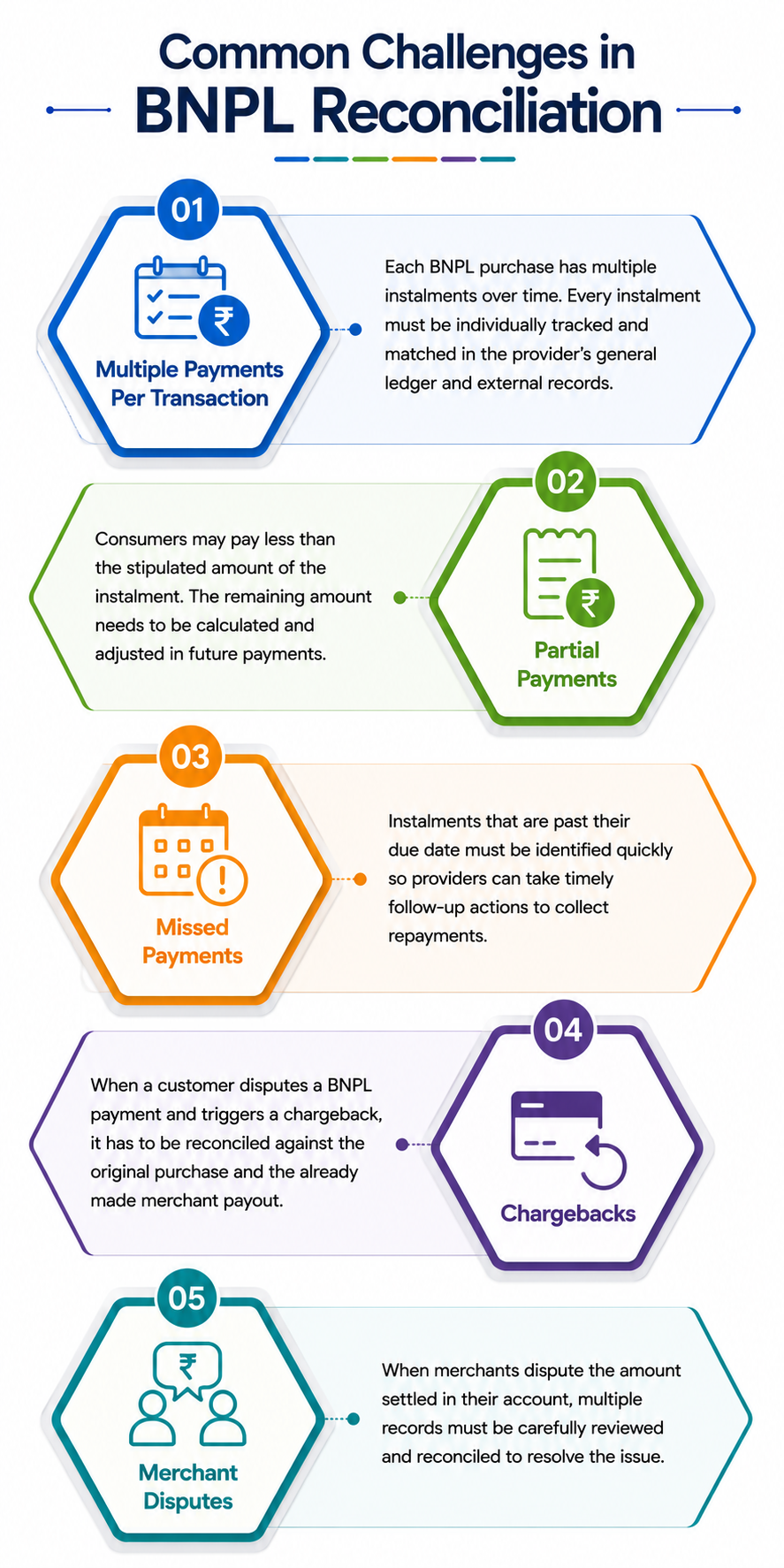
BNPL reconciliation comes with several challenges that often make accounting teams go through multiple records and check each transaction line by line. Some common challenges include:
1. Multiple Payments Per Transaction
Each purchase made with the buy now, pay later method generally consists of multiple instalments, paid over a period of 15 days to a few months. Instead of recording them as one transaction, each instalment has to be individually tracked and matched in the BNPL provider’s general ledger and external records.
2. Partial Payments
In some instances, consumers pay less than the stipulated amount of the installment. The remaining amount has to be calculated and adjusted in future payments.
3. Missed Payments
Instalments that have gone past their due date have to be identified quickly so providers can take follow-up actions for collecting repayments.
4. Chargebacks
When a customer disputes a BNPL payment and triggers a chargeback, it has to be reconciled against the original purchase and the already made merchant payout.
5. Merchant Disputes
In instances where the merchant disputes the amount settled in their account by the BNPL provider, it becomes a necessity to carefully review and reconcile multiple records.
{{banner1.1}}
What Is the Difference Between Manual vs Automated BNPL Reconciliation?
With so many challenges in BNPL reconciliation, are manual processes sufficient to accurately review and match hundreds of transactions? The simple answer is no.
Manual BNPL reconciliation means you will have to go through every purchase, instalment, merchant payout, and default payment line by line and consistently match them with the general ledger.
And when a transaction is recorded incorrectly, you will have to sift through numerous data sources to investigate the cause and make corrections. It quickly becomes unmanageable, resulting in multiple errors throughout the process while consuming significant time of the reconciliation team with repetitive, low-value work.
Automated reconciliation changes that. The software platforms offering automation for BNPL reconciliation are equipped with tools to capture data from BNPL systems, merchant platforms and payment processors, match each instalment and payout to the corresponding entries, and deliver output reports in a time- and cost-efficient manner.
How Does Osfin Streamline BNPL Reconciliation?
Osfin is an intelligent automation platform designed to reconcile high volumes of complex financial transactions. It serves enterprises across banking, payments and cards, insurance, etc. and is equally suitable for BNPL operations. It enhances BNPL reconciliation with the following features:
1. Multi-Source Data Ingestion
As a file format agnostic platform with 170+ connectors, Osfin can integrate multiple data sources, including BNPL systems, payment processors, ledgers, etc. and capture data, no matter what format it is in. To avoid downstream issues, it comes with custom deviation tolerances that filter out duplicates and outliers.
2. Lightning-Fast Reconciliation
Osfin is capable of reconciling 30 million transactions in 15 minutes. It applies logic-based matching rules to auto-reconcile one-to-many, many-to-one and multi-way transactions, including 2-way, 3-way, 4-way and 5-way.
3. Exception Handling Engine
It automatically flags unmatched transactions, assigns an accurate reason, and escalates and routes them to the appropriate team members for review via its ticketing and exception-handling engine. You can stay updated on match status and exception queues through its comprehensive dashboards.
4. Output Delivery
At the end of the reconciliation process, it delivers compliance reports and fully maintained audit trail workflows with complete traceability and transaction history.
5. Data Security
Osfin keeps your financial data secured with 256-bit encryption, role-based access and two-factor authentication. Along with this, it also has SOC 2, PCI DSS, ISO 27001, and GDPR certification that further delivers on this promise.
Wrapping Up
BNPL has changed how consumers shop, but it has multiplied the reconciliation work behind every purchase. With multiple installments, merchant settlements, and a steadily increasing regulatory focus, manual reconciliation simply cannot keep pace.
Osfin enables BNPL providers to process thousands of transactions in minutes, with 100% accuracy. From data ingestion to matching and delivery, Osfin automates each task, eliminating manual workload and streamlining the BNPL reconciliation. Book a demo now!
FAQs
1. What is BNPL?
BNPL stands for buy now, pay later. It is a popular payment method that allows customers to purchase goods but make payments in installments spread over a fixed period.
2. Why is automated BNPL reconciliation better than a manual process?
Since there are multiple records that need to be matched and reconciled, including merchant payouts, purchase installments, and defaults, manual processes can slow down the reconciliation process and might even result in a significantly high error rate. However, automated BNPL reconciliation takes over each step, be it data ingestion or matching, and reconciles each entry with high accuracy.
3. What are the benefits of BNPL reconciliation?
BNPL reconciliation helps ensure that merchant settlements match the sales record, repayments are collected on the agreed-upon schedule, and errors that could cause revenue losses are identified and corrected in a timely manner.
4. What issues complicate BNPL reconciliation?
Some issues that complicate BNPL reconciliation include missed or partial payments requiring follow-up, chargebacks that must be recorded and matched with the original purchase, and keeping track of each installment till the purchase amount is fulfilled.