What Is Co-Lending Reconciliation?
Co-lending has reshaped how credit reaches borrowers, especially when a single lender may not have sufficient funds or risk appetite. This lending allows two or more lenders to share the burden of disbursement and the risk of making loans, while still being appropriately rewarded.
However, co-lending structures can also introduce layers of operational complexity. When multiple lenders finance one loan, errors can always arise when disbursements, repayments, and interest have to be divided according to their participation percentages. With co-lending reconciliation, financial institutions can identify and resolve these errors in a timely manner and keep every lender’s share accurate.
In this article, we look into what co-lending is, its reconciliation process and best practices to enhance it.
Key Notes
- Co-lending is a collaborative service where two or more lenders jointly fund a loan to borrowers. The loan's risk and repayments are divided among the participants in proportion to the loan they finance.
- Co-lending reconciliation verifies that each lender’s share of disbursements, repayments, interest income and outstanding balances recorded in the loan servicing system matches the co-lending term and the records in participants' internal systems.
- Co-lending structures are complex and can be challenging for reconciliation teams to navigate when errors arise in participation percentages, payment allocations and documentation.
- Osfin’s reconciliation automation platform enhances accuracy and speed in the process. Its 170+ connectors allow it to integrate and capture data from multiple sources. It handles 2-way, 3-way, 4-way and 5-way reconciliation, flags and routes discrepancies and maintains an audit trail of every transaction.
- Errors during reconciliation can lead to disputes among co-lenders. They can reduce these disagreements by clearly defining the participation percentage in the co-lending agreement, regularly settling repayments, clearly communicating record errors and using automation tools to calculate and allocate funds.
What is Co-Lending?
Co-lending is a collaborative service where two or more lenders jointly fund a single loan to borrowers. In the most common scenario, the loan funding is split between a bank and an NBFC, where the bank covers 80% of the loan, and the NBFC covers the remaining 20%. Based on their funding proportions, each lender receives a corresponding share of the loan's repayments and interest income.
Co-lending enables lenders to expand loan services in underserved markets, such as MSMEs and individual entrepreneurs, while reducing their risk exposure, as risk is shared among the funding parties.
What Gets Reconciled
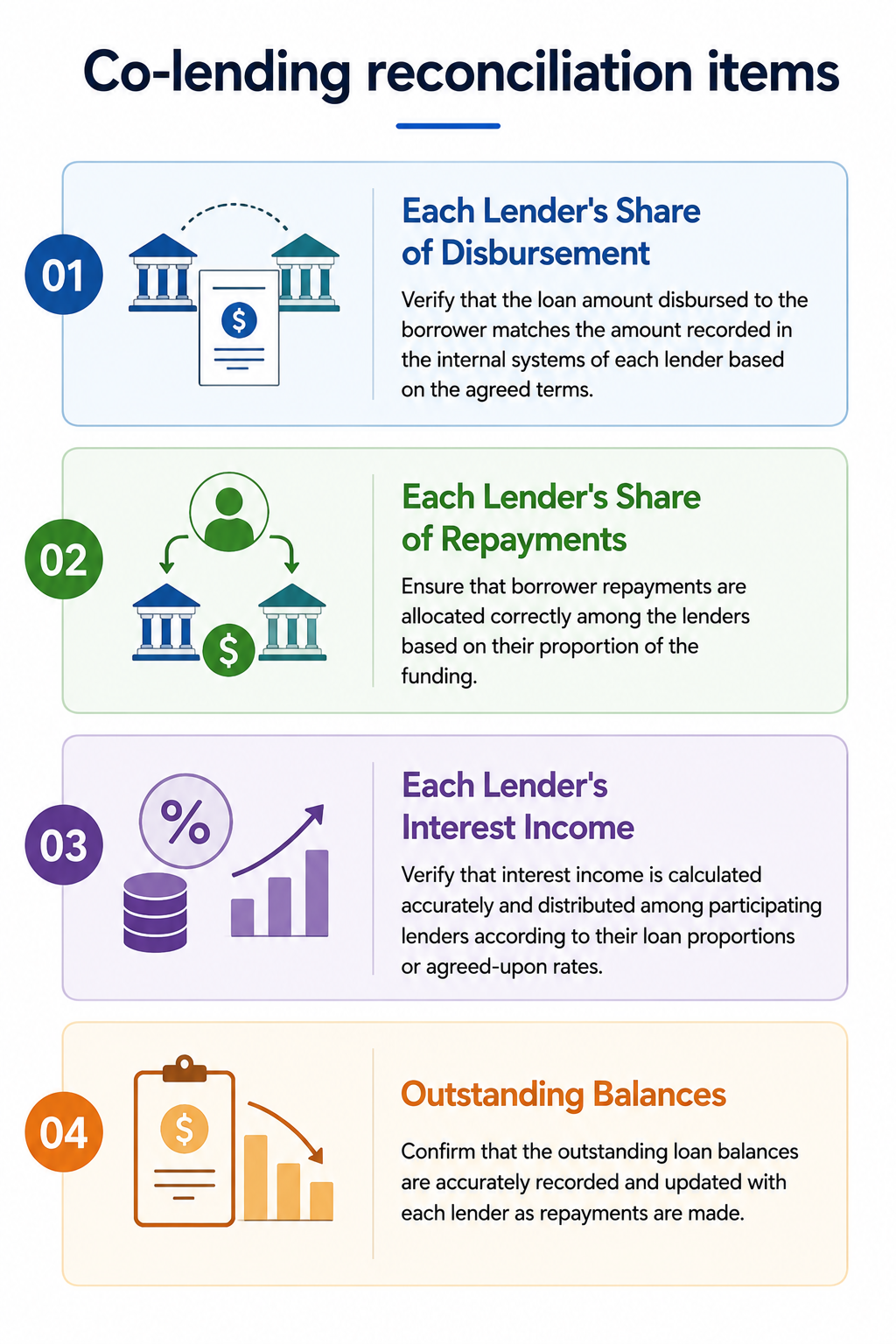
For the co-lending structure to work, the partners discuss key loan terms and how funding and repayments will be shared among them. The purpose of co-lending reconciliation is to ensure that the division of funds aligns with the terms discussed. The following are some of the items that are considered in co-lending reconciliation.
1. Each Lender's Share of Disbursement
In a co-lending partnership, although the loan is made to a single borrower, the funds are disbursed by both partners in accordance with the agreed-upon terms. Reconciliation verifies that the disbursed amount matches what has been recorded in the internal systems of each lender.
2. Each Lender's Share of Repayments
When the borrower makes a repayment, it has to be allocated correctly among the lenders based on their proportion of the funding.
3. Each Lender's Interest Income
Interest income is the profit that lenders earn from extending credit and must therefore be carefully calculated and distributed among participating lenders according to their loan proportions or agreed-upon rates.
4. Outstanding Balances
As the borrower makes repayment, their outstanding loan amount also decreases. Reconciliation confirms that the balances with each lender are accurately recorded and updated.
{{banner1}}
Co-Lending Reconciliation Process
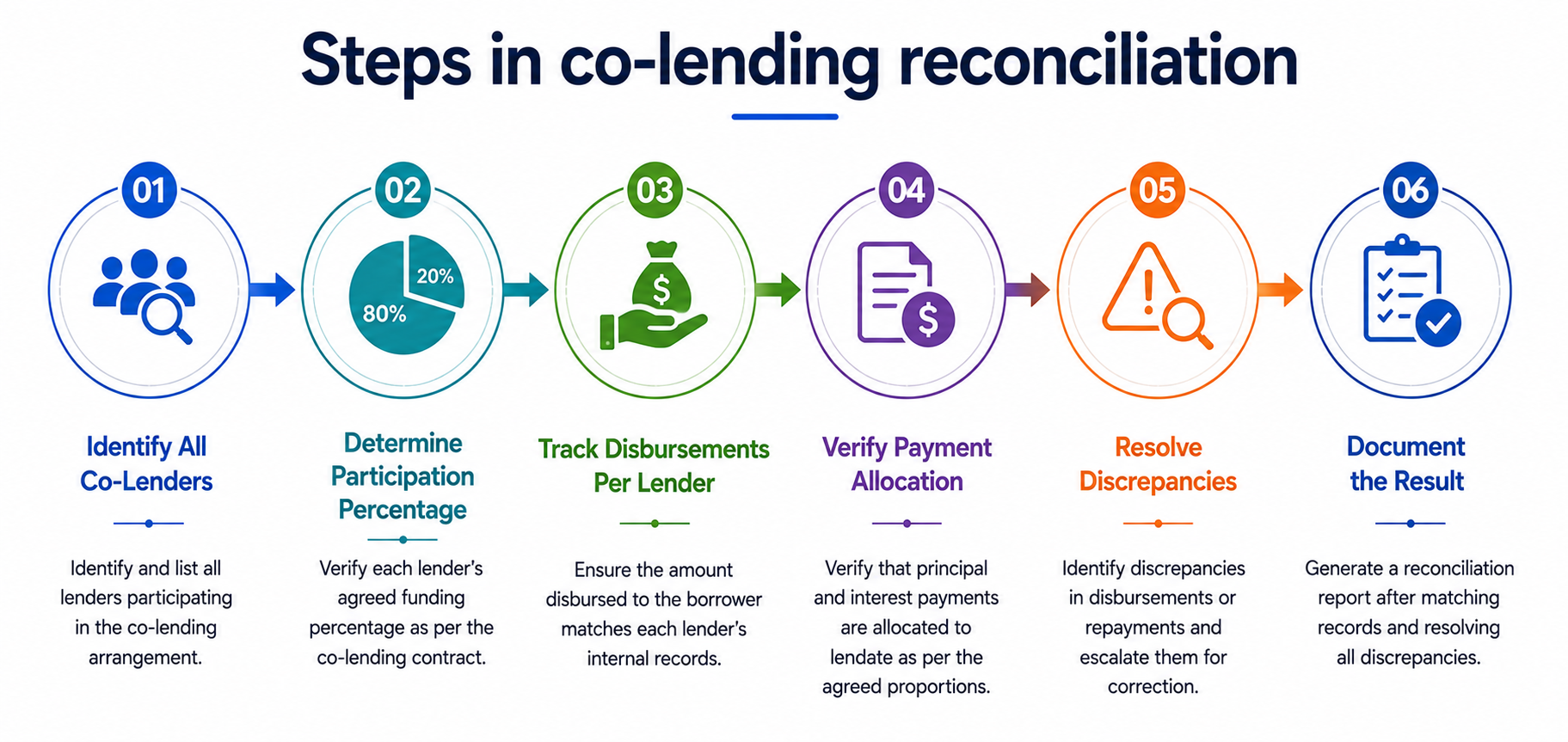
Whether the co-lending partnership involves two or more financial institutions, the reconciliation process always follows these steps.
1. Identify All Co-Lenders
The first step in the reconciliation process is to identify all participants in the co-lending.
2. Determine Participation Percentage
Next, the funding percentage of each lender is verified against what was agreed upon in the co-lending contract. Usually, the loan proportions are split 80% to 20% between the two lenders, but this can vary based on their choice.
3. Track Disbursements Per Lender
The loan is given to a single borrower, but it consists of a portion from each lender in the co-lending agreement. In reconciliation, it is verified that the amount disbursed to the borrower matches the lender's internal records.
4. Verify Payment Allocation
When the borrower starts making repayments on the loan, one part goes towards the principal balance and the other goes towards interest. Both principal and interest amounts are distributed among lenders, and this is verified during reconciliation.
5. Resolve Discrepancies
Since disbursements and repayments are distributed among different financial institutions in varying proportions, there is always a chance that incorrect amounts are recorded in the loan servicing system and the lender’s internal records. These discrepancies are identified and escalated for correction during the reconciliation process.
6. Document the Result
At the end of the co-lending reconciliation cycle, when all the entries about the loans given out have been matched with internal records of lenders and discrepancies raised have been resolved, a report is generated that documents the whole process and all updates made in it.
{{banner1.1}}
Co-Lending Vs Traditional Loans
Traditionally, loans are funded by either a bank or an NBFC. They are the only ones who bear the full risk of lending credit and receive repayments from borrowers. However, traditional loans are not accessible to all.
Usually, banks are the ones capable of lending large amounts of credit, but they are unevenly distributed across geographies. NBFCs, on the other hand, often have a broad customer base but lack the funds for large loans.
Co-lending agreements between banks and NBFCs help solve this problem by enabling loans to be extended to a broader user base at competitive interest rates. Co-lending benefits lenders and customers alike, as banks and NBFCs share fund disbursement, risks and EMI collections on loans, while customers get easier and faster access to loans.
Co-Lending Reconciliation Challenges
Traditional loans are quite straightforward, as there is only one lender who sets the loan terms, and they are the sole beneficiaries of repayment and interest earnings. However, co-lending structures can get complicated and pose the following challenges.
1. Participation Percentage Disputes
When there are two or more lenders, it may happen that the percentage of the loan financed by each party is recorded differently in the loan servicing system and their individual internal records. The error can appear anywhere in the records, and it can be difficult to resolve when you don’t know who made the mistake, leading to disputes between lenders.
2. Payment Allocation Errors
Errors may arise when recording the distribution of repayments received from the borrower and the interest earned on each EMI.
3. Documentation Gaps
Co-lending involves many steps, including disbursing funds, collecting EMIs and distributing repayments and interest among all lenders. At any step, it may happen that the proportions for each lender are incorrectly documented in the records, causing downstream issues during reconciliation.
How Osfin Automates Co-Lending Reconciliation
Manually reconciling co-lending accounts can consume significant resources and lead to many errors that can cause disputes among participants. This is where Osfin changes the game for you with its following features.
1. Seamless Integration
Osfin’s 170+ connectors enable it to integrate with loan servicing and other in-house banking systems to import co-lending data. Moreover, it's a file-format-agnostic platform, meaning it can capture information from any file format, whether PDF, JSON, XML, or more, and standardise it for reconciliation.
2. Logic-Based Matching
Osfin can handle one-to-many and many-to-one transactions and apply logic-based rules for performing multi-way reconciliation, including 2-way, 3-way, 4-way, and 5-way.
3. Exception Handling
Osfin comes with a ticketing and exception-handling engine that flags discrepancies in the co-lending and routes them to appropriate personnel for correction.
4. Audit-Trails
Errors in recording disbursement or repayment proportions by any lender can be difficult to resolve, leading to disputes among them. With Osfin, you get audit trails with complete traceability and transaction history of every log, helping you identify where the mistake was made and promptly resolve it.
5. Data Security
The data for reconciliation comes from different lenders and must be protected during import and reconciliation. For this, Osfin provides 256-bit encryption, role-based access and two-factor authentication. It also has global compliance certifications, including SOC 2, PCI DSS, ISO 27001 and GDPR, which further serve as evidence of security.
Best Practices for Co-Lending Reconciliation
Formulating and agreeing on co-lending terms, correctly financing their respective proportions of the loan and then distributing EMI accordingly can be an arduous task for banks, NBFCs and other financial institutions participating in a co-lending structure. Any errors in the processes can be costly and lead to disputes between participants. The following best practices can help co-lending participants avoid such disputes.
1. Clear Documentation of Participation
Lenders should avoid ambiguity while formulating co-lending agreements. It should clearly define each lender’s participating percentages, interest rate structures and allocation rules.
2. Regular Settlement
Repayments received from borrowers should be settled between co-lenders as per the pre-defined schedule. Infrequent settlement can cause discrepancies to accumulate in the records.
3. Automated Allocation
Instead of relying on manual calculations and fund allocation, use automated solutions that integrate with your systems and streamline operations. Along with this, reconcile your lending records with Osfin’s automation solution.
4. Clear Communication
Co-lending parties should establish structures and clear communication channels to discuss disbursements, repayments or any errors that may arise during recording and reconciliation.
Wrapping Up
Co-lending has made credit accessible to borrowers who would otherwise have struggled to obtain a loan. But for lenders, it becomes a complex web of disbursements, repayments and interest allocation that needs to be appropriately reconciled to verify accuracy.
However, manual reconciliation processes often leave space for errors to compile and go unnoticed, which, along with time, can lead to disputes between lenders. This is where Osfin comes into play.
Osfin is an intelligent automation platform that is built for reconciling high volumes of complex financial data. It can capture data from multiple sources, perform logic-based matching, and flag discrepancies in your data, all while maintaining audit trails for every transaction.
{{banner2}}
FAQs
1. What is typically included in co-lending reconciliation?
In co-lending reconciliation, the items matched and verified include each lender’s share of disbursements, repayments, interest income, and outstanding balances.
2. What is the purpose of co-lending reconciliation?
The purpose of co-lending reconciliation is to ensure the accuracy of loan records and to identify errors before they lead to disputes between lenders.
3. What challenges are faced during co-lending reconciliation?
The typical challenges faced in co-lending reconciliation arise from disputes in the loan proportion financed by each lender, payment allocation errors and incorrect documentation of funds disbursed and collected.
4. How can co-lending reconciliation be enhanced?
Lenders can enhance co-lending reconciliation by ensuring clear documentation of participation, regularly settling repayments, automating allocation processes, and clearly communicating any errors in the records.