Contract Reconciliation: Process, Challenges & Best Practices (2026 Guide)
TL; DR
Contract reconciliation is about making sure what you agreed to in a contract matches what’s actually happening in your transactions. For organizations handling hundreds of third-party contracts at once, it acts as a safety net, catching rate mismatches, missed credits, and overlooked penalties before they turn into bigger financial issues or show up during an audit.
Contracts are a constant in finance. You sign them with vendors, service providers, card networks, or payment processors. But that’s the easy part. The real work begins after that. The moment a contract is executed, it starts generating financial obligations. Rates, fee schedules, SLA thresholds, all need to be tracked, matched, and verified against what's actually being invoiced and paid.
And that’s where things start to get tricky. Terms don’t always flow cleanly into systems. Amendments get missed. What was agreed on paper slowly drifts from what’s happening in practice.
Over time, that gap between what you should be paying and what you are paying starts to grow.
What’s the solution then?
A process that ensures every number flowing through your systems is continuously checked against the contract behind it. In other words, contract reconciliation.
Let’s dive into this article to understand what it means and why it matters for your organization.
What is Contract Reconciliation?
Contract reconciliation is the systematic process of confirming that every monetary obligation specified in a contract -- rates, fees, volumes, timing of payments, penalties, and credits -- are correctly represented in what has been invoiced for fulfilment or payment across your systems.
This is far more than reading contract documents or checking specific invoices; this impacts banks and financial institutions.
Contract reconciliation is not legal contract review, which focuses on enforceability and adherence to terms. It is not an approach to contract lifecycle management, which follows a contract from execution through renewal.
It is also not about manual invoice validation, which compares an individual bill against a purchase order. And it is not a vendor audit, which is a periodic, snapshot exercise.
Contract reconciliation is an ongoing financial control. It operates at the transaction level, across each vendor relationship, every fee arrangement and every service agreement that hits your balance sheet.
In a setting where banks manage hundreds of third-party contracts at once, each with its own pricing tiers, SLA-linked adjustments and amendment history, reconciliation is what ensures any gap between what was agreed in the contract and what actually happens financially is caught early, before it builds up into a bigger problem.
Why Contract Reconciliation Matters in Enterprise Environments
In enterprise environments, especially within banks and financial institutions, contract reconciliation is an important control function. Here’s why:
1. Contract deviations multiply quickly
Missed SLA credit, incorrect fee, or wrong pricing tier may not seem like a big deal. But, when the same error occurs repeatedly across thousands of transactions or several counterparties, it can have a meaningful financial effect before it's even observed.
2. Manual oversight becomes unreliable
Spreadsheets and periodic checks don’t scale well. With hundreds of contracts to manage, each one with its own pricing logic, amendments, and conditional clauses, it can be hard to make sure each transaction matches agreed-upon terms.
3. Revenue recognition depends on contractual accuracy
In banking environments, revenue is frequently linked to contract terms, such as fees and commissions, interest and adjustments. If these are incorrectly applied, your financials may not accurately portray the true position, leading to audit concerns and additional scrutiny.
4. Disputes increase operational cost
Whenever reconciliation discrepancies occur, so does the need for back-and-forth between teams and counterparties. And without reconciliation, these issues take longer to resolve and use up more resources, sometimes unnecessarily escalating.
{{banner3}}
Contract Reconciliation Process (Step-by-Step)
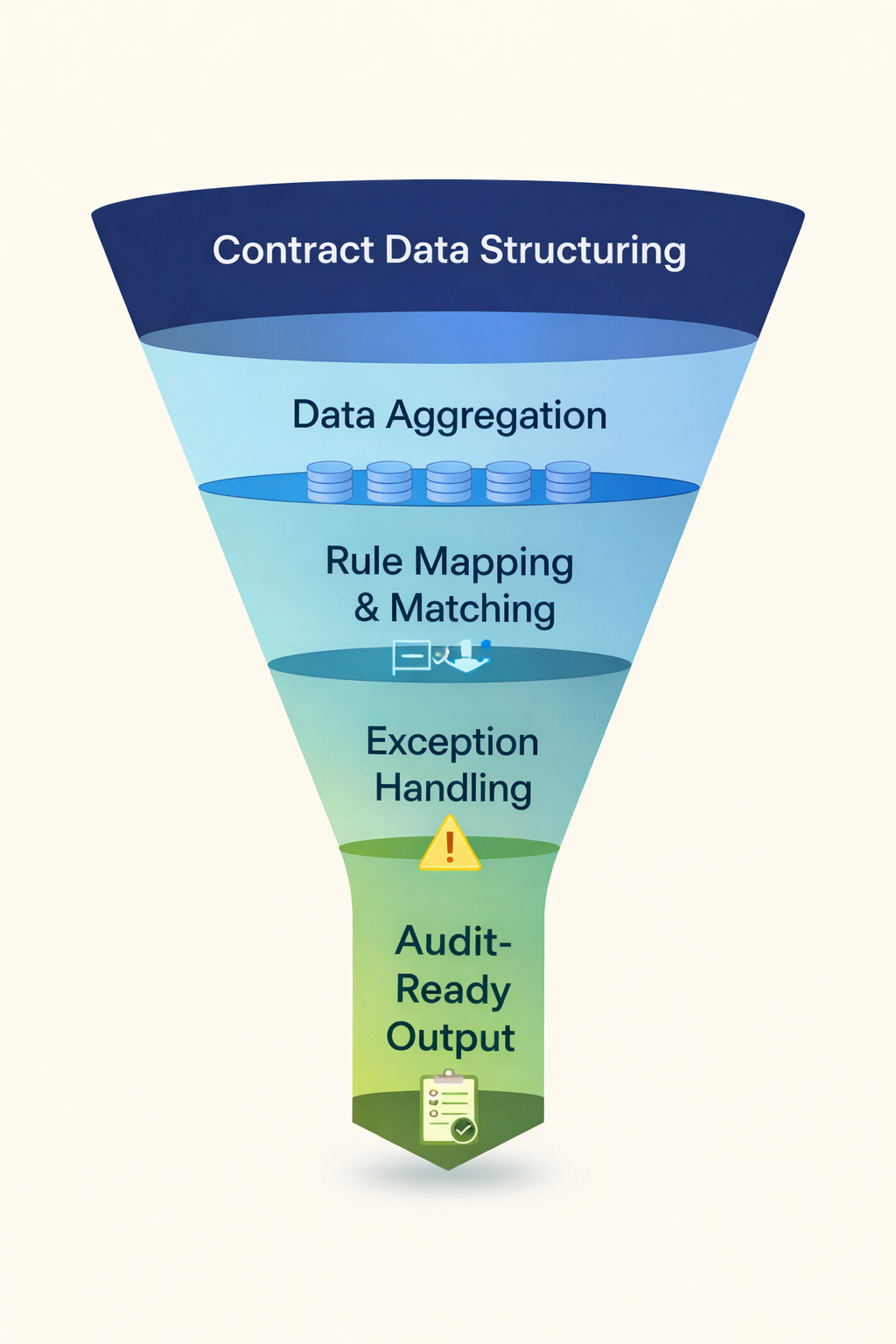
Contact reconciliation follows a very systematic approach with definite steps:
1. Contract Data Identification and Structuring
It begins with the contract in its raw format.
Contracts usually have complex terms. It could be tiered pricing, volume-based discounts, SLA-linked penalties, and conditional clauses. You are required to break them till it all looks structured and becomes usable data. For that, key elements like rates, fee logic, payment timelines, and adjustment rules must be clearly defined and standardized.
2. Data Aggregation Across Financial Systems
Once contract data is structured, the next step is pulling in transaction data from across systems.
For a typical bank, one can pull data from core banking systems, payment processors, general ledgers, and external partner reports. Issue is that different sources can follow different naming conventions and formats.
So, the next obvious step is cleaning and standardizing this data upfront to make the rest of the process far more reliable.
3. Rule Mapping and Transaction Matching
With both contract terms and transaction data in place, the focus shifts to applying logic. This is where the main work gets done.
Each contract defines how transactions should behave. These rules are mapped into the reconciliation process, whether it’s a fixed fee per transaction, a percentage-based charge, or a more complex tiered structure.
Some matches are straightforward. Others are not. One contract entry may correspond to multiple transactions, or multiple line items may roll up into a single settlement figure.
The goal here is simple: check whether what actually happened matches what should have happened. Anything that doesn’t match gets flagged.
4. Exception Identification and Investigation
Not every mismatch is an error, but every mismatch needs an explanation.
Exceptions can have various reasons. It could be due to incorrect fee application, timing differences, missed adjustments, or even upstream data issues. What’s important is to identify them early and understand the root cause.
This is also where documentation becomes critical. Whatever explanation is attached to the exception should have supporting evidence, and a defined resolution path. If the same issue keeps showing up, it’s usually a sign of a deeper control gap.
5. Certification and Audit Trail Preservation
Lastly, you need to make the entire reconciliation process ready for audits.
Post matching and exception resolutions, the reconciliation needs to be reviewed and approved. This typically involves a preparer and an independent reviewer to maintain proper control.
After approval, all records, including contract data, transaction inputs, matching logic, and exception documentation, must be preserved. This creates a clear audit trail that shows exactly how each number was derived.
Contract Reconciliation Use Cases
The best way to understand contract reconciliation is to see how it works in real-world scenarios. Let’s take a look at some of the use cases that require reconciliation of contract:
1. Revenue Share Agreements
Revenue share models are rarely straightforward. They often involve percentage splits, tiered structures, and conditional adjustments.
You’re dealing with different revenue streams, tiered percentages, exclusions, and timing differences. One system calculates revenue, another applies the split, and payouts may happen separately.
This is where reconciliation helps. It checks whether the actual payout matches the agreed share logic. If something is off, like a tier applied incorrectly or revenue calculated differently, it gets flagged early instead of showing up as a dispute later.
2. Vendor and Supplier Contracts
Vendor contracts often include fixed fees, variable charges, and performance-linked adjustments.
Problem is that these terms don’t always translate cleanly into invoices. That’s because your vendor may miss discounts you both agreed on, might apply charges in a different way, or even interpret clauses in their own way.
Reconciliation lets you verify every line item against what was agreed.
3. SaaS Subscription Billing
Subscription billing is always in a constantly evolving state. There are plan upgrades, downgrades, usage-based pricing, or mid-cycle changes. Billing systems try to keep up, but edge cases are common.
There can be a discount that isn’t applied or usage may be calculated differently than you expected.
Reconciliation gives you a way to check that billing outputs match contract terms in such frequently changing settings.
4. Banking & Payment Processor Agreements
For banks, this is where contract reconciliation becomes critical.
Agreements with payment processors, card networks, and partners often involve layered fee structures, interchange, processing fees, commissions, and settlement adjustments.
These are applied across large volumes of transactions every day. Even if one component is not applied correctly, the financial impact can be high.
Reconciliation guarantees that every fee and settlement entry reflects the agreed terms.
Read More: Payment Processor vs Payment Gateway: Complete Comparison
5. Insurance Claims Processing Agreements
In insurance, contracts define how claims should be processed, priced, and settled.
But claims move through multiple systems and third parties. By the time payments are made, there can be differences in how terms were applied.
Reconciliation helps connect the dots. It verifies that claim-related payments follow the agreed structure and highlights any gaps before they build into larger financial issues.
Contract Reconciliation Example
Let’s take a simple example from a banking setup.
A bank has an agreement with a payment processor where fees are charged on a tiered basis: 2% per transaction up to a certain volume, and 1.5% beyond that threshold.
At a monthly level, everything appears broadly in line. But when the team goes a level deeper and runs a proper reconciliation, they notice something slightly off. The effective fee being charged is a bit higher than expected. Not by much, but enough to raise a question.
Root cause:
On closer inspection, the issue turns out to be in how transaction volumes are being calculated. The processor is applying the lower rate later than expected because certain transaction categories are excluded from the volume count. This wasn’t clearly interpreted during implementation, even though it was defined in the contract.
System gap:
The bank’s internal systems were not set up to track volume thresholds in the same way as the processor. As a result, there was no immediate visibility into when the pricing tier should shift. The mismatch wasn’t obvious until reconciliation was performed at a detailed level.
Resolution documentation:
Once identified, the discrepancy is documented with supporting data like contract terms, transaction logs, and fee calculations. The bank raises this with the processor, aligns on the correct interpretation, and adjusts future calculations. Any required financial corrections are recorded, along with a clear audit trail explaining what happened and how it was resolved.
{{banner1}}
Common Contract Reconciliation Risks
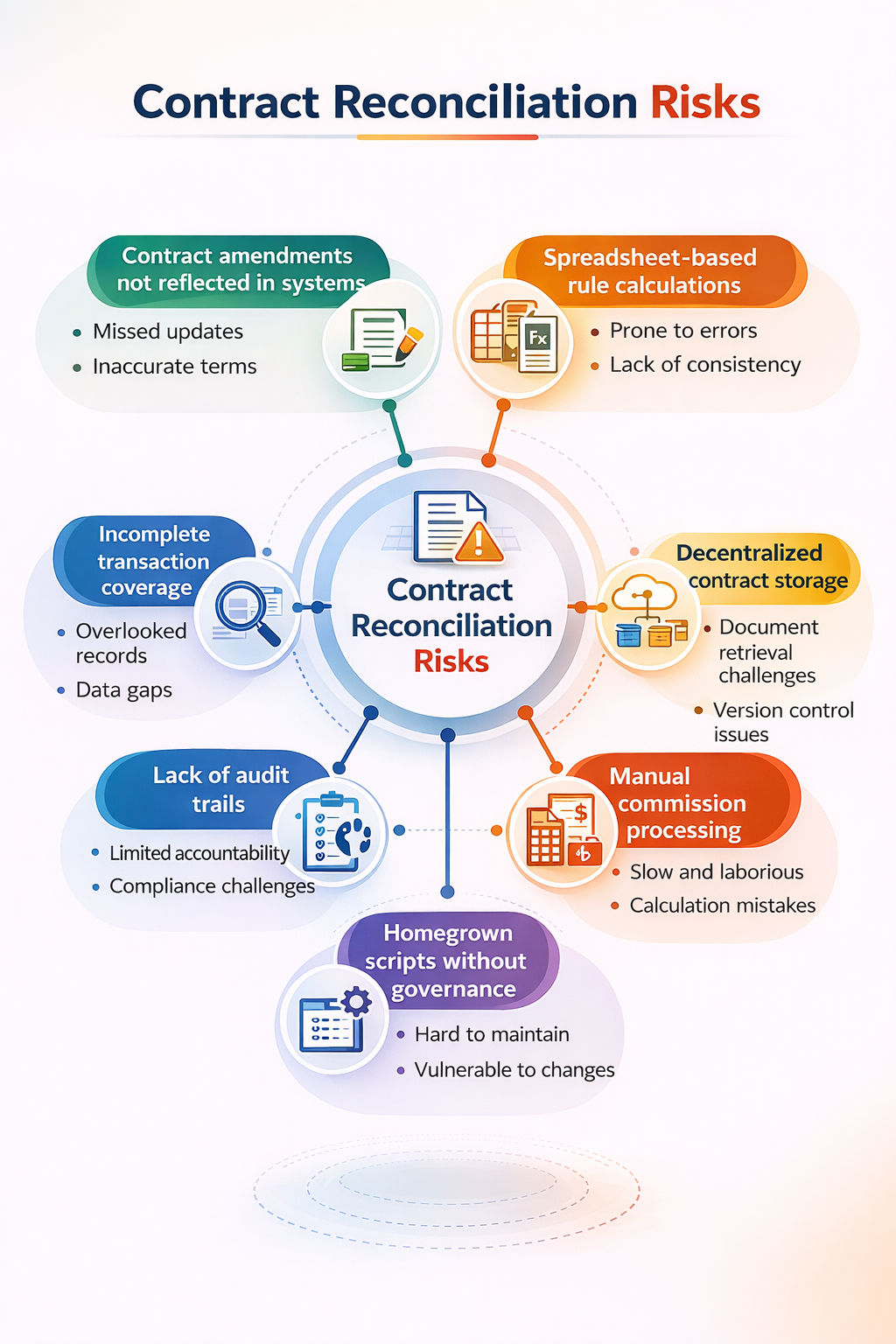
These are some risks that can you may encounter while doing reconciliation that can go unnoticed if you are not careful:
Contract amendments not reflected in systems
Contracts change all the time with pricing updates, new clauses, or revised terms. But these changes don’t always make it into the systems that actually calculate fees or payouts. So you end up applying old logic to new agreements without realizing it.
Spreadsheet-based rule calculations
A lot of teams still rely on spreadsheets to handle complex contract logic. It works for a while. But as volume grows, these files become harder to manage. Formulas break, versions get mixed up, and small errors slip through.
Decentralized contract storage
Contracts stored across emails, shared drives, and different teams make things harder than they should be. Without a centralized storage, it becomes difficult to know which version is the latest one.
Manual commission processing
Commissions and fee calculations, when manually done, are susceptible to mistakes. Especially when added in the mix are tiers, exceptions, or adjustments. Then, even a small mistake repeated at scale can leave quite a significant impact.
Incomplete transaction coverage
Sometimes, certain transactions don’t reach the reconciliation workflow. Could be because of a missing data source or an overlooked system, but they obviously leave gaps. And those gaps usually show up only when someone starts asking questions.
Lack of audit trails
If you can’t clearly show how a number was calculated or why an adjustment was made, it reflects badly during your audits. Missing documentation turns small issues into bigger ones.
Homegrown scripts without governance
Custom scripts often start as quick fixes. Over time, they become critical to the process, but without proper controls, documentation, or ownership. When something breaks, it’s hard to trace or fix.
Improving Contract Reconciliation Before Automation
Nowadays, automation is all the rage for any type of financial processes. And for good reasons. It makes processes faster and more reliable. But even automation can’t work if your underlying systems are rusty. Before bringing automation into the mix, there are certain things that should be taken care of efficiently.
Standardizing Contract Data Capture
Everything starts with how contract data is captured.
If different teams understand and record contract terms in their own way, reconciliation is going to be difficult.
You need a consistent way to capture key elements of the contract. Once this is standardized, it becomes much easier to apply the same logic across transactions.
Defined Ownership and Segregation of Duties
Reconciliation works best when responsibilities are separated.
Every contract or account should have a named owner responsible for preparing the reconciliation. Also, there needs to be a separate reviewer who validates the output. If the same person does both, it weakens the control.
Documentation and Evidence Guidelines
Just identifying and fixing discrepancies is not enough. You should show how and why they were resolved.
Every adjustment or exception should have attached documentation with a clear explanation, and an approval trail.
If this is not taken care of consistently, things become difficult during audits, especially when you’re trying to trace decisions made weeks or months earlier.
Role of Automation in Contract Reconciliation
Once your basics are set, automation takes care of the rest. Here’s how:
1. Automated Data Ingestion
One of the first problems teams run into is simply getting all the data together.
You are required to pull contract terms from one place. Transaction data from another. And invoices or partner reports from somewhere else. It’s easy to miss something or use the wrong version when you manually do it.
Automation remedies this by collating data directly from source systems on a defined schedule. It also keeps it in a consistent format, and makes sure you’re always working with the latest information.
2. High-Speed Transaction Validation
The next step is checking whether everything lines up with the contract.
At a small scale, you might manage this manually. But with real volumes, that quickly becomes impractical. There are too many rules, tiered pricing, percentages, exceptions, and too many transactions.
Automation applies these rules across all transactions in one go. What would take hours (or days) manually gets done in minutes. More importantly, it applies the same logic every time, so you’re not dealing with inconsistencies.
3. Structured Exception Workflows
There will always be mismatches. That’s normal.
The issue is what happens next. Without a clear process, exceptions tend to sit around, get missed, or bounce between teams.
Automation makes this more structured. It flags issues, informs you about what’s wrong, and routes the mistakes to the right person.
4. Enterprise Controls and Audit Logs
Finally, there’s the audit side of things to take care of.
You need to clearly show how you found the issues during matches. What you did to resolve them, and who approved it.
Automation handles this well. Every step is recorded. Approvals are tracked and access is controlled. So when auditors ask questions, you’re not scrambling to piece things together.
Measuring Contract Reconciliation Performance
Your contract reconciliation process is up and running. But how would you know it’s actually working?
Here are some KPIs to track:
- Revenue Leakage Rate: This tells you how much revenue is slipping through because contract terms aren’t being applied correctly. If this number isn’t trending down, it’s a sign that something in your process isn’t fully under control.
- Exception Aging: If mismatches remain unresolved for long, it usually means there's a problem. Either the issue isn’t clear, ownership isn’t defined, or it’s just not being prioritized. The goal is to catch and close exceptions quickly before they pile up.
- Dispute Frequency: This looks at how often discrepancies turn into external disputes, with vendors, partners, or processors. A high number here usually means issues are being caught late, often after the fact. It also increases operational effort, because every dispute takes time to investigate and resolve.
- Manual Adjustment Frequency: This metric tells you how often teams have to step in and fix things manually. Some level of manual intervention is expected. But if it’s happening too often, it points to gaps in your contract setup, rule logic, or system alignment. Over time, this number should go down.
- Audit Findings Related to Contracts: If contract-related issues keep showing up during audits, especially repeat findings, it’s a clear signal that controls aren’t working as expected.
How Platforms Like Osfin Support Enterprise Reconciliation
Osfin is built as an enterprise reconciliation platform designed for high-volume transaction environments. Instead of teams pulling data, matching transactions, and tracking exceptions across different tools, everything is handled in one place.
Data Ingestion Across Multiple Sources
Osfin is a data agnostic platform. Using its 170+ integrations, it can ingest data from anywhere in its original format, be it MT940, ISO 20022, BAI2, XML, CSV, TXT, or JSON, and standardize it automatically. While importing, it also filters out bad data using custom tolerances and flags duplicates or outliers early, so you’re not dealing with messy data later in the process.
High-Volume, Rule-Based Reconciliation
Once the data is in, Osfin handles matching using logic-based rules. It can manage simple matches as well as more complex ones like one-to-many or multi-way reconciliations across different datasets.
Whether it’s two-way or even five-way matching, the system processes large volumes quickly and can reconcile things like payment reports along with commissions, taxes, and fees without manual effort.
Structured Exception Handling
Osfin automatically flags unmatched transactions, assigns a clear reason to them, and routes them to the right person through its workflow system. You also get live dashboards that show match status, exceptions, and overall exposure, so you always know what needs attention and where things stand.
Audit-Ready Outputs and Controls
Osfin logs every step, from data ingestion to final approval. This creates a clear audit trail showing how each number was derived and how exceptions were handled. The platform also generates compliance reports and maintains audit-ready workflows with complete traceability and full transaction history, making it easy to answer even detailed auditor queries.
On the security side, data is protected with 256-bit encryption, and controls like maker-checker flows, role-based access, and two-factor authentication ensure that only authorized users can take action.
Plus, with compliance built in for standards like SOC 2, PCI DSS, ISO 27001, and GDPR, you’re staying ahead of audit requirements as part of your everyday reconciliation process.
It’s clear that Osfin makes the entire reconciliation process smoother, more reliable, and a lot easier to manage at scale.
{{banner1.1}}
FAQs
1. What is contract reconciliation?
At its core, contract reconciliation is just making sure what you agreed to in a contract is exactly what’s happening financially. It checks if the right fees are being charged, the discounts applied correctly, or if payments are matching the agreed terms.
2. How is contract reconciliation different from contract management?
Contract management is about handling the contract itself by creating it, tracking it, and renewing it.
Contract reconciliation kicks in after that. It’s focused on the money side, checking whether the financial outcomes actually match what the contract says.
3. Why is contract reconciliation important?
Because small errors don’t stay small. A missed clause or wrong rate can keep repeating across thousands of transactions. Over time, that turns into real revenue leakage, overpayments, or disputes that take effort and money to fix.
4. What industries need contract reconciliation most?
Any industry dealing with high transaction volumes and complex agreements. It can be banking, fintech, insurance, SaaS, or marketplaces. Basically, anywhere you have variable pricing, commissions, or partner-based revenue models.
5. How often should contract reconciliation be performed?
In high-volume environments, reconciliation of contracts needs to be done daily so issues don’t pile up and become harder to track later.
6. Can automation reduce contract-related financial risk?
Yes, significantly. Automation helps you catch mismatches early, apply rules consistently, and handle large volumes without missing details. It also reduces dependency on manual checks, which are where most errors creep in.
7. Is contract reconciliation part of internal audit?
Not exactly, but it supports it. Reconciliation is more of an ongoing financial control, while internal audit is a periodic review. That said, strong reconciliation makes audits much smoother because everything is already documented and traceable.