EMI Reconciliation: Process and Best Practices
EMI, or equated monthly instalment, is the most common method of loan repayment. In each EMI, one part of the instalment goes towards paying the principal balance and the other pays the interest. But banks don’t deal with just one EMI.
Every day, thousands of borrowers make repayments for their outstanding loans. It can be for a personal, commercial or retail loan. And every day, banks have to collect EMIs from different borrowers, allocate them to the correct loan account and apply them accordingly to principal and interest balances.
As such, it is pertinent that banks and other lending institutions regularly conduct EMI reconciliations and ensure that the data recorded in their loan servicing systems matches their general ledgers.
This article aims to understand the process behind EMI reconciliation, why it is important and learn some best practices that enhance it.
Key Notes
- EMIs are a common method for repaying loans. In each EMI, one portion goes towards paying the principal amount and the other towards interest.
- The monthly EMI is calculated based on the principal amount, the annual interest rate and the loan tenure.
- EMI reconciliation is necessary to keep your financial data accurate, promptly detect errors in your loan servicing system and general ledger, and stay compliant with regulatory reporting requirements.
- Inaccurate EMI application, timing differences, and high transaction volumes are among the challenges faced in manual EMI reconciliation.
- Best practices such as performing monthly reconciliations, regularly checking borrower statements, maintaining audit trails and using automation tools like Osfin can enhance your EMI reconciliation.
Understanding EMI
EMI, also known as an equated monthly instalment, is a fixed amount paid monthly by a borrower until the loan is fully repaid. Each EMI is split between principal and interest, where the principal is the total loan disbursed to the borrower, and interest is the cost charged by the bank for financing the loan.
The interest portion of EMI is initially higher, but as the loan tenure progresses, it decreases while the principal portion increases. How each EMi will be split depends on the amortisation schedule applied to that specific loan.
EMI Calculation Components
The fixed EMI amount is calculated based on the principal amount, interest rate and the loan tenure. Its formula is
EMI = [P x R x (1+R)^N]/ [(1+R)^N - 1]
Where,
P= principal amount
R= Monthly interest rate
N= Number of monthly installment
For example, a borrower takes out a Rs. 20 Lakh loan with an annual interest rate of 8% and a tenure of 10 years.
P is 20,00,000
R is 8/12/100 = 0.0067
N is 10 years or 120 months
EMI= [20,00,000 x 0.0067 x (1+0.0067)^120]/ [(1+0.0067)^120 - 1] = Rs. 24,312
What Gets Reconciled in EMI Payments
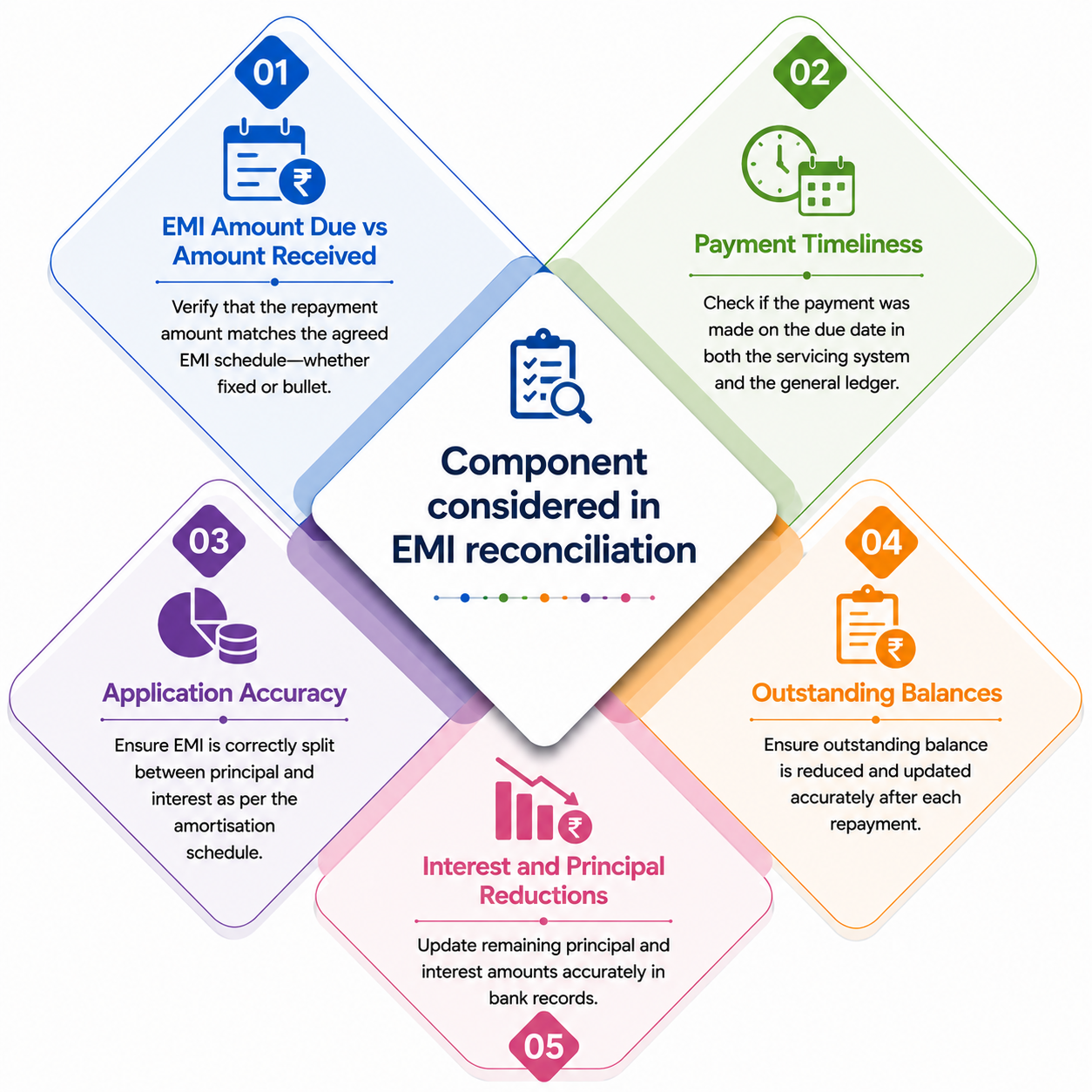
When it comes to EMI reconciliation, the bank or lending institution considers the following components that should match in their loan servicing system and general ledger.
1. EMI Amount Due vs Amount Received
Most often, EMI are fixed amounts paid monthly, especially for long-term loans like mortgages or car loans. However, banks allow balloon or bullet payments for short-term loans, where the EMI amount remains low throughout the tenure, interest is paid, and towards the end, the borrower makes a large payment to pay off the principal.
In the reconciliation process, the bank or lending institution verifies whether the borrower's repayments fall within the fixed or bullet EMI schedule and match the amount agreed in the loan terms.
2. Payment Timeliness
The lending institution verifies whether the amount was paid on the loan's due date and that it is the same in the loan servicing system and the general ledger. The reason for discrepancies should be adequately investigated.
3. Application Accuracy
Each EMI consists of payments made to repay the principal and interest. As the loan tenure progresses, the principal amount in the EMI starts increasing while the interest payment decreases. In EMI reconciliation, EMI is accurately split between principal and interest payments in accordance with the amortisation schedule.
4. Outstanding Balances
With each repayment, the borrower's outstanding balance decreases. These should be recorded and updated accordingly in the loan servicing systems and the general ledger.
5. Interest and Principal Reductions
Along with the outstanding balances, the interest and principal amounts still to be repaid by the borrower also need to be updated in the bank's internal records.
EMI Reconciliation Process
An EMI reconciliation follows multiple steps. These are as follows.
1. Calculate Expected EMI
Before disbursing the loan, the borrower and lender calculate the expected monthly EMI based on the principal amount, annual interest rate and the loan duration. Loans with short tenures often have higher EMI, while long-term ones are significantly lower.
2. Identify Payments Received
EMI is paid every month on the fixed due date. A major part of the EMI reconciliation involves bankers evaluating their income statements to identify the EMIs paid by different borrowers. The data of received payment, including amount and time, should match what has been recorded in the bank’s general ledger and loan servicing system.
3. Verify Principal and Interest Split
Every EMI is split between principal and interest according to the amortisation schedule for each loan. The lender needs to ensure that every EMI is applied to the correct loan account and split accurately between principal and interest balances.
4. Verify Loan Balance Reduction
A borrower’s outstanding balance reduces with each EMI they pay. These are updated every month in the loan servicing system and should accordingly be reflected in the lender’s general ledger as well.
5. Investigate Discrepancies
An EMI has to be correctly recorded in the loan servicing system and applied to the principal and interest amount, ensuring loan balances are updated accordingly. However, there is always the risk that the entries made in collection records do not match the general ledger. These discrepancies should be promptly investigated and resolved by the appropriate personnel in the lending institution.
{{banner1}}
Why EMI Reconciliation Matters

Every lending institution processes thousands of cash inflow and outflow transactions every day. EMI specifically accounts for a significant portion of these transactions and is especially important since interest earned constitutes the lending institution's revenue. EMI reconciliation serves the following three purposes for them
1. Financial Accuracy
EMI reconciliation ensures that entries made in the loan servicing system accurately match the general ledger of the lender.
2. Error Detection
It gives reconciliation teams the opportunity to identify errors or duplicates in their loan records, investigate their cause and make necessary corrections.
3. Regulatory Compliance
Banks and lending institutions are obligated to report their finances, including the profit earned through interest payments, to regulatory authorities. EMI reconciliation ensures that the numbers delivered in these reports accurately reflect the lender’s financial position.
Common EMI Reconciliation Challenges
In the past few years, a considerable rise has been observed in the general population taking out loans to meet their needs across retail, consumption and business sectors. Consequently, repayment transactions have also increased across lending institutions. Manual EMI reconciliation processes cannot keep up with this rise and pose the following challenges for lending institutions.
1. Incorrect Application
Reconciliation teams have to identify every EMI collection record, determine the loan account they apply to, and accurately split each of them into principal and interest payments in accordance with the amortisation schedule. However, manual processes often run the risk of a high error rate, especially in EMI application.
2. Timing Differences
Errors also arise when the time and date of EMI are recorded differently in the loan servicing system and the general ledger, which can cause difficulty while matching transactions between the two systems.
3. High Volumes of EMI Transactions
As EMI transactions increase, it becomes difficult for the current reconciliation teams to complete them within the stipulated time, requiring lending institutions to invest in hiring more personnel for this task and thus increasing their resource costs.
{{banner1.1}}
Best Practices for Effective EMI Reconciliation
There are many challenges that affect the speed and accuracy of EMI reconciliation. The following best practices can help reconciliation teams at lending institutions enhance this process and avoid errors.
1. Perform Monthly Reconciliation
With increasing transaction volumes, lending institutions should place emphasis on performing EMI reconciliation monthly. This assists in the early identification of gaps and errors in loan servicing records or the general ledger.
2. Regularly Check Borrower Statement
Every day, different borrowers make EMI payments on different types of loans. As such, the lenders should regularly check the borrower statements to verify repayments, outstanding balances, and distribution of principal and interest amounts.
3. Maintain Audit-Trails
Regulatory compliance is one reason to perform EMI reconciliation. The regulatory authority may request the reasons for adjustments to loan servicing records and the dates on which they were updated. For these reasons, lending institutions should maintain audit trails with timestamps and usernames for every transaction in the reconciliation process.
4. Leverage Automation Platforms
Instead of relying on slow, error-prone manual processes, it is better to leverage an automation platform like Osfin to streamline EMI reconciliation. Osfin is especially built to reconcile high volumes of financial data with 100% accuracy.
Osfin is a file format-agnostic platform with 170+ integrations, allowing it to capture data from multiple sources regardless of the format. It applies logic-based matching rules to handle many-to-one, one-to-many, and multi-way reconciliation, including 2-way, 3-way, 4-way, and 5-way.
Moreover, its exception-handling engine automatically flags discrepancies and routes them to the appropriate personnel for review. And to keep your data secure, it offers 256-bit encryption, role-based access, and two-factor authentication, all while maintaining audit trails for every transaction.
Finishing Off
EMI reconciliation is non-negotiable for lending institutions that want to maintain accurate financial records and ensure regulatory compliance. However, as disbursed loans increase, so do EMI transactions. It becomes inevitable that manual reconciliation processes fall short, consuming significant time and having a high error rate.
Osfin’s advanced automation solution performs every step of EMI reconciliation, from data ingestion to matching and output delivery, at lightning-fast speed with 100% accuracy. Its intuitive dashboards enhance visibility into the reconciliation process with real-time match status and exception queues. Moreover, its commitment to protecting your sensitive financial data is evident in its SOC 2, GDPR, PCI DSS and ISO 27001 certifications.
Book a demo with Osfin now if you’re aiming to boost your EMI reconciliation!
FAQs
1. What is EMI?
EMI stands for equated monthly instalment. It is the most common method of repaying loans. Each EMI is split between principal and interest balances according to the amortisation schedule.
2. What components are reconciled in EMI payments?
In EMI reconciliation, the components reconciled include the amount due, payment timeliness, application to principal and interest balances, and updates to outstanding balances.
3. Why should EMI reconciliation be automated?
The volume of loans taken has increased over the years, and so have the EMIs received by lending institutions. Manually reconciling EMI records can be slow and error-prone. Automation platforms like Osfin resolve this by taking over all the reconciliation tasks, including data ingestion, matching and delivering compliance reports.
4. What is the importance of EMI reconciliation?
With EMI reconciliation, you can ensure the accuracy of financial records, promptly identify and address errors in the loan servicing system and the general ledger, and stay compliant with regulatory reporting requirements.