How to Audit Your Loan Reconciliation Process
Banks and lending institutions process thousands of loans each day. they may be disbursing a loan to a customer, while at the same time numerous borrowers are paying EMIs on their outstanding loans. All of these loan transactions have to be recorded and reconciled in accordance with accounting standards like IFRS and GAAP to get a clear picture of the lender’s financial position.
Loan reconciliation specifically focuses on matching data in the lender’s loan servicing system, income statements and disbursement records with its general ledger. But how does one verify that the loan reconciliation was accurate and that the process followed internal controls? With the help of audits.
Let’s dive into how lending institutions can conduct audits for the loan reconciliation process.
Why Audit Your Loan Reconciliation Process
Leading institutions are answerable to their customers, regulatory authorities and the investors of their asset-backed securities. An audit of your loan reconciliation process can build their trust and verify that every action complies with regulatory standards. In addition, it serves the following purpose for a lending institution.
1. Meet Regulatory Requirements
Lending institutions like banks, NBFCs, credit unions, etc, are required by law and regulatory standards to conduct audits for loan reconciliation processes.
2. Improve Internal Controls
Audits allow you to gauge the effectiveness of your institution’s internal controls. The recognised weaknesses or gaps in internal controls can be improved or changed to newer ones.
3. Enhance Credibility
Audits help in building trust among your portfolio investors that your loan records are accurate and consistently match the general ledger and other internal systems.
{{banner1}}
Step-by-Step Loan Reconciliation Audit
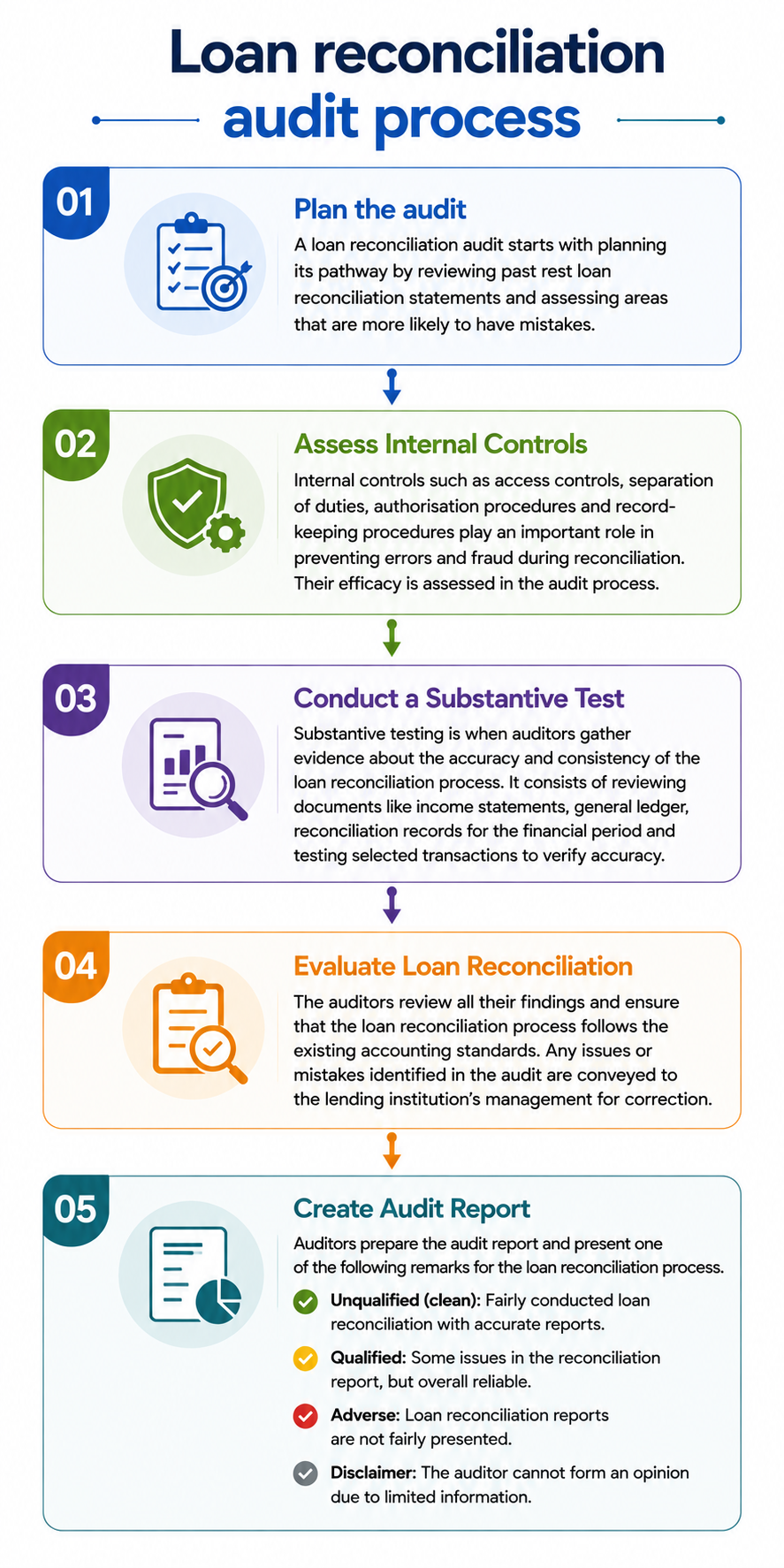
A loan reconciliation audit can be carried out by an independent audit firm, government regulators or the lending institution’s employees themselves. In all these scenarios, it will follow the steps mentioned below.
1. Plan the audit
A loan reconciliation audit starts with planning its pathway by reviewing past rest loan reconciliation statements and assessing areas that are more likely to have mistakes.
2. Assess Internal Controls
Internal controls such as access controls, separation of duties, authorisation procedures and record-keeping procedures play an important role in preventing errors and fraud during reconciliation. Their efficacy is assessed in the audit process.
3. Conduct a Substantive Test
Substantive testing is when auditors gather evidence about the accuracy and consistency of the loan reconciliation process. It consists of reviewing documents like income statements, general ledger, reconciliation records for the financial period and testing selected transactions to verify accuracy.
4. Evaluate Loan Reconciliation
The auditors review all their findings and ensure that the loan reconciliation process follows the existing accounting standards. Any issues or mistakes identified in the audit are conveyed to the lending institution’s management for correction.
5. Create Audit Report
Lastly, auditors prepare audit reports and present one of the following remark for the loan reconciliation process.
- Unqualified (clean): Fairly conducted loan reconciliation with accurate reports.
- Qualified: some issues in the reconciliation report, but overall reliable.
- Adverse: loan reconciliation reports are not fairly presented.
- Disclaimer: The auditor cannot form an opinion due to limited information.
Loan Reconciliation Audit Checklist
A structured checklist that verifies various aspects of loan reconciliation can make the audit process more effective and efficient. Some key aspects considered in this would be
- Loan disbursement is followed by proper authorisation and the submission of supporting documents.
- Interest rate and principal balances are split according to the amortisation schedule.
- Entries in the loan servicing system match the general ledger balances.
- Discrepancies are promptly investigated and resolved.
- Proper implementation of access controls and segregated duties.
Key Metrics Reviewed by Auditors in Loan Reconciliation
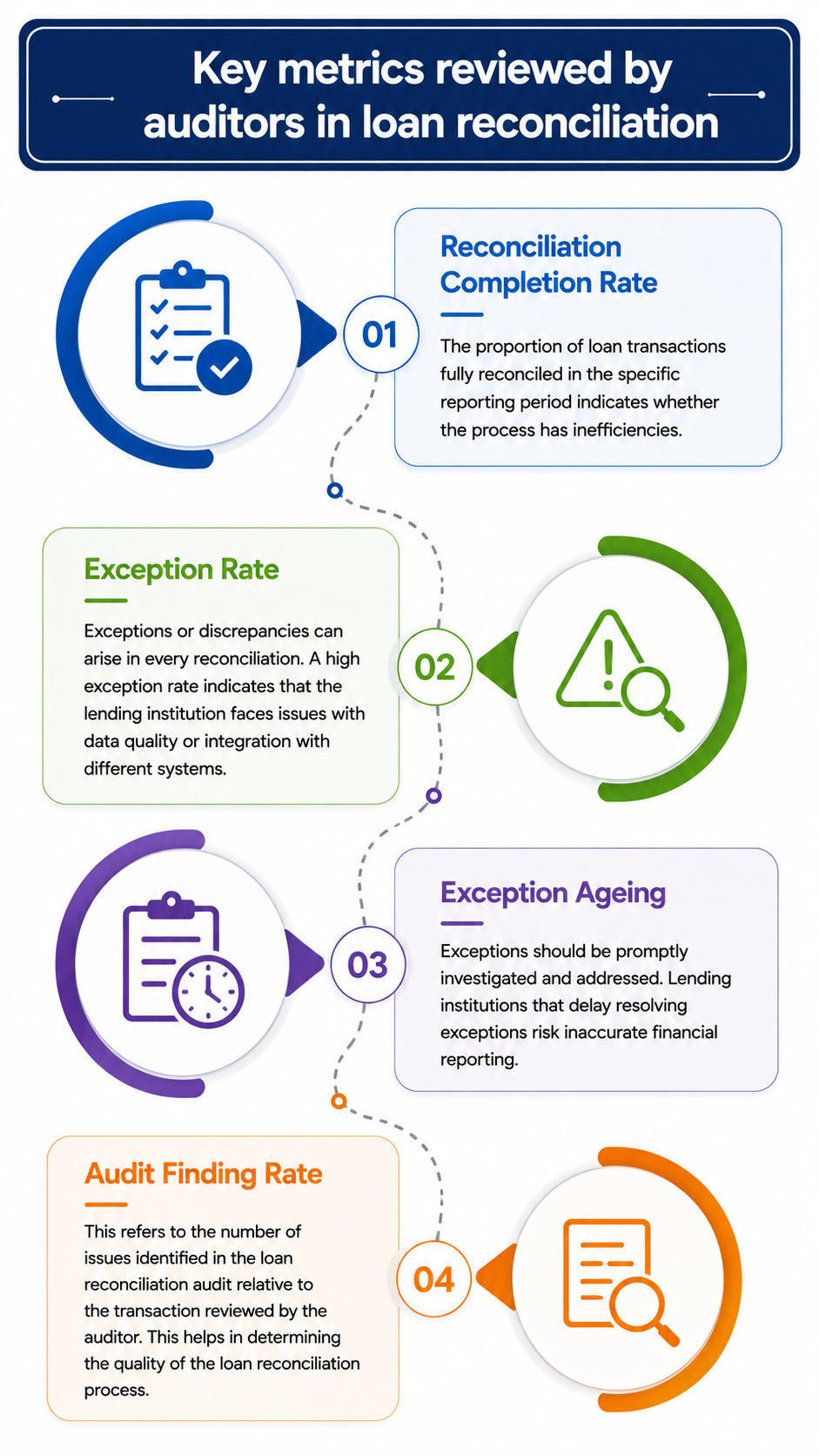
Investors and regulators alike place great trust in loan reconciliation audits to assess the credibility of lending institutions and their financial statements. These audits carefully review the following information about the loan reconciliation process.
1. Reconciliation Completion Rate
The proportion of loan transactions fully reconciled in the specific reporting period indicates whether the process has inefficiencies.
2. Exception Rate
Exceptions or discrepancies can arise in every reconciliation. A high exception rate indicates that the lending institution faces issues with data quality or integration with different systems.
3. Exception Ageing
Exceptions should be promptly investigated and addressed. Lending institutions that delay resolving exceptions risk inaccurate financial reporting.
4. Audit Finding Rate
This refers to the number of issues identified in the loan reconciliation audit relative to the transaction reviewed by the auditor. This helps in determining the quality of the loan reconciliation process.
{{banner1.1}}
Documentation Required for a Loan Reconciliation Audit
Auditors would require the following documents to review the loan reconciliation and support their findings.
- Loan agreements and amortisation schedules for sampled transactions.
- General ledger records for the financial period being reviewed.
- Disbursement and repayment records from the loan servicing system.
- Internal control policies covering authorisation, segregation of duties and record keeping.
Common Audit Findings
After conducting the loan reconciliation audit, the auditors' reports may present the following findings.
1. Disbursement without proper authorisation
Disbursing loan funds without the required documents and approval sign-offs indicates weak internal control.
2. Interest Rate Errors
Errors can arise in the loan servicing system data with incorrect application of the interest rate to loan accounts. These miscalculations can compile and seriously inflate a lending institution’s financial reports.
3. Untracked Delinquency
Loans that still show a current status after staying delinquent can distort risk reporting.
4. Missing Collateral Documents
Incomplete or missing collateral documents for secured loans are yet another sign of weak internal controls.
Software for Loan Reconciliation Audit
Loan reconciliation audits are usually carried out manually. However, they often have a high error rate, siloed communication and data security risks. Here are some of the audit software that automate tasks like data analysis, test controls, and generate standardised reports.
1. Trillion
Trullion is an AI-powered accounting and audit platform built by former Big Four professionals. It automates testing, data extraction, and financial statement validation, unifying structured and unstructured accounting data on one secure platform to help teams move faster and stay audit-ready.
2. Inflo
Inflo is a digital audit platform built by auditors. It connects people, data, and technology to replace manual effort with automation. It combines audit data analytics, workpapers, and collaboration tools to help firms improve audit quality without adding extra hours.
3. Onspring
Onspring is a no-code GRC automation platform that connects risk, compliance, and audit data across the business. It lets teams build custom workflows, applications, and reports without coding, giving organisations real-time visibility into their entire governance and risk landscape.
4. ASD Audit
ASD Audit is a cloud-based financial audit software built on International Standards on Auditing. It helps audit firms manage client risk assessment, project planning, task scheduling, and reporting in one secure, collaborative workspace accessible from any browser.
5. Optro
Optro is a GRC platform that helps enterprises manage audit, risk, and compliance workflows through an AI-driven system. It centralises scattered data, automates manual processes, and supports real-time monitoring across SOC 2, ISO, NIST, SOX, and other frameworks.
Best Practices for Auditing the Loan Reconciliation Process
While loan reconciliation ensures data consistency across systems, audits ensure that the process is carried out in accordance with accounting standards and reflects the true financial position of lending institutions. The following best practices help ensure the audit process is carried out smoothly.
1. Prepare necessary audit documents in advance, such as loan agreements, amortisation schedules, general ledger records, internal policies, etc.
2. Designate a person to assist the auditor with the process and provide them with the necessary information relating to loan reconciliation.
3. Audits help in identifying areas that require improvement. Documents or reconciliation-related information should not be hidden from auditors as it may create bigger issues in future.
The Bottom Line
A loan reconciliation audit is more than a regulatory checkbox. It is how lending institutions prove to themselves, their regulators, and their investors that the numbers on the books are accurate and trustworthy. Getting clean audit results depends entirely on how well you perform loan reconciliation. This is what Osfin helps you with.
Osfin is an automation platform designed to reconcile high volumes of financial transactions. It comes with 170+ connectors that easily integrate with various loan servicing and accounting systems and capture data regardless of format. It performs one-to-many, many-to-one and multiway reconciliation with logic-based matching rules at lightning-fast speed while maintaining 100% accuracy.
Osfin automatically flags discrepancies and routes them to the appropriate team member for resolution. At the end of the reconciliation process, it delivers a compliance report and maintains an audit-ready workflow with complete traceability and transaction history.
Make every loan reconciliation cycle audit-ready with Osfin. Book a demo now!
FAQs
1. What is the purpose of a loan reconciliation audit?
The purpose of a loan reconciliation audit is to ensure that your accounting and reconciliation processes meet the accounting standards like IFRS and GAAP, and that your financial records truly reflect what is reported.
2. What remarks are given by the auditor at the end of the loan reconciliation audit?
The remarks given by the auditor at the end of the loan reconciliation audit include unqualified, meaning the process was fairly conducted; qualified, which implies some issues in the process but overall satisfactory; adverse, which means reports submitted are not accurate; and disclaimer, meaning the auditor cannot form an opinion due to limited information.
3. What documents are required for a loan reconciliation audit?
The documents required for loan reconciliation audit include the loan agreement, disbursement and repayment records, general ledger records and internal control policies.
4. What are some common findings of a loan reconciliation audit?
Some of the common findings that may be presented in a loan reconciliation audit include disbursement with proper authorisation, interest rate errors, untracked delinquency or missing collateral documents.