How to Run a Reconciliation Health Check
Key notes:
- A reconciliation health check inspects if your reconciliation process is reliable and if it can hold up under scrutiny.
- Accuracy, timeliness, controls, documentation, team resources, and the tools being used tell you if your reconciliation is healthy or not.
- Run a health check after major system changes, audit findings, staff turnover, or recurring exceptions.
- Automation doesn't eliminate the need for a health check, but makes findings far less alarming.
- Clean data at ingestion, strong matching logic, and audit-ready outputs define a healthy reconciliation process.
Every finance team reconciles. Transactions get matched, discrepancies get flagged, and at the end of the period, the books get closed. It's a routine that most organizations have been running for years.
But what might often go unexamined is the reconciliation process itself.
Over the course of time, reconciliation processes develop blind spots. Like outdated matching rules, documentation gaps, or growing exception queues. The month-end close might still be happening. It's just taking longer than it used to, and requiring more manual effort than anyone wants to admit.
This is exactly what a reconciliation health check is designed to catch.
What is a Reconciliation Health Check?
A reconciliation health check is a periodic review of the reconciliation process itself, not just the figures it produces. It looks at what exceptions are piling up, if any, if the same errors keep repeating month after month, and if the audit trail actually holds up under scrutiny.
Most finance teams reconcile their accounts regularly. But over time, that process itself can develop cracks. So, a reconciliation health check is what remedies that.
Reconciliation Health Check Components
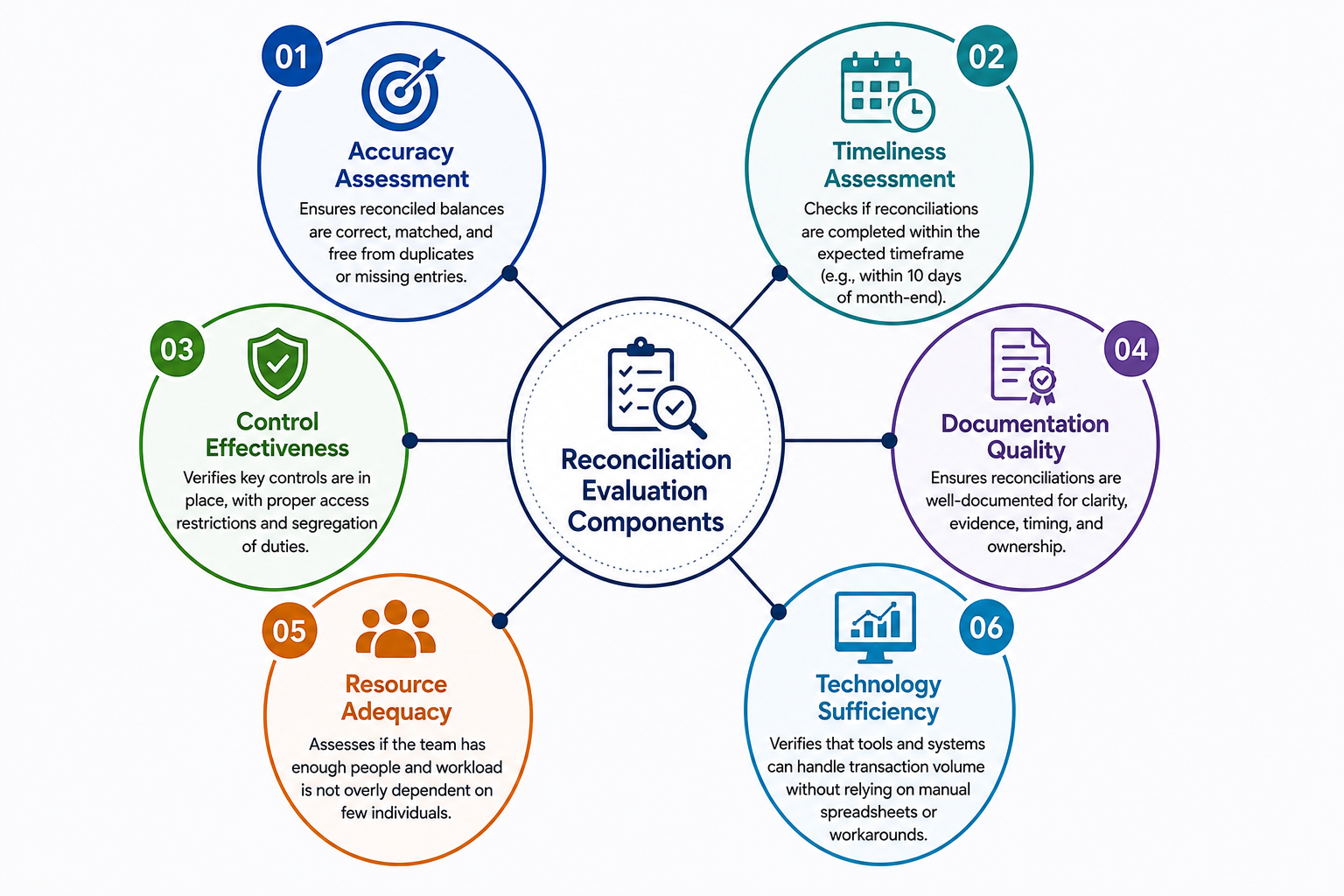
A reconciliation health check usually looks at six areas that point to different kinds of weaknesses in the process.
Accuracy assessment checks if reconciled balances are actually correct,matched against the right figures, with no duplicate or missing entries.
Timeliness assessment looks at whether reconciliations are completed within the expected window, such as within 10 days of month-end, or if they're routinely delayed until exceptions pile up.
Control effectiveness sees if the basic safeguards are in place. Like making sure the same person cannot create, approve, and reconcile transactions. And that system access is restricted to prevent unauthorized changes to balances.
Documentation quality records reconciliations clearly enough for someone outside the team to follow. It acts as evidence of completion, timing, and ownership.
Resource adequacy looks at the resources. Like if the team has enough people to handle the workload without over-relying on one person, since depending too heavily on a few employees with deep institutional knowledge creates risk if processes aren't well documented.
Technology sufficiency evaluates that the current tools and systems can keep up with transaction volume, and the process is not merely held together by manual spreadsheets and workarounds.
Step-by-Step Reconciliation Health Check Framework
Running a reconciliation health check needs to be structured. Here's how you can approach it in five steps.
1. Inventory All Reconciliations
Start by listing every reconciliation your team currently performs. Payment, loan, credit cards, and any other accounts that get matched against external or internal records. This checklist should outline all accounts requiring reconciliation, associated deadlines, responsible team members, and review requirements. This step also helps you spot accounts that may have been missed entirely as the business grew.
2. Gather Performance Data
Once you know what's being reconciled, pull the data on how well each one is actually performing. This means looking at KPIs like auto-match rate, exception aging, late reconciliations, and reopen frequency. Aging data is especially useful here. Aging analysis highlights process breakdowns and prevents unresolved balances from accumulating.
3. Review Controls
Next, review the controls around each reconciliation. Check that duties are properly separated, access is restricted, and no single person has too much control over the process.
4. Evaluate Documentation
Now check if reconciliations are backed by proper records. Confirm that all required evidence is attached and current, and that documents match the same period and entity being reconciled. Auditors and reviewers rely on this paper trail. Missing evidence weakens control credibility, even when the balances themselves are correct. If explanations exist only as verbal notes or scattered emails, that's a documentation gap worth flagging.
5. Identify Process Gaps
Find out where discrepancies originate. See if it's from timing gaps, integration failures, policy misunderstandings, training gaps, or upstream data errors, rather than treating each issue as a one-off.
{{banner1}}
Key Areas to Assess During a Reconciliation Health Check
A reconciliation health check covers five core areas. Each one looks at a different layer of the process. And weakness in any one of them can affect the others.
Process Efficiency
This looks at how much time and effort the reconciliation process actually consumes. If your team is spending most of their time pulling data and formatting spreadsheets, that's a process efficiency problem, not a people problem.
Data Quality
Assessing data quality means checking that the records coming in from different systems are consistent in format and free of duplicates or gaps before matching even begins.
Matching Performance
This area focuses on how well transactions are actually being matched. Key indicators here include the first-time match rate, the percentage of transactions that match automatically without manual intervention. And the exception rate, which shows how many transactions require further investigation.
Audit Readiness
If pulling together documentation for an audit takes days of frantic effort, the reconciliation process isn't audit-ready. True audit readiness means the records are clean, current, and accessible at any point.
When to Run a Health Check
A reconciliation health check isn't something you run once and forget. There's a case for doing a light review quarterly and a more thorough one annually. But beyond that regular cadence, certain events should trigger one immediately, regardless of timing.
After Major Changes
Like a new ERP, a change in payment processors, a merger, or even a shift to a new chart of accounts can break matching rules or create data gaps. Such changes are a good reason to pause and run a health check.
After Audit Findings
If an internal or external audit flags a reconciliation-related issue, that's a clear signal to go deeper than just fixing the immediate finding.
After Staff Turnover
A health check after a team change helps confirm that whoever steps in understands the process. And that the process itself is documented well enough to hand over cleanly.
When Problems Emerge
Some signals are hard to ignore, like exceptions piling up, the same discrepancy appearing again and again, close cycles running longer than usual, or team members raising concerns about the accuracy of reports. When these patterns appear, a health check is in order.
Creating Your Health Check Scorecard
A scorecard turns a scattered set of observations into a structured, actionable summary.
Rating
Score each area of the process. A 1-to-5 rating scale works well. Here, 1 means the lowest level of maturity and 5 is best-in-class performance. Apply this across the key areas covered in the health check like accuracy, timeliness, controls, documentation, and technology.
Scoring System
Each rating should mean something specific. A score of 1 might mean the process is manual with no documented rules. And a 5 means a well-defined reconciliation process that is automated wherever possible, backed by a skilled team and centralized data.
Strengths
Once scores are in, look at what's working well. These are the areas scoring 4 or above. Meaning your processes that are reliable, well-documented, and running with minimal intervention.
Weaknesses
Anything scoring a 2 or below needs attention. Focus on understanding why the score is low.
Priorities
Don’t fix every weakness at once. Adopt risk-based prioritization. That means you just focus on high-risk discrepancies first, and lower-risk areas can be addressed in due course.
{{banner1.1}}
Best Practices for Maintaining Reconciliation Health
Maintaining reconciliation health is an ongoing exercise. These are the practices that keep the process reliable between checks.
Standardize the process across teams
If all your team members follow different steps, templates, or matching rules, the results become difficult to compare and even harder to audit. A standardized process keeps reconciliations consistent across the organization. So, there's better efficiency, oversight, and no confusion at all.
Automate wherever it makes sense
Manual reconciliation can work at low volumes, but it’s not for scaling. Automation removes much of that manual effort. Teams can, therefore, process more transactions, reduce errors, and close faster without hiring more people.
Track the right KPIs
You can't improve what you don't measure. That’s what KPIs like auto-match rate, exception rate, time to resolve discrepancies, and the age of unreconciled items are for. To identify problems, improve accountability, and reduce repeat issues.
Build in regular reviews
Long-term reconciliation success comes from continuous improvement. Don't assume process improvements will last on their own. Review reconciliations regularly to catch problems early and adapt as business needs change.
Summing Up
A reconciliation health check is only as revealing as the process underneath it. If the process is fragile, the health check will surface problem after problem.
That's where the right tool makes a difference. Osfin is built to address reconciliation at every stage, so the gaps a health check typically uncovers are dealt with before they become issues.
It starts at ingestion. Osfin connects to over 170 data sources and accepts any file format, applying custom deviation tolerances to filter out poor-quality data and detecting duplicates and outliers before they enter the reconciliation pipeline.
The reconciliation engine does logic-based matching across complex transaction structures. It then processes up to 30 million records in 15 minutes and automatically reconciles payment gateway reports with commission, tax, and fee breakdowns built in.
When exceptions do occur, the platform flags and categorizes them automatically. Routes them to the right team member through a built-in ticketing engine.
And on the output side, every reconciliation produces compliance-ready reports with complete transaction history and traceability. Data is secured with 256-bit encryption, maker-checker workflows, role-based access, and two-factor authentication. With compliance built in for SOC 2, PCI DSS, ISO 27001, and GDPR.
{{banner2}}
FAQs
1. How is a reconciliation health check different from a regular reconciliation?
A reconciliation health check sits a level above the reconciliation process. It evaluates the reconciliation process itself, checks if everything is working correctly or not. It looks at the quality of controls, documentation, matching rules, and team structure rather than the numbers themselves.
2. Who should be responsible for running the health check?
Someone who isn’t a part of the day-to-day reconciliation process. Like a finance controller, internal audit team, or an external reviewer.
3. What are the most common issues a reconciliation health check uncovers?
Poorly defined matching rules, unresolved exceptions, poor documentation, and outdated reconciliation tools are some of the common issues.
4. What should a reconciliation health check produce at the end?
It should offer a clear scorecard rating each area of the process, a documented list of strengths and weaknesses, and a prioritized action plan for addressing gaps.